11/18/2025 Building a World: The UProd Theatrical Shops at Work > The Scenic Painting Shops
The Scenic Painting Shops: The UProd Theatrical Shops at Work
Transformation is the name of the game in the scenic painting shops, where artists use an array of tricks and techniques to achieve special effects on backdrops and built scenery. They change foam into stone, turn wood into steel, and make flat objects three-dimensional. Depending on the production, the result might be realistic or impressionistic, colorful or dreary, contemporary or historical – whatever is needed to complete the illusion of the world being created onstage.
There are two scenic painting shops, one in the Power Center, managed by Beth Sandmaier, and one in the Walgreen Drama Center, managed by Madi Stinemetz.
Power Center Scenic Painting Shop
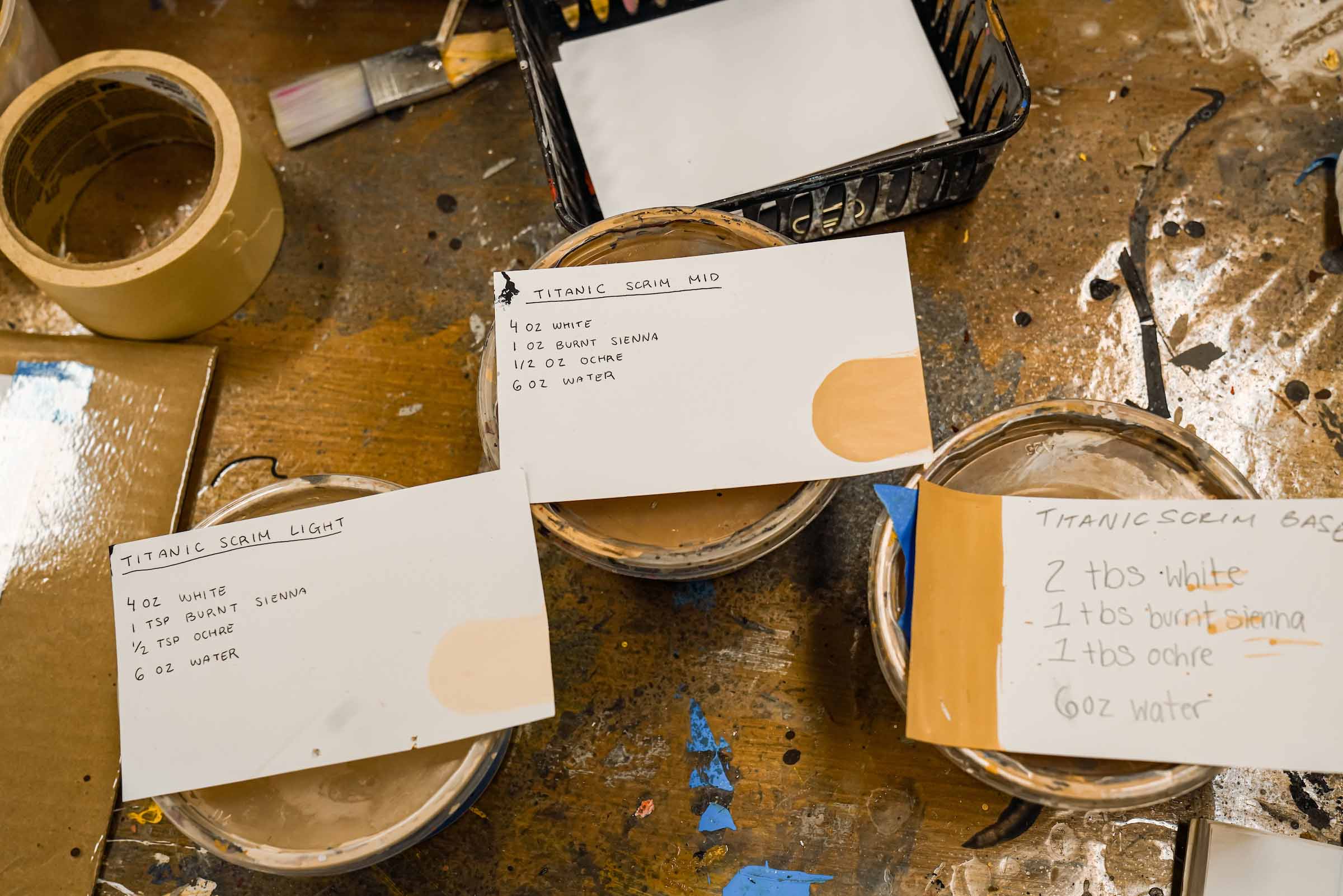
Over the course of a few days during the winter 2025 semester, staff and students in the paint shops were busily working on projects for several different productions. In the vast Power Center Scenic Painting Shop, students were painting a large canvas to look like an eerie moon for The Turn of the Screw (the canvas would later be placed over the moon box that the lighting shop had wired with custom lighting). They prepped foam tombstones to be painted so they would look like aging, crumbling stone. For Titanic, they mixed colors to paint a scrim – a sheer fabric backdrop that is opaque when lit from the front but translucent when lit from behind – showing a cross-section of the ship. They had also been painting a ghostly scrim for The Turn of the Screw to complete the production’s haunting atmosphere. Recently, they had expertly painted the judge’s bench for A Few Good Men to make it look like high-quality oak instead of inexpensive building materials – a finishing process that created an illusion and saved money.
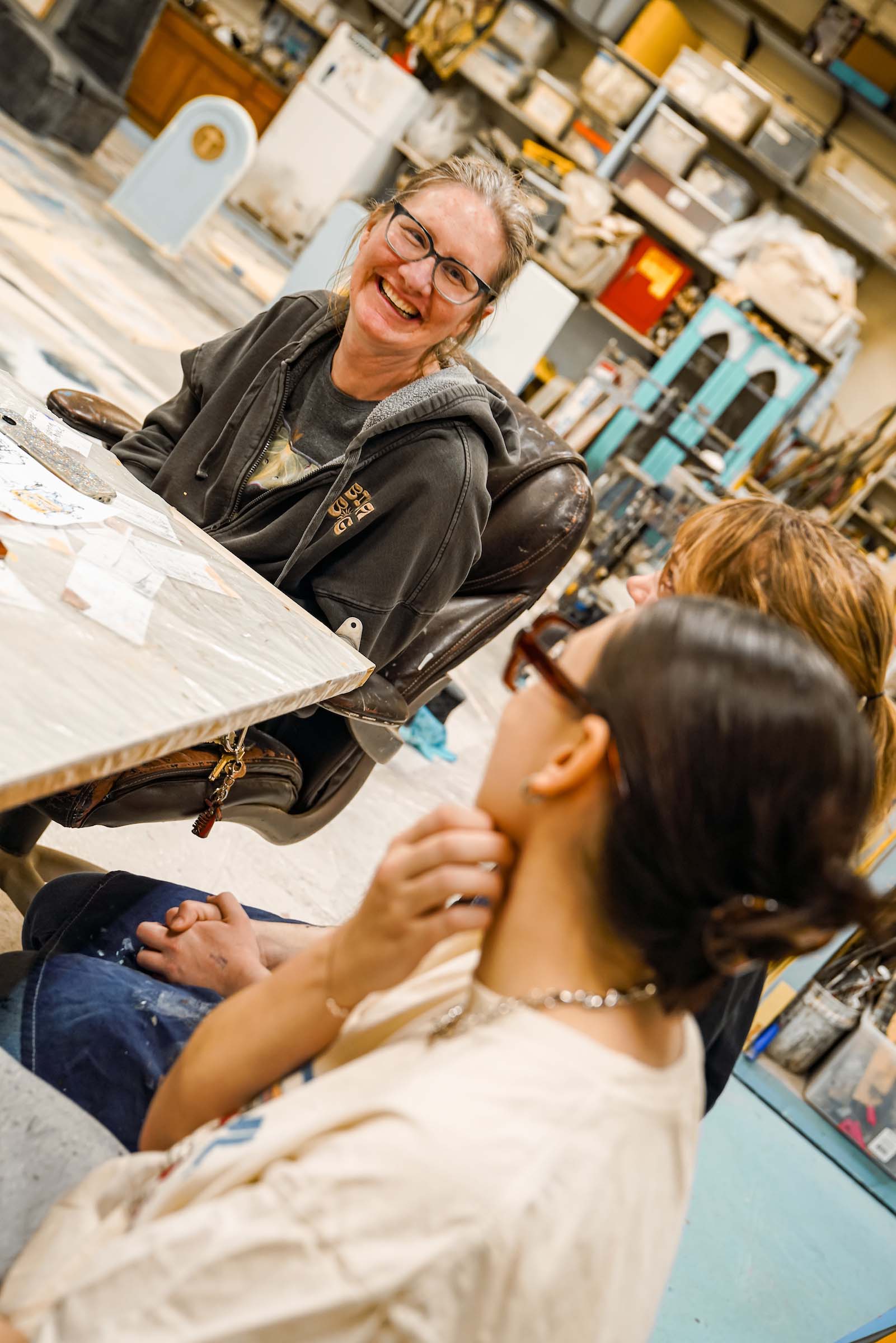
Beth Sandmaier, in the Power Center Scenic Painting Shop. Photo: Chris Boyes

Ellie Vice (left) and Seri Stewart add details to a painting of the moon for use in The Turn of the Screw. Photo: Chris Boyes

The moon looms in the background in The Turn of the Screw. Photo: Peter Smith
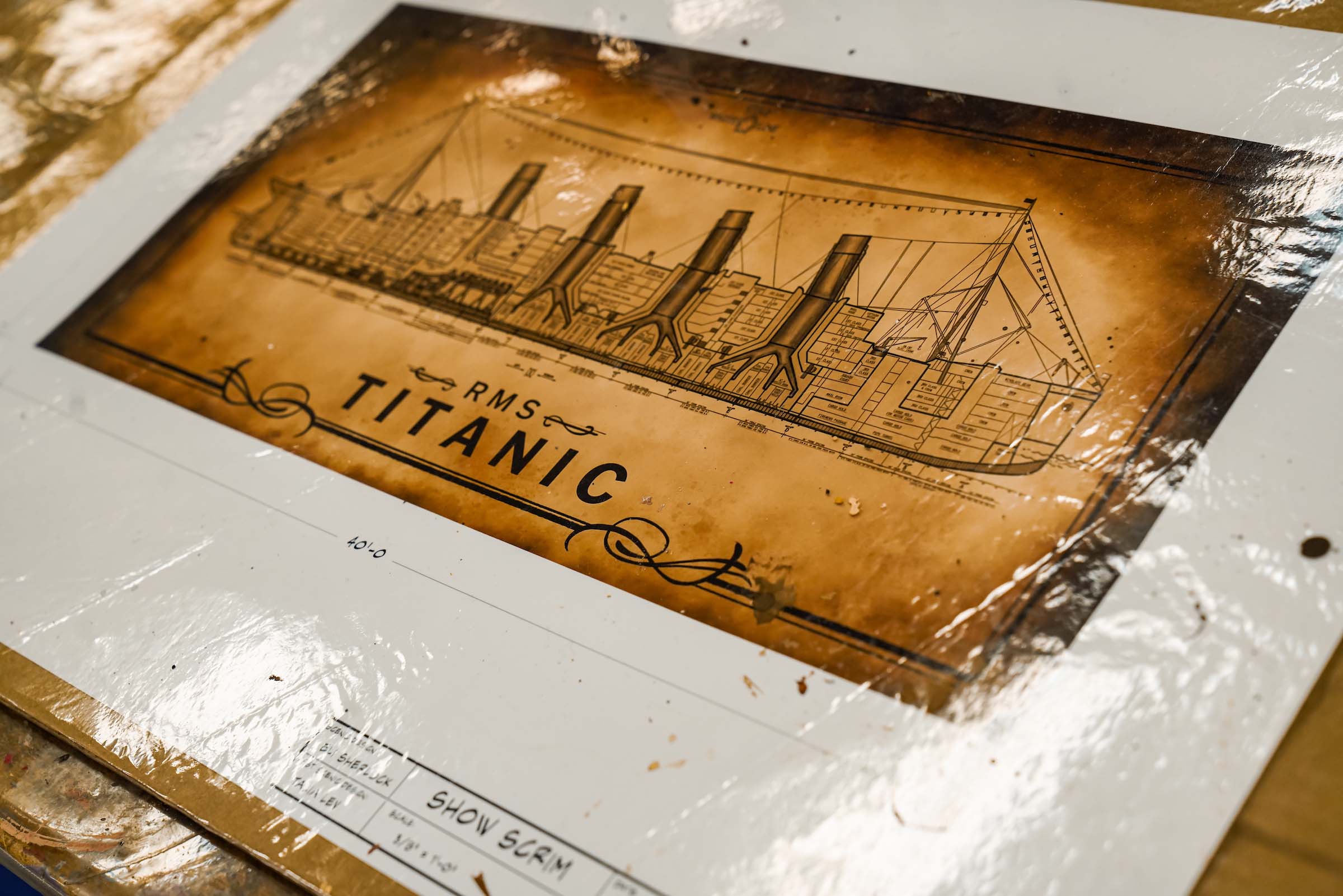
A small-scale rendering of what would become a hand-painted scrim featured in Titanic. Photo: Chris Boyes

The scrim showing a cross-section of the ship onstage in Titanic. Photo: Peter Smith

Beth Sandmaier (left, with Ellie Vice and Gretchen Brookes) holds a rendering that served as the model for the scrim used in The Turn of the Screw. Photo: Chris Boyes

The scrim contributes to the unsettling atmosphere in the production of The Turn of the Screw. Photo: Peter Smith
Student workers in the paint shops gain valuable hands-on experience for future careers. They learn how to paint differently according to the size of the theatre, knowing that making something look real from 80 feet away in the Power Center is different from making it look real from five feet away in the Arthur Miller Theatre. They become immersed in useful painting techniques, such as painting in perspective, which originated in the Renaissance era. Ellie Vice (BFA ’25, design & production) described the benefits of working in the scene painting shop: “Beth [Sandmaier] is my mentor, and the collaboration with her has been really important. Learning from the staff, my professors, and my friends and peers has been really wonderful and has shaped me as a scenic painter.” Gretchen Brookes, a first-year design and production student who is also pursuing a degree in chemical engineering, echoed the importance of the resources at SMTD – from the EXCEL Lab’s guidance on launching a business, to the staff and faculty who have extensive industry experience. “And I got to make a lot of friends,” she noted, “because it’s such a small community, and it’s much easier with small classes instead of being in lecture halls with 100 people.”
Walgreen Scenic Painting Shop
The Walgreen Scenic Painting Shop is smaller than that of the Power Center, and it shares space with the Walgreen scene shop, necessitating careful planning between Stinemetz and Rich Lindsay, head of the Walgreen scene shop. The proximity of the two shops makes for a more integrated experience for students, who could be painting one day and doing carpentry or metalworking another. Over a few days in late February, much of the floor space was taken up by large foam pieces being painted to look like concrete pillars for Our Oz – and to match exactly the color of the back wall of the Arthur Miller Theatre. Elsewhere in the shop, students were prepping metal bars they would be cutting the next day.

Madi Stinemetz in the Walgreen Scenic Painting Shop
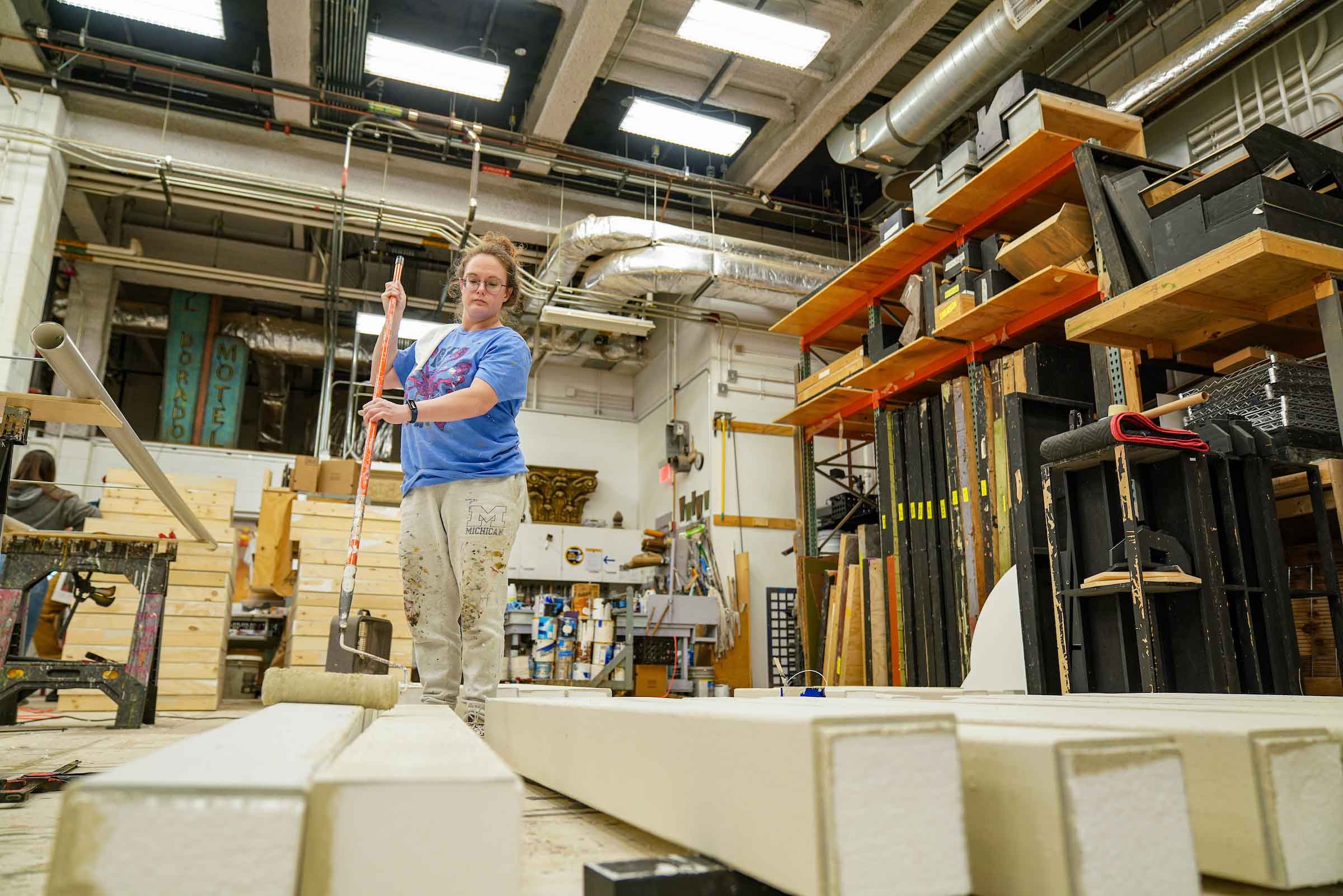
Martha Sprout, a Stamps student, paints foam pillars to resemble stone for Our Oz. Photo: Chris Boyes
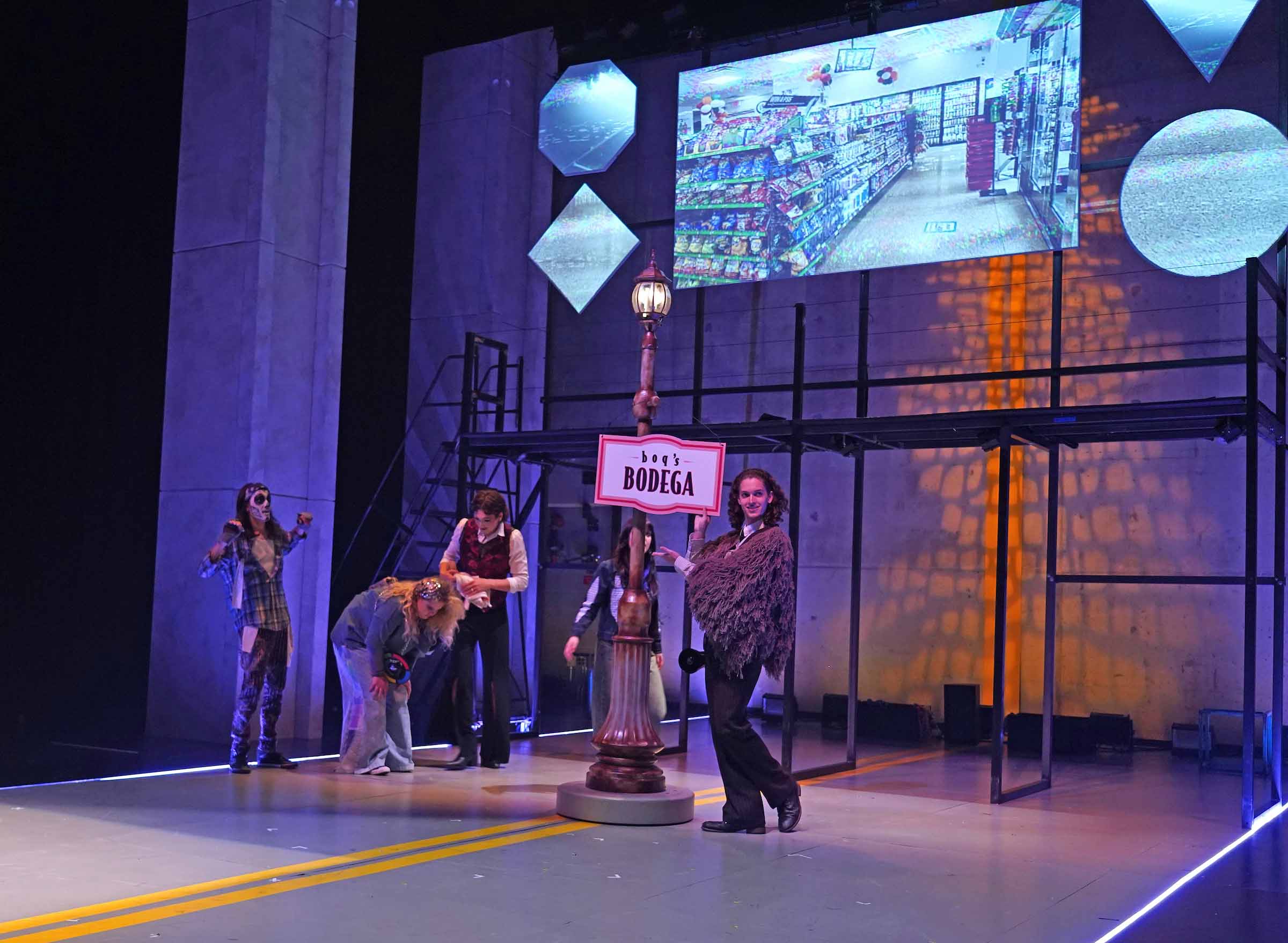
Concrete-like foam pillars frame the stage in the production of Our Oz. Photo: Peter Smith
The professionals who work in the shops have deep education and years of varied experience that enable them to do their own part in creating the technical side of productions. For John Proctor Is the Villain, for example, Stinemetz painted the Masonite floor to look like typical school linoleum flooring. The staff have worked in theatre, film, theme parks, museums, and on retail displays. They acknowledge, though, that the learning goes both ways. Stinemetz related that one of the students working in the shop “is a practical, trained oil painter, and it’s really beautiful to see his approach and be like, I’ve never thought of doing that before.” And she noted that Martha Sprout and Michael Russell, both Stamps students, “have helped me sculpt and do things on different shows, whether it’s making different fabric, or carving trees out of foam.”
While their work undoubtedly poses challenges, the professionals in the scenic painting shops appreciate the variety of their projects and the ability to blend teaching and training with the work they love. “Painting and painting together with others are my two favorite things,” Sandmaier said. “We’re really lucky. It’s the best place to be.”

The fall 2024 production of John Proctor Is the Villain featured a Masonite floor hand-painted by Madi Stinemetz to resemble linoleum. Photo: Peter Smith
Photo Gallery