
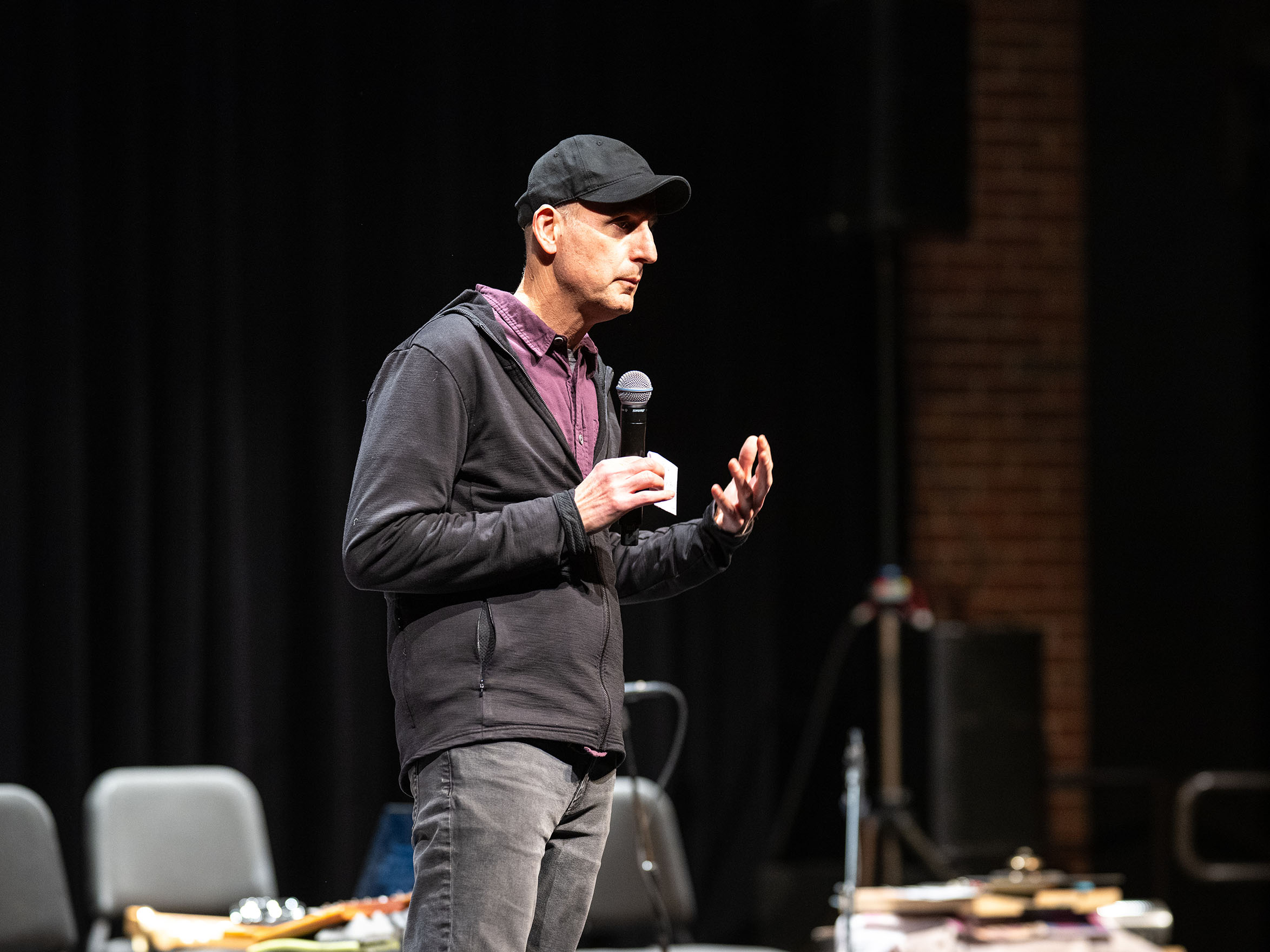
The Center for World Performance Studies (CWPS), which offers a multidisciplinary space for artists, performers, scholars, and the community, has announced that its director of nine years, Professor Michael Gould, will be leaving the center to begin a new administrative role at SMTD as associate dean of undergraduate affairs. Below, Gould reflects on his time as director of CWPS and considers its impact on his next position.
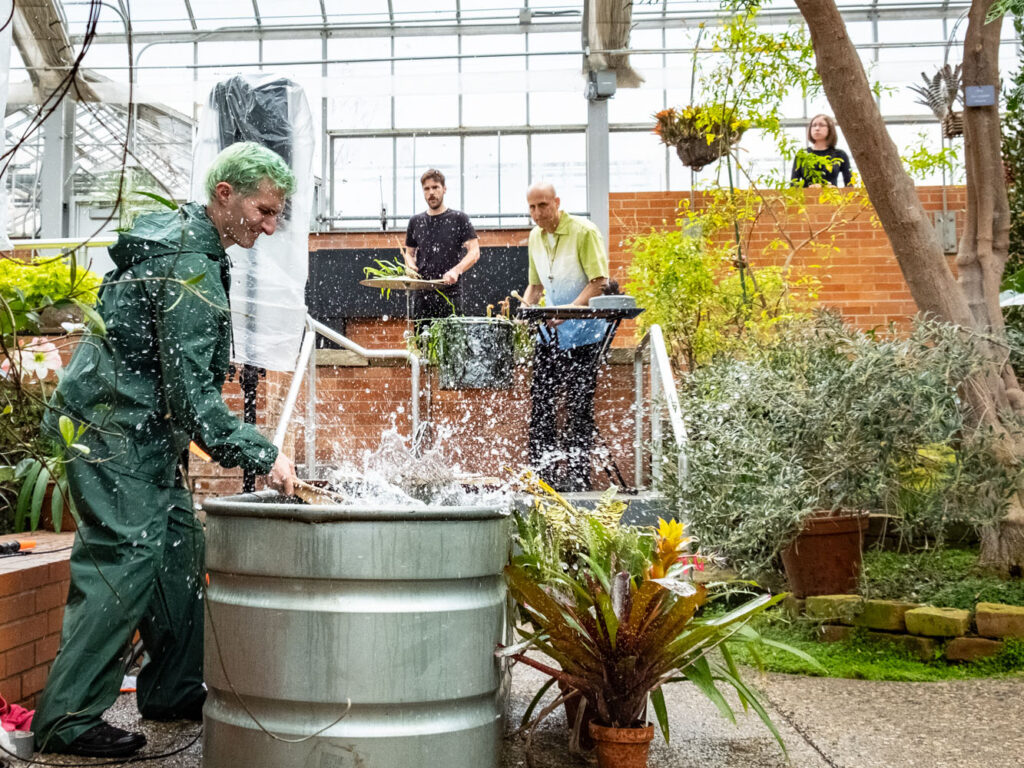
Michael Gould (right) performs a work by Raven Chacon with members of the Living Earth Show in March 2019.
When I look back on the past nine years as director of the Center for World Performance Studies, I feel an enormous sense of gratitude – for the artists, scholars, students, staff, faculty, and community partners who have made this center such a vital and generous space. CWPS has always been more than a presenting organization or an academic unit. At its best, it is a meeting ground: a place where performance becomes a way of knowing, a way of gathering, a way of asking difficult questions, and a way of imagining new relationships across cultures, disciplines, and communities.
During my tenure, one of the most meaningful parts of the work has been helping steward the center from its home in the LSA Residential College into its new administrative home in the School of Music, Theatre & Dance. That transition has felt both natural and expansive. CWPS has deep roots in the Residential College’s commitment to interdisciplinary learning, global engagement, experimentation, and community-based practice. At SMTD, those values continue to grow in conversation with artists and scholars whose daily work is grounded in music, theatre, dance, performance studies, improvisation, design, and embodied research. The move has not changed who we are; it has allowed us to build new bridges while honoring the center’s history.
Over these years, CWPS has brought an extraordinary range of artists and thinkers to campus and into the wider community: the National Theatre of Ghana performing Ten Blocks on the Camino Real in public spaces across Ann Arbor, Ypsilanti, and Detroit; the Yandong Grand Singers sharing one of the world’s rare polyphonic vocal traditions; the JIT Exchange project, which culminated at the University of Michigan Museum of Art, combining Jit dancing from Detroit and Zimbabwe; Makuyeika Colectivo Teatral connecting theatre-making to social life in southwest Detroit; Jen Shyu, Jonathan Scales Fourchestra, the Naghash Ensemble of Armenia, Gina Chavez, Autophysiopsychic Millennium, Pamela Z and the Living Earth Show, Raven Chacon, and so many others. Each residency, performance, workshop, class visit, lecture, and conversation has reminded me that performance is never only something we watch. It is something we enter into. It changes the room.
I am especially proud of the center’s role in supporting students and faculty as they develop their own performance-based research. The Graduate Fellows and Faculty Fellows programs have created a remarkable archive of work across ethnomusicology, dance, theatre, musicology, anthropology, American culture, information, education, art and design, Asian languages and cultures, romance languages, women’s and gender studies, and many other fields. These projects have examined everything from Indigenous performance and Black opera to queer dance, carillon traditions in South Africa, prison theatre in the Amazon, climate change in Zambia, Haitian opera, Japanese festival costume, and improvisation at the edge of democracy. That breadth is not incidental – it is the point. CWPS insists that performance belongs everywhere knowledge is being made.
The pandemic years tested CWPS’s commitment to live performance in profound ways. When we could not gather in person, we found other ways to remain in relation: virtual roundtables, online conversations, the Performing the Moment, Performing the Movement series, the CWPS blog, and the 20th anniversary programs that brought alumni, faculty, and guest scholars together in new formats. Those years reaffirmed for me that the center’s strength is not simply in events, but in community – in the shared desire to keep learning from one another even when the terms of gathering have to change.
As I step into my new role as associate dean of undergraduate affairs at SMTD, I carry the lessons of CWPS with me. The center has taught me that undergraduate education, like performance, is relational, embodied, collaborative, and alive. I am deeply proud of what we have built together: a center that welcomes experimentation, supports risk-taking, values cultural knowledge, and brings campus and community into meaningful exchange. CWPS has had an impact because so many people have treated it not as a program to attend, but as a space to inhabit and shape. It has been an honor to help hold that space, and I am excited to see how it continues to grow.
Michael Gould is a professor of music in the Department of Winds & Percussion and the associate dean for undergraduate academic affairs. He is the outgoing director of the Center for World Performance Studies.