
Michigan Muse Spring 2026 > Making Something from Nothing: The Hard Work and Magic of Creating an Original Work
Making Something from Nothing: The Hard Work and Magic of Creating an Original Work
By Judy Galens
Creative expression takes many forms. Every day at the School of Music, Theatre & Dance – in every classroom, practice room, rehearsal hall, studio, and performance space – students and faculty members are refining and reinventing modes of expression. For many, their talents lie in creating a new and original work: a play or musical, a dance, a musical composition.
Students interested in a formal course of study to learn about the creation of new works can pursue an undergraduate or graduate degree in the Department of Composition, a minor in playwriting through the Department of Theatre & Drama, or a minor in musical theatre composition (for composers and lyricists) in the Department of Musical Theatre. For dance students, choreography constitutes a significant part of both the undergraduate and graduate curriculum in the Department of Dance.
Finding Inspiration and Getting Started
Inspiration might hit while you’re walking through the woods, while watching a documentary or reading a book, while taking a shower. It might feel like a thunderclap or like an ethereal wisp that must be captured before it disappears forever. Inspiration doesn’t typically come on command, but creators know to seize it when it comes – and they also know ways to encourage it to blossom.
Sources of inspiration are as varied as the artists seeking it. For Jillian Hopper, interim chair and assistant professor in the Department of Dance, choreographing a new dance piece often begins with words: “I process my creativity through writing a lot of the time, which is just another way of crafting and then translating meaning into movement.” She noted that many people will start creating a new dance work simply by moving their bodies: “Sometimes people are just so overcome by whatever idea sparks an interest that they can’t help but process it through movement.” When getting started on a new composition, Erik Santos, chair and associate professor in the Department of Composition, might find inspiration from “poetry, sometimes pictures, sometimes chance. A word might jump out at me and I think, What does that mean? And then suddenly it’s interesting.”
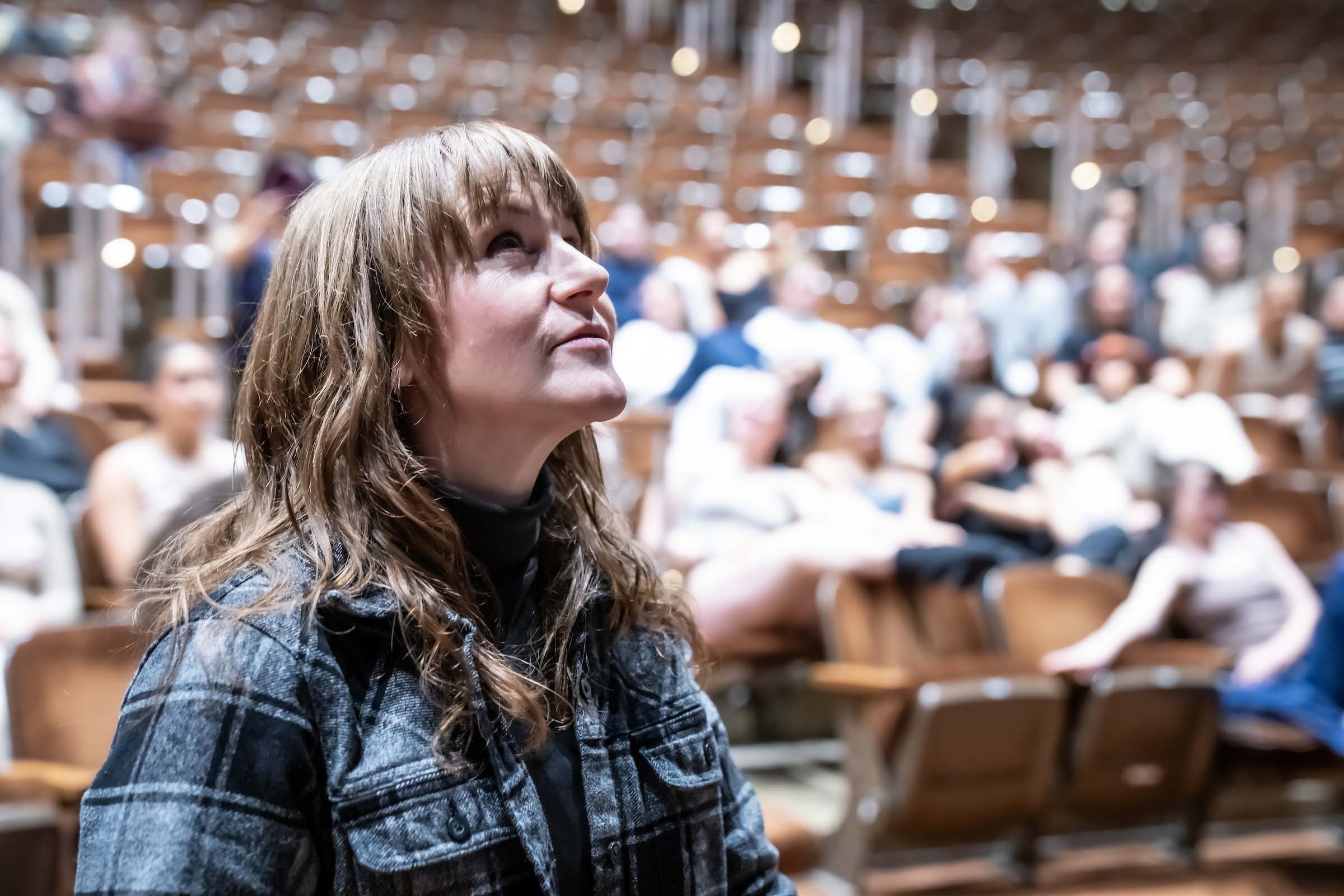
Jillian Hopper: Professor, choreographer, dancer, and specialist in the dance technique of Doris Humphrey. Photo: Kirk Donaldson
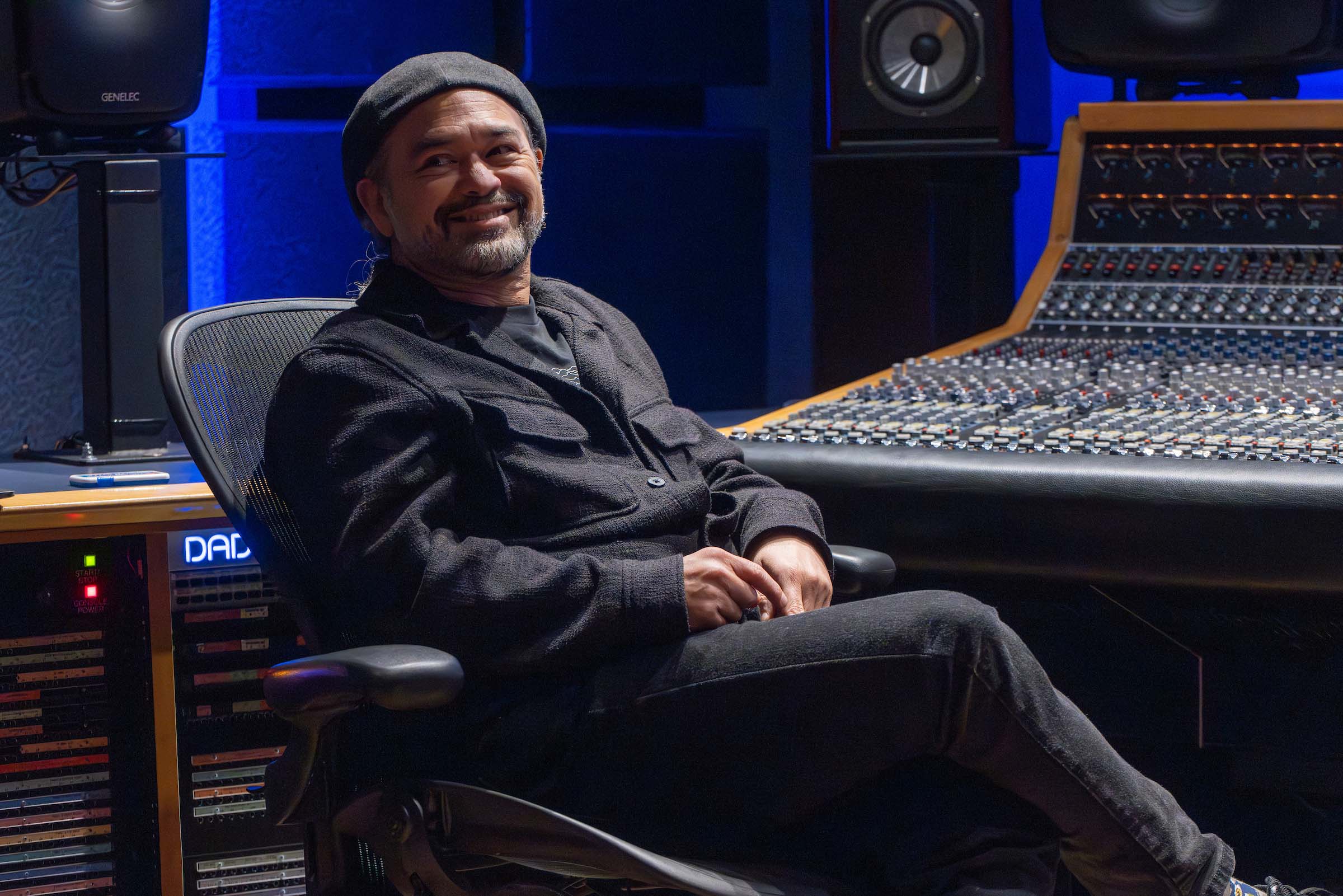
Erik Santos: Professor, composer, multi-instrumentalist, singer, and producer. Photo: Robert Coelius
For José Casas, associate professor of theatre and drama, the geneses for his new plays are social issues that have sparked outrage: “My ideas come from issues that I’m really passionate about. And when I grab onto an issue, that’s really, for me, when the creativity starts.” When Lynne Shankel – assistant professor of music and Carole Caplan Lonner Professor of Musical Theatre Writing – is writing something new, it’s often for musical theatre, and for her, the creative process starts with an understanding of dramatic intent and character arc. Shankel pointed out that, unlike with a pop song, a song in a dramatic piece must move the plot forward or reveal characters’ desires or intentions.
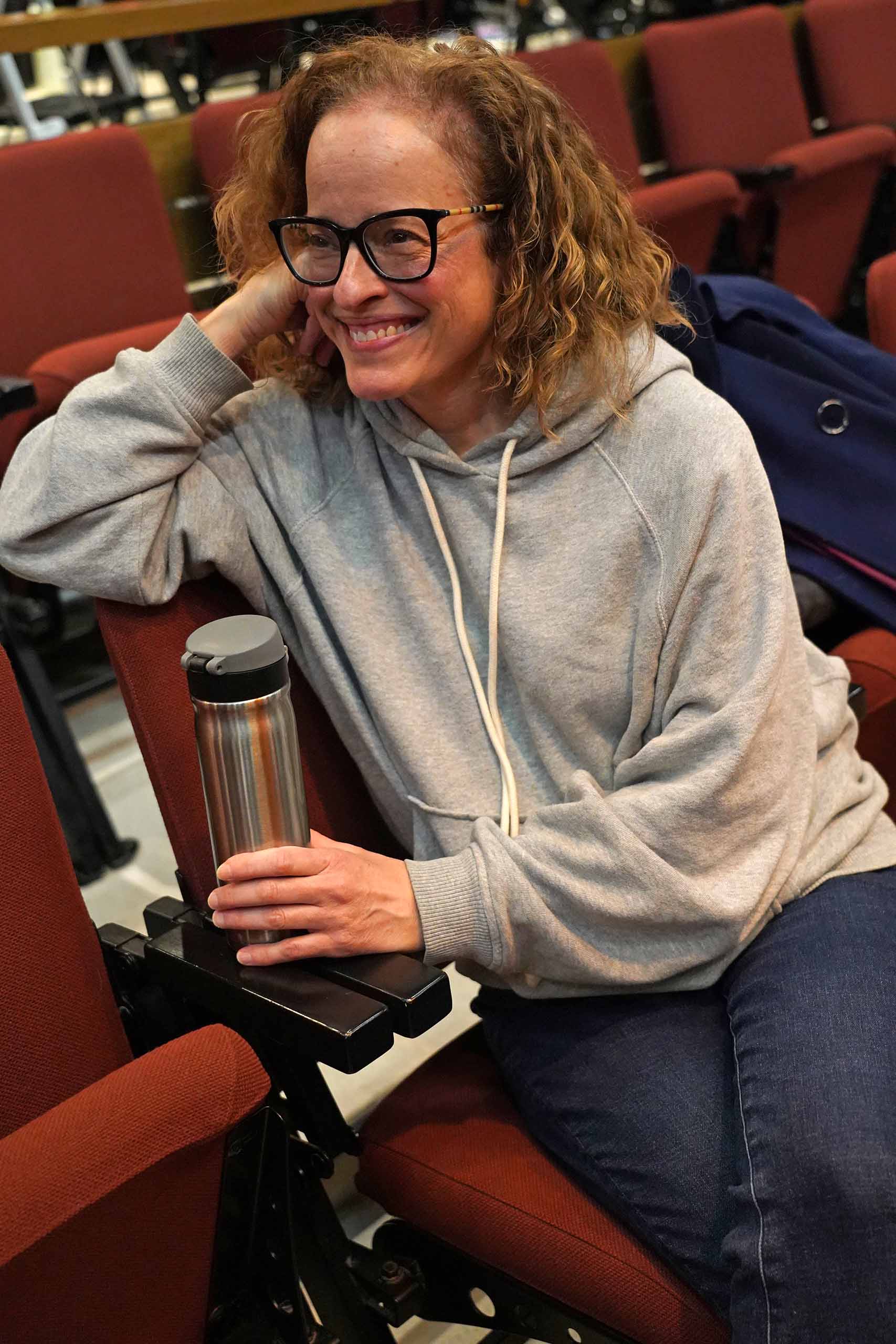
Lynne Shankel: Professor, composer, lyricist, orchestrator, arranger, and music supervisor. Photo: Peter Smith
Whether inspiration has struck or not, sometimes it’s simply time to get started and see what happens. Santos described the process as “feeling your way through the dark.” He explained the progression he experienced with a recent composition: “I found this one opening gesture and I thought, Oh, that’s got some energy, some direction and form. So I’m playing with this idea with my fingers, and I wrote it down as a kind of a squiggle on the page, and then I took that idea and started trying to give it some sense of rhythm, meter, all of the contextual stuff. And that just started taking me.” Shankel, who writes both music and lyrics, has varying methods for starting something new. When writing lyrics, she shared, “I have a special notebook and a set of special pens.” When writing music, she often works out initial concepts by playing piano, which was the instrument she started on, earning a bachelor’s degree at Michigan in piano performance. She occasionally starts by playing around in Logic, software for creating, editing, and mixing music, for pieces that are more synthetic in nature. Or sometimes, she’ll pick up her guitar. “I’m a really terrible guitar player,” she shared, “but I use it to write sometimes, and it can just kind of break me out of the patterns that I have as a pianist.”
For choreographers, new works generally aren’t expressed in written form. While a written notation form does exist for dance – Labanotation, developed in the 1920s by the Hungarian-born dance theorist and choreographer Rudolf Laban – it is complicated and not widely used in the 21st century. Some choreographers will create written diagrams that show groupings of dancers and map out their movements through space. But very often, according to Hopper, choreographers today work out new ideas using movement, recording themselves on video as they improvise, explore, and test out concepts.
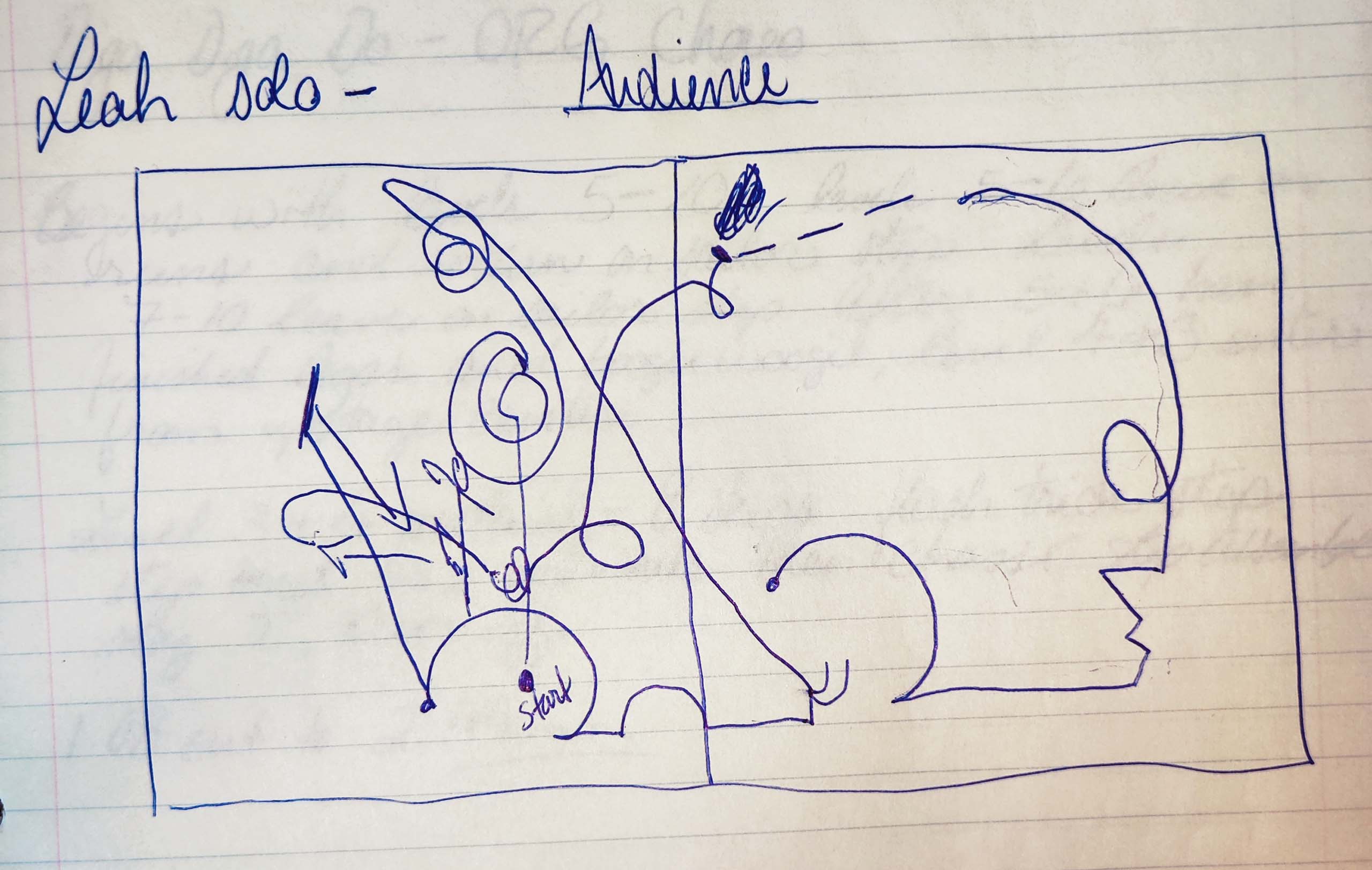
This dance map shows Jillian Hopper’s notes for the movement of a dancer’s body through space for a solo she choreographed.
Working Through Creative Blocks
It’s hard to imagine a creator who has never experienced a sense of frustration, a feeling of being stuck, when constructing a new work. The sensation is universal, but the approaches to resolving such rough patches vary widely.
“It’s very rarely just a smooth flow from beginning to end,” Santos noted. Sometimes if he feels a bit stuck, he will try scheduling a set time each day to work on a piece. Other times, he compels himself to sit down and power through for as long as it takes. “I don’t necessarily try to stop writer’s block,” he said, “because in a certain way, it’s kind of important, I think, to earn the piece.” Shankel shared that, like Santos, she sometimes simply forces herself to sit down and get something written. But for her, the key to solving creative challenges is often to step away – to take a walk, become immersed in a different environment, and stop thinking about the work. Shankel also works hard to practice what she teaches students: to turn off the mental edit button in order to get a first draft out. “I tell my students, this is a first draft,” she said. “It’s not the final product. But you have to get through a first draft. Sometimes you have to throw maybe five bad ideas up against the wall, but then the sixth idea, that’s the magic one.” Shankel concluded, “I just have to not tell myself that I can’t, because I’m the only one here, you know?”
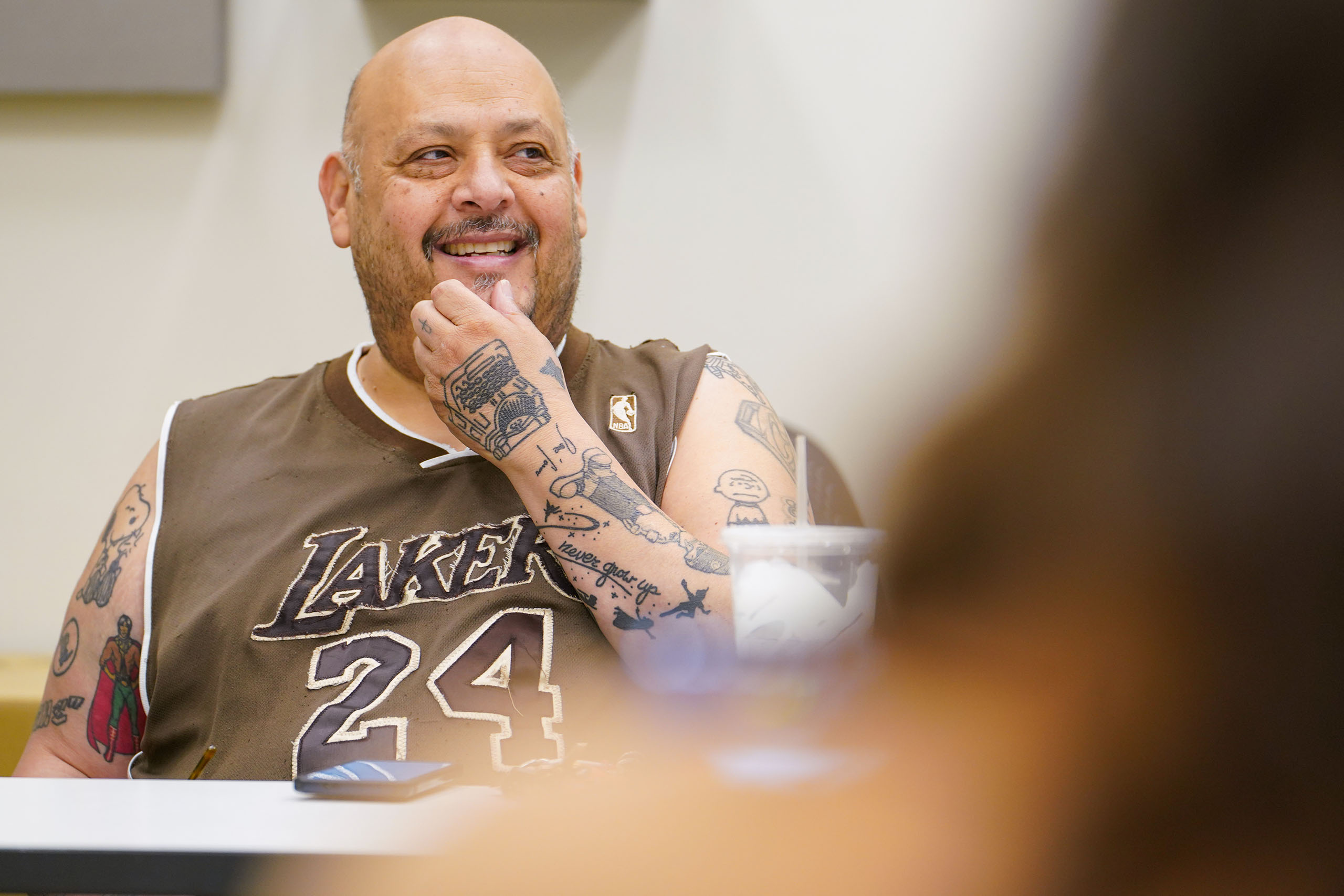
José Casas: Professor, scholar, playwright, director, and actor. Photo: Chris Boyes
Casas acknowledged that starting a new play is often when the obstacles seem hardest to overcome. “For the most part, I experience a certain paralysis at the beginning of the process, where it won’t be rare for me to be at a computer screen for five hours, just staring.” But he reminds himself of why the work is important to write (“I’ve always had this mantra: Don’t write a play you want to write, write a play you need to write”). And, like Shankel, he tells himself what he tells his students: “You’re only a writer for one draft; for the rest of them, you’re a rewriter.” Once that first draft is done, the revision process feels like a relief.
Like anything else, the process of creating requires discipline and mental fortitude, qualities that are built up through repetition. When working with student choreographers who are struggling, Hopper will ask them, “What are you trying to make? What’s really captivating you? Go deeper there. Keep repeating until you can’t repeat anymore, and something else will come from it.” In composition classes, she will often give her students an exercise where they have 30 seconds to craft a 10-second solo that they then have to perform to a timer. The whole point, she noted, is, “Get out of your own way, make no judgment. And oftentimes, we get better by making more.”
Interacting with Performers to Shape a New Work
While many creators find it excruciating to get started, they acknowledge that it can also be difficult to know when a work is truly finished. For many, that definitive feeling of being done is elusive, and the desire to continue tinkering is powerful. Many creators say they never truly feel a work is finished; they just reach a point where it’s time to introduce their creation to the wider world – a point that Shankel described as part satisfaction and part torture.
Getting to that point often involves testing out a new work with performers and, for some types of new works, with audience members. For choreographers composing a new dance work, they might begin the rehearsal process with concepts and ideas, with a fully formed piece, or anything in between. As Hopper explained, even when choreographers have a pretty definitive plan for a work, that plan often evolves once they begin working with dancers. She described a recent experience a choreographer had working with SMTD students: “He thought he was going to come in and do one thing, and then when he started crafting, the dance evolved and morphed into something different, based on who was in front of him moving and trying out this choreography.”
In the context of a major theatrical production, whether a play or a musical, going from a first draft to the opening of a major production can take several years. Some works might go faster, some may take far longer, but every step of the process is invaluable, and rushing the process can prove disastrous. Once the work has been written and the initial editing process is done, the next step might be to do a reading, where actors read the script without any staging or costumes. This process yields incredible insights for the creators, “because really good actors ask really good questions,” Shankel said, “and those questions can help you determine where you want to go next.” Readings generally lead to further edits, additional readings, and still more edits. The next step might be a workshop, which could last two to four weeks and involves some staging and choreography and minimal props and costumes. Whatever the process is, the act of working through the script and the score with performers is invaluable.
Add in audience members to a workshop or other pre-production process, and the insights for the creators deepen. “I definitely am aware of whenever people start rustling, or if they’re coughing, or if their attention is going somewhere else,” Shankel said. “It means something is not written correctly, something is not quite right.” For Casas, given that his plays focus on social issues, his measure of success is whether audiences engage with the work’s ideas. “When it comes to audience reactions,” he noted, “if people are pissed with what I’m saying, that doesn’t bother me. If they like what I’m saying, that doesn’t bother me. It’s when they come out, and you could tell they were bored, that’s when, as a writer, I think that play isn’t finished.”
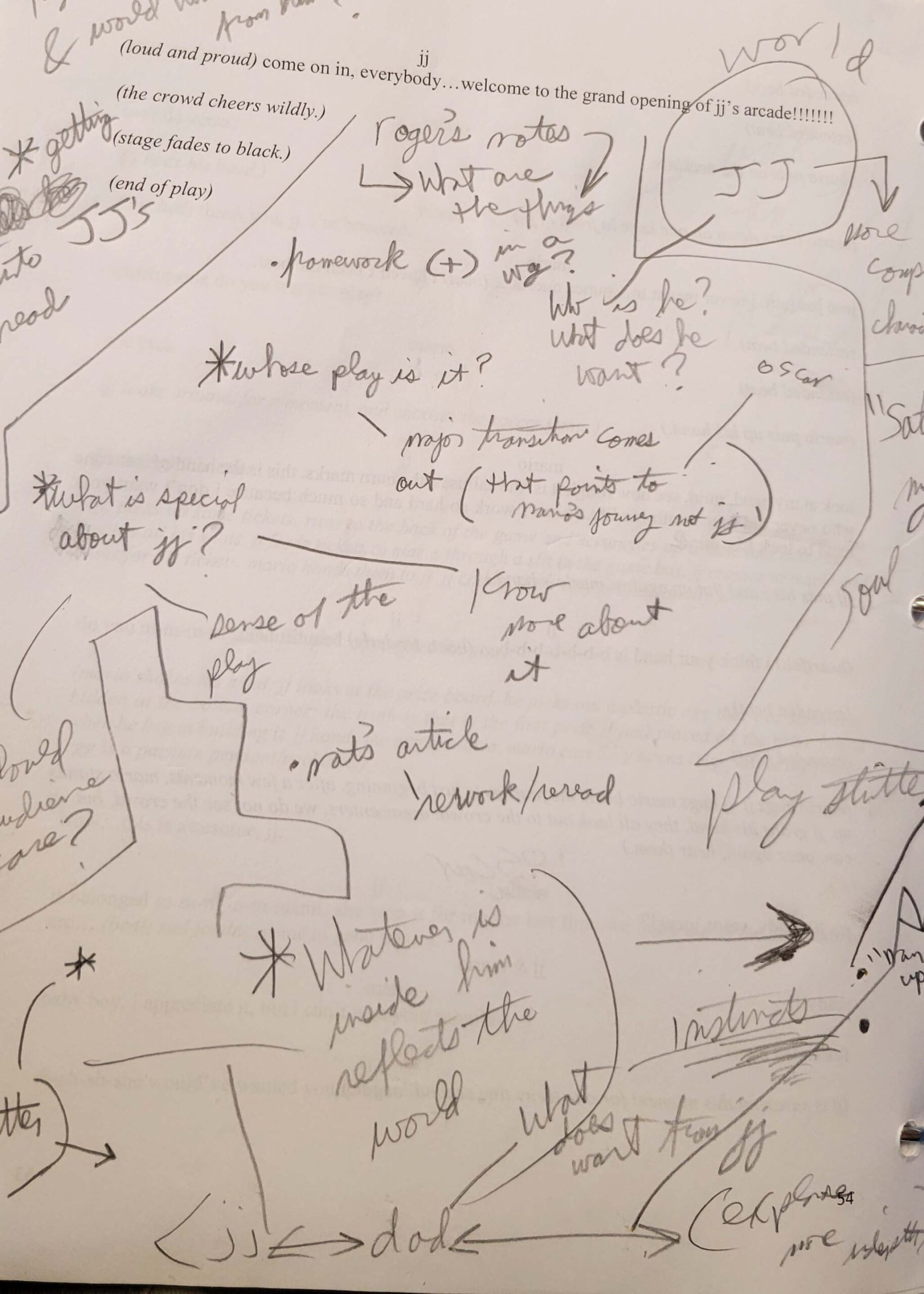
This page reflects José Casas’s notes taken after what he described as “an incredibly insightful workshop session” for his play jj’s place.
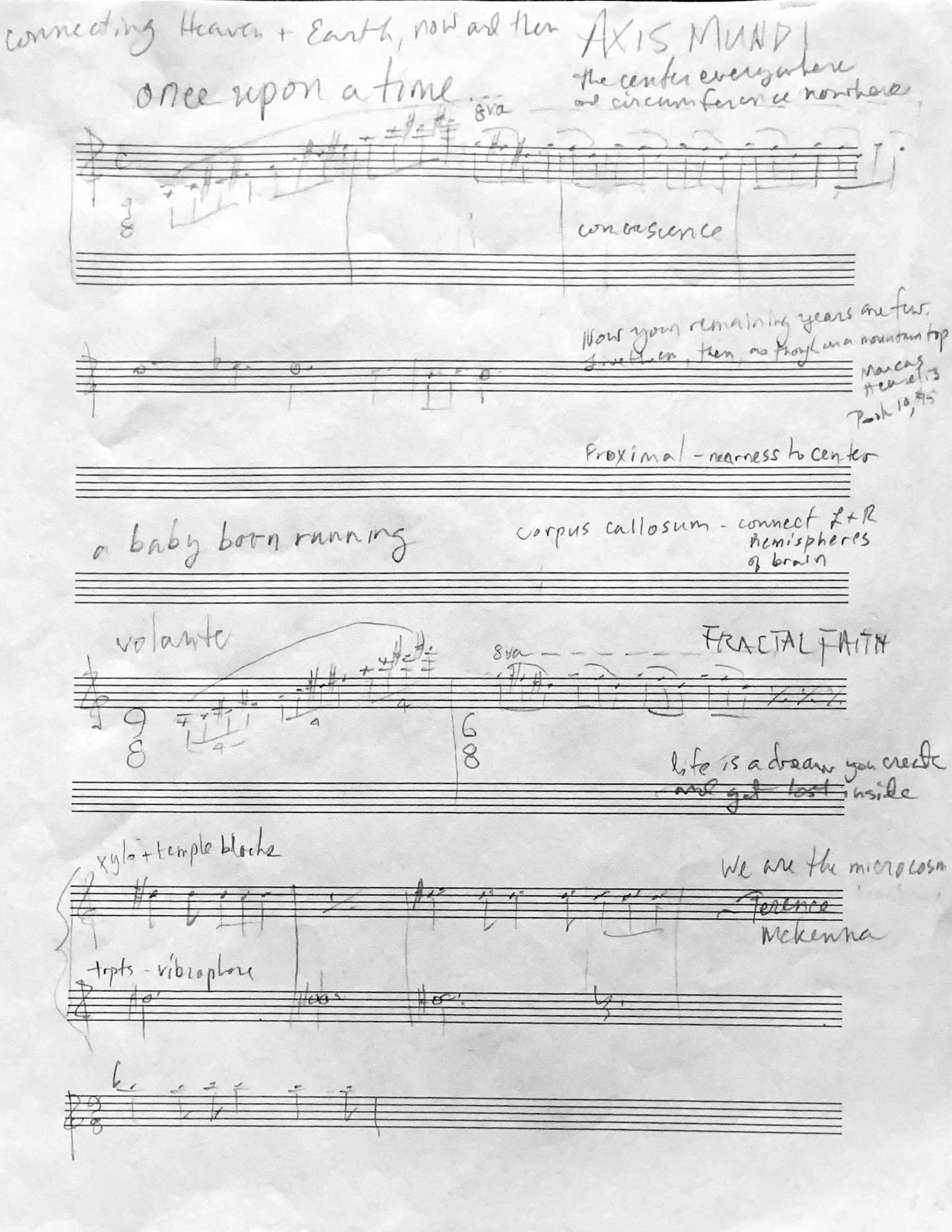
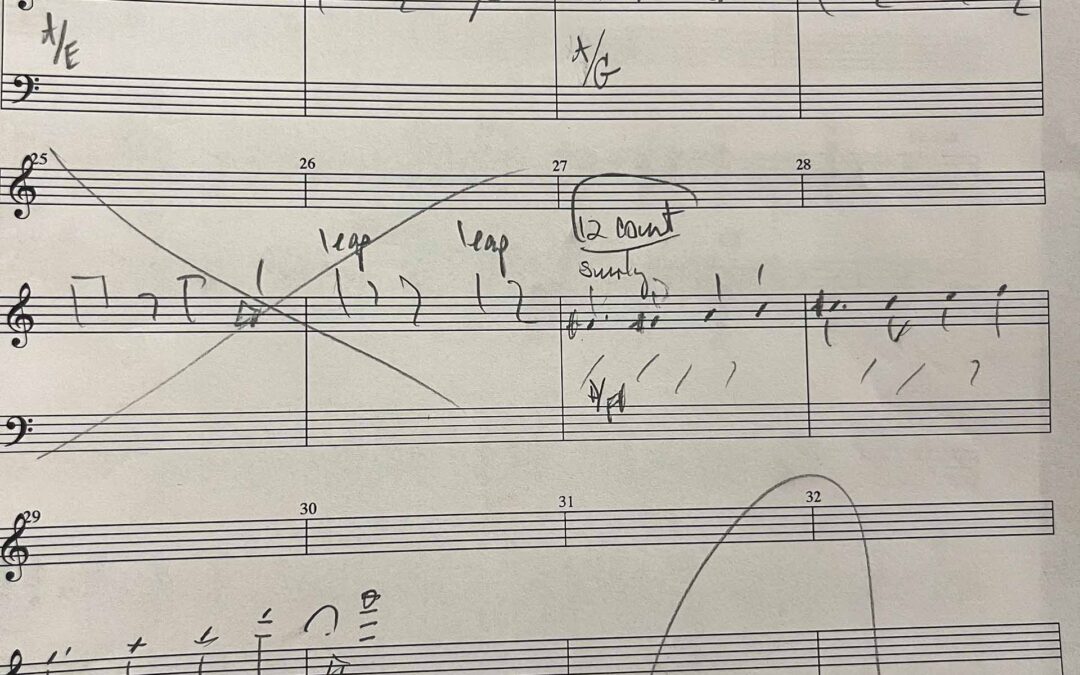
This early draft shows Erik Santos’s notes for what eventually became his commissioned work Pangea Proxima, a piece for symphony band.
The process for composers is as varied as the composers themselves. At some point, a new composition, especially an orchestral piece, must be played by musicians, existing beyond notation software or digital audio workstations (DAWs). For some composers, workshopping with musicians to develop a new work starts early and is an invaluable piece of the puzzle. Others, like Santos, might choose to keep a work private until it feels complete. “It’s not necessarily advisable,” he said, “but I tend to keep it to myself as long as I possibly can, and then just hope.”
Whatever the development process, once the response of others comes into the picture, the key is to be willing to follow that response wherever it goes. Creators have to be willing, as Shankel said, to “kill your darlings.” She recalled an experience with her main writing partner, Sara Cooper: “It was the first time that we were doing a full reading with actors, and we got to this reflective ballad that we both just absolutely loved. In the middle of it, we looked at each other and said, it’s stopping the show dead. It has to go.” At such a point, those beloved songs become what are called “trunk songs” – they get cut from the show and placed in a metaphorical trunk to be used, ideally, in some future work.
Teaching Students to Create
The creative act is so personal and subjective, it seems a challenging concept to teach. And yet, faculty who work with students to create new works have abundant strategies and approaches to help their students. Of course, foundational concepts are taught, including a substantial background in the history of the field, topics like music theory, and exposure to the field’s canonical works. Composers must learn how to use various types of software and must develop orchestrational prowess. Playwrights and musical theatre writers must learn how to create a story with dramatic intention and an arc. Dancers must learn how to interweave the basic components of choreography: time, space, and energy. All creators must learn how to work with performers and effectively communicate.
But at the same time, the art of teaching artists also involves fostering less concrete skills. For undergraduate dance students, choreography courses begin right away, and the first thing they learn is how to improvise freely. It’s about “training the mind and the body to get comfortable with making in the moment, and not judging,” Hopper said. For her, a key element of teaching choreography is helping each person express their unique qualities. “You can’t escape your own experiences and the things that have influenced you. So really, it’s about intention and thinking about how your individual experience is different from the person standing next to you in that composition class. And through that intentionality, your work is then new and different.”
Casas also spoke of the importance of students finding their voice and having permission to use their voice without being judged. He speaks to students about creating a structure and logic that make sense for whatever world they’re trying to create. He encourages his students to focus on “process, not product,” emphasizing the value of workshopping, collaboration, and community when creating a new work rather than just cranking out pages. Ultimately, Casas’s main concern is who his students are, rather than what they do. “I do not care if they become playwrights at all,” he said. “If they do, that’s great. But in the end, I just want them to be good citizens, empathetic human beings, and to be successful, whether it’s in theatre or somewhere else.”
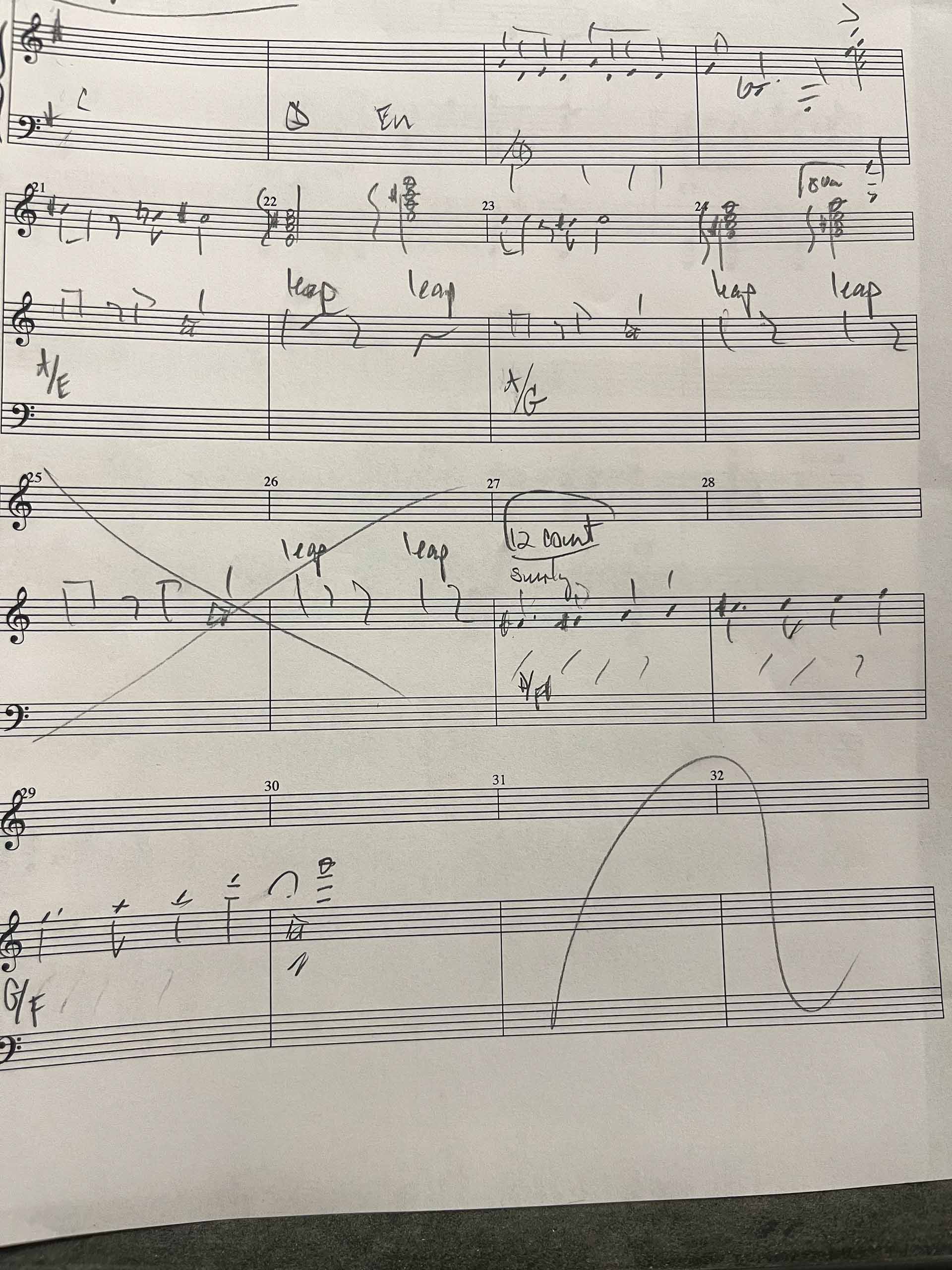
This early draft shows Lynne Shankel’s notes for a new dance piece that she is arranging and orchestrating.
For Shankel, working with students on their musical theatre writing is never about being prescriptive; it’s more about exploring with them what’s working and what isn’t in terms of form, melody, logic, and more. She works to instill a necessary discipline in her students, imposing frequent deadlines for the works they must complete by the end of the semester. “I think it helps them to understand,” she noted, “that they need to just get something out. You cannot wait for the creative muse to strike you.” Her courses are also structured to emphasize the value of working with collaborators, adapting to other people’s creative processes. One of the most important lessons she conveys to students is to be willing to abandon what isn’t working and try something new. “Don’t be precious about your own work,” she advised, “and don’t be afraid to just try something else, because you never know what’s going to happen.”
Santos indicated that much of what he views as his role in teaching composition is to listen to what students are composing, encourage them to stay open to something new, and help them see things in different ways. He expressed the need to give students freedom, but also structure. “Everybody needs a little bit of flexibility,” he noted, “but sometimes, if they’re too flexible, they’re floating out at sea, and they need somebody to just give them some landmarks.” He seeks to cultivate in his students “a sense of fearlessness as well as obstinacy,” sticking with something even when it gets difficult. Santos acknowledged that developing that discipline is extremely important when creating an original work. “But at the same time,” he said, “it’s just an adventure. It’s magic. Everybody always wants to know, how do you compose? And nobody can answer that. Even the ones who have a very organized pursuit, they’re still getting a flash of some unexpected thing that’s glinting in the dark.”
“We Are All Composers”: Advice About the Creative Process from Professor Evan Chambers
Below, Evan Chambers, professor of music in the Department of Composition, describes the perspective he shares with young students about being a composer. He also relates his approach with his own students at SMTD, advising them to treat the creative process, and themselves, with love and compassion.
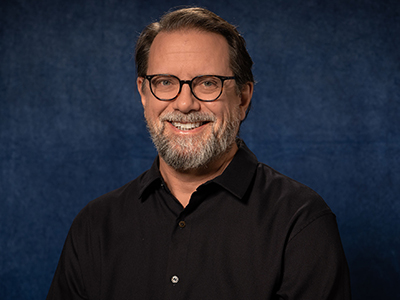
Evan Chambers
When I talk to young students, I always emphasize that everyone is a composer. I ask if anyone in the room is a composer, and usually one person tentatively raises their hand. “Great! You’re a composer!” Then I ask, “Has anyone in the room ever made up a song?” A few more hands go up. “Great! Y’all are composers!” Then I ask, “Has anyone ever done something embarrassing and sung a little ditty about it? Or dropped something on your toe and spontaneously made up a little tune?” Everyone’s hands go up. “Great! That means that you ALL are composers!” If you have ever put a sound to a feeling, you are inherently a composer. Matching sounds to feelings is a very basic human quality. We almost all do it, from birth onwards. So we are all composers, every time we burst into song-feeling.
Now. If you ask about being what people call “blocked,” or “stuck,” I’d say that it’s best not to talk like that. Those words are not allowed in lessons with my students at U-M. Instead, we say: “This piece is not going as quickly as I had expected!” Or: “The process of working out the notes for the music that I have imagined in my head is not proceeding with the tremendous ease I might have hoped for!” If we speak of a “block,” then we are reifying that, making it a structure in our minds. We are giving it power as a thing in itself, when it really is merely an unanticipated and unwelcome difficulty, which is, honestly, to be expected in ANY creative endeavor. So it behooves us to be kind to ourselves when we encounter that inevitable-and-yet-always-unexpected difficulty, because being kind to ourselves is essential. Being harsh with ourselves for our own difficulties in our process is just another way of inhibiting the process with negative judgement. Our creations, and indeed our creative processes, deserve love, care, and compassion! That’s the real way forward!