
Michigan Muse Spring 2026 > View from the Pond
View from the Pond
The Telegraph Quartet Brings an “Amazing Musical Energy” to SMTD Residency
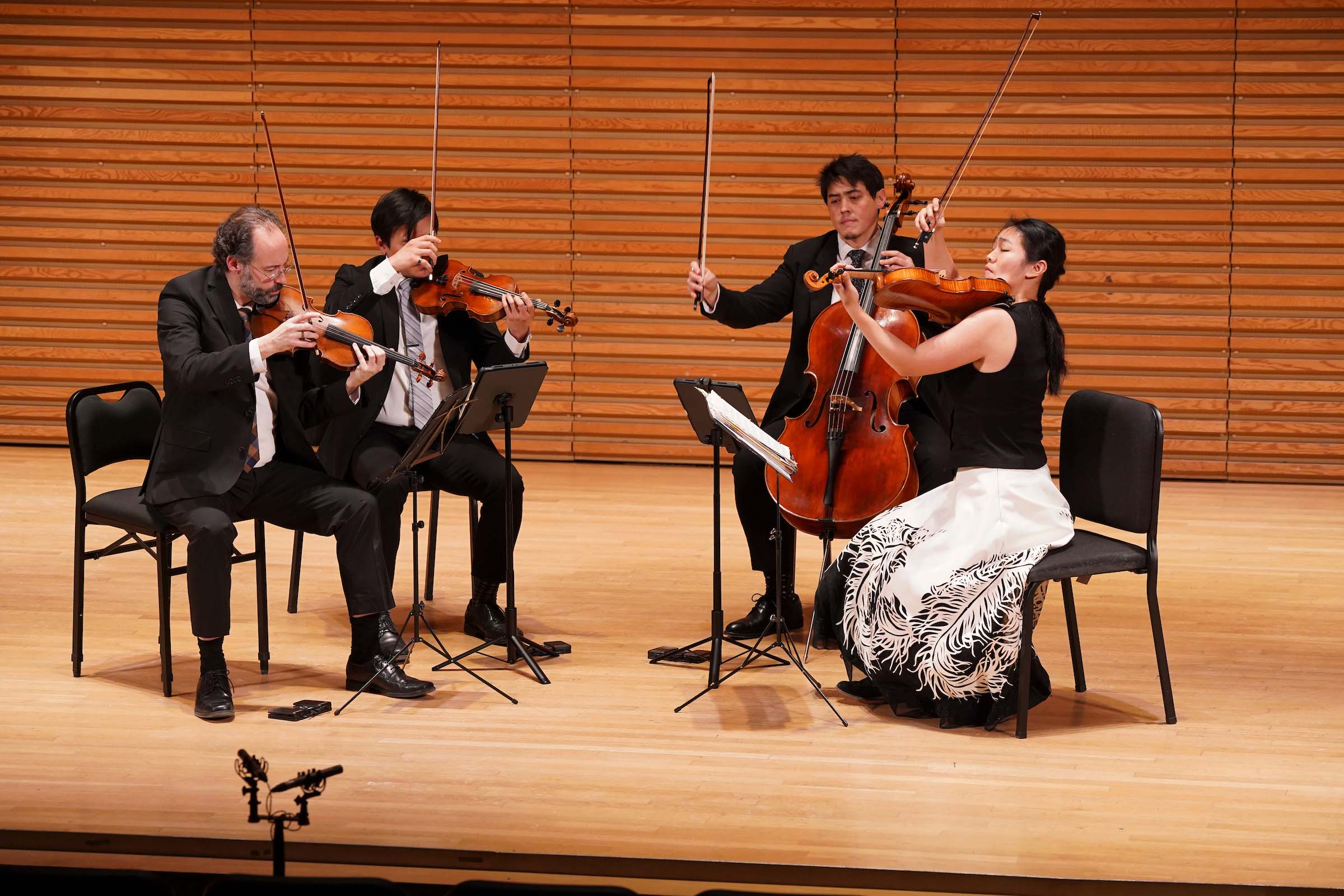
In fall 2024, the Telegraph Quartet began a three-year artist residency at the School of Music, Theatre & Dance, a residency that brought with it high hopes and ambitious plans. The quartet, which formed in 2013 and has performed in concert halls and at music festivals and academic institutions across the United States and abroad, planned to coach student chamber music groups, conduct studio classes and seminars, and offer mentorship sessions to students interested in chamber music careers. The plans also included several performances each year on campus. By the mid-point of their residency, it had become clear that the quartet’s contributions to the school would exceed all expectations.
The members of the quartet – Eric Chin and Joseph Maile (violins), Pei-Ling Lin (viola), and Jeremiah Shaw (cello) – have had abundant meaningful interactions with students, offering them invaluable exposure to musicians working outside of academia. In the first three full semesters of their residency, they conducted a whopping 63 coaching sessions with student chamber music groups. One of those groups, coached by Maile, went on to win second prize in SMTD’s Briggs Chamber Music Competition in April 2025. During the winter 2025 semester, Chin and Maile covered the teaching for Fabiola Kim’s violin studio while Kim was on sabbatical. The quartet members offered one-on-one mentorship to several students throughout the year. And in each semester, they have presented four “Chamber Music Forums” – department-wide performance classes where they work with chamber music groups across the departments, specializing in strings but also lending their perspectives to piano, woodwind, brass, and percussion chamber groups.
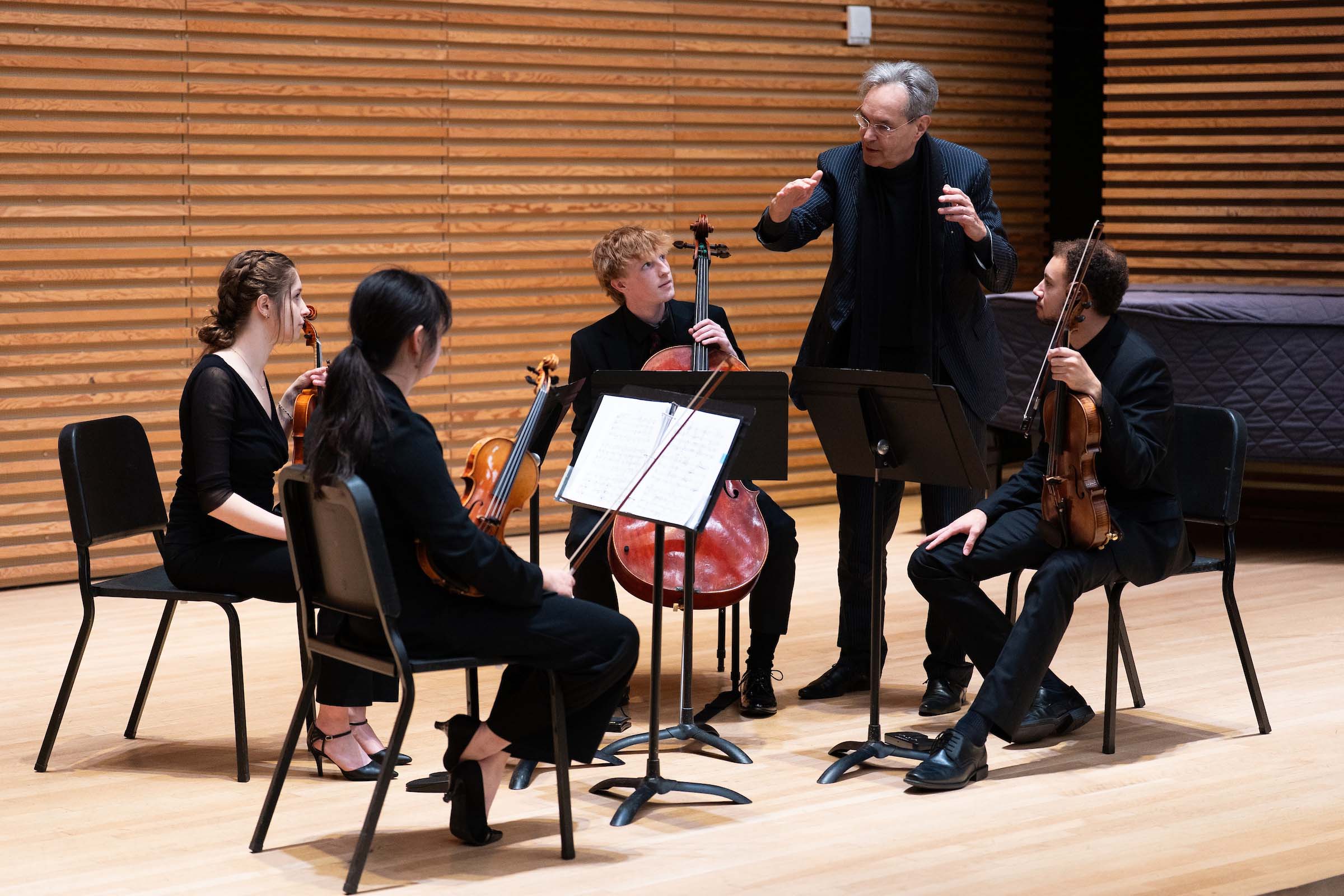
In fall 2025, the quartet hosted guest artist Henk Guittart, violist of the acclaimed Schoenberg Quartet and Schoenberg Ensemble, for a mini festival of Second Viennese School music. They arranged for Guittart to provide more than 20 hours of coaching with students. Under the guidance of Guittart, the Telegraph Quartet put on a performance of the music of Eleanor Alberga and Arnold Schoenberg that involved two other faculty and two students; a second concert involved student performances of pieces by Anton Webern and Schoenberg. After Guittart’s residency, the quartet traveled to the Bay Area with five SMTD students to perform some of this repertoire in side-by-side concerts, an extraordinary opportunity for the students.
Benefitting SMTD students and the entire southeastern Michigan community, the Telegraph Quartet has performed several public concerts across campus, as well as an invitation-only “President’s Concert.” These performances have run the gamut of creativity, including a pairing of the German Expressionist silent film The Cabinet of Dr. Caligari with Alban Berg’s Lyric Suite; a performance of Derrick Skye’s American Mirror where the audience was invited to lend their voices to the music; and participation in the “Count Basie Orchestra: Melange Concert,” organized by the jazz department’s Dennis Wilson. These performances have often included the talents of several doctoral and master’s students, working immersively alongside the Telegraph Quartet.
The members of the quartet have also been active members of the Departments of Strings and Chamber Music, attending meetings, collaborating with fellow faculty members, and helping to market and advertise events. During summer 2025, the quartet taught and performed at Center Stage Strings, an M-Pulse summer program held on campus and directed by Danielle Belen. They served on the judging panel for SMTD’s first-ever Rosseels String Quartet Competition and, in early 2026, they observed auditions by over 70 string students for placement in chamber music ensembles.
The quartet did all of this “while being kind, inspiring, fun colleagues,” said Matt Albert, associate professor and chair of chamber music. “It’s been a huge joy to work with them, and they have absolutely leveled up the string chamber music experience here at SMTD.”
Noting the impact the Telegraph Quartet has had at SMTD, David Halen, professor and chair of strings, said, “They have brought an amazing musical energy that has inspired countless students at our school. Having a group in residence that in addition to coaching large numbers of students performs regularly both locally and nationally has raised the visibility and scope of the offerings at Michigan for prospective students and supporters.” He praised the quartet for going beyond expectations: “The quartet members are exemplary members of the department and are extremely generous with the students. I can’t emphasize enough that [their residency here] has been truly transformative.”

A Memorable Concert Unites the Count Basie Orchestra with SMTD Faculty and Student Musicians
Among hundreds of concerts performed on campus during the fall 2025 semester, only one featured the legendary Count Basie Orchestra. The “Count Basie Orchestra: Mélange Concert” took place at the Power Center for the Performing Arts on October 24, 2025, featuring not just the celebrated orchestra but the U-M Jazz Ensemble, members of the University Symphony Orchestra, and the Michigan Youth Jazz Orchestra.
Also performing were several jazz faculty members: Andrew Bishop (tenor sax), Robert Hurst (double bass), Andy Milne (piano), Daniel Pinilla (guitar), Ed Sarath (trumpet), and Ellen Rowe (piano), as well as the Telegraph Quartet (a string quartet serving a three-year residency at SMTD). Special guests included Detroit-born Grammy-nominated jazz vocalist Carla Cook; U-M graduate and former Michigan Poet Laureate Nandi Comer; and Detroit-based arts journalist and author Mark Stryker acting as the evening’s emcee.
The concert was the brainchild of Dennis Wilson, associate professor in the Department of Jazz & Improvisation, conceived as a celebration of the Count Basie Orchestra’s 90th anniversary. A trombonist, composer, arranger, and former member of the Count Basie Orchestra (1977–87), Wilson viewed the concert as an opportunity to unite generations of musicians on stage in celebration of the orchestra’s legacy and the enduring power of jazz.
Founded in 1935 by pianist and bandleader William “Count” Basie, the Count Basie Orchestra became a defining ensemble of the swing era. One of the longest-running jazz orchestras, the ensemble toured internationally and collaborated with well-known performers, including Ella Fitzgerald, Frank Sinatra, and Tony Bennett.
Wilson spent years planning the concert, which primarily featured works he had arranged or composed. One of the evening’s centerpieces was Wilson’s composition “Dark Morning,” written the night he learned of Basie’s death in April 1984. The piece became Wilson’s tribute to Basie, and he recorded it with the Count Basie Orchestra about a decade ago. At the Melange Concert, the work was performed jointly by the Michigan Youth Jazz Orchestra and the Count Basie Orchestra.
For Wilson, the concert was more than a performance; it was a teaching moment. He saw it as an opportunity for young musicians to absorb lessons that can’t be taught in the classroom. “I want students to learn how to improvise by telling a story,” he said. “It’s not about showing off your chops. It’s about making people feel something.” He also viewed the concert – among the most ambitious projects he has undertaken since he began teaching at U-M in 2000 – as a way of uniting the legacy of the Count Basie Orchestra with the next generation of jazz musicians: “A chance to honor the past, but also to look forward.”
Adapted from an article in the University Record by Genevieve Monsma
From Artistic Vision to the Stage: The UProd Theatrical Shops
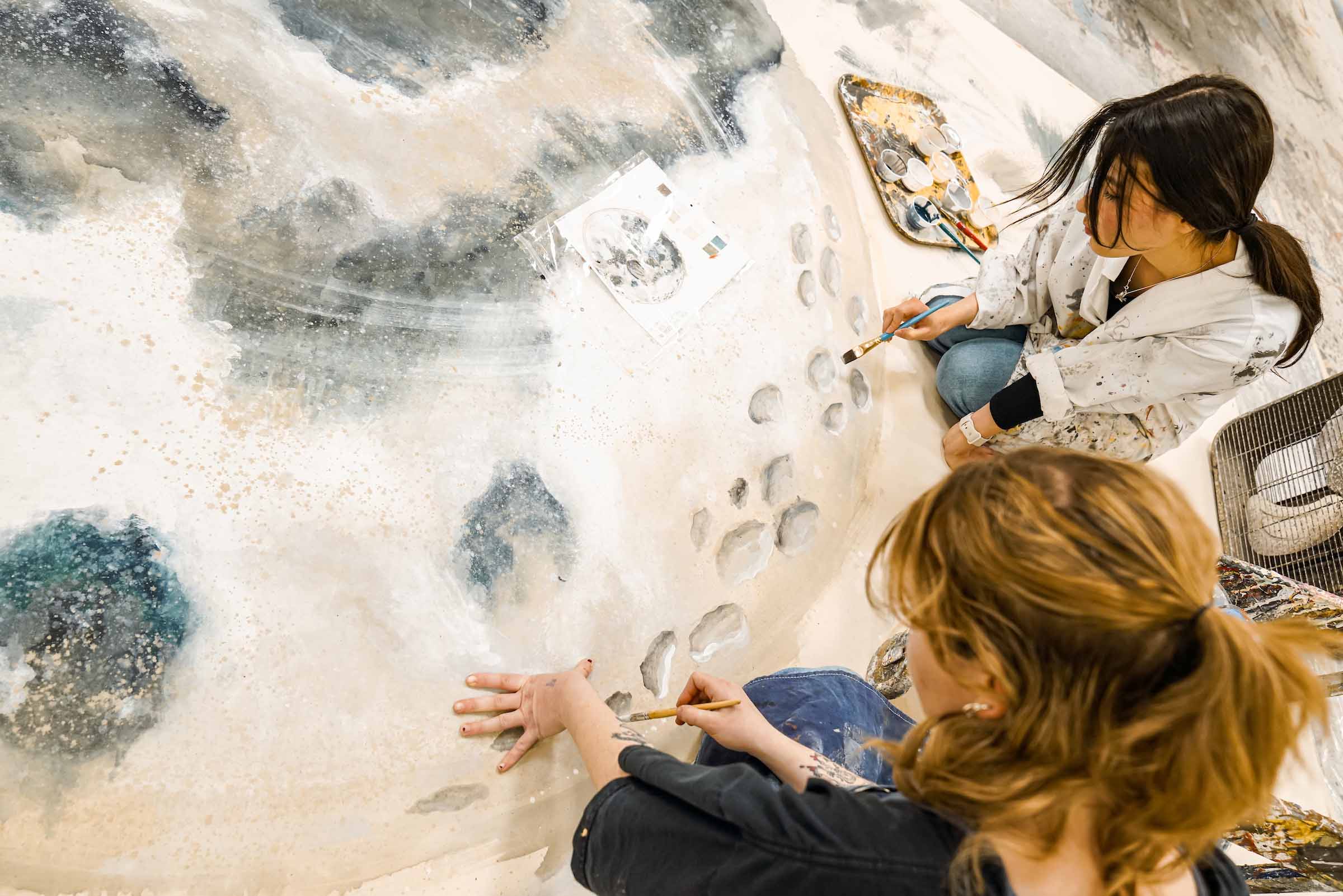
For the nine ticketed events at SMTD each year, a cadre of students, staff, and faculty in the theatrical shops collaborate to build the technical aspects of each production. Managed by University Productions (aka UProd), SMTD’s producing arm, are the Prop Shop, two Scene Shops – each of which also includes a Scenic Painting Shop – the Sound Studio, the Theatrical Lighting Shop, and the Wig, Hair & Makeup Studio.
It’s difficult to overstate the importance of the theatrical shops to the fully produced dance concerts, musicals, operas, and plays presented at the School of Music, Theatre & Dance. The students and professionals who work in the shops focus on every detail, large and small, as they build an entire world for the stage. Their work transforms the production and transports both performers and audience members into a different place and time.
The technical aspects of every production begin with the design team. Working in tandem with the director, designers develop their vision for the production. They conduct research, explore concepts, create sketches and renderings, and ultimately produce designs that are then shared with the theatrical shops. What follows is a conversation between the shop heads, the designers, and UProd’s production team to determine what is feasible within the constraints of time, budget, and labor. Then the engineers, carpenters, artists, and artisans get to work to implement the designers’ visions.
The shops are staffed by professionals with extensive experience in their respective fields. Students work in the shops, including in work-study positions or to fulfill course requirements. Many students working in the shops are either design and production majors or performance majors, who are required to spend a few weeks working in each shop to gain a fuller understanding of, and respect for, the work done behind the scenes. The appeal of working in the theatrical shops spreads well beyond SMTD; several of the student workers come from other U-M schools and colleges, from Stamps School of Art & Design to LSA to Engineering.
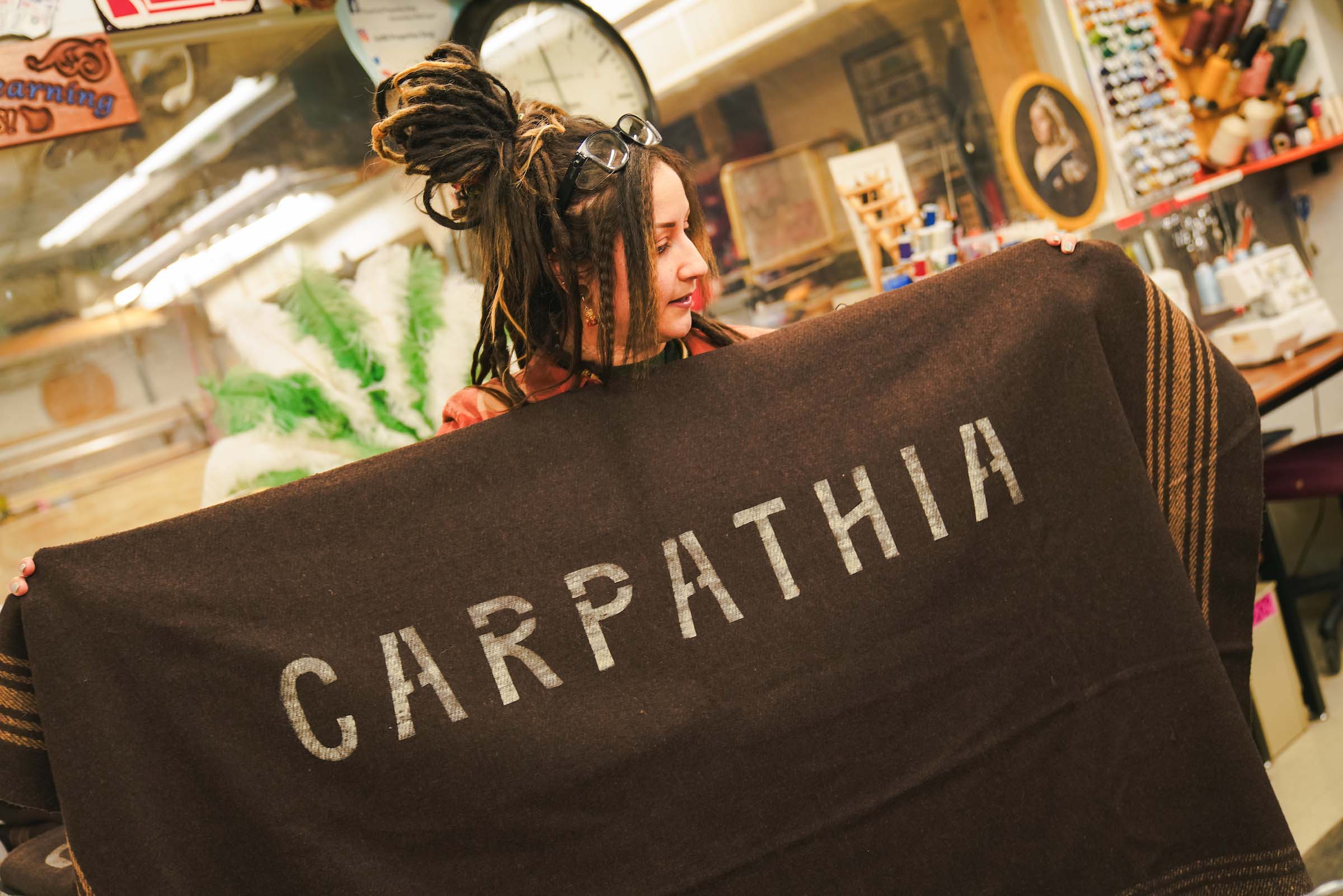
Design and production students begin with a course that surveys all of the theatrical shops; after that, they can dive deeply into whatever area interests them. With experience, they can assume greater responsibility in the shops, hold leadership positions backstage, and even become lead designers of sets, costumes, and lighting. And because each year’s productions include various theatrical modes, with works spanning numerous genres, styles, and time periods, the students amass vast experience over the course of four years. While the work varies from one production to the next and from one shop to the next, it is all connected by a common thread: every task is performed by the students and professionals with commitment, dedication, creativity, and curiosity.
Read on for more detail – and photos! – covering each shop.
Dance Department Partners with Talent Agency to Help Students Launch Careers
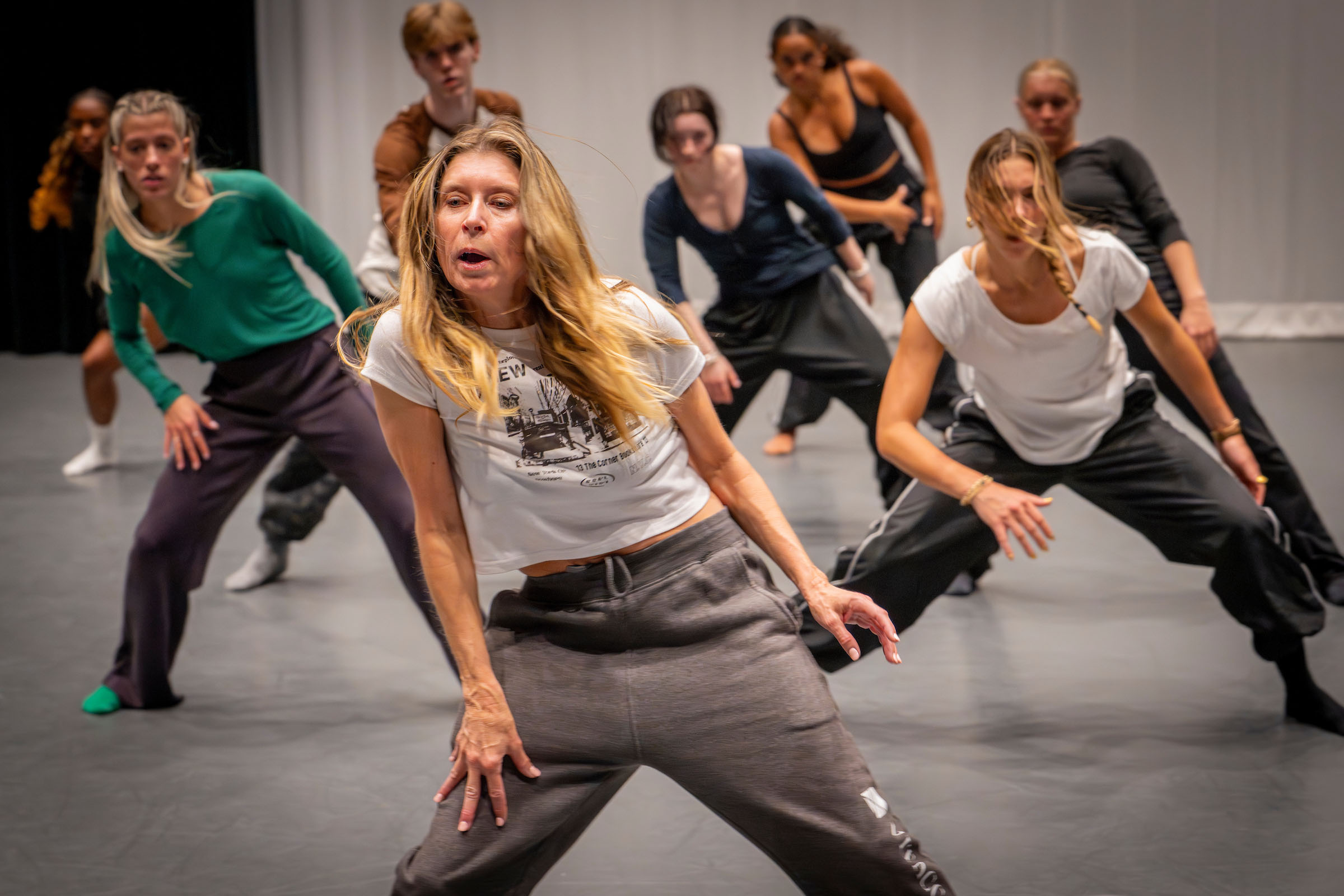
SMTD’s Department of Dance has entered into a first-of-its-kind partnership, working with talent agency McDonald Selznick Associates (MSA) to give students an edge in launching their careers post-graduation. This arrangement is not only a first at SMTD – according to Jillian Hopper, interim chair of dance and clinical assistant professor, “it’s the first time that a public university has offered a collaboration with a talent agency focused on representing dancers through all aspects of the professional career.”
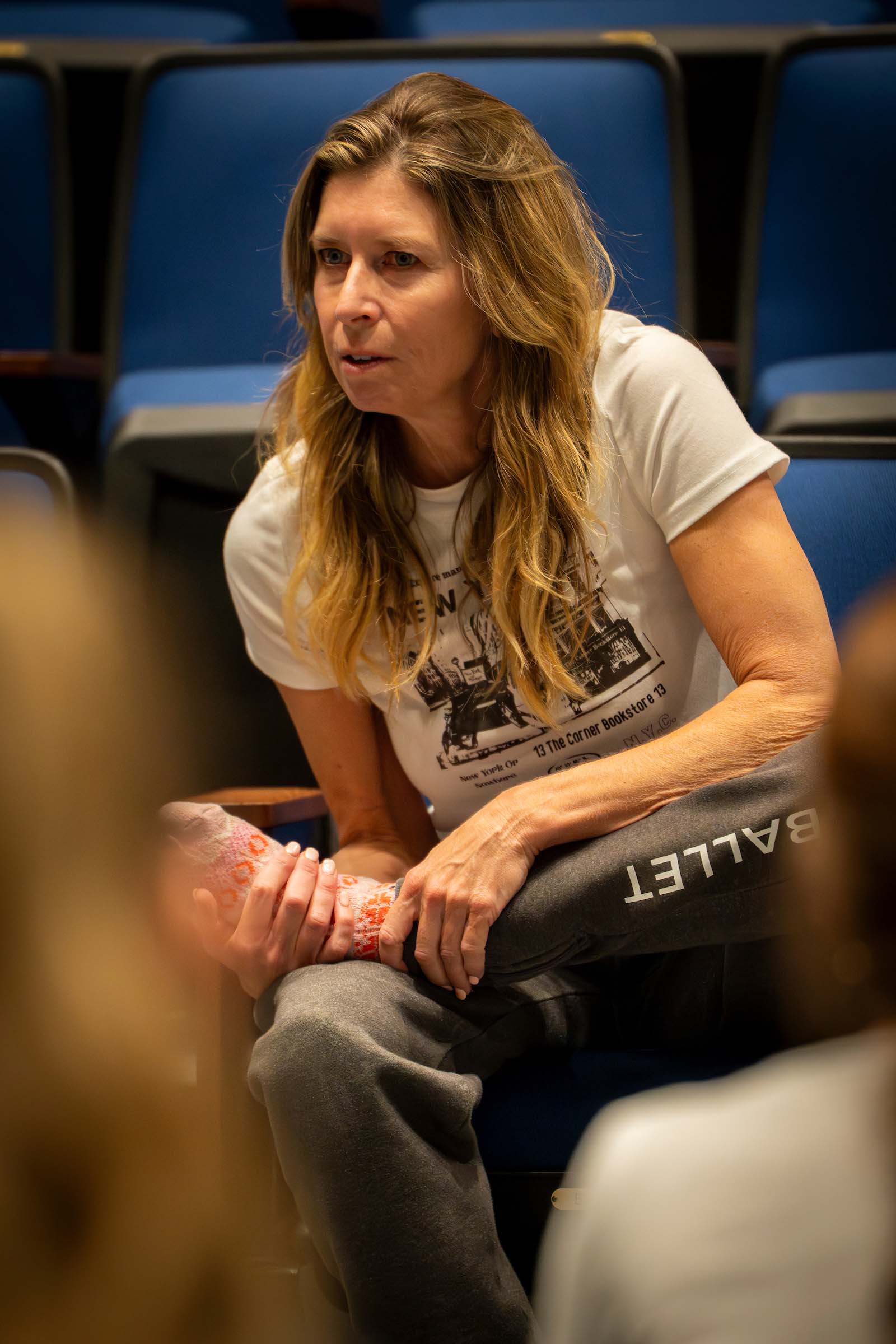
Based in Los Angeles and New York City, MSA represents dance artists and choreographers pursuing careers in the commercial dance industry, connecting their clients with opportunities in a variety of settings, from Broadway and touring productions, to live events (like a Vegas production or a pop artist on tour with a crew of dancers), to commercials, television, and film. They also represent those seeking careers in dance education. The connection between MSA and SMTD was facilitated by Judy Rice, associate professor in the Department of Dance, who is represented by the agency.
In years past, academic dance departments almost exclusively emphasized training students for roles in concert dance settings – as performers, choreographers, or artistic directors with dance companies – or as educators. In recent years, colleges and universities have begun to broaden their approach. Hopper suggested that educators are “becoming more comfortable with the idea that the first touchpoint for many students graduating with an undergraduate degree in dance is going to be in the commercial field.”
As part of MSA’s arrangement with SMTD, the agency will send five artists each semester to Ann Arbor for two weeks. During that time, the visiting artists will teach classes in their specific area of expertise; each class will be taught at a lower level and an upper level to encompass the range of experience among undergraduate and graduate students. The final classes will serve as mock auditions where the students can demonstrate what they’ve learned and get feedback for improvement. “This collaboration will offer real networking opportunities to students,” Hopper noted. “With five MSA guests every semester, first-year students will be connected with 35–40 working professionals by the time they graduate – professionals who know their name and have seen them in action.”
Hopper and MSA are also planning to have an agent come to campus at the end of the winter 2026 semester to conduct a department-wide mock audition, giving students the opportunity to get feedback from a working agent in the field. “What’s really exciting,” Hopper noted, “is that our graduating seniors could potentially be signed by MSA at the end of that audition. I’m super excited.”
The core curriculum of the Department of Dance will retain its focus on various forms of concert dance, from ballet to modern to contemporary, as well as composition, history, and performance. The collaboration with MSA simply enables the department to expand its offerings and add to students’ skillsets. “It’s an important part of their education,” Hopper noted, “helping them embody a broader dynamic range, instead of just staying in one lane, aesthetically.”
Dance Department Partners with Talent Agency to Help Students Launch Careers
SMTD’s Department of Dance has entered into a first-of-its-kind partnership, working with talent agency McDonald Selznick Associates (MSA) to give students an edge in launching their careers post-graduation. This arrangement is not only a first at SMTD – according to Jillian Hopper, interim chair of dance and clinical assistant professor, “it’s the first time that a public university has offered a collaboration with a talent agency focused on representing dancers through all aspects of the professional career.”
Based in Los Angeles and New York City, MSA represents dance artists and choreographers pursuing careers in the commercial dance industry, connecting their clients with opportunities in a variety of settings, from Broadway and touring productions, to live events (like a Vegas production or a pop artist on tour with a crew of dancers), to commercials, television, and film. They also represent those seeking careers in dance education. The connection between MSA and SMTD was facilitated by Judy Rice, associate professor in the Department of Dance, who is represented by the agency.
In years past, academic dance departments almost exclusively emphasized training students for roles in concert dance settings – as performers, choreographers, or artistic directors with dance companies – or as educators. In recent years, colleges and universities have begun to broaden their approach. Hopper suggested that educators are “becoming more comfortable with the idea that the first touchpoint for many students graduating with an undergraduate degree in dance is going to be in the commercial field.”
As part of MSA’s arrangement with SMTD, the agency will send five artists each semester to Ann Arbor for two weeks. During that time, the visiting artists will teach classes in their specific area of expertise; each class will be taught at a lower level and an upper level to encompass the range of experience among undergraduate and graduate students. The final classes will serve as mock auditions where the students can demonstrate what they’ve learned and get feedback for improvement. “This collaboration will offer real networking opportunities to students,” Hopper noted. “With five MSA guests every semester, first-year students will be connected with 35–40 working professionals by the time they graduate – professionals who know their name and have seen them in action.”
Hopper and MSA are also planning to have an agent come to campus at the end of the winter 2026 semester to conduct a department-wide mock audition, giving students the opportunity to get feedback from a working agent in the field. “What’s really exciting,” Hopper noted, “is that our graduating seniors could potentially be signed by MSA at the end of that audition. I’m super excited.”
The core curriculum of the Department of Dance will retain its focus on various forms of concert dance, from ballet to modern to contemporary, as well as composition, history, and performance. The collaboration with MSA simply enables the department to expand its offerings and add to students’ skillsets. “It’s an important part of their education,” Hopper noted, “helping them embody a broader dynamic range, instead of just staying in one lane, aesthetically.”