
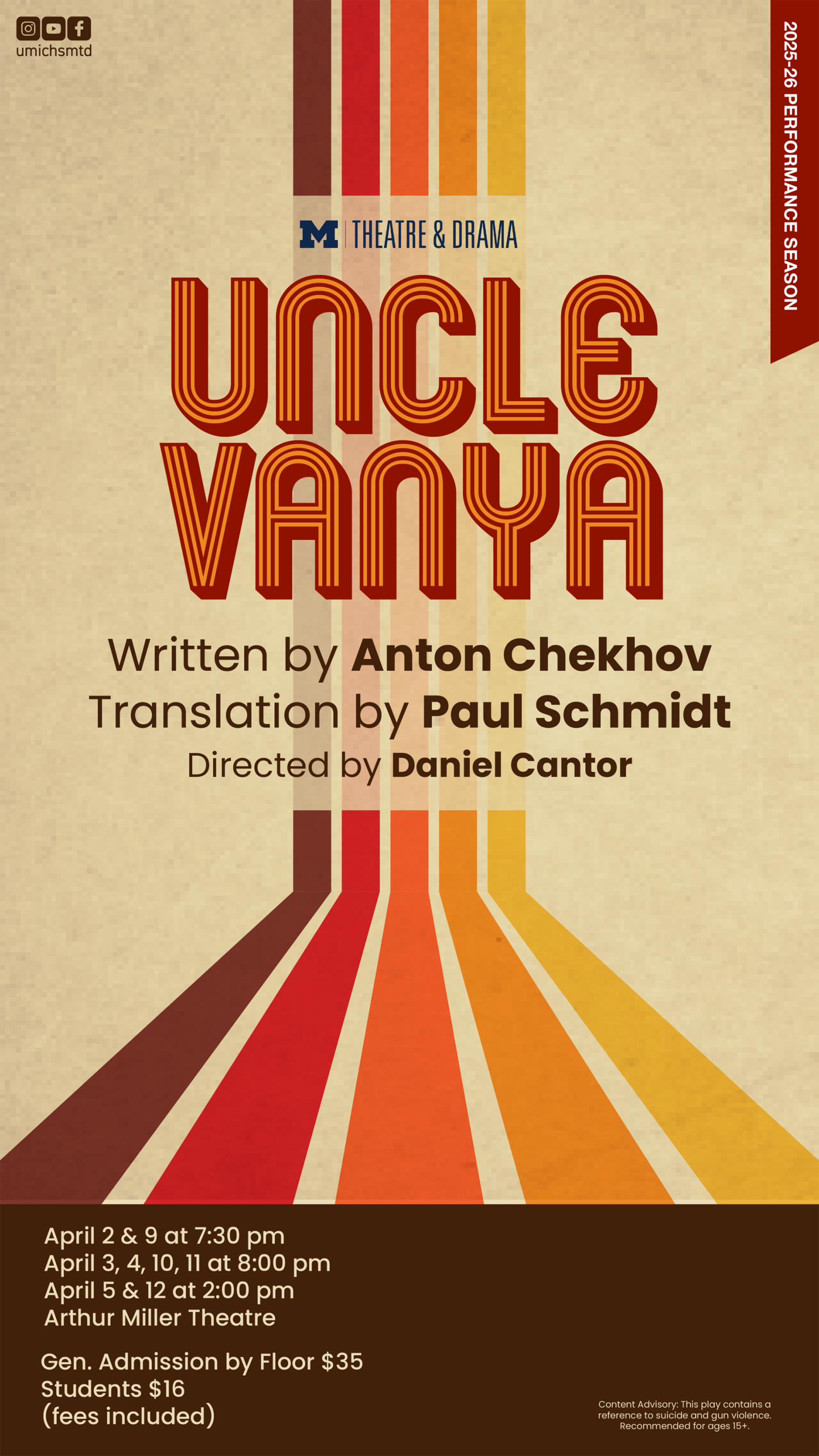
Content Advisory
About the Production
Creative Team
Director Daniel Cantor
Co-Choreographers Jeff Wagner †, Drey’von Simmons †, Daniel Cantor
Scenic Designer Jungah Han
Costume Designer Sammer Ali †
Hair & Makeup Designer Brittany Crinson
Lighting Designer Samantha Weiser ‡
Sound Designer Katie Hopgood
Video Designer Josi Middaugh †
Voice & Speech Coach Jeremy Sortore
Dramaturg Karin Waidley
Resident Intimacy Choreographer and Cultural Consultant Raja Benz
Production Stage Manager Katie Kutzko †
† SMTD Student
‡ SMTD Guest
Cast
Marína, the family’s old nurse Faith Park
Mikhaíl Lvóvich Ástrov, a doctor Hugh Finnigan
Vanya (Iván Petróvich) Raymond Ocasio IV
Alexánder Serebriakóv, a retired professor Nate McCanna
Ilyá Il´ych Telégin, an impoverished neighbor Matthew Werthman
Sónya, the professor’s daughter by his first wife Maya Guacci
Yeléna, the professor’s wife, 27 years old Micah Webster-Bass
Mrs. Voinítsky (María Vasílyevna) a widow, mother of the professor’s first wife Samantha Mutabaruka
Hired Woman Audrey Colbourn
Night Watchman Sean Forman
Yelena U/S Faith Park
Professor U/S Matthew Werthman
Sonya, Mrs. Voinitsky, Marina U/S Audrey Colbourn
Vanya, Astrov, Telegin U/S Sean Forman
Hired Woman, Night Watchman U/S Ellie Mayfield
Production Staff
Assistant Director Jeff Wagner
Assistant Stage Manager Sarita Gankin
Production Assistants Lyd Herrera, Soph Irfani, Kangxin Li, Charlotte Murray
Assistant Dramaturgs Penelope Clark, Ellie Mayfield, Hope Orban
Assistant Lighting Designer Tate Zeleznik
Running Crew
Light Board Operator Joe Guzon
Sound Operator Mateo St. Remy
Deck Crew Louie Diaz, Cameron Mann
Props Crew Jiahe Duan, Esther Hwang, Ivana Jimenez, Georgia Turner
Wardrobe Crew Payton Cottrill, Shea Giese, Lucy Knas^, Schnadè Saintïl
Hair & Makeup Crew Miranda Bourne, Bradyn Prisand, Keri Radonovich
^ Crew Head
Shop Crews
Costumes Iliana Beauchamp, Katy Dawson, Sarita Gankin, Lucy Knas, Alex Li, Maya Liu, Rachel Pfeil, Isabella Pruter, Kayti Sanchez, Ellie Van Engen & 250/252/262 students
Lighting Eliza Anker, Clayton Collins, Morgan Gomes, Ethan Hoffman, Brandon Malin, Tate Zeleznik, Gabriela Ribeiro Znamensky & 250/252/262 students
Paint Gretchen Brookes, Miles Hionis, Norah Klocke, Ren Kosiorowski, Hannah Kryzhan, Emmie Pokryfke, Ceri Roberts, Seri Stewart^, Amber Walters, Angela Wu & 250/252/262 students
Scenery Kelly Burkel, Ren Kosiorowski, Soph Irfani, Michael Russell, Nathaniel Steever & 250/252/262 students
Props Andy Blatt, Kendall Brisco, Brook Galsky, Alex Heskett, Sam McLaughlin, Tessie Morales, Leah Stchur, Reese Stevens & 250/252/262 students
Wigs/Hair/Makeup Gretchen Brookes, Christine Chupailo, Miles Hionis & 250/252/262 students
Production Management Justin Comini, Shelby Holloway, Esther Hwang, Greta Steever
Department of Theatre & Drama
SMTD Leadership
David Gier, Dean
Paul Boylan Collegiate Professor of Music
Department of Theatre & Drama
Department Chair Dr. Tiffany Trent
Department Manager/Artistic Administrator Kathryn Pamula
Walgreen Events Manager Nickie Smith
Studio and Performance Manager Arie Shaw
Walgreen Office Coordinator Tyler Brunsman
Performance/Directing Christina Traister (Head of Performance), Halena Kays (Head of Directing), Daniel Cantor (Head of Acting), Raja Benz, Mark Colson, Antonio Disla, Holly Hughes, Tzveta Kassabova, Geoffrey Packard, Jeremy Sortore, Malcolm Tulip, Tiffany Trent
Design/Production Kevin Judge (Head of Design & Production), Jess Fialko, Heather Gilbert, Jungah Han, Jenn Rae Moore, Christianne Myers, Sarah M. Oliver
Theatre Studies/Playwriting Mbala Nkanga (Head of Theatre Studies), José Casas, Shavonne Coleman, Antonio C. Cuyler, Antonio Disla, Jenna Gerdsen, Amy E. Hughes, Holly Hughes, Jason Fitzgerald, Petra Kuppers, Ashley Lucas, Jay Pension, Rogério Pinto, Alexis Riley, Emilio Rodriguez, Karin Waidley
Arts Management Paul Bonin-Rodriguez, antonio c. cuyler, Aaron Dworkin, Afa Dworkin, Ken Fischer, Gala Flagello, Andrew Kuster, Jonathan Kuuskoski, Kari Landry, Robin Myrick, Jay Pension, Jesse Rosen, Omari Rush, Anna Sampson
Interarts Scott Crandall, Holly Hughes, Tzveta Kassabova, Malcolm Tulip
Professors Emeriti Alan Billings, Peter W. Ferran, Jessica Hahn, Philip Kerr, Priscilla Lindsay, Janet Maylie, Vincent Mountain, John Neville-Andrews, Leigh Woods
Faculty Advisors
Costume Design Advisor Sarah M Oliver
Stage Management Advisor Jenn Rae Moore
Staff Mentors
Staff Mentors Laura Brinker, Brittany Crinson, Patrick Drone, Chad Hain, Heather Hunter, Richard W. Lindsay, Beth Sandmaier
University Productions Administrative Staff
Executive Director Jeffrey Kuras
Administrative Specialist Christine Eccleston
Administrative Asst. Emily Erlich
Facilities Manager Shannon Rice
Performance Halls House Mgr. Kelley Krahn
Lead Backstage Operations Mgr. Dane Racicot
Sr. Backstage Operations Mgr. David Pickell
Backstage Operations Mgrs. Tiff Crutchfield, Yvette Kashmer, Brian Koepele, Robbie Kozub
University Productions Production Staff
Director of Productions Aaron Keller
Asst. Production Manager Michelle Williams-Elias
Technical Director (Walgreen) Richard W. Lindsay Jr.
Theatrical Scenery Manager Chad Hain
Lead Scenic Carpenter Devin Miller
Scenic Carpenter Heather Udowitz
Charge Scenic Artist Beth Sandmaier
Assoc. Theatrical Paint Mgr. Madison Stinemetz
Lead Theatrical Properties Manager Patrick A. Drone
Assoc. Theatrical Properties Manager Danielle Keys
Properties Artisan Adam Ashlock
Theatrical Properties Stock and Tech Coord. Kat Kreutz
Theatrical Lighting Manager Heather Hunter
Assoc. Theatrical Lighting Manager Jorrey Calvo
Theatrical Sound Manager Katie Hopgood
Sr. Costume Shop Manager Laura Brinker
Asst. Costume Shop Manager Leslie Ann Smith
Lead Cutter/Draper Tj Williamson
Cutter/Drapers Sarah Havens, Lani Tortoriello
Stitchers Mag Grace, Rene Plante
Lead Costume Crafts Artisan Elizabeth Gunderson
Costume Stock Manager Theresa Hartman
Wardrobe Manager Meredith Miller
Theatrical Hair and Makeup Mgr. Brittany Crinson
Resources
- About the Performance
- About the Authors
- About the Cast
- About the Creative Team
- Director's Note
- Dramaturg's Note
- Statement on the Anishinaabe Land Transfer
- Freedom of Expression Statement
- Download Program
Setting: The action takes place on the Serebriakóv farm.
There will be one fifteen-minute intermission.
Latecomers will be seated at a suitable break. As a courtesy to others, please turn off cellular phones and refrain from texting during the performance. Photography, audio recording, and videotaping of any kind are not permitted.
Uncle Vanya is presented by special arrangement with Theatrical Rights Worldwide. trwplays.com
Uncle Vanya was first produced in 1899 by the Moscow Art Theatre, directed by Konstantin Stanislavski. This translation was originally commissioned by the American Conservatory Theatre, San Francisco, California.
The performers in this production are students in the Department of Theatre & Drama. The designers for this production are students, faculty, and/or guests of SMTD. Scenery, costumes, properties, sound, and lighting were realized by the students and staff of University Productions, the producing unit of SMTD. Thank you for supporting our educational mission.
Anton Chekhov (Playwright) was born on January 29, 1860, in Taganrog, Russia. His father, Pavel, was a grocer with frequent money troubles; his mother, Yevgeniya, shared her love of storytelling with Chekhov and his five siblings. Through stories such as “The Steppe” and “The Lady with the Dog,” and plays such as The Seagull and Uncle Vanya, Anton Chekhov emphasized the depths of human nature, the hidden significance of everyday events, and the fine line between comedy and tragedy.
From the late 1890s onward, Chekhov collaborated with Constantin Stanislavski and the Moscow Art Theater on productions of his plays, including his masterpieces The Seagull (1895), Uncle Vanya (1897), The Three Sisters (1901), and The Cherry Orchard (1904). In 1901, Chekhov married Olga Knipper, an actress from the Moscow Art Theatre. However, by this point his health was in decline due to the tuberculosis that had affected him since his youth.
While staying at a health resort in Badenweiler, Germany, he died in the early hours of July 15, 1904, at the age of 44. Chekhov is considered one of the major literary figures of his time. His plays are still staged worldwide, and his overall body of work influenced important writers of an array of genres, including James Joyce, Ernest Hemingway, Tennessee Williams, and Henry Miller.
—Adapted from Biography.com
Paul Schmidt (Translator), whose translations and/or adaptations of Phaedra, The Bacchae, and In the Jungle of Cities were staged at the American Repertory Theater in past seasons, was one of the most influential critics, translators, and playwrights of his time. His translations, including plays by Chekhov, Gogol, Genet, Brecht, and Marivaux, have been produced by such directors as Robert Wilson, JoAnne Akalaitis, and Peter Sellars and have won awards in France, Italy, and the United States.
His plays have been performed at the Brooklyn Academy of Music, Thalia Theatre in Hamburg, and the Institute for Contemporary Art in London. Dr. Schmidt, who held a PhD in Slavic literature from Harvard, was a professor of Russian literature at the University of Texas and at Wellesley College. He also taught at Harvard, Cornell, and Yale and lectured widely in the United States and abroad. His critical essays appeared in The Nation, The New York Review of Books, and Delos. A recipient of a fellowship from the National Endowment for the Arts, Dr. Schmidt was the author of Meyerhold at Work and editor of The Complete Works of Arthur Rimbaud and The Collected Works of Velimir Khlebnikov. His collected translations of Chekhov’s plays were published in 1997.
—Adapted from American Repertory Theater
Audrey Colbourn (Hired Woman) First-year, BFA Acting, Bethesda, MD
Hugh Finnigan (Mikhaíl Lvóvich Ástrov) Senior, BFA Acting/History minor, Rochester, NY
Sean Forman (Night Watchman) First-year, BFA Acting, Celina, TX
Maya Guacci (Sónya) Junior, BFA Acting/Playwriting and Education for Empowerment minor, Sayville, NY
Ellie Mayfield (Hired Woman/Night Watchman U/S) First-year, BFA Acting, Atlanta, GA
Nate McCanna (Alexánder Serebriakóv) Junior, BFA Acting
Samantha Mutabaruka (Mrs. Voinítsky) Sophomore, BFA Acting, Frisco, TX
Raymond Ocasio IV (Vanya) Junior, BFA Acting, Ridgewood, NJ
Faith Park (Marína) Sophomore, BFA Acting, Lakewood, WA
Micah Webster-Bass (Yeléna) Sophomore, BFA Acting/Dance minor, Jacksonville, FL
Matthew Werthman (Ilyá Il´ych Telégin) First-year, BFA Acting, San Jose, CA
Sammer Ali (Costume Designer) is a junior from Houston, TX, concentrating in costume design within the BFA design and production program. Ali thanks her advisor, Sarah Oliver, for her guidance and wisdom; the costume shop for their incredible work; and the Department of Theatre & Drama for creating such a supportive environment! She hopes anyone raised in the 1960s–70s thoroughly cringes with nostalgia as you watch this show. Select costume design credits include: Le Nozze Di Figaro (UProd), 33 Variations (Basement Arts), This Is Our Youth (RA Productions), The Effect (Basement Arts), and Orion and the Goatman (Basement Arts). sites.google.com/view/sammeralicd | Instagram: @sammeraliCD
Daniel Cantor (Director) is an actor, director, writer, and educator. Acting credits include the original Broadway cast of Leopoldstadt; Off-Broadway in Things You Shouldn’t Say Past Midnight, Tuesdays with Morrie, and Strictly Personal; and the national production of Steve Martin’s Picasso at the Lapin Agile. Chicago credits include Goodman Theater, Court Theater, Victory Gardens, Drury Lane, Chicago Shakespeare, Silk Road Rising, Next, American Theater Company. Regional credits include A.C.T., Berkeley Rep, Cincinnati Playhouse, Milwaukee Rep, Cleveland Play House, Studio Theater (DC), Hartford TheaterWorks, Marin Theater, Shakespeare Santa Cruz, CATF, Barrington Stage, Notre Dame Shakespeare, Arkansas Rep, Worcester Foothills Theater, Mill Mountain Theater, National Shakespeare Company. TV and film appearances include Empire, Chicago Fire, Chicago PD, Law & Order, Law and Order: SVU, Law and Order: CI, Conviction, Sopranos (webisode), As the World Turns, Asphalt Man, Miskits, The Auteur Theory, Alchemy, Justice, House of Satisfaction, Alternative Universe: A Rescue Mission, and Asphalt Man. He has directed at Joe’s Pub, Westbeth Theater, PSNBC, SoloArts, StandUpNY, with Roundabout Theater (Prospect High outreach project), UV Theater Project, and at various universities, and as associate director at Chicago Shakespeare Theater and Marriott Theatre. Cantor received his MFA in acting from A.C.T. and his BA from Wesleyan University.About the Creative Team
Brittany Crinson (Hair & Makeup Designer) is the Wigs, Hair, and Makeup Studio manager and designer for all of UProd. Crinson spent several years in Chicago building her portfolio and skill set as a wig, hair, and makeup designer. Her credits include hair department head of HBO’s Somebody Somewhere, season 3; the head of hair and makeup for the Joffrey Ballet for several seasons; and hairstylist on Hulu’s The Bear, seasons 1-4, in addition to designing for theatres around Chicago and Detroit. She is thrilled to be back for her 2nd full year at U-M.
Jungah Han (Scenic Designer) is a New York-based freelance set designer, specializing in theatre, film, and television. Her work spans a wide range of artistic mediums, with recent design credits including Chiaroscuro: A Light and Dark Skin Comedy (Flea Theatre), My Onliness (Sibiu International Theater Festival), The Duat (Philadelphia Theatre Company), Disinform (American Opera House), A Little Night Music (Power Center), Grand Horizons and The Chinese Lady (Tipping Point Theatre), and L’incoronazione di Poppea (Brockman Hall for Opera). Other highlights include The Power of the Dog (Juilliard School), Bernarda Alba (Arthur Miller Theatre), Don Giovanni (Lydia Mendelssohn Theatre), and Marat/Sade (Power Center). In addition to her freelance work, Han has also contributed as an associate and assistant set designer for several Broadway and international productions, such as Lempicka (Longacre Theatre), The Thanksgiving Play and Kite Runner (Helen Hayes Theatre), Jagged Little Pill (national tour), The Empire of Light (Théâtre National de Bretagne, France), and Rigoletto (Die Staatsoper Unter den Linden). Her artistic journey has been deeply influenced by mentors like Ming Cho Lee, Ralph Funicello, and Riccardo Hernandez and has led her to expand her creative work beyond theatre into film and immersive art projects. Han received her MFA from the David Geffen School of Drama at Yale and currently teaches at the University of Michigan, Ann Arbor. She currently serves as an executive committee About the Creative Team
member at the Nam Center for Korean Studies and as a scenic design exam review committee member for USA 829. Visit her website at jungahhan.com for more details.
Katie Hopgood (Sound Designer) is thrilled to be joining the team for Uncle Vanya. Broadway credits: Birthday Candles (Roundabout’s American Airlines Theater). Regional credits include: Mrs. Harrison (Williamston Theatre), Nora, 8 nights, Clyde’s, Soft Target (Detroit Public Theatre), Julius Caesar (PlayMaker’s Repertory Company), The Beauty Queen of Leenane (Detroit Public Theatre), The Tempest, Richard III, Twelfth Night, Hamlet, Love’s Labour’s Lost (Michigan Shakespeare Festival). Chicago: Into That Darkness, The Corrosive Hours of Edgar Allan Poe (The Edge Off-Broadway), Love’s Labour’s Lost (Lifeline Theatre), Titus Andronicus (Babes with Blades), The Electric Baby, Wrens (Rivendell Theatre Ensemble).
Katie Kutzko (Production Stage Manager) is a fifth-year student from Kalamazoo, MI, concentrating in stage management within the BFA design and production program. In addition to stage management, she enjoys painting, photography, and making puppets. She would like to thank previous and current SM Advisors: Nancy Uffner, Nan Luchini, and Jenn Rae Moore, for all of their guidance and wisdom. Select stage management credits include: Cunning Little Vixen (UPROD, 2nd ASM), Intimate Apparel (UPROD, 1st ASM), Accidental Death of an Anarchist (UM Theatre & Drama, PSM), Twelfth Night (UPROD, 1st ASM), 33 Variations (Basement Arts, calling SM), Epiphany Play (RCDRAMA, PSM), Cabaret (UPROD, ASM).
Josi Middaugh (Video Designer) is a theatre design & production sophomore concentrating in technical direction. This is her first UProd in a design capacity! Middaugh works in the Power Center scene shop and with Filmic Productions as an art director. Select credits: MUSKET: Into the Woods (technical director), Matilda (TD & scenic designer); directing theses: Red About the Creative Team
(lighting designer). She would like to thank her parents, sister, and jazz fusion music for getting her through this show. “Go forth and do GREAT things!” @josi.h.middaugh
Jeremy Sortore (Voice & Speech Coach) (he/him) is an associate professor in the Department of Theatre & Drama. Regional: American Repertory Theater, Utah Shakespeare Festival, Colorado Shakespeare Festival. Member, National Alliance of Acting Teachers; associate faculty, Theatrical Intimacy Education; associate teacher of Fitzmaurice Voicework; certified teacher of Knight-Thompson Speechwork; certified Vocal Combat Technique trainer/coach; PAVA-recognized vocologist; editorial board, Journal of Consent-Based Performance; associate editor, Voice & Speech Review. Education: Moscow Art Theater School/American Repertory Theater Institute at Harvard University. JeremySortore.com
Jeff Wagner (Assistant Director/Co-Choreographer) is a junior from Louisville, KY, pursuing a BFA in directing. Wagner thanks Dan Cantor for his guidance, support, and collaboration during this process, and the department of Theatre & Drama for creating such a supportive environment! Select directing design credits include: Julius Caesar (UProd), The Effect (Basement Arts), and Much Ado About Nothing (Rude Mechanicals).
Samantha Weiser (Lighting Designer) is so excited to be returning to University of Michigan after graduating in 2020! Weiser is a lighting designer and associate based out of Brooklyn, NY. Recent design credits include: Macbeth (Long Island University, NY), Sulfur Bottom (The Theater Center, NYC), Jekyll & Hyde (Timberlake Playhouse, IL), and The Tempest (Two River Theater, NJ). Her portfolio can be found at SamanthaWeiserLD.com
The great American philosopher Cornel West said, “The greatest literary artist of the last 200 years was Anton Chekhov. Anton Chekhov was a kind of Russian bluesman. In some ways even deeper into the blues than bluesmen.” West compared Chekhov to John Coltrane, suggesting that both artists express “the spirituality of doubting, the spirituality of genuine giving and serving in profound love and kindness.” He elaborated that Chekhov’s writing compassionately “wrestles with death, disappointment…with the steady ache of misery, the constant heartbreak of daily life, while trying to convince us to keep on—this is the blues sensibility—‘I’ve been down so long, down don’t worry me no more—that’s why I keep on keeping on.’”
I would agree with West that Chekhov and Coltrane share a deep intuitive insight into the human experience, both offering a kind of redemptive response to suffering. Yet Chekhov brings something uniquely his own to that sensibility: humor. His plays can be hilarious, even when full of pathos. While some may think of Chekhov as the greatest writer of the Modernist era, he may be more aptly described as the first Postmodernist writer, a good 75 years before that movement got going. Chekhov’s plays somehow holistically hold together while built around a pastiche of forms—from realism, to farce, to expressionism, to symbolism, and certainly in his last two plays, the beginnings of abstractionism.
Uncle Vanya occupies a particularly intriguing place within Chekhov’s work. While he labeled The Seagull and The Cherry Orchard as comedies, he subtitled Uncle Vanya as simply, “Scenes from Country Life in Four Acts.” The description feels deliberately indeterminate. The play is often ridiculous, often sad, and sometimes both at once. Vanya manages to be funny even as it dives directly into the griefs of lost love, disillusionment, time slipped by, and the quiet recognition of our own transience. Chekhov somehow transforms the play’s basic narrative of a love quadrangle (or maybe pentangle)—soap-operatic on one level—into a deep meditation on the human experience, with its humor part and parcel of its depth. Indeed, Chekhov’s insights, and his characters, are never simple, always wrapped in contradiction. Above all, Chekhov is a dealer in paradox, in the uncertain, the asymmetrical, and the ambiguous.
Given that spirit of indeterminacy and Chekhov’s kinship with the blues, along with the play’s canonical status (which begs for re-contextualization as a bridge to contemporary relevance), we’ve allowed ourselves to explore a leap in the production’s framing. I won’t say much about that here, except to quote another genius, David Bowie, who reflected, “I think in the ’70s there was a general feeling of chaos, a feeling that the idea of the ’60s as an ‘ideal’ was a misnomer. Nothing seemed ideal anymore. Everything seemed in-between… I think the ’70s showed conclusively that everything we knew was wrong.”
Perhaps Chekhov would have understood that feeling well. Though even in our ignorance, I hope we’re smart enough to enjoy a great play.
—Daniel Cantor, director
Written in 1897, premiering at the Moscow Art Theatre with Konstantin Stanislavsky as the first director in 1899, Uncle Vanya has been produced over 10 times on Broadway in the last 100-plus years, with a revival done as recently as 2024, with Steve Carell in the titular role. This figure doesn’t include the countless productions and adaptations done off Broadway, across the country, in the West End, and all over the world, such as The Uncle Vanya Project in Australia (focusing on its environmental themes) and a new interpretation at La Mama this month where Russian visionary Dmitry Krimov directed the Chekhov classic for the first time, “transforming it into a grotesque elegy, a wasteland vaudeville.”
Is Uncle Vanya everywhere and everything, all at once?
No doubt. The themes are timeless and the characters relatable across geographies. Here, we’ll build for you another time and space through which we weave its relevance. This production both embraces and shakes up what feels like, at times, a dangerous nostalgia for a time before—a love letter to the music of the early 1970s and the movements of the late ’60s with a microscopic look at internal conflicts fracturing and fading some of the idealism from underneath. Some argue this was a time of great disillusionment within the United States. The nation was plagued by the Vietnam War, infiltrating many a living room through television; we try to reimagine the absolute horror and newness of accessing this kind of news, not from the palm of one’s hand but from the confines of our homes. Tragedy brought on by war, a distant afterthought for many, was now readily visible and undeniable by the American public.
Iconic images from the Civil Rights Movement also streamed in. Demands for equal rights for Black Americans, women, and LGBTQ communities exposed systemic inequities within the movements themselves similar to what was being fought against. A string of unfathomable assassinations and their effects rippled out from the decade before. The hard fight, while achieving many landmark goals, revealed some of the most hideous sides of the American government. FBI probes into personal lives, accompanied by large-scale political scandals such as Watergate, eroded American trust in the government in a way that perhaps we’ve never recovered from. Mainstream media was stuck between holding onto an aesthetic of nostalgia and embracing the changing tastes brought on by a new generation and new technologies.
Who could have even imagined then where we would be now?
The setting of Uncle Vanya in this era may seem like a bit of a stretch on the surface, yet we’ve leaned into how anachronism—coupling Chekhov’s time and place with this one—built a creative bridge for all the artists involved, a fun and fraught way to reimagine this frequently told story. And this tension, when thoroughly examined, revealed profound connections between time and text—striking similarities between the social movements of both eras and thus the general ethos of both cultures. Amidst the destruction of war abroad, environmentalism gained momentum throughout the United States, similar to that of late 19th-century Russia’s significant shifts in land and labor as a result of the end of serfdom, rapid industrialization, and soil depletion, a precursor of revolutions to come. We even found a surprising connection to U-M. March 11th, 1970, marked the first-ever Teach In and Scream Out for the environment on the University of Michigan campus, an event that became the precursor for the first official Earth Day a month later. (See the digital lobby display for more on this.)
Moreover, the feminist movements in late 19th-century Russia were analogous in many ways to those in 1970s USA. Russian culture contained strict gender norms—that is, they expected women to become housewives—which were maintained by family structures and severe limits to education across gender and class. Towards the end of the century, these inequalities sparked a movement where Russian women began Dramaturg’s Note
to view education, the economy, work, and family through a gendered lens that advocated for parity. Similarly, in the 1970s USA, waves of seismic change surrounding issues such as workplace inequalities, education, and reproductive rights led to significant legal reforms, such as the passing of Title IX and the protection of a pregnant person’s right to choose through Roe v. Wade, a decision overturned less than 50 years later.
While the themes are timeless, the play particularly lends itself to a time period where listlessness and a lack of inspiration pervade—and perhaps one that is eerily similar to now. How does one push through the lethargy of feeling helpless or hopeless, when the actions of others have made a mess of the bag we are left holding?
Ultimately, the eternally relatable characters of Uncle Vanya embody a truly timeless tale that begs to be retold again and again. There will always be someone whose loftiness and disconnection seem, if not cruel, then incomprehensible; a love we so desperately want; and a difficult truth we are forced to reckon with. At some point, we may all experience the simultaneous drudge of life and fear of death; we may find ourselves too tired to pursue the life we thought we’d already have. Yet, despite suffering, we may discover how to move beyond small-scale disappointments and large-scale atrocities to make the most of what remains.
We may be rewarded; we may find peace.
—Hope Orban, Penelope Clark, and Ellie Mayfield
Anishinaabeg gaa bi dinokiiwaad temigad manda Michigan Kichi Kinoomaagegamig. Mdaaswi nshwaaswaak shi mdaaswi shi niizhawaaswi gii-sababoonagak, Ojibweg, Odawaag, minwaa Bodwe’aadamiig wiiba gii-miigwenaa’aa maamoonjiniibina Kichi Kinoomaagegamigoong wi pii-gaa aanjibiigaadeg Kichi-Naakonigewinning, debendang manda aki, mampii Niisaajiwan, gewiinwaa niijaansiwaan ji kinoomaagaazinid. Daapanaming ninda kidwinan, megwaa minwaa gaa bi aankoosejig zhinda akiing minwaa gii-miigwewaad Kichi-Kinoomaagegamigoong aanji-daapinanigaade minwaa mshkowenjigaade.
The University of Michigan is located on the traditional territory of the Anishinaabe people. In 1817, the Ojibwe, Odawa, and Bodewadami Nations made the largest single land transfer to the University of Michigan. This was offered ceremonially as a gift through the Treaty at the Foot of the Rapids so that their children could be educated. Through these words of acknowledgment, their contemporary and ancestral ties to the land and their contributions to the University are renewed and reaffirmed.
Thank you for attending this program. The University of Michigan strives to create a truly open forum, one in which diverse opinions can be expressed and heard. You can see our full Freedom of Expression policy at smtd.umich.edu/FOE