
Michigan Muse Fall 2025 > The Ties That Bind: Campus Visits Tap Into the Power of the SMTD Alumni Network
The Ties That Bind: Campus Visits Tap Into the Power of the SMTD Alumni Network
By Judy Galens

For decades, students in the Department of Musical Theatre have used a buddy system that pairs first-year students with seniors. Throughout the year, the seniors check in on their buddies regularly – texting them, taking them out for coffee, offering advice on navigating life at SMTD. The buddies are paired with care and attention, based on a questionnaire the first-year students have filled out about themselves, and announced in a jubilant ceremony. Part of this tradition involves the first-years learning not only who their buddies are, but their entire lineage – their grandbuddy, great-grandbuddy, and so on through the generations. Catherine Walker, professor of music and associate chair of the department, related that students reach out to their buddy ancestors, going to New York to see them perform on Broadway, taking pictures with them after the show, and spending time with them in the city. “Not only do we have a horizontal community,” she noted, “but there’s also a vertical structure where students are able to connect to alums, and alums are able to connect to current students.”
The musical theatre buddy system is just one of many examples of such vertical structures that tap into the strength of the alumni network and lead to lasting connections between students and alumni. One tried-and-true method of forging such connections, a practice employed by every department at SMTD, is the alumni visit – bringing graduates back to campus for master classes, guest artist residencies, recitals, expert panels, and more. Sometimes these visits last for an afternoon, sometimes they stretch over several days, sometimes they continue for several weeks, as when an alum serves as a guest director, choreographer, designer, or other member of a production’s creative team. Regardless of duration, these visits offer substantial advantages to students – and benefit the visiting alumni themselves.
Broadening Their Academic Horizons
Many alumni visits offer educational opportunities that expand upon students’ training at SMTD, reinforcing what they’re learning or opening them up to broader aspects of their field. Christopher Harding, professor of music and chair of the Department of Piano, related that the department frequently invites alumni to campus to perform recitals. Attending these recitals helps piano students develop critical listening skills and, sometimes, offers them a perspective they may not typically be exposed to. Svetozar Ivanov (MM ’96, DMA ’99, piano), a long-time professor at the University of South Florida School of Music, has come back to Ann Arbor several times. “He does incredibly imaginative programming,” Harding explained, “with multimedia presentations and very unusual repertoire. It’s fascinating for our students to see.”
Harding also described recent visits from Mi-Eun Kim (MM ’16, DMA ’21, piano), director of keyboard studies at the Massachusetts Institute of Technology (MIT), that featured something entirely different than recitals. Kim came to SMTD to give a talk, “The Biomechanics of Piano Playing,” in March 2025 and again in June (as part of Center Stage Strings, one of SMTD’s MPulse Institutes, where Kim serves as head of piano collaboration). She described her ongoing research project, funded by the MIT Human Insight Collaborative, that uses motion capture, ultrasound, EKG, and other sensors to conduct essentially a full-body scan while a musician plays piano. The goal is to improve the understanding of musicians’ physical connection with their instrument, while also reducing performance-related injuries. Kim noted the deep connection this project has to SMTD. Her former advisor, Logan Skelton – Artur Schnabel Collegiate Professor of Music in Piano and Arthur F. Thurnau Professor of Music – serves as a consultant and close collaborator on the project. The SMTD piano pedagogy faculty have been extremely supportive, as have string faculty members, who are intrigued by the potential to transfer the study’s findings to other instruments. And many of the pianists being recruited to take part in the study are SMTD alumni. “Though this study is taking place at MIT,” she said, “it would not be possible without the foundational knowledge, community, network, and support from the UMich SMTD community.”
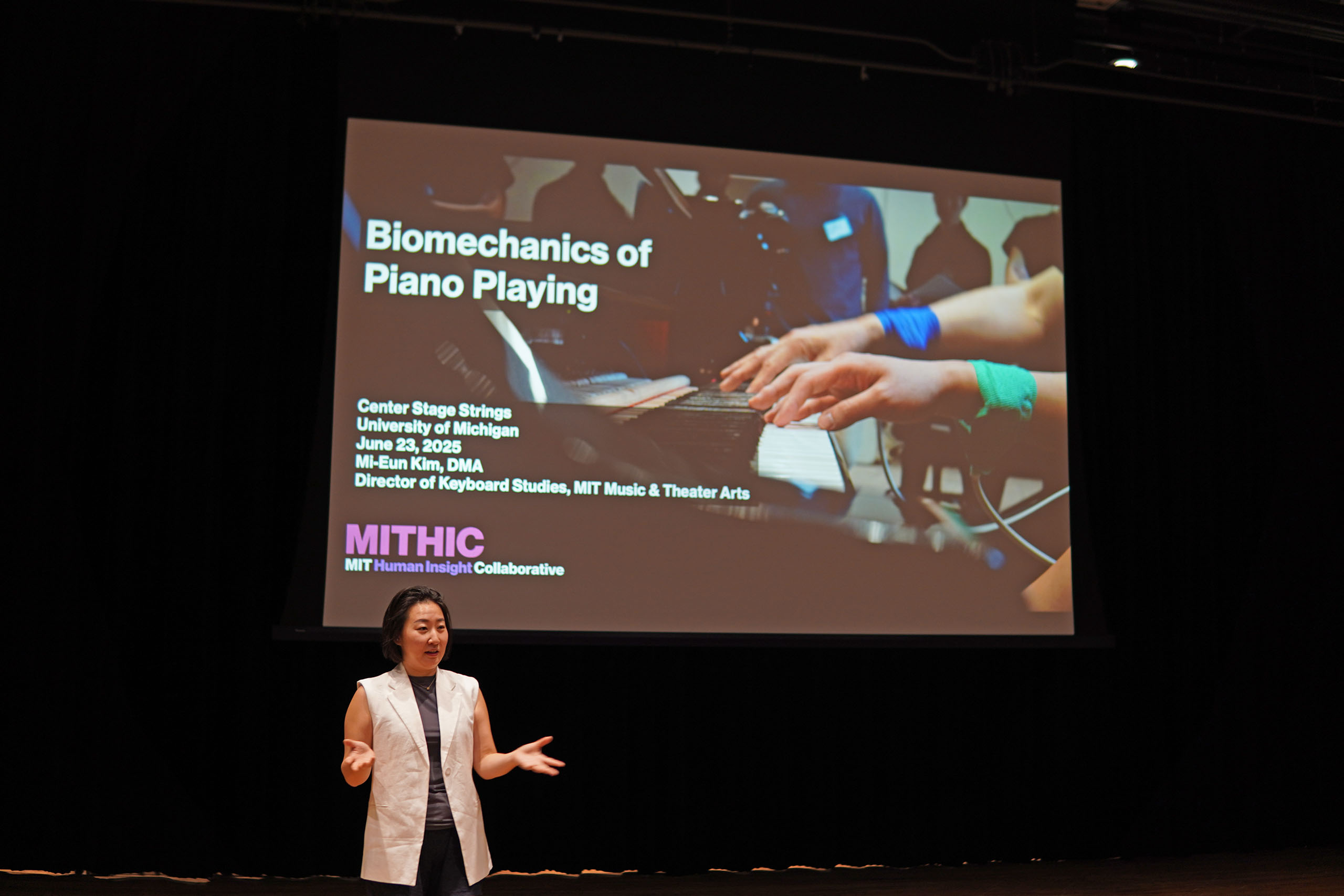
Mi-Eun Kim speaking at SMTD, June 2025
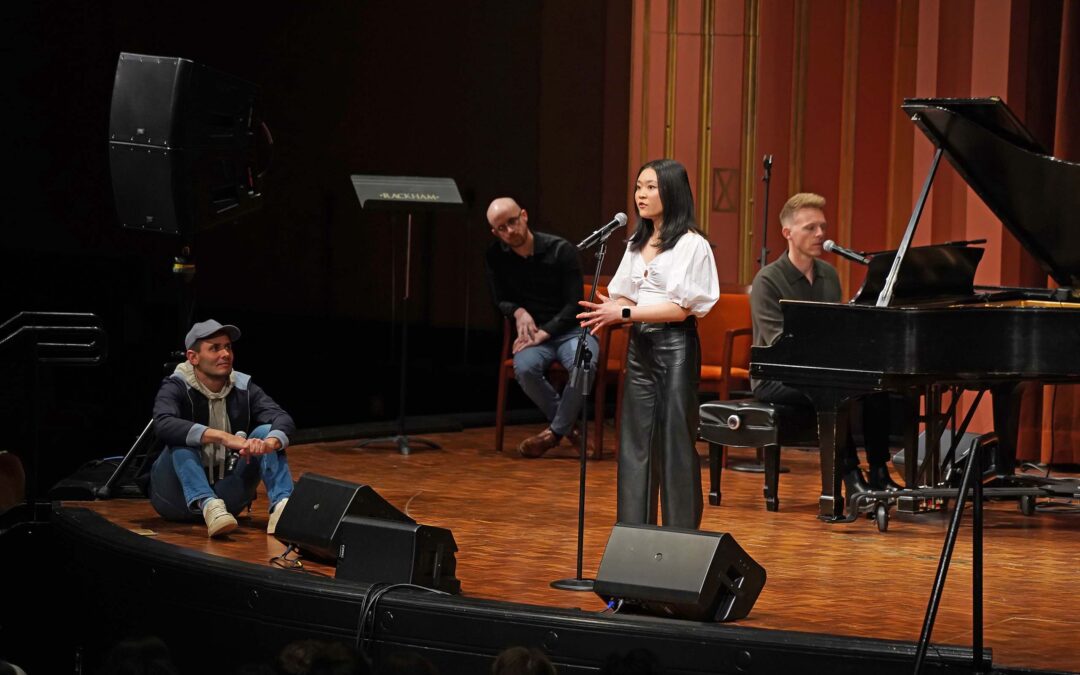
In April 2025, Benj Pasek and Justin Paul – the extraordinarily accomplished songwriting and producing duo who graduated from SMTD in 2006 and attained EGOT status (having won Emmy, Grammy, Oscar, and Tony awards) in 2024 – came to campus. The SMTD Alumni Board presented Pasek and Paul with their Hall of Fame award, and the duo held a Q&A session with musical theatre faculty and students and attended a reception in their honor. They also taught a master class at Rackham Auditorium as part of the Sally Fleming Master Class Series, offering feedback and sharing insights on several students’ performances of Pasek and Paul songs – an opportunity department chair Cynthia Kortman Westphal described as “truly rare.” She explained: “There’s no amount of coaching from anyone, from a teacher, from a mentor, that compares with the chance to work with the writer on material that person wrote. It is a gift.”
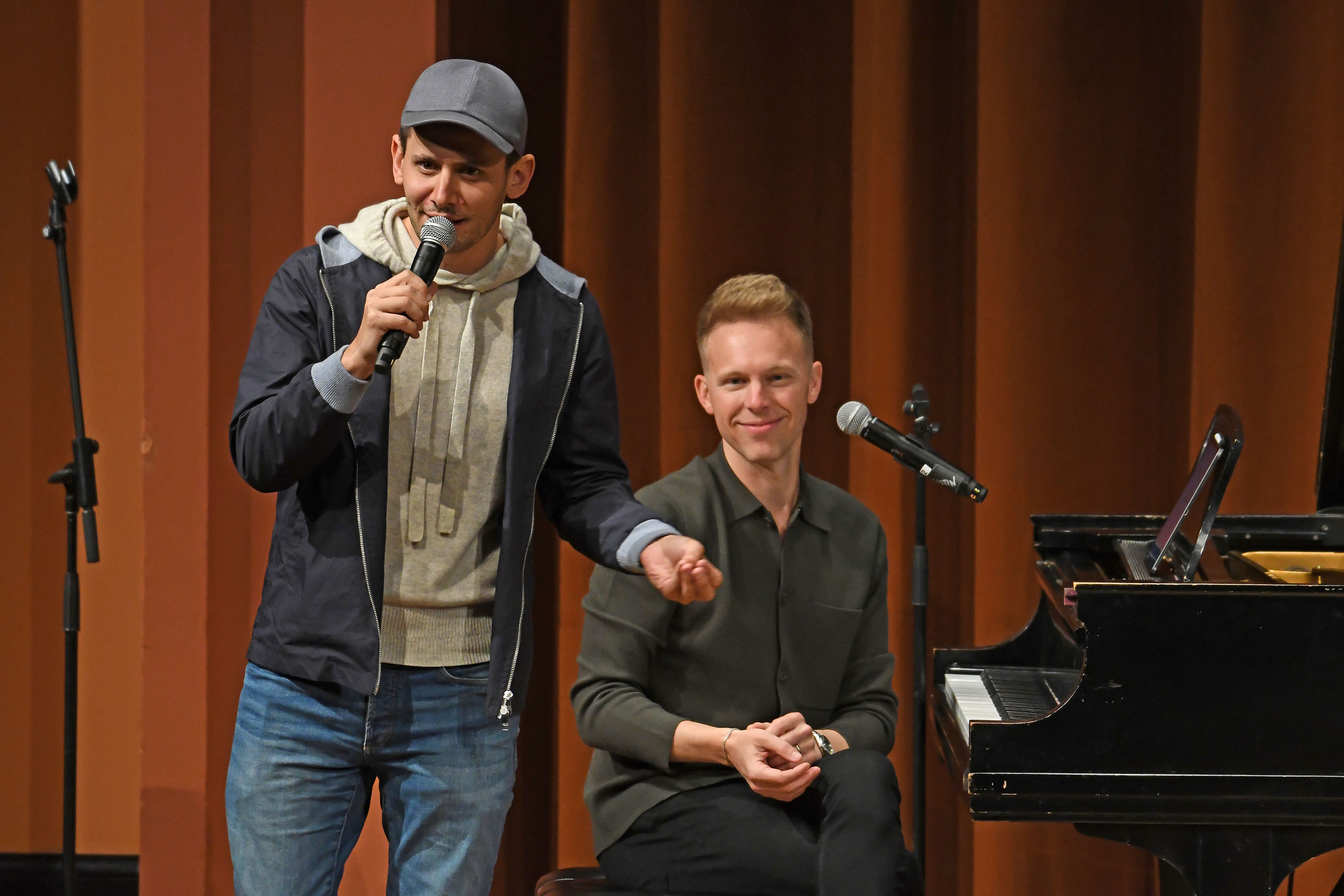
Benj Pasek (left) and Justin Paul teaching a master class at Rackham Auditorium, April 2025. Photo: Peter Smith
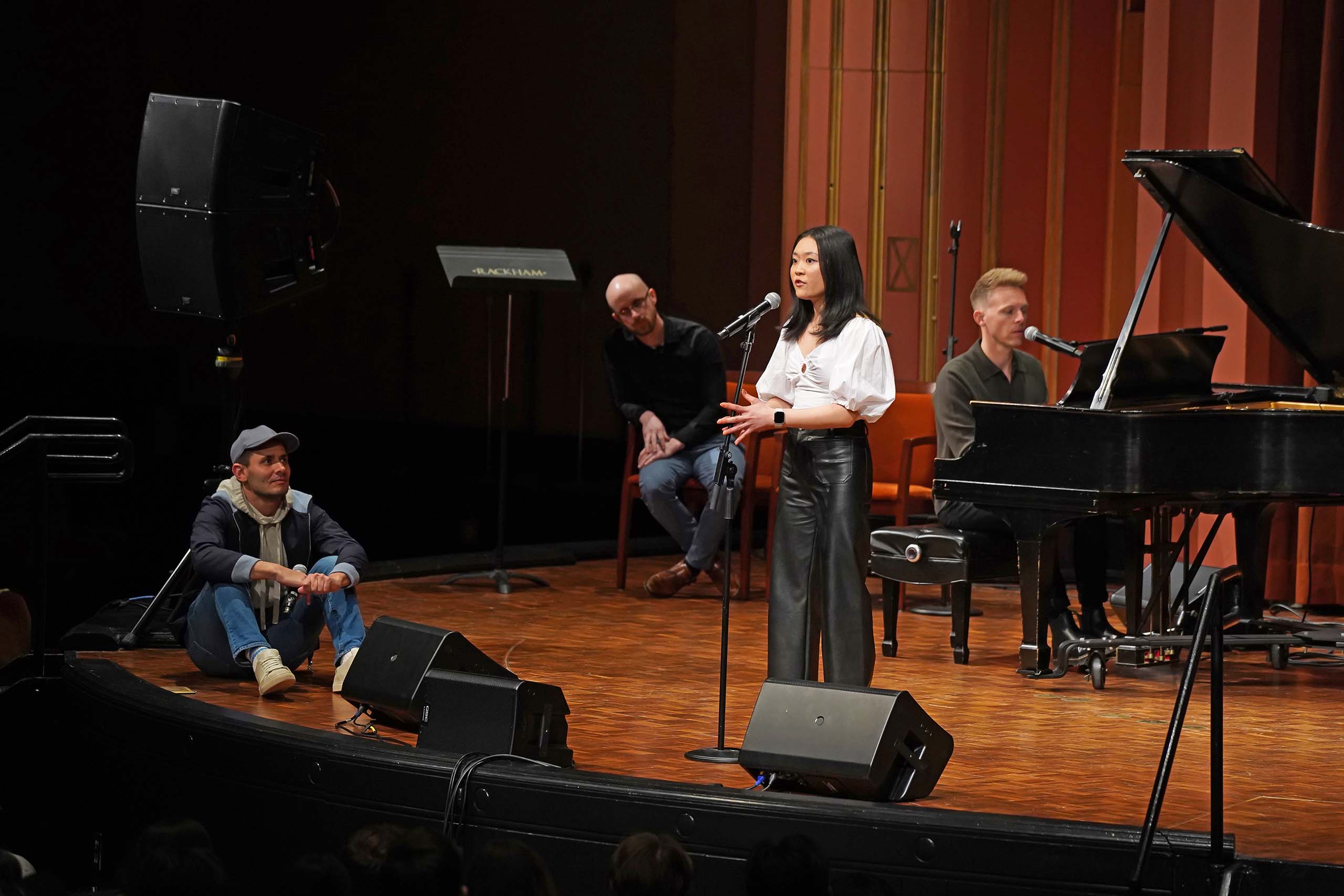
Alyssa Sunew (BFA ’25, musical theatre) performs for Pasek and Paul during their master class, April 2025. Photo: Peter Smith
Envisioning Themselves as Artists
In addition to the academic benefits from alumni visits, faculty describe the value of these encounters in helping students see themselves as artists and envision the path they might take after graduating. “Alumni visits offer our students the opportunity to interact with folks who have been in their shoes as students,” noted Jillian Hopper, interim chair of the Department of Dance, “and who are now successful artists, carving a life for themselves in a world that, as an artist, can feel daunting. These alumni make careers for themselves in all sorts of ways.”
One such alumna is Briana Ashley Stuart. Based in Brussels, Belgium, she has forged a multifaceted career: she performs and choreographs, she conducts workshops and teaches, she is a public speaker and dance entrepreneur. In March 2025, Stuart, who graduated from U-M in 2013 with degrees in dance and sociology, came to Ann Arbor for a two-week residency supported by a Visiting Artist Grant from the U-M Arts Initiative. During her residency, she hosted a symposium exploring arts and entrepreneurship, conducted a Q&A session with students, and formally received her recent award from the SMTD Alumni Board. She also conducted classes on stepping, a high-energy African American percussive dance, and on her research combining body percussion with contemporary dance movement. She visited schools in the area, including Cass Technical High School, her alma mater. “I wanted to come back to campus to be the alum I wish I could have met when I was at Michigan,” she stated, “someone in the field that I could look up to who had the same dance training and experiences at U-M and who could answer the many questions I had about the career possibilities in dance in the US and abroad.”
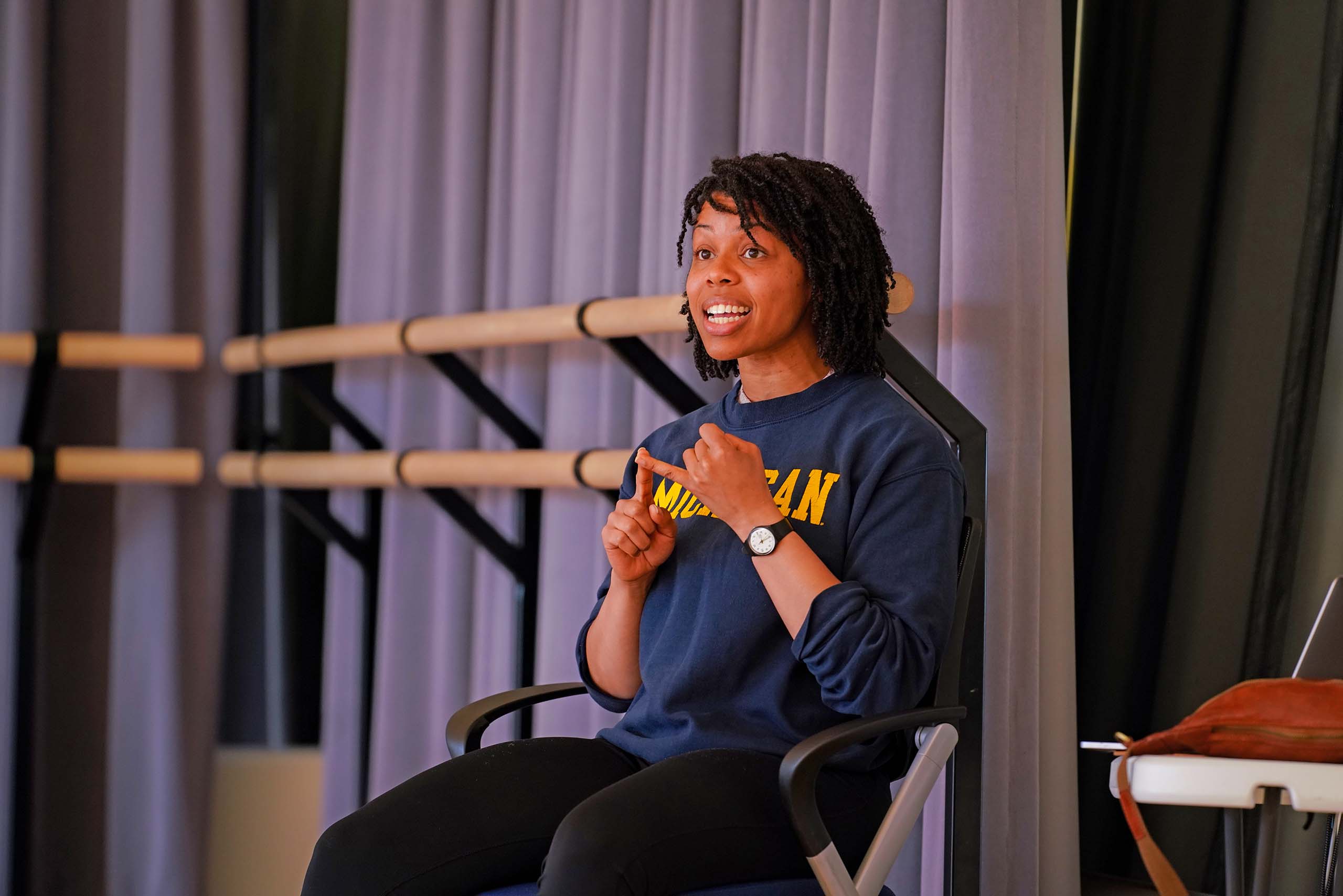
Briana Ashley Stuart speaking to SMTD dance students, March 2025. Photo: Chris Boyes
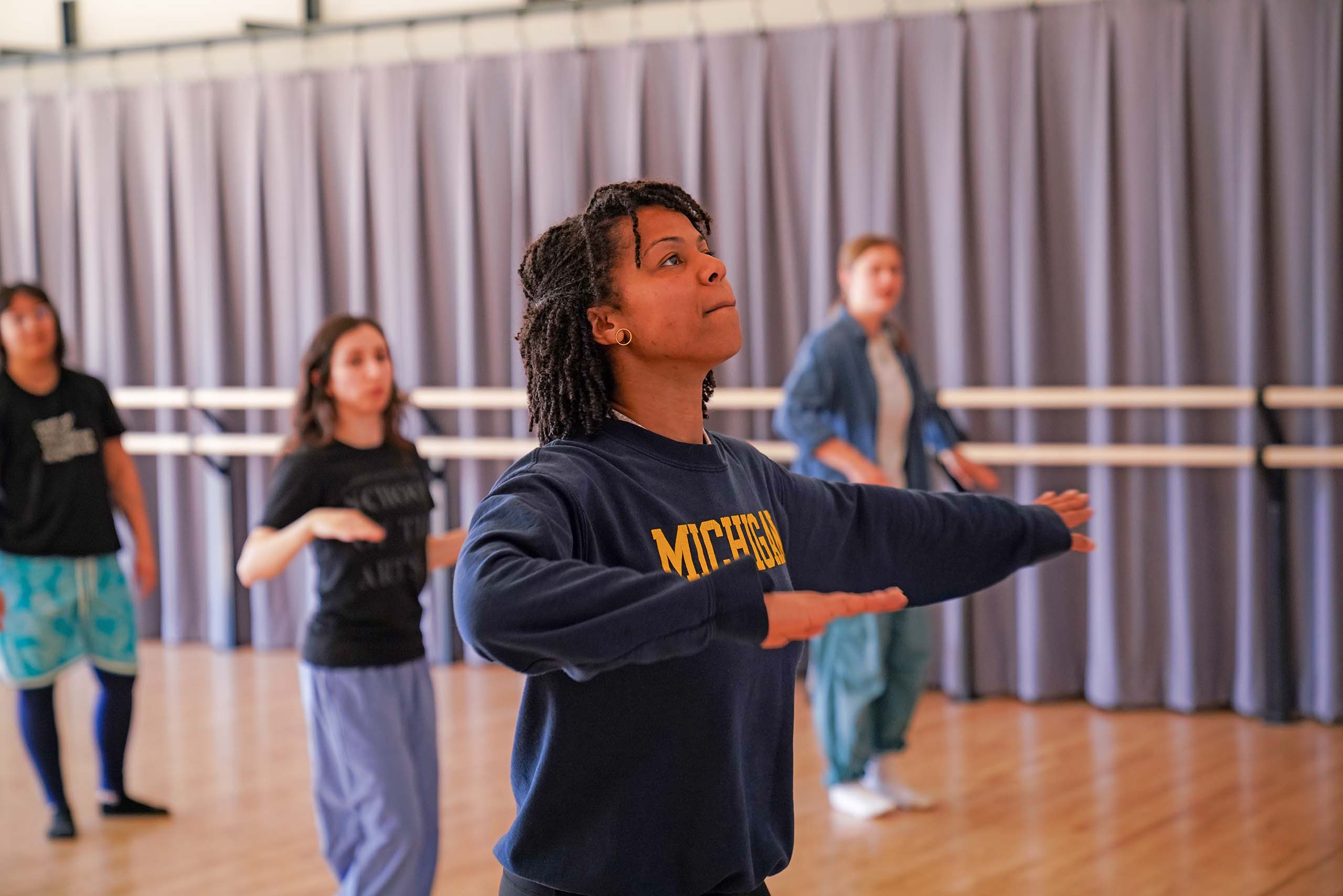
Briana Ashley Stuart teaching a class at SMTD, March 2025. Photo: Chris Boyes
Sometimes the important message alumni convey to students is to be open to unexpected twists and turns as they begin establishing their careers. The Pasek and Paul origin story includes one such pivot that resonates powerfully with students. During their sophomore year at SMTD, the two aspiring performers were disappointed that they weren’t cast in major roles in that year’s musicals. They then realized that what they really wanted to do was write music, so they created their own work, the song cycle Edges. “They wanted to create, and they just went for it,” Westphal said. “For students to hear that in this business you’ll often not get what you’re hoping for, so make your own opportunities – that is always an inspiring message.”
Alumni visits often convey a sense of validation for students, affirming that their training at SMTD will pay off after they graduate. Visiting grads frequently reference the training they received at SMTD as a cornerstone of their achievements, and Westphal noted the impact it has on students to hear that. “When someone comes back, having worked for 10 or 15 years, and says, ‘I know exactly what you learned in your sophomore performance class, and it’s the thing I fall back on more than anything,’ it helps the students see that it wasn’t just a magic trick that that person became successful,” she said. “They actually are using the training and the foundation they got here.”
Hopper expressed a similar idea, indicating that alumni help students draw a direct line between their education and their lives post-graduation: “Understanding the diversity of approach from alumni speaking about their own experience – and the fact that current students are learning the skills to be successful here and now – is an important part of the learning process. It grounds the student experience in real-life examples of success.” She described the experience of seeing the impact when alumni visit, noting that such visits can really change the way students think about themselves: “Once they begin to understand that it is possible to be a successful working artist, it opens up their minds to possibilities they had never considered before. Oftentimes it can push our students out of their comfort zones and into new ways of thinking, participating, and making art.”
While alumni at all levels can help students visualize their careers and affirm the value of their degree, there is perhaps additional relatability with alumni who have graduated more recently, those who Tiffany Trent, chair of the Department of Theatre & Drama, described as “aspirational peers.” These alumni, Trent said, “may not have it all figured out, but they are doing well, and that makes students feel like they can do it.” Speaking of the range of artists piano students might be exposed to, Harding noted, “It’s one thing to go to the concert of Murray Perahia [considered one of the greatest living pianists], but it’s also good to see people at the very next step, or maybe two steps ahead, so you can see that you yourself can get there.”
Making Connections
Students gain valuable knowledge from alumni visits, but they also gain advantages from being known to those alumni. Visits from alumni often enable students to introduce themselves to, interact with, and even perform for them, making connections that will serve them well down the road. Just realizing that there will be a network of fellow Wolverines to reach out to after they graduate gives students a sense of confidence. Trent pointed out the value of “knowing there are meetups in this city that you’re going to move to, the assurance that you will be able to pick up the phone and get through to somebody, that it’s okay to go to their show and see them afterwards.”
The broad range of fields represented by the alumni who return to campus – musicians, composers, conductors, actors on stage and screen, writers, casting directors, agents, managers, directors, choreographers – means that students can gradually weave together a strong, varied network of connections. And this network has the potential for exponential growth through what Westphal calls “cross-referencing” – each alum a student connects with can then connect that student with others in their networks. Harding pointed out that while making connections is not the only thing that matters, “it helps an awful lot, just to open the door. Once the door is open for you, you have to walk through it, and you have to show that you’ve got the goods. But people who know you will say, ‘Yes, I know that person from Michigan, and it would be really good to see what they’ve got.’”
The benefits of alumni visits go both ways, helping the alumni as well as current students. Harding noted that, particularly for alumni who are on faculty at other institutions, visiting their alma mater is an important facet of building their careers. “They need to be establishing themselves in the world,” he said, “so that their schools see that they’re active, that they are continuing to make connections. Coming back and performing at Michigan is very useful for their research and their study, their performance, their new ideas.” Reflecting on her residency at U-M in March, Stuart stated, “I find that every time I teach or engage with younger artists, I learn just as much from them as they do from me. I’m also able to continue deepening my artistic practice and building my research as well as broadening the pedagogical tools to transmit my research and practice.”
Finding Inspiration
One of the most powerful benefits of alumni visits could be summed up as inspiration, a quality that is hard to predict but is unmistakable when it strikes. During the fall 2024 semester, the Department of Theatre & Drama welcomed a group of four accomplished alumni who are notable not just for what they’ve achieved but for their longstanding friendship with each other. Patrick Chu (head of film and TV at Annapurna Pictures), Sas Goldberg (writer and producer on Only Murders in the Building), Shayna Markowitz (BAFTA Award-winning casting director of Joker, Maestro), and James Wolk (film and TV actor, star of Watchmen and Ordinary Joe), all of whom graduated in 2007, spent quality time with students during their visit. They met with graduating acting majors for dinner. Goldberg and Chu conducted a workshop on pitching, writing, and producing for television and film. Markowitz and Wolk taught a master class on audition technique, coaching some of the seniors on self-taped performances and Zoom auditions. They participated in a panel discussion, a Q&A session, and a quiz show exploring departmental lore and the personal histories of the contestants.
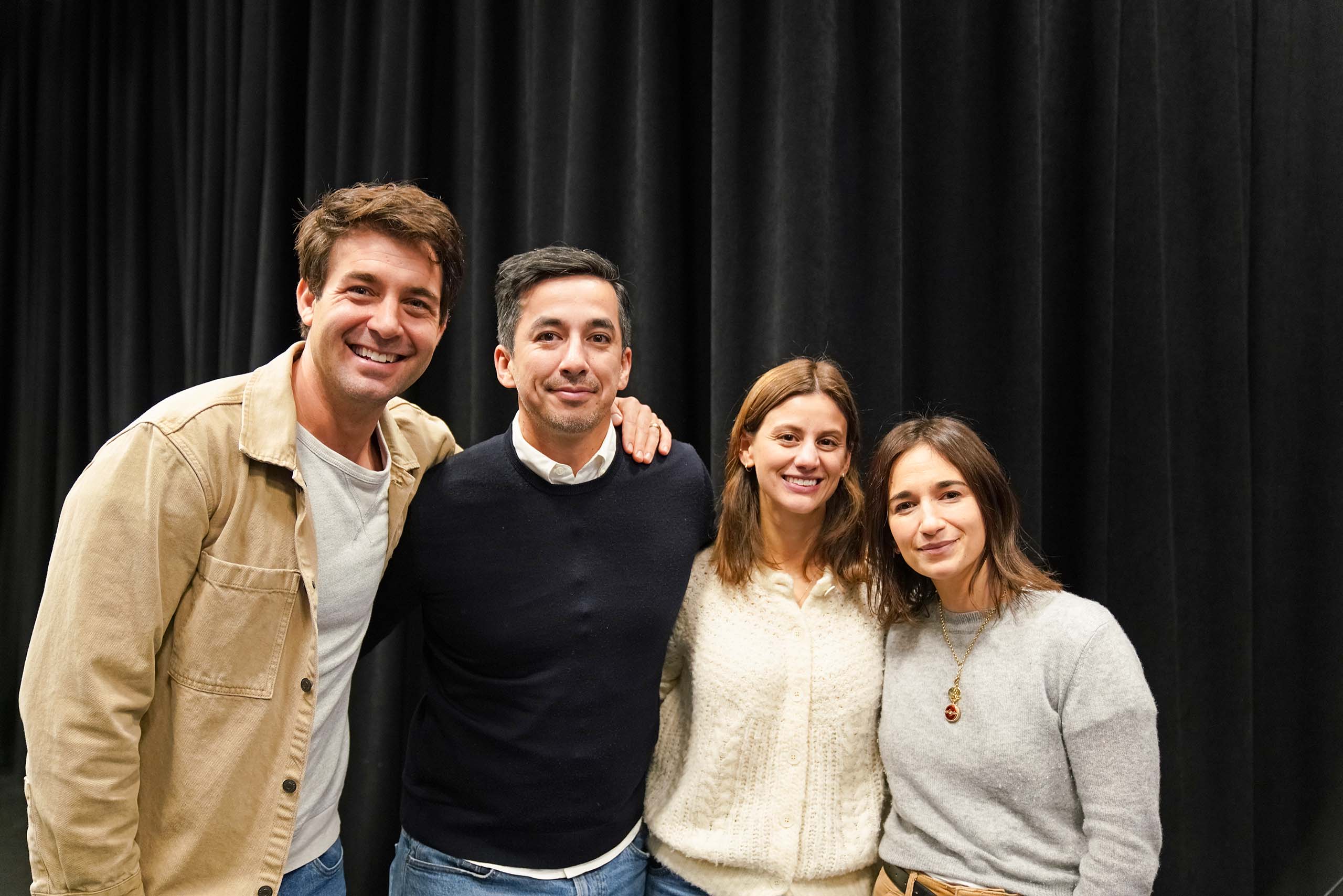
James Wolk (left), Patrick Chu, Shayna Markowitz, and Sas Goldberg during a November 2024 visit to SMTD. Photo: Chris Boyes
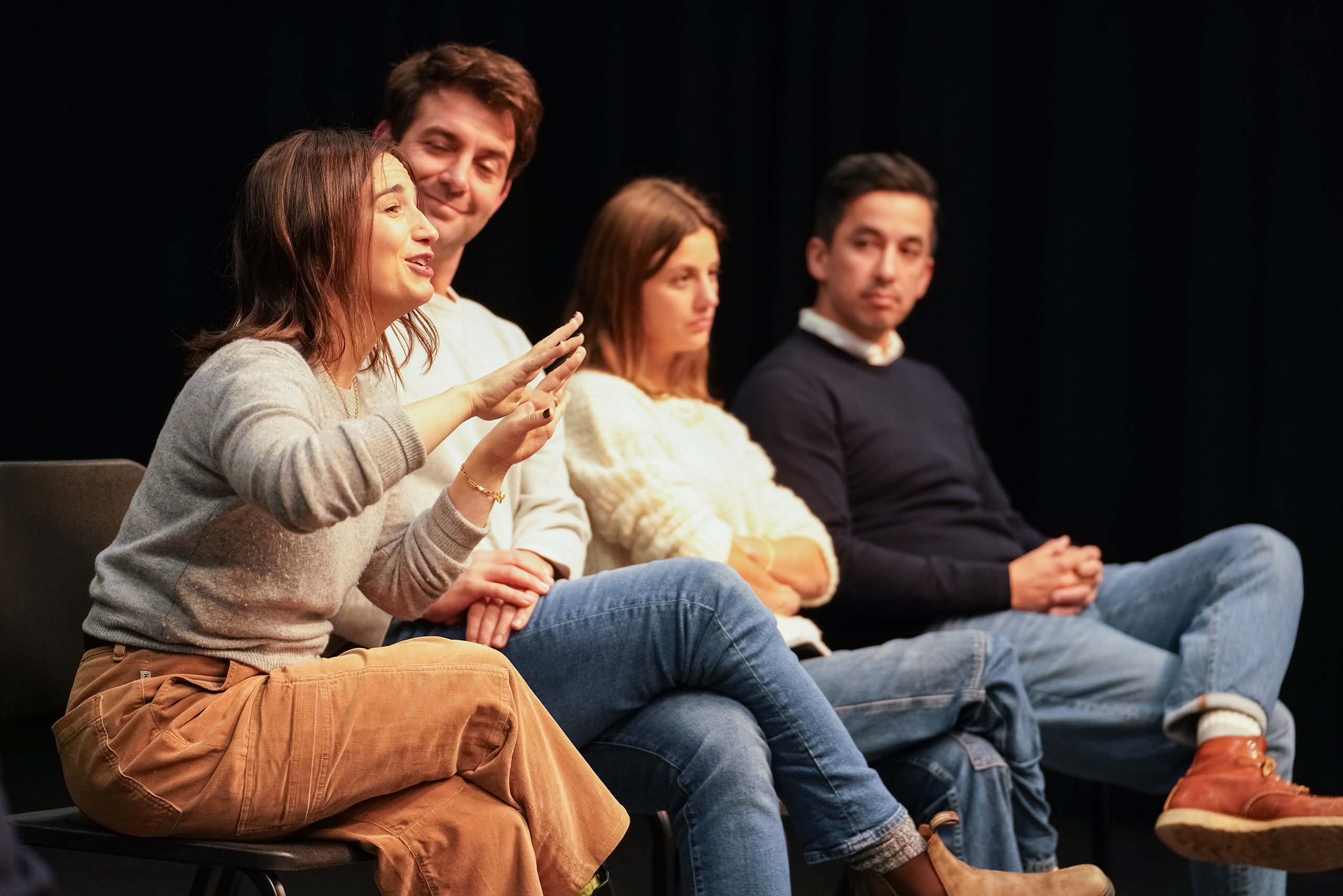
Sas Goldberg (left), James Wolk, Shayna Markowitz, and Patrick Chu speak to SMTD students during a November 2024 visit. Photo: Chris Boyes
Geoff Packard, associate professor of theatre & drama, coordinated the visit and described its significant impact on students: “In my six years at SMTD, I can’t recall a more invigorating visit from alumni than the one we had with Sas, James, Pat, and Shayna. They were brilliant speakers, hilarious storytellers, and an absolute joy for our students to engage with. Students learned about four very different – but equally inspiring – paths through the performance industry. They also witnessed something even more powerful: the deep admiration, love, and support these friends have maintained through every stage of their journeys. May all our alumni visits be as fun, meaningful, and inspiring as this one.”
Packard noted that, since their visit last fall, these four alumni “have already reached out to many of our graduating students with mentorship and encouragement that will become the foundation for a future generation of giving back.” While the generosity of alumni offering such support to students is, in some ways, extraordinary, Packard observed that it is not at all unusual when it comes to the SMTD alumni network: “What Michigan does better than any place I’ve seen is cultivate authentic, generous relationships among its alumni.”