

Michigan Muse Fall 2025 > The Beat Goes On: Talent, Friendship, and Dedication Help SMTD Music Ensembles Carve Out Professional Careers
The Beat Goes On: Talent, Friendship, and Dedication Help SMTD Music Ensembles Carve Out Professional Careers
By Claudia Capos
Trailblazers: Akropolis Reed Quintet
When five undergraduate musicians at the School of Music, Theatre & Dance got together in fall 2008 to form the school’s first-ever reed quintet, they had no long-term plans for their unusual ensemble – or even a name.
A random Google search turned up the word “Akropolis,” and the name stuck. “We built our ensemble around friendship and a desire to try something new and different,” recalled Kari Landry (BM ’11, MM ’13, clarinet). “The reed quintet was a complete unknown at the time, and it sounded like fun.”
No one could have predicted where the future would take them. “Never in our wildest dreams did we imagine the Akropolis Reed Quintet would become our full-time careers, a Grammy Award-winning ensemble, and a half-million-dollar nonprofit organization,” Landry remarked.
On February 2, 2025, Landry and the four other quintet members – Tim Gocklin (BM ’12, oboe), Matt Landry (BM ’10, music education), Andrew Koeppe (attended ’12, clarinet), and Ryan Reynolds (BM ’12, MM ’14, bassoon) – walked down the red carpet at the Peacock Theater in Los Angeles during the 67th Grammy Awards premiere ceremony. With them were composer Pascal Le Boeuf and drummer Christian Euman, who collaborated on their 2024 album, Are We Dreaming the Same Dream?
Up on stage, the quintet and their two collaborators received their first-ever Grammy, winning Best Instrumental Composition for the track “Strands” on their album. The award ceremony was a storybook ending to the ensemble’s 16th performance season. “It was rewarding to see all this hard work come to fruition on a national scale,” Landry said. “It was a once-in-a-lifetime experience.”

The Akropolis Quintet celebrates their Grammy win, February 2025. Pictured are percussionist Christian Euman (left), Ryan Reynolds, Kari Landry, Andrew Koeppe, Matt Landry, Tim Gocklin, and composer Pascal Le Boeuf. Kari wore a gold dress in a nod to the quintet’s color scheme during their student days. Photo by Getty Images, courtesy of Kari Landry
Tracing Their Roots to Michigan
Like other SMTD student ensembles that have carved out professional careers in the music world, the Akropolis Reed Quintet traces the roots of its success back to its formative years at the University of Michigan. “We all feel deeply connected to Michigan and Ann Arbor,” Landry said. “The institution and its faculty celebrate the success of current and former students. Friendship and camaraderie are built into SMTD’s ecosystem, which is very open and collaborative and encourages you to pursue your own ideas. That is what makes it special.”
SMTD served as a performing-arts incubator for Akropolis throughout its members’ collegiate careers. Inspired by Amsterdam’s Calefax Reed Quintet, Akropolis started to create its own music and commissioned SMTD student composers to write original music arrangements for the new instrumentation. The Duderstadt Center’s audio studios, manned by student recording engineers and overseen by faculty advisers, provided state-of-the-art recording facilities for producing the ensemble’s first album, High Speed Reed, in 2011. “Recording our own album was an ambitious project, but it opened up the possibility of becoming recording artists and disseminating this amazing music,” Landry remarked.
Former SMTD director of bands Michael Haithcock offered Akropolis support and advice on improving its rehearsals and new music programming. Bassoon professor Jeffrey Lyman coached the quintet extensively and helped it polish its performance for chamber music competitions. In 2014, Akropolis became the first reed quintet to win the prestigious Fischoff Gold Medal. The future looked bright and full of promise for members of the Akropolis Reed Quintet as they prepared to graduate from U-M and leave SMTD’s creative cocoon. “We had touchpoints in people who were inspiring and encouraging, but when it came down to figuring out the nuts and bolts of a professional performance career, we were on our own,” Landry said.
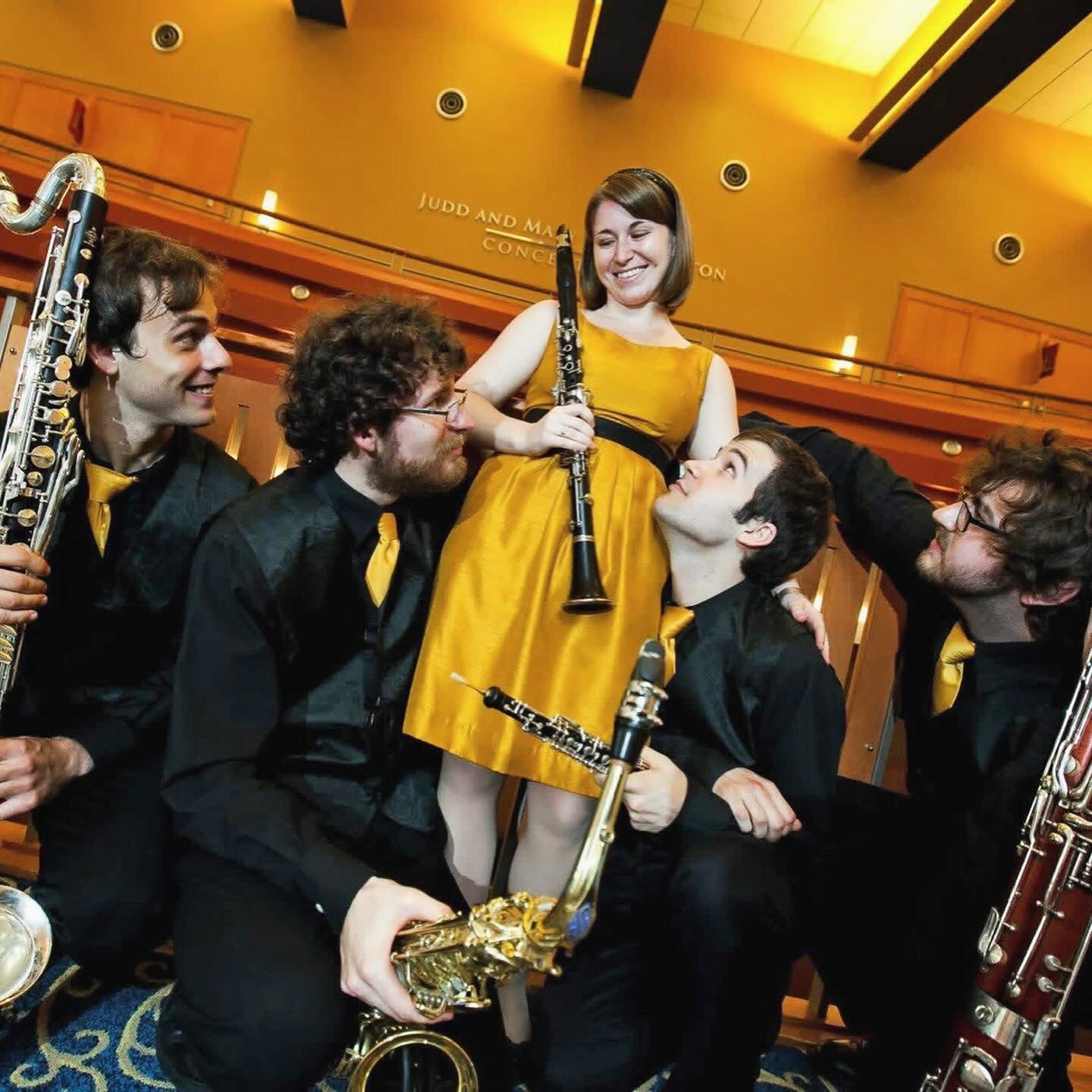
The Akropolis Quintet in 2012 after winning the silver medal in the Fischoff Competition. Two years later, they won the Fischoff gold medal.
Learning Brick by Brick
Several key strategies kept Akropolis together as a performance group, even after several members left Ann Arbor to pursue graduate degrees and full-time jobs elsewhere. “We loved playing together so much that we created a culture to support each other and what we wanted to do as individual artists in the field,” Landry explained. “We used Akropolis as an amazing vehicle to achieve our individual goals, as well as the group’s goals, and that has kept us coming back together over the years.”
The ensemble’s shared aspiration to establish the reed quintet as a known instrumentation within classical chamber music, and to stand out in the field, also propelled Akropolis forward. However, building a sustainable entrepreneurial organization proved challenging. “We had to figure out how to run a business and grow a performing arts group,” Landry recalled. “How do you land new gigs, get your name known, and build credibility? We learned along the way, brick by brick.”
After Landry completed a master’s degree in arts administration, she and her husband, Matt Landry (whom she married in 2016), took on business management and marketing responsibilities in addition to their artistic roles. “I wear many hats at once,” she said. Against seemingly insurmountable odds, Akropolis survived and thrived.
To date, the ensemble has won seven national chamber music prizes, recorded six albums, and toured internationally. It presents 120 concerts and educational events worldwide each year and has commissioned 200 works for reed quintet. Three of its albums have made it to the Billboard classical albums charts. “We have a lot of firsts,” Landry said. “We were the first reed quintet to be nominated for a Grammy and the first to appear on the UMS Chamber Music Series in 2024.”
Akropolis transitioned from an LLC to a nonprofit organization in 2015 to ensure its longevity and to boost its impact in the music world. Recently, the group hired Deanna Sirkot (BM ’13, clarinet) as development and operations manager. “Highs and lows are inevitable for any performing arts group,” Landry said. “Our biggest secret is that we have not let anything stop us over the last 16 years. Instead, we have used obstacles as a way to grow, get better, and keep going.”
Inspired by a Shared Mission: Ivalas Quartet
The two founders of the Ivalas Quartet – Reuben Kebede (MM ’18, violin) and Pedro Sanchez (MM ’18, cello) – encountered one another in a rather unexpected place: a soccer field. “I met Reuben playing soccer on North Campus during U-M student orientation,” Sanchez recalled. “It’s hard to imagine that a soccer game would lead to meeting your future colleague and forming a string quartet together.”
During the summer 2017 Center Stage Strings – part of SMTD’s MPulse Institutes – Danielle Belen, professor of violin, put Kebede and Sanchez together with Anita Dumar (BM ’18, violin) and Caleb Georges (MM ’19, viola, chamber music) to create what became the Ivalas Quartet. The group gained experience and exposure that summer by performing alongside the internationally known Calidore Quartet. “We all got to live and learn together in this small part of the world that is North Campus in Ann Arbor,” Sanchez observed. “Sharing time and experiences during our student days helped us build future connections. It is very important to create this sense of community as you go through your studies at the university.”
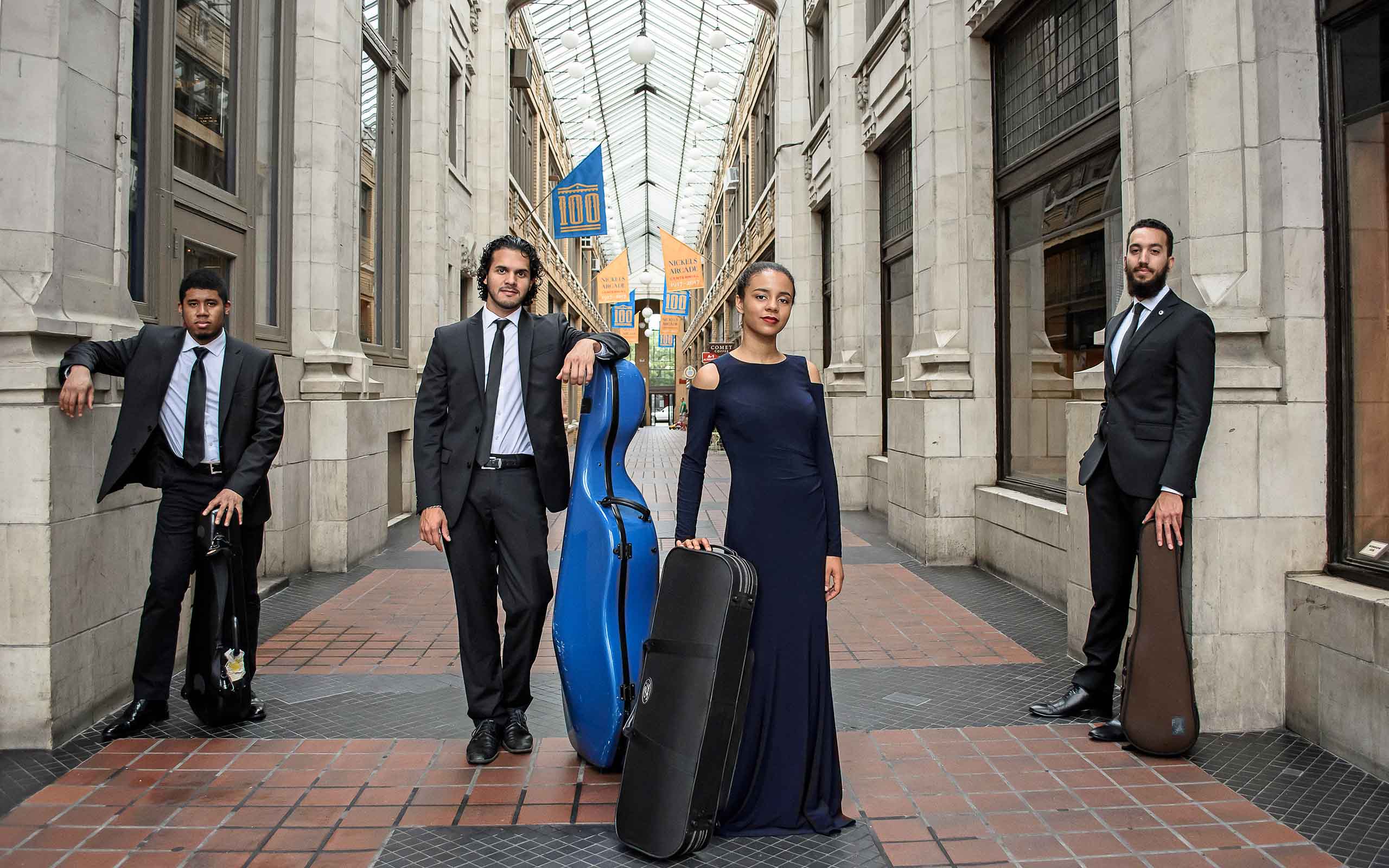
The original members of the Ivalas Quartet – Caleb Georges (left), Pedro Sanchez, Anita Dumar, and Reuben Kebede – at the Nickels Arcade In Ann Arbor. Photo: Natali Herrera-Pacheco
From the beginning, members of the Ivalas Quartet were inspired by their shared mission. “We noticed in the classical music world that there were not a lot of quartets whose members looked like us,” explained Sanchez, who immigrated to the US from his native Venezuela. “We wanted to create a group, a presence, that could bring new voices to the forefront and highlight the works of BIPOC composers.” (BIPOC is an acronym for Black, Indigenous, and People of Color.)
Gradually, the Ivalas Quartet gained traction, winning the Briggs Chamber Music Competition and the WDAV Young Chamber Musicians Competition. After leaving SMTD, the ensemble landed two prestigious residencies that broadened their performance and teaching experiences. The group also added two new members following the departure of Dumar and Georges.
Violinist Tiani Butts (MM ’21, violin, chamber music) joined the Ivalas Quartet during its 2019 residency at the University of Colorado-Boulder, where the ensemble was mentored by the Takacs Quartet. Violist Marcus Stevenson, who holds degrees from the Cleveland Institute of Music and the Juilliard School, became a member in 2024 during the ensemble’s residency at Juilliard, where the musicians studied with the Juilliard String Quartet. “These two residencies convinced us that we had a shot at pursuing a string quartet career and provided a great incentive to stay together,” Sanchez said. “We firmly believe our mission is very important and that we provide a good service to our community.”

The Ivalas Quartet: Reuben Kebede (left), Marcus Stevenson, Tiani Butts, and Pedro Sanchez. Photo: Titilayo Ayangade
The Ivalas Quartet’s repertoire combines the standard canon of works for string quartets with pieces by well-established BIPOC composers, such as George Walker, Eleanor Alberga, and Jessie Montgomery, as well as lesser-known emerging composers. The ensemble has collaborated with several SMTD composition alumni, including Gabriela Lena Frank (DMA ’01) and Carlos Simon (DMA ’17). In 2021, Ivalas created the first recording of Simon’s Warmth from Other Suns for string quartet and, three years later, premiered Derrick Skye’s Deliverance through a 2024 commission from Caramoor.
When the ensemble is not rehearsing or performing, its members are tackling the entrepreneurial tasks associated with a professional performing arts organization. “You have to be an audio engineer, a web designer, a marketing manager, a social media promoter, and a grant writer,” Sanchez said. “It is definitely challenging, but mostly fun.”
And All That Jazz: Kenji Lee’s Fortune Teller Trio
SMTD’s Department of Jazz & Contemporary Improvisation created the perfect milieu for Kenji Lee (BFA ’19, jazz studies; BM ’19, music education) to hone his performance skills on saxophone and bass, learn the ropes from seasoned jazz masters, and break into the Southeast Michigan jazz scene as a freelance musician and private teacher.
His SMTD connections also led to the formation five years ago of his Fortune Teller Trio, which has made a name for itself in the Detroit area and beyond. “I don’t have a day job,” Lee quipped. “For me, it’s all music, all the time. This is my groove.”
He credits the jazz department’s diverse “transidiomatic” approach for giving him a well-rounded background spanning the historical continuum of jazz music. “The department includes professors who specialize in 1950s and ’60s hard bop, Jelly Roll Morton and the 78 RPM era, and avant-garde jazz,” Lee noted. “Every student who becomes a professional musician carries this ‘of many into one’ ideology with them.”

Fortune Teller Trio perform at the 2023 Detroit Jazz Festival. Pictured from left are guest vocalist Estar Cohen, Kenji Lee, Andrew Peck, and Jonathan Barahal Taylor.
Another advantage of SMTD’s jazz department is that some faculty are also professional musicians who perform regularly in jazz clubs and on concert stages. “I got to see what the highest level of professionalism looks like from professors who are Grammy Award-winning artists,” Lee said. “They have climbed to the top of their field and can give students advice on how to get plugged into the jazz scene and build a career.”
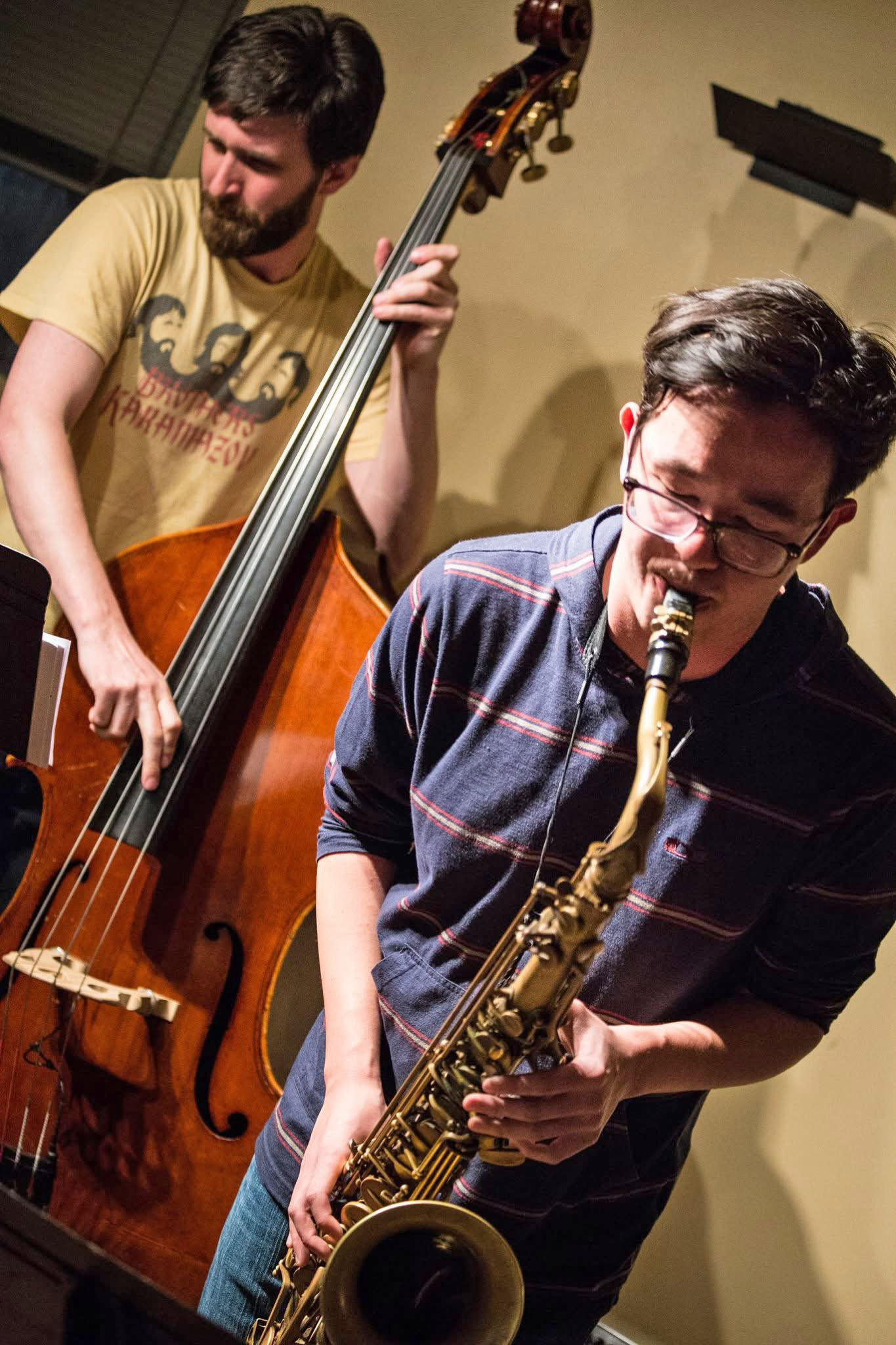
Andrew Peck (left) and Kenji Lee at Canterbury House in Ann Arbor as students, 2016
Jazz professor Andrew Bishop helped Lee land a post-graduation gig with jazz pianist and composer Wayne Horvitz in Seattle. “This was one of my first opportunities to work with a bonafide master of music,” Lee recalled. “The experience was really formative in my career.”
During his student days at SMTD, Lee crossed paths with bassist Andrew Peck (MM ’16) and percussionist Jonathan Barahal Taylor (BFA ’13, MM ’24). In late 2021, the three came together to form the Fortune Teller Trio. “It was a perfect fit, and everything clicked,” said Lee, who chose the name Fortune Teller to reflect a surreal, prescient dream where he performed with Peck and Taylor. He describes the trio’s sound as “transidiomatic expression,” combining a variety of music idioms ranging from traditional folkloric tunes to Indian classical music to John Coltrane-style bebop – sometimes all in the same piece.
The ensemble released its debut album, Kyudo, in December 2022, appeared at the Detroit Jazz Festival in 2023, and toured Michigan’s Upper Peninsula in 2024. The three musicians plan to go to Japan during fall 2025.
Preparing the Next Generation of Musicians
An important aspect of professional life for all three ensembles is their commitment to inspiring, teaching, and preparing next-generation musicians for rewarding careers. Landry, of the Akropolis Reed Quintet, is a lecturer at SMTD, where she teaches courses on entrepreneurship in the EXCEL Lab program and performs with the quintet on stage. The ensemble runs Together We Sound, a Detroit-based summer festival, and holds annual music composition residencies at three Detroit-area high schools, where it premieres and records works by young composers.
The quintet also produces the Akropolis Chamber Music Institute, a 10-day artist training and mentorship program in Petoskey, Michigan. “We got started as an educational ensemble, and teaching is a tremendous part of who we are,” Landry said.
Growing up in Caracas, Venezuela, the Ivalas Quartet’s Sanchez saw the power of music to enrich the social fabric of communities and impart values and hope to children who are struggling to find a foothold in life. “Our quartet travels around the country to do school presentations and to teach master classes and studios at colleges,” Sanchez explained. “A surprising number of kids are Spanish speakers. When they see me on stage, it puts the possibility of a music career in their mind.”
Lee, who teaches private lessons, stresses the need for musicians to continue the learning process beyond the classroom. “When you keep that momentum of being a student in your professional career, it will pay dividends,” he said.