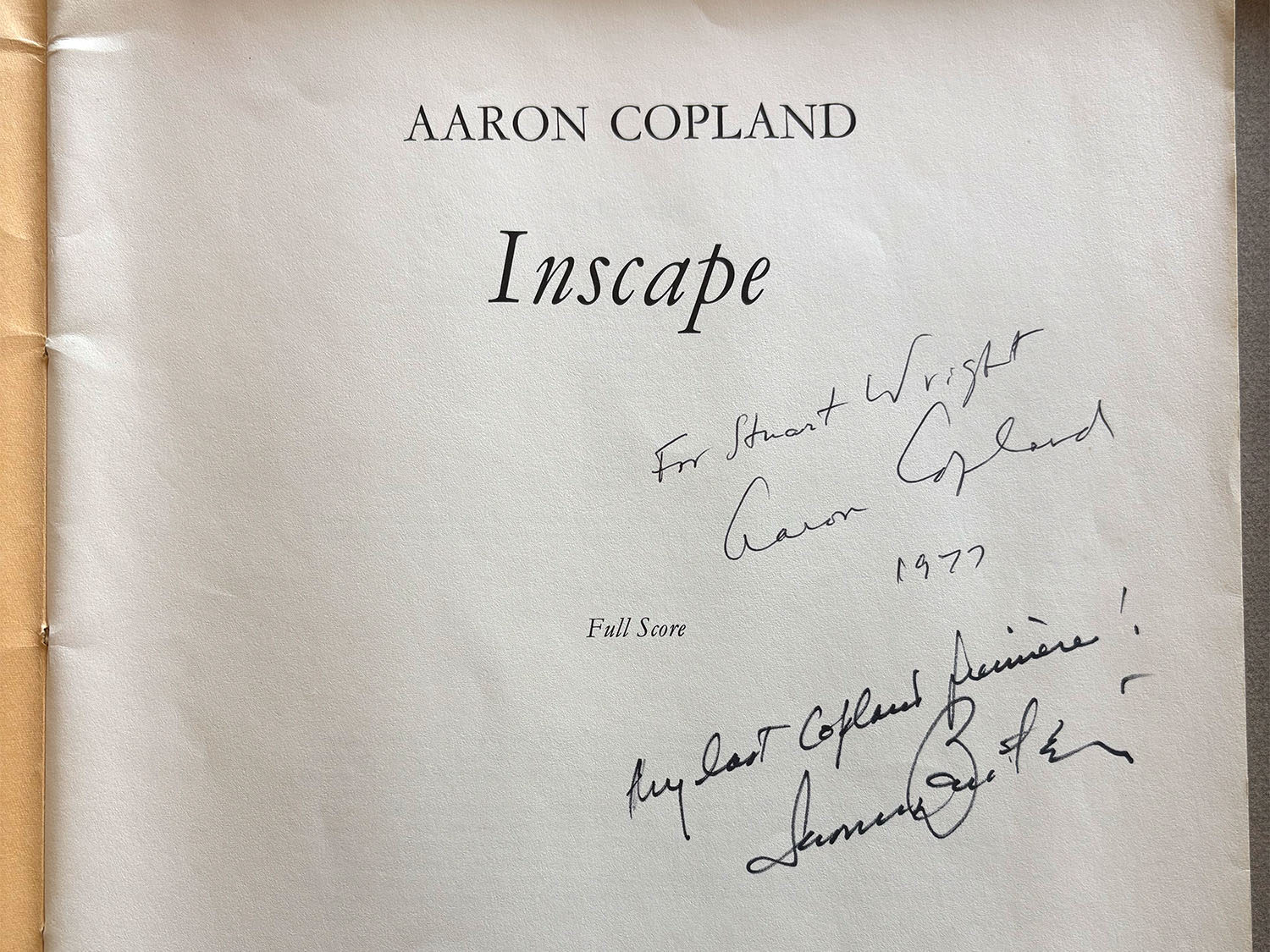
The U-M Music Library has recently acquired a first edition full score of Aaron Copland’s Inscape.
While the library already holds the Inscape score in our circulating collection, this particular copy of the score is rather special. The title page features an autographed inscription to noted collector and author Stuart Wright signed in full by Copland and dated 1977. Beneath that is an additional inscription by highly distinguished composer and conductor Leonard Bernstein: “My last Copland première! Leonard Bernstein.”

The title page of the Music Library’s newly acquired score of Inscape, featuring inscriptions by Aaron Copland and Leonard Bernstein
The origin of the title of this notable Copland work is described by Howard Pollack in his 1968 book, Aaron Copland : The Life and Work of an Uncommon Man:
The title Inscape derived from the writings of Gerard Manley Hopkins (1844–1889), the Victorian poet-priest…. Copland had long admired Hopkins, an enthusiasm possibly explained by his friendship with Britten, who was working on some Hopkins settings when he and Copland spent the summer together in 1939…. Hopkins coined the word inscape to describe the essential qualities of things, which he contrasted with instress, meaning one’s perceptions of things…. Copland thought music particularly well matched to such ideas, in that the composer uses sounds as an “instress” that communicates a deeper inner essence, an “inscape.”
Inscape has a strong U-M connection. Composed in 1967, Inscape was commissioned by and dedicated to the New York Philharmonic in celebration of its 125th anniversary. The piece – Copland’s fourth and, as Pollack described, “essentially last” work employing the 12-tone technique – was premiered by the New York Phil, but not in New York. It was first performed in Ann Arbor on September 13, 1967, at Hill Auditorium. Under Bernstein’s direction, the orchestra performed at Hill during its pre-season tour, presented by UMS as part of the University of Michigan’s sesquicentennial celebration.

A page from the UMS concert program featuring the premiere of Aaron Copland’s Inscape
Adding intrigue to the evening’s events, Leonard Bernstein requested an encore piece arranged by Jerry Bilik, arranger and composer for the Michigan Marching Band, to be premiered at the end of the concert. Bilik arranged a piece based on “The Victors: March,” which was received with uproarious applause from an enthusiastic Michigan audience. According to Bilik, as related in a video recollection, Copland was less than pleased to share the program with another premiere. You’ll have to do your own research to inquire further into the backstage dynamics of this incredible night.
This newly acquired copy of the Inscape score can be seen in the Music Library’s Rare Book Room. Visit this link for more information on the Music Library.