
Peter Weiss’s 1964 play, The Persecution and Assassination of Jean-Paul Marat as Performed by the Inmates of the Asylum of Charenton Under the Direction of the Marquis De Sade, shortened simply as Marat/Sade, will be presented by the SMTD Department of Theatre & Drama February 19–22, at the Power Center for the Performing Arts. As the title indicates, the play is set in the French Charenton Asylum, where inmates act out a play-within-a-play that depicts the murder of Jean-Paul Marat, a complex figure at the forefront of radical politics during the French Revolution. Marat was murdered by Charlotte Corday in 1793. Associated with moderate politics, Corday felt the murder of Marat was justified, helping to stop the bloodshed enacted by radical revolutionaries during the Reign of Terror. The Charenton inmates act out this assassination under the direction of the notorious Marquis de Sade, a fellow inmate who spent much of his adult life incarcerated for his sexual perversions and erotic writings.
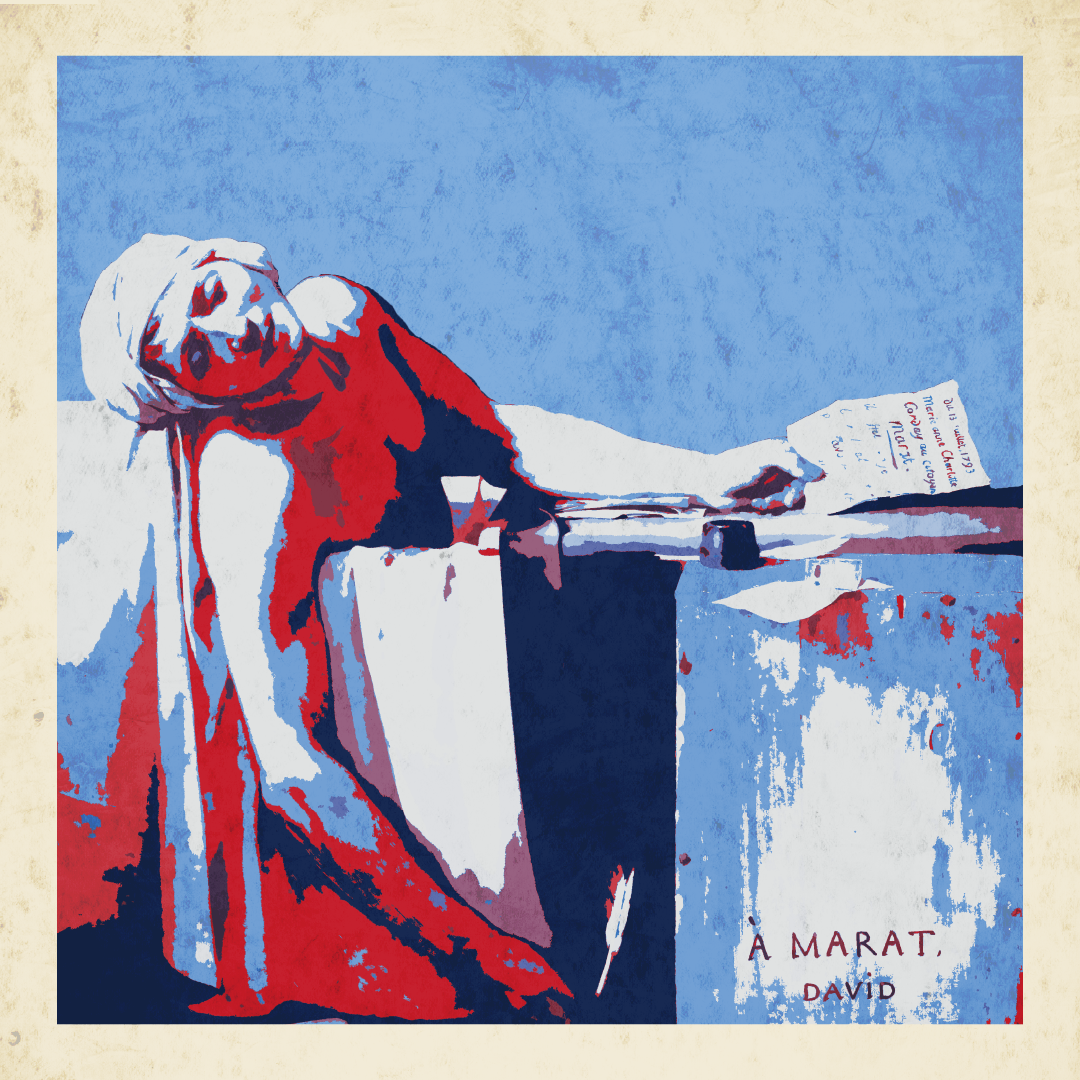
Taking place in 1808 – less than 20 years after the French Revolution began – Marat/Sade is a thought-provoking, multilayered play that explores the blurred line between sanity and insanity, the complexity of revolution, and the powerlessness of those on society’s margins.
Below, associate dramaturg Tate Zeleznik (BFA ’27, theatre design & production) describes the investigative process the cast and creative team explored in presenting Marat/Sade.
By Tate Zeleznik
In the SMTD production of Marat/Sade, Professor Malcolm Tulip directs a cast of BFA acting students. As the students prepare to present their work to the community, they are hard at work investigating the play – the term Tulip uses to refer to what are traditionally termed rehearsals. Here, the daily practice of dissecting and drawing connections to the text and creating the physical world for the performance takes place. “We’re kind of getting the best of both worlds when it comes to theatre-making: this really focused, almost academic level of text analysis, and this very playful, open, creatively stimulating process,” said Simon Nigam (BFA ’28), who portrays the outspoken political leader Jean-Paul Marat. Hayden Steiner (BFA ’26) portrays Sade, who, he described, “has power with the inmates he’s directing in his play. [He has a] super privileged state in this asylum.” Steiner went on to explain that, “In some ways, Sade is the hero, giving these inmates a platform. And in other ways, Sade is [understood as] a villain, because his writing was horrible and he was a horrible person.”
The other members of the 24-person cast are tasked with playing equally complex characters, but with added layers. One such character is Charlotte Corday, the assassin from Caen who comes to Marat’s door ironically hoping to stop the post-Revolution bloodshed by murdering him. In the play-within-the-play, Corday is played by an asylum inmate who struggles with “melancholia” and narcolepsy; this inmate is in turn portrayed by Tessie Morales (BFA ’26). The layers within the character, Morales observed, have “three main components: the actor alone (me), the actor portraying the patient, and the patient portraying Corday. The goal is that the audience will see this come together as a union, one single figure, without losing awareness of the parts. For me, the union is not yet tangible, but I feel it slowly building in each rehearsal through explorations and insights.” Morales explained the unique nature of preparing for this play: “Previous rehearsal processes have never required so much patience with myself. Fortunately, Malcolm skillfully guides the exploration in Brechtian ways that I can’t quite describe. All I know is we, as actors, can’t be protective of the choices we’ve made coming into the room; we have to be ready to play!”
Tulip’s methods in the production’s daily investigations derive from the work of influential 20th-century German theatre practitioner and playwright Bertolt Brecht. These methods provide actors with a way of both portraying the action and simultaneously commenting on and questioning who they are portraying and what they say and do.
One of the Brechtian influences in Marat/Sade is that of an intermediary between the performers and the audience, a figure who guides audiences through the series of often juxtaposed or conflicting plotlines and speeches. In Weiss’s play, it is the playful and quick-witted Herald, played by Lewis Jackson III (BFA ’26). “I’m there for the audience, to move things along, to give them a little update on what’s going on if anybody’s a little confused,” Jackson explained. “But I’m also kind of Sade’s right-hand man. I keep the play going in the context of the [play-within-the-play]. So I sometimes get the patients where they need to be or give cues to people who might forget their lines.”
Weiss’s play not only serves to recount the triumphs, shortcomings, and facts of the French Revolution, but also, being set in an asylum, reveals that the struggles of the revolution are echoed in the systems of power within the carceral system the actors and characters are bound in. “I think the device of the patients at the asylum playing revolutionaries is interesting,” Nigam noted. “[The revolutionaries have] gotten rid of the ruling class, and then another ruling class emerges and more and more people are oppressed.” Nigam further explored the setting for the retelling of this historical period in which his character lived and died: “We’re seeing this revolutionary struggle being represented by…the most oppressed class; people who have been totally removed from society, confined for oftentimes illegitimate and outdated reasons. We’re seeing the fight against oppression, paralleled with the active oppression of these actors in the asylum setting.”
Jackson observed the play’s shocking reflection on realities of the present day: “Where we are in 2026, they were at in 1793 and 1808… I think it’s showing a mirror of how things haven’t changed that much – how there are still martyrs and there are still people trying to be in control all the time.” Nigam also noted this resonance: “It feels very relevant.… They start by fighting for, at the start of the revolution, democracy. And yet they end up getting a new set of oppressive rulers, and obviously in 2026, at a national level, we’re seeing the dismantling of democracy and seeing the weaknesses of democracy…being exploited and exposed at such a rapid pace.” Theatre can both reflect and refract real life. In Weiss’s play, these distortions become as revelatory as they are revolutionary.
Marat/Sade will be performed at the Power Center for the Performing Arts February 19–22. Get tickets.

Author Tate Zeleznik, a junior pursuing the BFA in Theatre Design & Production, serves as associate dramaturg for Marat/Sade.