
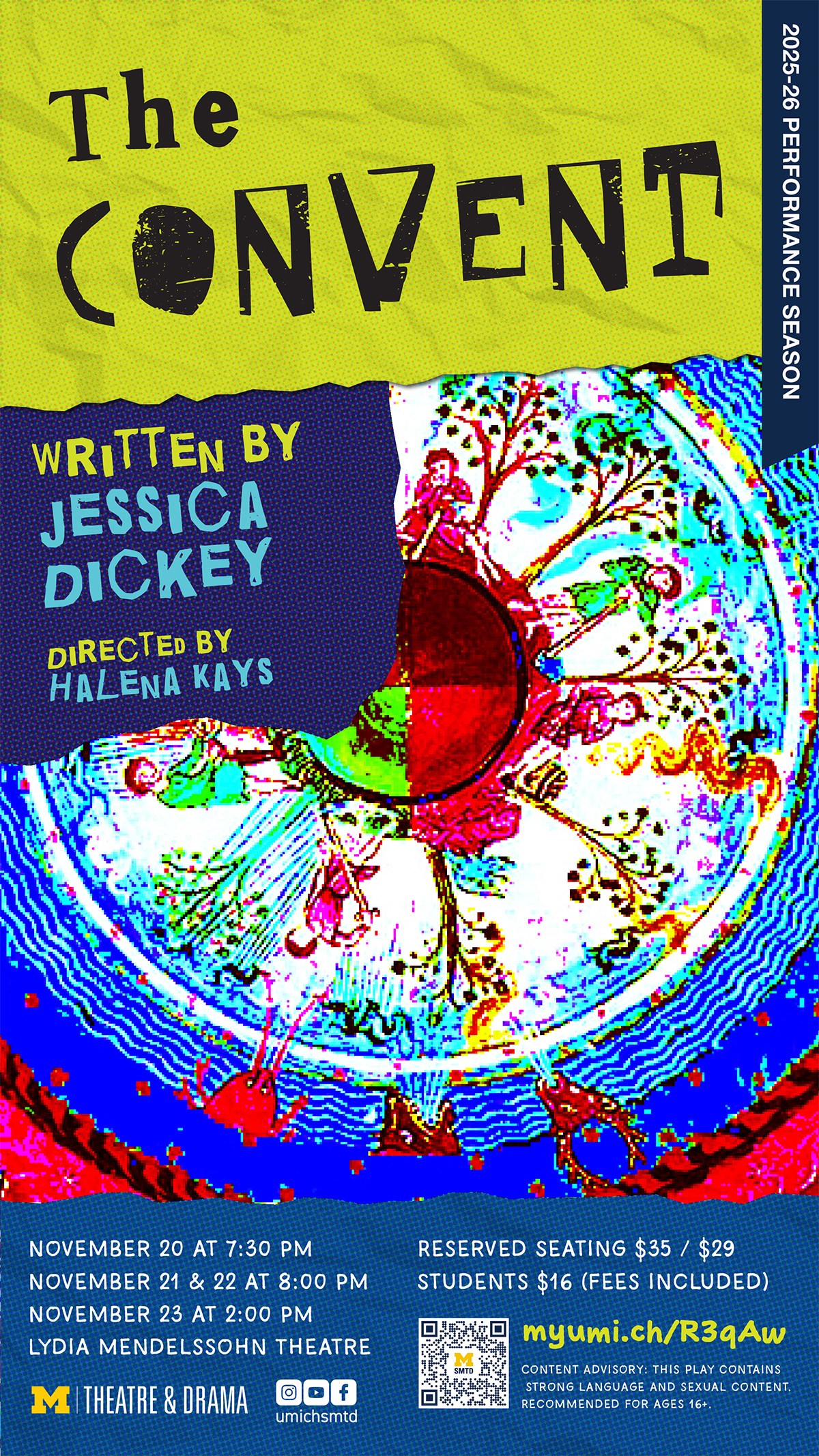
Content Advisory
About the Production
Creative Team
Director Halena Kays
Movement & Choreography Naomi Parr †
Scenic Designer Lauren Streng †
Costume Designer Christianne Myers
Hair & Makeup Designer Brittany Crinson
Lighting Designer Eliza Anker †
Sound Designer Kate Hopgood
Voice & Speech Coach Jeremy Sortore
Dramaturg Karin Waidley
Resident Intimacy Choreographer & Cultural Consultant Raja Benz
Production Stage Manager Frannie Walton †
†SMTD Student
Cast
Mother Abbess Kaylin Gines
Bertie Micah Webster-Bass
Dimlin Maya Guacci
Jill Audrey Andrews
Patti Mary-Kate Sunshine Mahaney
Tina Annika Juliusson
Wilma Faith Park
Production Staff
Associate Director Carter Van Erp
Assistant Director Adilynn Cardenas
Assistant Costume Designer Rachel Pfiel
Assistant Dramaturgs Kendal Bazerman, Joe Guzon
Assistant Stage Managers Brook Galsky, Shelby Holloway
Production Assistants Kendall Brisco, Laney Carnes
Running Crew
Light Board Operator Sarah Lau
Sound Operator Yuchen Wu
Deck Crew (Scenery) Yuchen Ma, David Roden
Deck Crew (Props/Electrics) Taylor Strilesky
Deck Crew (Props) Cecilia Bermudez, Lewis Jackson
Wardrobe Crew AJ Dagenais, Aspen Kinomoto^, Patrick McCaffity, Elby Schader
Hair & Makeup Crew Lilly Geer, Tiffany Nagano
Backup Crew Jasmin Rhymes
Shop Crews
Costumes Iliana Beauchamp, Katy Dawson, Sarita Gankin, Lucy Knas, Alex Li, Maya Liu, Rachel Pfeil, Isabella Pruter, Kayti Sanchez, Ellie Van Engen & 250/252/262 students
Lighting Eliza Anker, Morgan Gomes, Ethan Hoffman, Brandon Malin, Tate Zeleznik, Gabriela Ribeiro Znamensky & 250/252/262 students
Paint Gretchen Brookes, Miles Hionis, Norah Klocke, Ren Kosiorowski, Yuchen Ma, Ceri Roberts, Seri Stewart^, Amber Walters, Landon Wouters, Angela Wu & 250/252/262 students
Scenery Kelly Burkel, Ren Kosiorowski, Aiden Heeres, Soph Irfani, Hannah Kryzhan, Josi Middaugh, Luke Moyer, Michael Russell, Nathaniel Steever & 250/252/262 students
Props Andy Blatt, Kendall Brisco, Brook Galsky, Alex Heskett, Sam McLaughlin, Leah Stchur, Reese Stevens & 250/252/262 students
Wigs/Hair/Makeup Gretchen Brookes, Christine Chupailo, Miles Hionis & 250/252/262 students
Production Management Shelby Holloway, Esther Hwang, Greta Steever
Department of Theatre & Drama
SMTD Leadership
David Gier, DeanPaul Boylan Collegiate Professor of Music
Department of Theatre & Drama
Department Chair Dr. Tiffany Trent
Department Manager/Artistic Administrator Kathryn Pamula
Walgreen Events Manager Nickie Smith
Studio and Performance Manager Arie Shaw
Walgreen Office Coordinator Tyler Brunsman
Performance/Directing Christina Traister (Head of Performance), Halena Kays (Head of Directing), Daniel Cantor (Head of Acting), Raja Benz, Mark Colson, Antonio Disla, Holly Hughes, Tzveta Kassabova, Geoffrey Packard, Jeremy Sortore, Malcolm Tulip, Tiffany Trent
Design/Production Kevin Judge (Head of D&P), Jess Fialko, Heather Gilbert, Jungah Han, Jenn Rae Moore, Christianne Myers, Sarah M. Oliver
Theatre Studies/Playwriting Mbala Nkanga (Head of Theatre Studies), José Casas, Shavonne Coleman, Antonio C. Cuyler, Antonio Disla, Jenna Gerdsen, Amy E. Hughes, Holly Hughes, Jason Fitzgerald, Petra Kuppers, Ashley Lucas, Jay Pension, Rogério Pinto, Alexis Riley, Emilio Rodriguez, Karin Waidley
Arts Management Paul Bonin-Rodriguez, Antonio C. Cuyler, Aaron Dworkin, Afa Dworkin, Ken Fischer, Gala Flagello, Andrew Kuster, Jonathan Kuuskoski, Kari Landry, Robin Myrick, Jay Pension, Jesse Rosen, Omari Rush, Anna Sampson
Interarts Scott Crandall, Holly Hughes, Tzveta Kassabova, Malcolm Tulip
Professors Emeriti Alan Billings, Peter W. Ferran, Jessica Hahn, Philip Kerr, Priscilla Lindsay, Janet Maylie, Vincent Mountain, John Neville-Andrews, OyamO, Leigh Woods
Faculty Advisors
Stage Management Advisor Jenn Rae Moore
Scenic Design Advisor Jungah Han
Lighting Design Advisor Heather Gilbert
Staff Mentors
Staff Mentors Laura Brinker, Brittany Crinson, Patrick Drone, Chad Hain, Heather Hunter, Richard W. Lindsay, Beth Sandmaier
University Productions Administrative Staff
Executive Director Jeffrey Kuras
Administrative Specialist Christine Eccleston
Administrative Asst. Emily Erlich
Facilities Manager Shannon Rice
Performance Halls House Mgr. Kelley Krahn
Lead Backstage Operations Mgr. Dane Racicot
Sr. Backstage Operations Mgr. David Pickell
Backstage Operations Mgrs. Tiff Crutchfield, Yvette Kashmer, Brian Koepele, Robbie Kozub
University Productions Production Staff
Director of Productions Aaron Keller
Asst. Production Manager Michelle Williams-Elias
Technical Director (Walgreen) Richard W. Lindsay Jr.
Theatrical Scenery Manager Chad Hain
Lead Scenic Carpenter Devin Miller
Scenic Carpenter Heather Udowitz
Charge Scenic Artist Beth Sandmaier
Assoc. Theatrical Paint Mgr. Madison Stinemetz
Lead Theatrical Properties Manager Patrick A. Drone
Assoc. Theatrical Properties Manager Danielle Keys
Properties Artisan Adam Ashlock
Theatrical Properties Stock and Tech Coord. Kat Kreutz
Theatrical Lighting Manager Heather Hunter
Assoc. Theatrical Lighting Manager Jorrey Calvo
Sr. Costume Shop Manager Laura Brinker
Asst. Costume Shop Manager Leslie Ann Smith
Lead Cutter/Draper Tj Williamson
Cutter/Drapers Sarah Havens, Lani Tortoriello
Stitchers Mag Grace, Rene Plante
Lead Costume Crafts Artisan Elizabeth Gunderson
Temp Wardrobe Manager Meredith Miller
Costume Stock Manager Theresa Hartman
Theatrical Hair and Makeup Mgr. Brittany Crinson
Resources
- About the Performance
- About the Author
- About the Cast
- About the Creative Team
- Director's Note
- Dramaturg's Note
- Statement on the Anishinaabe Land Transfer
- Freedom of Expression Statement
- Download Program
Setting: The play takes place in an old convent somewhere in the south of France. A place where as long as you’ve got, the Truth has longer.
There will be no intermission.
Latecomers will be seated at a suitable break. As a courtesy to others, please turn off cellular phones and refrain from texting during the performance. Photography, audio recording, and videotaping of any kind are not permitted.
THE CONVENT is presented by arrangement with Concord Theatricals.
THE CONVENT was produced by Rising Phoenix Repertory and Weathervane Productions, in association with Rattlestick Playwrights Theater in New York, New York from January to February 2019.
The performers in this production are students in the Department of Theatre & Drama. The designers for this production are students, faculty, and/or guests of SMTD. Scenery, costumes, properties, sound, and lighting were realized by the students and staff of University Productions, the producing unit of SMTD. Thank you for supporting our educational mission.
Jessica Dickey (Playwright) is an award-winning playwright whose writing was hailed by the New York Times as having “freshness, economy, cheeky vulgarity, with a fine measure of poetic insight,” and by New Yorker magazine as “funny, smart, deep and sad.” Jessie is most known for her award-winning play The Amish Project, which premiered Off-Broadway at Rattlestick Playwrights Theater and has since been produced around the world. Jessie’s most recent premiere, Galileo’s Daughter, premiered in Chicago at Remy Bumppo, and her play The Convent premiered Off-Broadway with Rattlestick Playwrights Theater, Rising Phoenix, and WeatherVane. Jessie’s play The Rembrandt had a sold-out run at Steppenwolf starring John Mahoney, and her plays Charles Ives Take Me Home and Row After Row both premiered Off-Broadway in New York and have been produced around the country. Nan and the Lower Body had its world premiere at TheatreWorks Silicon Valley and was originally commissioned by the Sloan Foundation and Manhattan Theater Club. In TV and film, Jessie is currently writing a feature film, with Sharon Horgan producing (Catastrophe, Divorce) and Susanna Fogel directing (The Flight Attendant, Book Smart); she is also developing a series for Netflix. Jessie co-wrote a book with her sister, published by Pilgrim Press, called Sistering: The Art of Holding Close and Letting Go. A proud member of New Dramatists, Jessie divides her time between Brooklyn, LA, and the south of France.
—excerpted from LA Theatre Works (www.latw.org)
Audrey Andrews (Jill) Senior, BFA Acting/Dance minor, Denver, CO
Kaylin Gines (Mother Abbess) Senior, BFA Acting, Orlando, FL
Maya Guacci (Dimlin) Junior, BFA Acting/Playwriting and Education for Empowerment minor, Sayville, NY
Annika Juliusson (Tina) Junior, BFA Acting/PAME minor, Winnetka, IL
Mary-Kate Sunshine Mahaney (Patti) Senior, BFA Acting, New York, NY
Faith Park (Wilma) Sophomore, BFA Acting, Lakewood, WA
Micah Webster-Bass (Bertie) Sophomore, BFA Acting/Dance minor, Jacksonville, FL
Eliza Anker (Lighting Designer) is a junior pursuing a BFA in theatre design and production with a concentration in lighting design and a minor in Judaic studies. Design credits include Tick, Tick… Boom! and I and You (Basement Arts). Assistant design credits include Titanic (UProd), Attempts on Her Life and Stop/Kiss (Rude Mechanicals), and Jesus Christ Superstar (MUSKET). Production electrician credits include Hänsel und Gretel and Gloria (UProd) and The Hunchback of Notre Dame (MUSKET). Special thanks to her mom, dad, and sister.
Brittany Crinson (Hair & Makeup Designer) is the Wig, Hair, and Makeup Studio manager for all of UProd. She takes on the roll of designing for each production. Crinson spent several years in Chicago building her portfolio and skill set as a wig, hair, and makeup designer. She is thrilled to be back for her 2nd full year at UMICH. Break legs, cast and crew of The Convent!
About the Creative Team
Kate Hopgood (Sound Designer) is thrilled to be joining the team for The Convent. Credits: Broadway: Birthday Candles (Roundabout’s American Airlines Theater). Regional credits include: Mrs. Harrison (Williamston Theatre); Nora, 8 nights, Clyde’s, Soft Target (Detroit Public Theatre); Julius Caesar (PlayMaker’s Repertory Company); The Beauty Queen of Leenane (Detroit Public Theatre); The Tempest, Richard III, Twelfth Night, Hamlet, Love’s Labour’s Lost (Michigan Shakespeare Festival). Chicago: Into That Darkness: The Corrosive Hours of Edgar Allan Poe (The Edge Off Broadway); Love’s Labour’s Lost (Lifeline Theatre); Titus Andronicus (Babes with Blades); and The Electric Baby and Wrens (Rivendell Theatre Ensemble).
Halena Starr Kays (Director) is a founding member of the artistic collaborative the Ruffians, an artistic affiliate of American Blues Theatre, a former member of the Big Apple Circus Clown Care unit, past artistic director of the Hypocrites, former co-artistic curator for Theater on the Lake, and co-founder and former artistic director of Playmakers Lab. Kays is an artistic associate with the Neo-Futurists Chicago, where she co-created and directed Comfortable Shoes, Pop/Waits, 44 Plays for 44 Presidents, Burning Bluebeard, Daredevils, Daredevils Hamlet, Fake Lake, and Wildcat! (Jeff-nominated for Best Direction, Best New Work, and Best Actor). Kays primarily makes professional work in Chicago but has directed across the country, from LA to Portland to NYC. She has been nominated for Jefferson awards for Best Supporting Actress, Best Direction, Best New Work, and Best Production; named one of the top 50 “players” in Chicago theater by NewCity; is a recipient of the prestigious 3Arts Award; and received a signed letter from Mr. Rogers saying she was “special” in 1978. She is a UT-Austin and Northwestern grad, a proud member of SDC, and head of directing at the University of Michigan. Thanks to her mystical dad.
Christianne Myers (Costume Designer) is the Claribel Baird Halstead Collegiate Professor in the Department of Theatre & Drama. More than 50 productions at U-M; favorites include: About the Creative Team
Elizabeth Cree; Bernarda Alba; La Bohème; Candide; Night and Day; A Midsummer Night’s Dream; Clybourne Park; Henry IV, Part I; and Caroline, or Change; among others. New York: Running Man, Oedipus, American Dreams: Lost & Found; Theatreworks/USA, the Public Theatre & Ma-Yi Ens., Irondale Ens., Lincoln Center Institute, the Juilliard School. Regional Theatre: Santa Fe Opera, Detroit Public Theatre, Florentine Opera, Indiana Rep, Vermont Stage Co., Clarence Brown Theatre, Syracuse Stage, Opera Memphis. Other: BFA, Pace University; MFA, New York University.
Naomi Parr (Movement & Choreography) is pursuing a BFA in directing and a BA in Judaic studies, with a minor in playwriting. In her time at U-M, Naomi has directed Falsettos (Basement Arts) and The SpongeBob Musical (Pioneer Theatre Guild) and assistant directed John Proctor Is the Villain (UProd), Pippin; Her Life and Times (MT New Works), and Accidental Death of an Anarchist (senior directing thesis). Dramaturgy credits include Tick, Tick… Boom! (Basement Arts), Jesus Christ Superstar (MUSKET), and The Grown Ups (senior directing thesis). She’s thrilled to be a part of this production and grateful for Halena and the incredible team!
Jeremy Sortore (Voice & Speech Coach) (he/him) is an associate professor in the Department of Theatre & Drama. Regional: American Repertory Theater, Utah Shakespeare Festival, Colorado Shakespeare Festival. Member, National Alliance of Acting Teachers; associate faculty, Theatrical Intimacy Education; associate teacher of Fitzmaurice Voicework; certified teacher of Knight-Thompson Speechwork; certified Vocal Combat Technique Trainer/Coach; PAVA-recognized vocologist; editorial board, Journal of Consent-Based Performance; associate editor, Voice & Speech Review. Education: Moscow Art Theater School/ American Repertory Theater Institute at Harvard University. www.JeremySortore.comAbout the Creative Team
Lauren Streng (Scenic Designer) is a fourth year student pursuing a BFA in Theatre Production and Design, as well as a BSE in Mechanical Engineering. The Convent is Lauren’s debut design with UProd. Her other designs with the University of Michigan include Every Brilliant Thing, Plano (Senior Directing Thesis), 33 Variations (Basement Arts), Golden Boy (Senior Directing Thesis), and Blood at the Root (Senior Directing Thesis). She was also the scenic design assistant on Turn of the Screw (UProd). Lauren is very grateful to have worked on The Convent, and has appreciated the collaboration with everyone on the team.
Carter Van Erp (Associate Director) is a master’s student at the University of Michigan’s Ross School of Business and an alum of the School of Music, Theatre & Dance, where he earned his bachelor of theatre arts degree with concentrations in performing arts management and theatre studies. At Michigan, he has worked on developmental productions including Loud Nite by Gavin Creel, Kill the Boy Band by Kerrigan + Lowdermilk, and his own short film Bound. Van Erp plans to move to the East Coast post-grad to pursue a career blending artistic development with business strategy. He is very grateful to have been pulled into this process as, to quote Halena, the Walgreen’s “local gay Catholic,” and hopes you enjoy your stay at the convent.
Frannie Walton (Production Stage Manager) is a fourth-year student receiving her BFA in theatre design and production with a concentration in stage management. Other U-M credits include: UProd—The Government Inspector (PSM), A Little Night Music (1st ASM), Intimate Apparel (1st ASM); MUSKET—Catch Me If You Can (Rehearsal SM); Golden Theatre Co—A Gentleman’s Guide to Love and Murder (PSM); Basement Arts—Orion and the Goatman (PSM); OPEN—Painless:The Opioid Musical (ASM). She would like to thank the entire team, especially her ASMs and PAs, for such a wonderful experience!
The process of building the surprising and revolutionary world of The Convent has been transformative. Thank you for coming; we are thrilled to share the joy we’ve found in this story with you. We hope you leave with some new ideas, laughs, and perhaps, clarity about what you might want for your life and world in the coming years.
The ritual of coming together in a shared space is a cornerstone of a thriving community; thank you for supporting live performance (it is very punk rock of you).
—Halena Kays
The Queer and the Divine, the Profane and the Sanctified
“The whole of life is capable of being sanctified. The means by which its sanctification is brought about are various, but the result is always the same: life is lived on a twofold plane…”
–Mircea Eliade, The Sacred and the Profane
Eliade leads us not to a destination but to a doubling, an awareness that life is always lived in tension with something else—the sacred with the profane, the profane with the sacred. The divine and the earthly aren’t opposites; they are overlapping realities, always bleeding one into the other. In that sense, queerness might also share the same spiritual and spatial architecture—a faith in something beyond what has been named or felt but always in relation to it. To live queerly is to live in devotion to another possibility, to believe in ways of being that have not yet been made fully legible. Queerness, like faith, demands imagination. It asks us to trust in what cannot always be proven and to love what cannot always be spoken.
Dickey’s “convent” becomes a microcosm of this yet-to-be belonging. The women within it reach toward transcendence, but their pathways and obstacles differ. Some pray for union with God, others for freedom from the body, and some for a wholeness they can’t yet define. The result is a spiritual, primal, and erotic charge that blurs the line between revelation and rebellion. The sacred and the profane cease to be separate in this space—they become reflections of each other, mirroring the same hunger, like that of the mystics they learn from, to know what lies beyond comprehension.
In this light, queerness is not merely a matter of sexuality but a posture toward the unknown. It mirrors faith’s paradox. Leaps of faith and sexuality here are acts of surrender—to a mystery, to an unnameable truth, to a sense of self that might always be in flux. But as faith has historically demanded obedience from women, queerness resists such containment. It claims the unseen as a place of power rather than punishment. The convent walls, once Dramaturg’s Note
meant to enclose, now become thresholds—spaces where the ineffable might be touched and transcended, even for a moment.
May we consider in this convent, then, that the divine and the queer are not so different after all? Both dwell in the margins of understanding. Both demand courage to reach for something more expansive than what the world outside allows. And both remind us that what is unseen does not mean unreal; it means what is still becoming understood.
Throughout history, women’s relationships to faith have been shaped by confinement as much as by devotion. Monastic living has often been both a refuge and a restraint, where women could learn, lead, and love one another, but only under the conditions of the patriarchal church and an ever-present God. Sanctity was contingent on submission. Even the mystics who achieved spiritual ecstasy were punished or silenced when their revelations outshone the men interpreting them. The line between holiness and heresy became, for women, razor-thin.
Dickey’s play doesn’t just acknowledge that history; it calls it into conversation and confronts it. The women of The Convent inherit centuries of defiant expectation: to be pure, to be quiet, to be vessels of faith rather than its architects, yes, but also to resist. Their struggle is not only spiritual but generational; it carries the weight of women who were told that submission is sacred, that obedience is love, that the body is a site of temptation to subdue. And yet, through Dickey’s dramaturgy, we watch them push back as far as they can to search for belief that doesn’t require self-erasure.
What’s striking is how little this quest has changed. The same cultural forces that kept medieval women cloistered still manifest today, only dressed in new vocabulary: respectability, professionalism, modesty, independence, motherhood. Dickey threads this linguistic tapestry into the texture of her play. Each woman’s story feels both ancient and immediate, as though the centuries between them have folded in on themselves. Their yearning for Dramaturg’s Note
freedom, whether that be spiritual, sexual, or emotional, is timeless, as if their rebellion is inherited.
In this way, our story breaks from constructed constraints in the most cloistered of places. Yes, it asks how much progress have we really made when structures of faith, politics, and gender still police female and queer bodies. But it also offers a kind of hope: that the act of questioning and naming and screaming profanity at what has been forbidden is instead a sacred practice. These women aren’t seeking sainthood; they’re seeking selfhood. And that, perhaps, is the holiest thing of all.
—Carter Van Erp, Associate Director and Honorary Dramaturg
Anishinaabeg gaa bi dinokiiwaad temigad manda Michigan Kichi Kinoomaagegamig. Mdaaswi nshwaaswaak shi mdaaswi shi niizhawaaswi gii-sababoonagak, Ojibweg, Odawaag, minwaa Bodwe’aadamiig wiiba gii-miigwenaa’aa maamoonjiniibina Kichi Kinoomaagegamigoong wi pii-gaa aanjibiigaadeg Kichi-Naakonigewinning, debendang manda aki, mampii Niisaajiwan, gewiinwaa niijaansiwaan ji kinoomaagaazinid. Daapanaming ninda kidwinan, megwaa minwaa gaa bi aankoosejig zhinda akiing minwaa gii-miigwewaad Kichi-Kinoomaagegamigoong aanji-daapinanigaade minwaa mshkowenjigaade.
The University of Michigan is located on the traditional territory of the Anishinaabe people. In 1817, the Ojibwe, Odawa, and Bodewadami Nations made the largest single land transfer to the University of Michigan. This was offered ceremonially as a gift through the Treaty at the Foot of the Rapids so that their children could be educated. Through these words of acknowledgment, their contemporary and ancestral ties to the land and their contributions to the University are renewed and reaffirmed.
Thank you for attending this program. The University of Michigan strives to create a truly open forum, one in which diverse opinions can be expressed and heard. You can see our full Freedom of Expression policy at smtd.umich.edu/FOE