
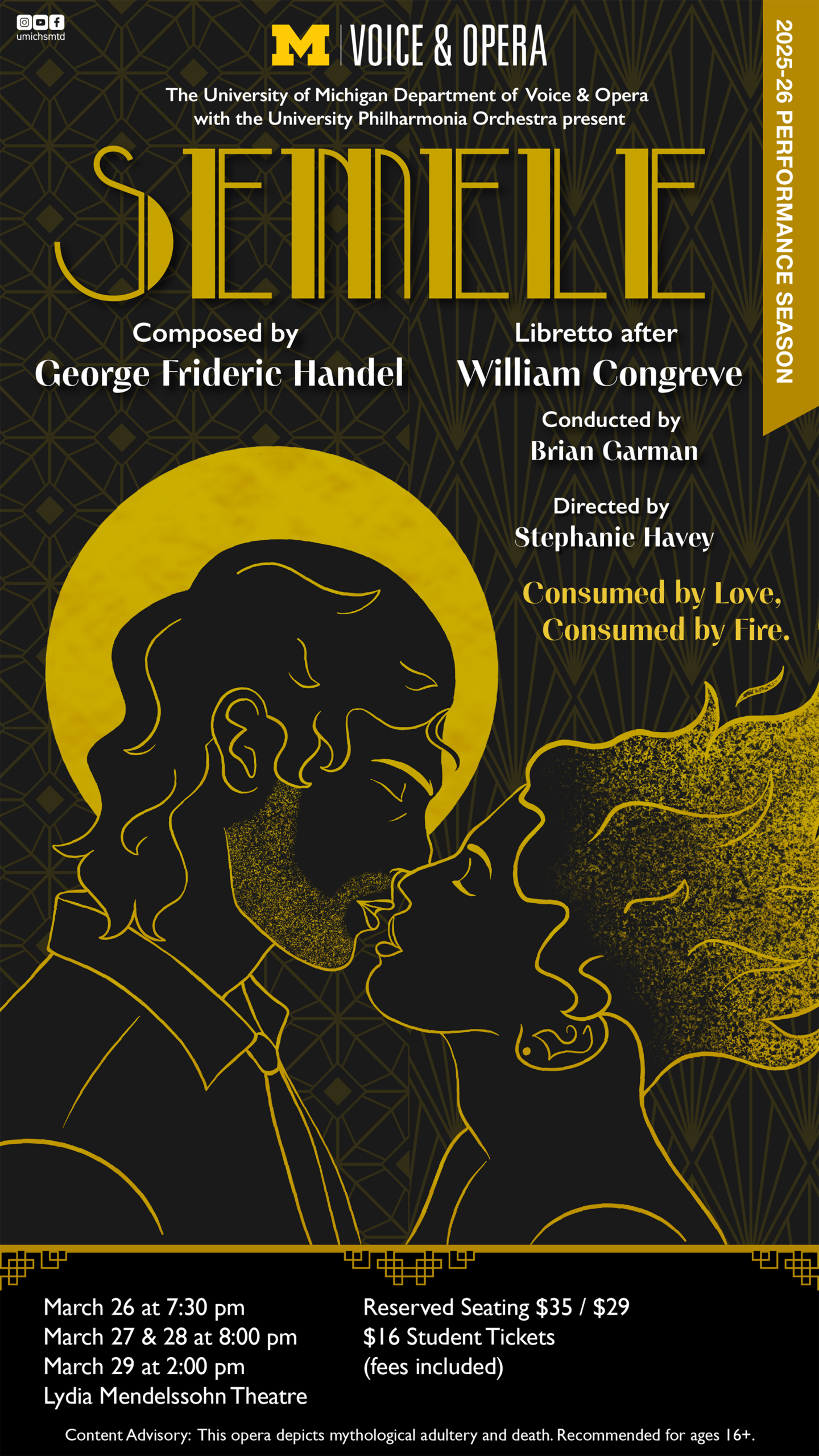
Content Advisory
About the Production
Creative Team
Conductor Brian Garman ‡
Director Stephanie Havey
Assistant Conductor Elijah Schuh * †
Scenic Designer Talia Lev †
Costume Designer Sarah M Oliver
Lighting Designer Andrew DG Hunt ‡
Hair & Makeup Designer Brittany Crinson
Chorus Director Gukhui Han †
Rehearsal Pianists/Coaches Amelia Arguelles †, Raphael Chou †
Diction Coach Timothy Cheek
Dramaturg Karin Waidley
Resident Intimacy Choreographer and Cultural Consultant Raja Benz
Production Stage Manager Nan Luchini ‡
† SMTD Student
‡ SMTD Guest
Cast
Thursday/Saturday
Semele Haley Burgh
Jupiter Spencer VanDellen
Juno/Ino Grace Ryan
Athamas Delaney Finn
Cadmus/Somnus Paul Leland Hill
Iris Hallie Ackerman
Apollo Maxwell Vernon
Chief Priest of Juno Brendan Lockhart
Friday/Sunday
Semele Cecelia Rose Fornuto
Jupiter Ryan Hughes
Juno/Ino Koralynn Kennedy
Athamas Natalie Bridgnell
Cadmus/Somnus Collin Stillday
Iris Marisa Redding
Apollo Maxwell Vernon
Chief Priest of Juno Brendan Lockhart
Chorus Seth Amoguis, Allison Artlip, Henry Clark, Kaitlyn Dolan, Abigail Eagan, Lilya Heidelbaugh, Amelia Knapp, Dana Lockhart, Kaiyah Luethy, Vincent Que, Nadia Stolz, Jimmy Tang, Maxwell Vernon
Semele Cover Marisa Redding
Somnus/Cadmus CoverBrendan Lockhart
Jupiter CoverWilliam Fishwick
Juno/Ino CoverMolly Levin
Orchestra
Conductor Brian Garman
Violin I Sua Yun**Della Gardner, Lauren Juntunen, Anna Lee
Violin II Sophie Ng*, Landon Kim, Bradley Smith
Viola Dylan Gutierrez-Aguilar*, Kaiwan BilalIan Crush
Cello Elena Kim*, Ryan Day
Double Bass Lucio Pranis-Ricci*
Oboe Madeline Antony, Charlotte Kosek
Bassoon Quinlan Bollwitt, Jackson Crouse
Horn Nicholas Valencia, Adir Waxman
Trumpet Dash Kwan, Thomas Welch
Percussion Nathan Sepinwall
Harpsichord Amelia Arguelles
Organ Raphael Chou
*Principal **Concertmaster
Production Staff
Assistant Stage Managers Maya Liu, Bree Anzures, Jack Bishop
Assistant Directors & Dramaturgs Amelie Besch, Sofia Vazquez
Production Assistants Jasmine Coates, Alex Heskett, Norah Klocke, Grace Walton
Ensembles Coordinator Jonathan Mashburn
Sound Engineer Katie Hopgood
Assistant Costume Designer Iliana Beauchamp
Supertitles Author Maya Liu
Supertitles Operator Sofia Vasquez
Running Crew
Light Board Operator Allison Lange
Follow Spot Operators Ella Billington, James Parascandola
Supertitles Operator Sofia Vazquez
Deck Crew (Scenery) Julianne Doner, Grace Torgerson, Chelsea Wallington
Deck Crew (Props) Aaliyah Brown, Natalia Gomez, Kennedy Marshall
Wardrobe Crew Katy Dawson^, Samantha Marchena, Carly Mulay, Aaliyah Nicholas, Bradyn Prisand
Hair & Makeup Crew Bridghaite Lemrow-Collazo-Rosario, Zoe Papadakis
^ Crew Head
Shop Crews
Lighting Eliza Anker, Clayton Collins, Morgan Gomes, Ethan Hoffman, Brandon Malin, Tate Zeleznik, Gabriela Ribeiro Znamensky & 250/252/262 students
Paint Gretchen Brookes, Miles Hionis, Norah Klocke, Ren Kosiorowski, Hannah Kryzhan, Emmie Pokryfke, Ceri Roberts, Seri Stewart^, Amber Walters, Angela Wu & 250/252/262 students
Scenery Kelly Burkel, Ren Kosiorowski, Aiden Heeres, Soph Irfani, Josi Middaugh, Luke Moyer, Michael Russell, Nathaniel Steever & 250/252/262 students
Props Andy Blatt, Kendall Brisco, Brook Galsky, Alex Heskett, Sam McLaughlin, Tessie Morales, Leah Stchur, Reese Stevens & 250/252/262 students
Wigs/Hair/Makeup Gretchen Brookes, Christine Chupailo, Miles Hionis & 250/252/262 students
Production Management Justin Comini, Shelby Holloway, Esther Hwang, Greta Steever
Department of Voice & Opera and the Concerts & Events Office
SMTD Leadership
David Gier, Dean
Paul Boylan Collegiate Professor of Music
Department of Voice & Opera
Chair Stephen West
Faculty Timothy Cheek, Stephanie Havey, Freda Herseth, Norman Hogikyan, Valdis Jansons, Caitlin Lynch, Rose Mannino, Stanford Olsen, Ana María Otamendi, Chía Patiño, Kirk Severtson, Matthew Thompson, Louise Toppin, Daniel Washington
Visiting Faculty Sahar Nouri
Concerts & Events Office
Director of Concerts and Events Paul Feeny
Head Performance Librarian & Licensing Manager Liz Nowland
Performance Librarian & Programs Manager Katie Klich
Coordinator: Event Scheduling Feagin Oliver
Percussion Program Manager Matt Jordan
Production Manager: Ticketed Events & Small Ensembles Jonathan Mashburn
Production Manager: Large Ensembles Kate Johnson
Daily Operations Coordinator Jimmy Stagnitti
Faculty Advisors
Costume Design Advisor Sarah M Oliver
Stage Management Advisor Jenn Rae Moore
Staff Mentors
Staff Mentors Laura Brinker, Brittany Crinson, Patrick Drone, Chad Hain, Heather Hunter, Richard W. Lindsay, Beth Sandmaier
University Productions Administrative Staff
Executive Director Jeffrey Kuras
Administrative Specialist Christine Eccleston
Administrative Asst. Emily Erlich
Facilities Manager Shannon Rice
Performance Halls House Mgr. Kelley Krahn
Lead Backstage Operations Mgr. Dane Racicot
Sr. Backstage Operations Mgr. David Pickell
Backstage Operations Mgrs. Tiff Crutchfield, Yvette Kashmer, Brian Koepele, Robbie Kozub
University Productions Production Staff
Director of Productions Aaron Keller
Asst. Production Manager Michelle Williams-Elias
Technical Director (Walgreen) Richard W. Lindsay, Jr.
Theatrical Scenery Manager Chad Hain
Lead Scenic Carpenter Devin Miller
Scenic Carpenter Heather Udowitz
Charge Scenic Artist Beth Sandmaier
Assoc. Theatrical Paint Mgr. Madison Stinemetz
Lead Theatrical Properties Manager Patrick A. Drone
Assoc. Theatrical Properties Manager Danielle Keys
Properties Artisan Adam Ashlock
Theatrical Properties Stock and Tech Coord. Kat Kreutz
Theatrical Lighting Manager Heather Hunter
Assoc. Theatrical Lighting Manager Jorrey Calvo
Theatrical Sound Manager Katie Hopgood
Sr. Costume Shop Manager Laura Brinker
Asst. Costume Shop Manager Leslie Ann Smith
Lead Cutter/Draper Tj Williamson
Cutter/Drapers Sarah Havens, Lani Tortoriello
Stitchers Mag Grace, Rene Plante
Lead Costume Crafts Artisan Elizabeth Gunderson
Costume Stock Manager Theresa Hartman
Wardrobe Manager Meredith Miller
Theatrical Hair and Makeup Mgr. Brittany Crinson
Resources
- Synopsis
- About the Performance
- About the Authors
- About the Cast
- About the Creative Team
- Dramaturg's Note
- Statement on the Anishinaabe Land Transfer
- Freedom of Expression Statement
- Download Program
PART ONE
Cadmus and his employees have gathered in the posh hotel, Juno’s Palace, to bless the arranged marriage of his daughter Semele to Athamus. The ballroom fills with light and Juno, Queen of the Gods, appears as the chorus proclaims that the omens for the marriage appear favorable. Semele arrives for the ceremony after many attempts to delay the marriage due to her new love of Jupiter (referred to as Jove), the King of the Gods. She pleads to Jupiter to intervene, and his responding thunder interrupts the ceremony. The symbolic flames of Juno are extinguished while Cadmus and the other wedding guests pray for their return. Sensing a war between the immortal spouses, the chorus flees from the hotel, but Athamus and Semele’s sister, Ino, remain. Ino and Athamus each reveal surprising truths. Both are startled when Cadmus interrupts with the shocking news that Jupiter has abducted Semele, despite his attempts to use bribery to achieve a different outcome. The trio languishes while Semele transcends to the realm of the Gods.
Juno, angered by her husband’s adultery, has ordered her messenger, Iris, to discover where Semele has been taken. Iris reports that Jupiter has built his new mortal lover an elaborate palace guarded by fierce dragons that never sleep. He has whisked her away to the penthouse and has his guards standing watch. The enraged Juno swears vengeance and hurries to visit Somnus, the God of Sleep, in his lair deep beneath the hotel, to demand his aid in reaching Jupiter’s secret hideaway.
Semele wakes and immediately calls out for Jupiter. He arrives in human form, reassures her of his fidelity, and reminds her of her fragile mortality. Semele professes devotion to him but reveals her discontent that she has not yet been made immortal. Sensing Semele’s dangerous ambition, Jupiter promises to summon Ino from earth to keep her company. Ino, enraptured, describes the extraordinary journey to the immortal realm. The sisters are joyfully reunited and decide to indulge in the pleasures of the immortal realm.Synopsis
PART TWO
Somnus is disturbed from his deep sleep by the arrival of Juno and Iris. He wakes but refuses to help Juno. She barters, offering his favorite nymph in return for his aid, and he relents. Juno orders Somnus to make Jupiter have an erotic dream that will make him desperate for Semele. She also orders Somnus to use his power to subdue Ino so that Juno may appear to Semele in her place. Juno imitates Ino in order to convince Semele that she has been made as beautiful as a god. Trusting her sister, Semele sees her glorified reflection and becomes narcissistically obsessed. Juno, still disguised as Ino, advises that if Semele wishes to become truly immortal, she must refuse Jupiter until he promises to grant any wish she desires. The disguised Juno suggests that Semele demand that Jupiter appear to her only in his true form. Semele eagerly accepts this advice. Juno departs when she senses the approach of her husband.
Jupiter is alarmed when Semele rejects him. He rashly swears an irrevocable vow to grant her whatever she desires, and she demands that he visit her in his true form. He reacts with horror, knowing that his non-human form will instantly kill her. Semele refuses to listen, assuming that Jupiter’s protestations are only to resist granting her immortality. Left alone, Jupiter tries to find a way to save Semele’s life, but he is forced to accept his loss. Juno, victorious, enjoys Semele’s demise. Semele sees the full force of Jupiter’s glory approach her in the form of paparazzi eager to document their celebrity; she laments her folly in wishing to attain his rank and is consumed by flames. Ino, safely discovered having been subdued by Somnus, announces the tragic news that Semele has perished. Athamus offers Ino unexpected comfort. Jupiter sends Apollo to speak on his behalf. The mortals rejoice while the gods continue to rage on….
—Adapted from James Darrah, Opera Philadelphia
*Assistant Conductor Elijah Schuh will conduct the performance on March 29.
Semele is produced by arrangement with European American Music Distributors Company, U.S. and Canadian agent for Baerenreiter Music Corp., publisher and copyright owner.
There will be one 15-minute intermission.
Latecomers will be seated at a suitable break. As a courtesy to others, please turn off cellular phones and refrain from texting during the performance. Photography, audio recording, and videotaping of any kind are not permitted.
The performers in this production are students in the Department of Voice & Opera and the University Philharmonia Orchestra. The designers for this production are students, faculty, and/or guests of SMTD. Scenery, costumes, properties, sound, and lighting were realized by the students and staff of University Productions, the producing unit of SMTD. Thank you for supporting our educational mission.
George Frideric Handel (composer, born February 23, 1685, Halle, Brandenburg [Germany]—died April 14, 1759, London, England) was a German-born English composer of the late Baroque era, noted particularly for his operas, oratorios, and instrumental compositions. He wrote the most famous of all oratorios, Messiah (1741), and is also known for such occasional pieces as Water Music (1717) and Music for the Royal Fireworks (1749).
Handel was the son of a barber-surgeon. He showed a marked gift for music and became a pupil in Halle of the composer Friedrich W. Zachow, learning the principles of keyboard performance and composition from him. The first basis of Handel’s style was the north German music of his childhood, but it was soon completely overlaid by the Italian style that he acquired in early adulthood during his travels in Italy. Above all, his music is eminently vocal. Handel’s directness of manner makes him one of the great masters of choral music. Handel had a lifelong attachment to the theatre—even his oratorios were usually performed on the stage rather than in church. Until almost the end of his life he loved Italian opera, and only after it involved him in ever-increasing financial losses did he abandon it for English oratorio. Like other composers of his time, he accepted the conventions of Italian opera, with its employment of male sopranos and contraltos and the formalized sequences of stylized recitatives and arias upon which opera seria was constructed.
But Handel’s oratorios now seem even more dramatic than his operas, and they can generally be performed on the stage with remarkably little alteration. With Israel in Egypt and Messiah, however, the emphasis is quite different, Israel because of its uninterrupted chain of massive choruses, which do not lend themselves to stage presentation, and Messiah because it is a meditation on the life of Christ the Saviour rather than About the Authors
a dramatic narration of his Passion. Handel also used the dramatic oratorio genre for a number of secular works, chief among which are Semele and Hercules, both based on stories from Greek mythology. —Adapted from Britannica.com
William Congreve (born January 24, 1670, Bardsey, near Leeds, Yorkshire, England—died January 19, 1729, London) was an English dramatist who shaped the English comedy of manners through his brilliant comic dialogue, his satirical portrayal of the war of the sexes, and his ironic scrutiny of the affectations of his age. His major plays were The Old Bachelour (1693), The Double-Dealer (1693), Love for Love (1695), and The Way of the World (1700).
According to Dr. John Andrews, who wrote his doctoral theses at the University of Cambridge on the subject, Congreve wrote his version of the Semele libretto in the early 18th century, around 1705, when it was set to music by John Eccles. Handel adapted the existing libretto in 1744, likely with Newburgh Hamilton, who is uncredited. Per Dr. Andrews, Handel and his adapter “made three types of changes. First, a series of cuts reduce the length of the text to accommodate da capo arias and the more melismatic vocal writing of Italian opera. But there are also cuts of individual lines, couplets, and even single words, which seem to accommodate the piece to a more censorious age. Second, there are interpolations from Congreve’s poetry, from Pope’s Pastorals and from untraced sources. These provide additional arias for his principals but more importantly create and shape the role of the chorus. Handel also created two choruses by reassigning lines from minor characters. Finally, one aria was re-written to fit better with Handel’s music.”
—Adapted from Britannica.com and the Handel Friends UK
Hallie Ackerman (Iris) Grad Student, MM Voice Performance, Grand Ledge, MI
Seth Amoguis (Chorus) Sophomore, BM Music Education
Allison Artlip (Chorus) Sophomore, BM Voice Performance/BS Environmental Science, Bellaire, MI
Natalie Bridgnell (Athamas) Junior, BM Voice Performance/BA Creative Writing, Chico, CA
Haley Burgh (Semele) Grad Student, DMA Voice Performance, Greenwood, IN
Henry Clark (Chorus) Sophomore, BMA Voice Performance, White Bear Lake, MN
Kaitlyn Dolan (Chorus) Sophomore, BM Voice Performance, Ann Arbor, MI
Abigail Eagan (Chorus) Sophomore, BM Voice Performance, Naperville, IL
Delaney Finn (Athamas) Grad Student, MM Voice Performance, West Bloomfield, MI
William Fishwick (Jupiter Cover) Grad Student, MM Voice Performance
Cecelia Rose Fornuto (Semele) Grad Student, DMA Voice Performance, Atlanta, GA
Lilya Heidelbaugh (Chorus) Sophomore, BM Voice Performance/Germanic Languages and Literatures, Superior Township, MI
Paul Leland Hill (Somnus/Cadmus) Grad Student, SM Voice Performance, Clinton, UT
Ryan Hughes (Jupiter) Junior, BM Voice Performance/BM Choral Music Education, West Chester, PA
Koralynn Kennedy (Juno/Ino) Junior, BM Voice Performance/LSA Creative Writing, Three Oaks, MI
Amelia Knapp (Chorus) First-year, BM Voice Performance/BS Microbiology, Royal Oak, MI
Molly Levin (Juno/Ino Cover) Junior, BM Voice Performance, Bloomfield Hills, MIAbout the Cast
Brendan Lockhart (Chief Priest of Juno, Somnus/Cadmus Cover) Junior, BM Voice Performance, Waterford, MI
Dana Lockhart (Chorus) First-year, BM Voice Performance, Waterford, MI
Kaiyah Luethy (Chorus) First-year, BM Voice Performance, Howell, MI
Vincent Que (Chorus) First-year, BM Voice Performance/Music Education, Northville, MI
Marisa Redding (Iris, Semele Cover) Senior, BM Voice Performance/BS Computer Science, Ann Arbor, MI
Grace Ryan (Juno/Ino) Grad Student, MM Voice Performance, Chicago, IL
Collin Stillday (Somnus/Cadmus) Grad Student, MM Vocal Performance, Plymouth, MI
Nadia Stolz (Chorus) First-year, BM Voice Performance/Performing Arts Management and Entrepreneurship, Raleigh, NC
Jimmy Tang (Chorus) Sophomore, BM Voice Performance, Shanghai, China
Spencer VanDellen (Jupiter) Grad Student, SM Voice Performance, Claresholm, Alberta, Canada
Maxwell Vernon (Apollo/Chorus) Junior, BM Voice Performance/Business Minor, Ankeny, IA
Brittany Crinson (Hair & Makeup Designer) is the Wigs, Hair, and Makeup Studio manager and designer for all of UProd. Crinson spent several years in Chicago building her portfolio and skill set as a wig, hair, and makeup designer. Her credits include hair department head of HBO’s Somebody Somewhere, season 3; the head of hair and makeup for the Joffrey Ballet for several seasons; and hairstylist on Hulu’s The Bear, seasons 1-4, in addition to designing for theatres around Chicago and Detroit. She is thrilled to be back for her second full year at U-M.
Talia Lev (Scenic Designer) is a senior pursuing a BFA in design and production, concentrating in scenic design, at the University of Michigan. This is her final design being produced at the university, and she is excited to continue to pursue scenic design in the professional world. She thanks Kevin Judge, her advisor, for his mentorship throughout her academic career, and University Productions for the opportunity to design this production. Previous credits include: Gloria (SD), Waitress (SD), Titanic (musical) (asst. SD), The Opposite of Killing (SD), Twelfth Night (musical) (asst. SD), Julius Caesar (graphic designer). Talialevdesign.com
Brian Garman (Conductor) Maestro Brian Garman is the artistic director and co-founder of Berkshire Opera Festival, conducting their inaugural production of Madama Butterfly in 2016 and every subsequent mainstage production. He also joined the Crested Butte Music Festival in 2018 as the first music director of opera, leading a production of Falstaff. Prior to this, he opened Seattle Opera’s season conducting La Traviata and the preceding fall was appointed the inaugural music director of the Seattle Opera Young Artists Program. He was previously on the conducting roster at New York City Opera and concurrently led runs of productions at Wolf Trap Opera Company. Garman was resident conductor at Pittsburgh Opera for ten years, leading several productions to unanimous critical acclaim. Additionally, he was at the helm for numerous About the Creative Team
productions as music director of the Pittsburgh Opera Center. On the senior music staff of the Santa Fe Opera for six years, he was an associate conductor and assisted in the musical preparation of dozens of operas. As a pianist and coach, Garman is sought after by numerous singers of renown and has been called upon frequently to give recitals and master classes around the United States and Europe.
Gukhui Han (Opera Chorus Director) is currently pursuing a DMA in choral conducting with Dr. Eugene Rogers at the University of Michigan. Originally trained as a pianist, she discovered her passion for conducting through collaborative work with choirs, singers, and many inspiring conductors. Before joining the University of Michigan community, Han served as choir director at California State University, Los Angeles; conducting teacher with the Los Angeles Children’s Chorus; and staff pianist at Chapman University and California State University, Long Beach. Her work as a pianist and conductor includes recognition as a finalist in the Wigmore Hall Song Competition and participation in the Aspen Music Festival, SongFest, the Franz-Schubert-Institut, and Chorus America’s Conducting Academy. She is grateful to Kenneth Griffiths, Alan Smith, and Robert Istad, mentors who have guided and inspired her artistic path. Having recently moved from California, she, her husband Chris, and their cat Tiki are enjoying life in Michigan, even in winter!
Andrew DG Hunt (Lighting Designer) is a lighting designer who graduated from Carnegie Mellon School of Drama. He points lights at things so that we can see them and have emotions. He has pointed lights at performers more than 100 times, and at stuff more than 70 times. Hunt once designed a comedic romantic opera as a K-Pop music video. See some of his work (and credit soup) at adghunt.com.
Nan Luchini (Stage Manager) is returning after a brief stint as stage management faculty for the fall 2025 semester. Luchini has stage managed at Detroit Opera since 2009, along with About the Creative Team
several other opera companies in Tulsa, San Diego, Pensacola, Palm Beach, Atlanta, Naples, New Orleans, Florentine, Annapolis, to name a few. Other SM credits include Tamar-kali’s Freedom Is A Constant Struggle at Damrosch Park, Phoenicia Festival of the Voice, Ann Arbor Summer Festival. Local AEA Shakespeare in Detroit, Williamston Theatre, Meadowbrooke Amphitheatre, Michigan Stage, Tipping Point, PNT, Detroit Public Theatre. Thank you, De’Andre and Nevaeh.
Sarah M Oliver (Costume Designer) is an associate professor of costume technology and design in the Department of Theatre & Drama. Design credits: (U-M) Gloria, Our Oz, No Other, Hansel und Gretel, Orpheus in the Underworld, Arbor Falls, Don Giovanni, The Cunning Little Vixen, somebody’s children, and Nora: A Doll’s House; (regional) Music Academy, Kansas City Repertory Theatre, Kalamazoo Symphony Orchestra, Kansas City Actors Theatre, Unicorn Theatre, the New Theatre Restaurant, and Kansas University Opera. Costume construction credits: (international) MaiOui Dance, St. Lawrence Center for the Arts, Celebrity Cruises Quixotic Fusion, G&S Society Bermuda, Spanish Summer Dance Festival, Hong Kong Ballet, and Hong Kong Academy for Performing Arts; (New York) the Juilliard School, the Irish Repertory Theatre, and New York City Opera; (regional) Shakespeare in Detroit, Theatre Aspen, Des Moines Metro Opera, the Coterie Theatre, Gulfshore Playhouse, the Magic Theatre, Washington National Opera, and Crossroads Theatre.
Elijah Schuh (Assistant Conductor) is currently pursuing the DMA in orchestral conducting at U-M, studying under Maestro Kenneth Kiesler. Schuh serves as music director for the U-M Campus Philharmonia Orchestra and is a graduate student instructor. He previously served as a conducting fellow with the Wisconsin Chamber Orchestra, as music director for the Hub City Symphony, and as philharmonia conductor for the Central Wisconsin Youth Symphony Orchestra Program. Schuh received the master of music degree in orchestral conducting from the University of Wisconsin—Madison, studying with Dr. Oriol Sans and serving as a teaching assistant in the choral and orchestral areas. Active in opera and musical theatre, he has conducted and music directed productions for several companies, including the American Gothic Performing Arts Festival, Middleton Players Theatre Company, and Second Act Theatre Company. He served as chorus master for the University of Wisconsin—Stevens Point opera program and as assistant conductor for the University of Wisconsin—Madison opera program.
What if…
George Frideric Handel was one of the most influential musical figures of the 18th century, with great success writing Italian operas and later English oratorios. Handel’s music blended cultures of Germany, Italy, and England to create works of grandeur and great dramatic expression, shaping characters with remarkable psychological insight. The da capo aria form reveals inner emotions as much as outward action, allowing for further exploration of emotional states. Characters return repeatedly to the opening sections of the lyrics with increased ornamentation to express greater intensity as their emotional journeys deepen and shift.
The question of whether to classify Semele as an opera or oratorio has long been debated. The original concert performance premiered during Lent. Because staged operas tended to be considered more scandalous, the work was marked an oratorio to get it past censure during this solemn religious season. Yet, it is operatic in nearly every sense, with its virtuosic da capo arias, dramatic recitatives, and expressive ensembles typical of Italian opera seria. Discussion has also swirled around Semele regarding the context in which it was written. The rumor is that, with Semele, Handel was critiquing a very public affair happening in his social circle. And perhaps that is why Semele is such an exciting and exquisite piece to bring to modern audiences. We love celebrities involved in scandals, intrigue, unchecked power, and falling from grace. This approach would make sense if Handel hoped to take some high-society hijinks down a notch with a highbrow art form.
Dramaturgs, too, are curious about context; we love to ask the question “what if”? So what if something else beyond form and gossip of the day was motivating this composer?
What if Handel wanted to sneak in a foil to the popular Italian opera with the English-language “oratorio,” and what if he came across a libretto, written by a Restoration playwright, evocative of ideologies of the Enlightenment era, even though it was set in a mythical world, and what if that playwright had looked to the ancient stories for not only inspiration but a way to speak to ideas across time?
As England emerged from the turbulent years of regicide and shuttered theatres, William Congreve wrote to satiate a need for escapist entertainment through the uproarious comedies of manners he prolifically produced. The reopening of the theatres in 1660 brought back the missed art and exciting new technical achievements in lighting and stage mechanics. But another revolution happened in these same spaces—female performers! So what if Congreve was excited about representing in dramatic form the “antics between the sexes,” which could now be played out with all genders taking to the stage? What if Congreve was drawn to dimensionalizing and dramatizing female characters, both mortal and immortal, through the adaptation of this mythical tale into scripted and sung form? Semele, Ino, Juno, Iris—through this libretto—are all given voice.
Congreve penned an adaptation of a myth that, through infidelity and intrigue, deception and desire, results in the birth of Bacchus, the god of wine, fertility and…theatre! What if Congreve was celebrating the cherished form that had brought him such success by venturing into another realm? And what if he borrowed Semele and Jupiter from Ovid’s Metamorphoses to provide a perfect backdrop on which to measure morality, warning of the traps of individual ambition and insatiable wants?
But what if something else was at work? In combination with women now treading the boards, this era also saw a dramatic Dramaturg’s Note
increase of women’s voices in print. Female writers took to new and traditional forms to convey their ideas, from plays, poems, and novels to essays, journalism, annotated translations, and household manuals, as well as dedicated political tracts. So what if Semele’s story was not necessarily just to celebrate the (re)birth of theatre or a more general nod to keeping oneself in check but was a more pointed message? What if this story was about shining a spotlight on women who were putting their experiences into permanence through legible means? What if this story was showing these same women asserting their independence in print and performance what vengeful others might do if they rose too far above their stations, if they resisted a place of subservience to men…and to gods?
Or, perhaps it was a different cautionary tale entirely.
What if the unchecked ambition wasn’t that of individuals but of governments? The British empire, during the time of Semele’s premiere, was not nearly at its imperialist peak; however, the conquering of land, resources, and peoples had already begun in earnest and was a firmly embedded political practice on the rise. Although Congreve and Handel would have had to be eerily prescient, what if this was a cautionary tale being told to audiences in an Age of Empire about to take an irreversible hold on our global landscape; what if this story was a warning to keep relentless and reckless pursuits of power at bay, if not for a yesterday then definitely for a today—theirs and…ours?
Passed down through myth and music, Semele still has something urgent to say to audiences. What if every retelling is a call to re-examine how ambition and power move through not only our own lives but across borders as well? Conversely, what if the stage becomes not just a place to witness gods and mortals at serious play, but to see ourselves, our values, our aspirations reflected and challenged in their actions?
And what if…this story was always meant for now?
–Team Dramaturgy
Anishinaabeg gaa bi dinokiiwaad temigad manda Michigan Kichi Kinoomaagegamig. Mdaaswi nshwaaswaak shi mdaaswi shi niizhawaaswi gii-sababoonagak, Ojibweg, Odawaag, minwaa Bodwe’aadamiig wiiba gii-miigwenaa’aa maamoonjiniibina Kichi Kinoomaagegamigoong wi pii-gaa aanjibiigaadeg Kichi-Naakonigewinning, debendang manda aki, mampii Niisaajiwan, gewiinwaa niijaansiwaan ji kinoomaagaazinid. Daapanaming ninda kidwinan, megwaa minwaa gaa bi aankoosejig zhinda akiing minwaa gii-miigwewaad Kichi-Kinoomaagegamigoong aanji-daapinanigaade minwaa mshkowenjigaade.
The University of Michigan is located on the traditional territory of the Anishinaabe people. In 1817, the Ojibwe, Odawa, and Bodewadami Nations made the largest single land transfer to the University of Michigan. This was offered ceremonially as a gift through the Treaty at the Foot of the Rapids so that their children could be educated. Through these words of acknowledgment, their contemporary and ancestral ties to the land and their contributions to the University are renewed and reaffirmed.
Thank you for attending this program. The University of Michigan strives to create a truly open forum, one in which diverse opinions can be expressed and heard. You can see our full Freedom of Expression policy at smtd.umich.edu/FOE