
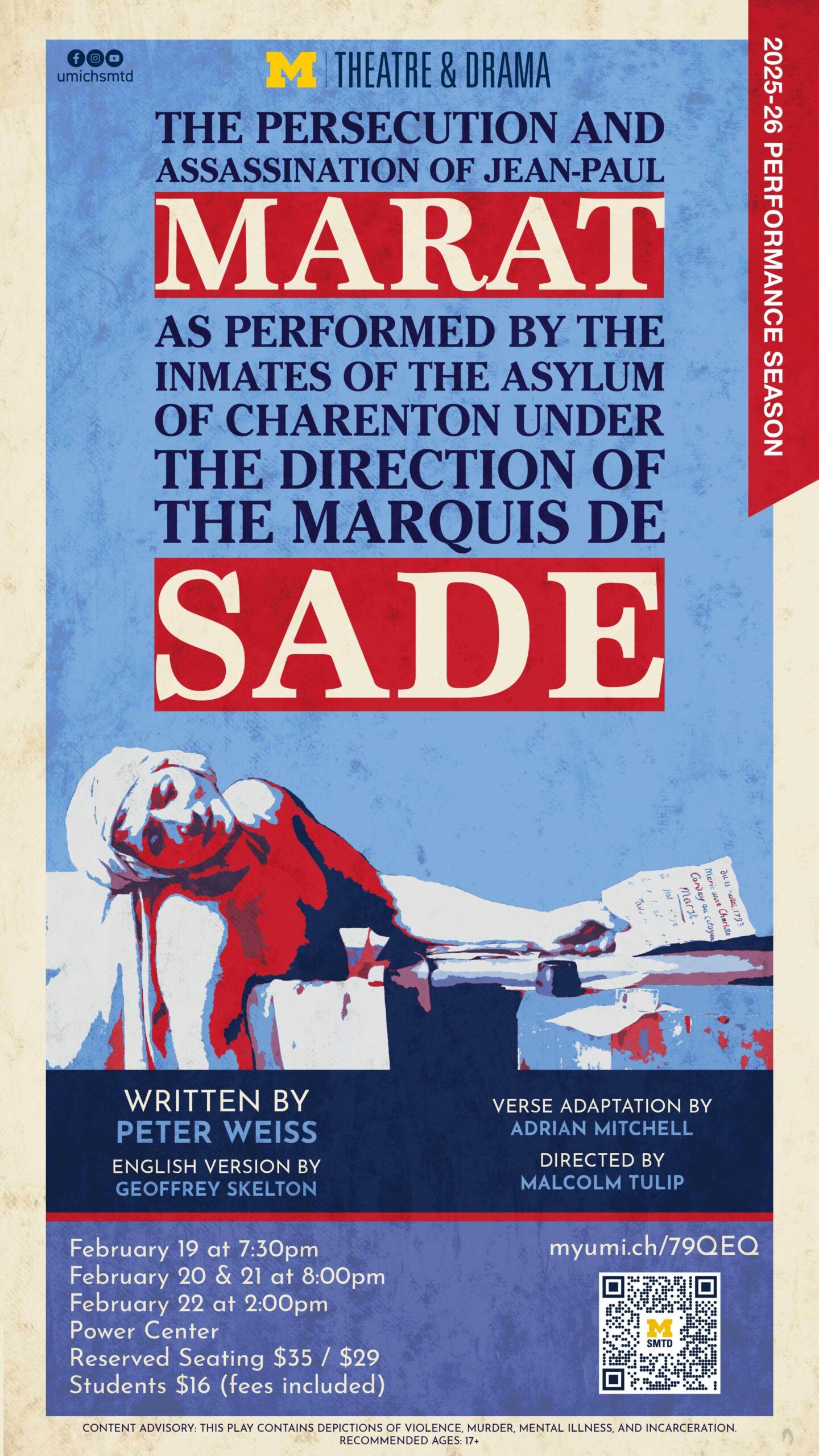
Content Advisory
About the Production
Creative Team
Director Malcolm Tulip
Assistant Director Vera Alonzo †
Scenic Designer Jungah Han
Costume Designer Kayti Sanchez †
Hair & Makeup Designer Brittany Crinson
Lighting Designer Heather Gilbert
Sound Designer Katie Hopgood
Music Director Frank Pahl ‡
Fight Choreographer Christina Traister
Disabilities Consultant Alexis Riley
Dramaturg Karin Waidley
Voice & Speech Coach Jeremy Sortore
Resident Intimacy Choreographer and Cultural Consultant Raja Benz
Production Stage Manager Brook Galsky †
Cast
Marquis de Sade Hayden Steiner
Jean-Paul Marat Simon Nigam
Simonne Evrard Zoe Papadakis
Charlotte Corday Tessie Morales
Duperret Liam Meister
Jacques Roux Zeke Zaharoni
Kokol Mateo St. Remy
Polpoch Sophia Santos Ufkes
Cucurucu Sophia Karaz
Rossignol Ella Saliba
Herald Lewis Jackson III
M. Coulmier Lucas Somers
Mme. Coulmier Ivana Jimenez
Mlle. Coulmier Luciana Gardner
Nurse/Guard DeJon JacksonCast of Characters
Nurse/Guard Louie Diaz
Sister/Nun Georgia Turner
Sister/Nun Shea Giese
Patients Audrey Andrews, Issie Contreras, Lilly Geer, Kaylin Gines, Ella Dale Lewis, Charlotte Rivera
Musicians
Keyboards/Euphonium/Ukelele/Guitar Frank Pahl
Percussion Harry Beau
Violin/Stroviol Mary Riccardi
Production Staff
Assistant Scenic Design Kelly Burkel
Assistant Lighting Design Eliza Anker
Associate Dramaturg Tate Zeleznik
Assistant Dramaturgs Ellie Mayfield, Elby Schader
Assistant Stage Managers Justin Comini, Greta Steever
Production Assistants Kendal Bazerman, Clayton Collins, E. Holmes
Running Crew
Light Board Operator Eva Berney
Projections/Sound Operator Caedmon Kephart
Scenery Crew Landrie Adams, Carly Perrino
Props Crew Ava Barber, Chloe Erwin
Wardrobe Crew Payton Cottrill, Lucy Knas^, Isaiah Liggins, Maxwell Vernon, Amelie Vidrio
Hair & Makeup Crew Alyanna Carriedo, Aileen Pereda, Ellie Van Engen^
Backup Crew Zee Perea
^Crew Head
Shop Crews
Costumes Iliana Beauchamp, Katy Dawson, Sarita Gankin, Lucy Knas, Alex Li, Maya Liu, Rachel Pfeil, Isabella Pruter, Kayti Sanchez, Ellie Van Engen & 250/252/262 students
Lighting Eliza Anker, Morgan Gomes, Ethan Hoffman, Brandon Malin, Tate Zeleznik, Gabriela Ribeiro Znamensky & 250/252/262 students
Paint Gretchen Brookes, Miles Hionis, Norah Klocke, Ren Kosiorowski, Hannah Kryzhan, Ceri Roberts, Seri Stewart^, Amber Walters, Angela Wu & 250/252/262 students
Scenery Kelly Burkel, Ren Kosiorowski, Aiden Heeres, Soph Irfani, Josi Middaugh, Luke Moyer, Michael Russell, Nathaniel Steever & 250/252/262 students
Props Andy Blatt, Kendall Brisco, Brook Galsky, Alex Heskett, Sam McLaughlin, Tessie Morales, Leah Stchur, Reese Stevens & 250/252/262 students
Wigs/Hair/Makeup Gretchen Brookes, Christine Chupailo, Miles Hionis & 250/252/262 students
Production Management Justin Comini, Shelby Holloway, Esther Hwang, Greta Steever
Department of Theatre & Drama
SMTD Leadership
David Gier, DeanPaul Boylan Collegiate Professor of Music
Department of Theatre & Drama
Department Chair Dr. Tiffany Trent
Department Manager/Artistic Administrator Kathryn Pamula
Walgreen Events Manager Nickie Smith
Studio and Performance Manager Arie Shaw
Walgreen Office Coordinator Tyler Brunsman
Performance/Directing Christina Traister (Head of Performance), Halena Kays (Head of Directing), Daniel Cantor (Head of Acting), Raja Benz, Mark Colson, Antonio Disla, Holly Hughes, Tzveta Kassabova, Geoffrey Packard, Jeremy Sortore, Malcolm Tulip, Tiffany Trent
Design/Production Kevin Judge (Head of D&P), Jess Fialko, Heather Gilbert, Jungah Han, Jenn Rae Moore, Christianne Myers, Sarah M. Oliver
Theatre Studies/Playwriting Mbala Nkanga (Head of Theatre Studies), José Casas, Shavonne Coleman, Antonio C. Cuyler, Antonio Disla, Jenna Gerdsen, Amy E. Hughes, Holly Hughes, Jason Fitzgerald, Petra Kuppers, Ashley Lucas, Jay Pension, Rogério Pinto, Alexis Riley, Emilio Rodriguez, Karin Waidley
Arts Management Paul Bonin-Rodriguez, Antonio C. Cuyler, Aaron Dworkin, Afa Dworkin, Ken Fischer, Gala Flagello, Andrew Kuster, Jonathan Kuuskoski, Kari Landry, Robin Myrick, Jay Pension, Jesse Rosen, Omari Rush, Anna Sampson
Interarts Scott Crandall, Holly Hughes, Tzveta Kassabova, Malcolm Tulip
Professors Emeriti Alan Billings, Peter W. Ferran, Jessica Hahn, Philip Kerr, Priscilla Lindsay, Janet Maylie, Vincent Mountain, John Neville-Andrews, OyamO, Leigh Woods
Faculty Advisors
Costume Design Advisor Jess Fialko
Stage Management Advisor Jenn Rae Moore
Staff Mentors
Staff Mentors Laura Brinker, Brittany Crinson, Patrick Drone, Chad Hain, Heather Hunter, Richard W. Lindsay, Beth Sandmaier
University Productions Administrative Staff
Executive Director Jeffrey Kuras
Administrative Specialist Christine Eccleston
Administrative Asst. Emily Erlich
Facilities Manager Shannon Rice
Performance Halls House Mgr. Kelley Krahn
Lead Backstage Operations Mgr. Dane Racicot
Sr. Backstage Operations Mgr. David Pickell
Backstage Operations Mgrs. Tiff Crutchfield, Yvette Kashmer, Brian Koepele, Robbie Kozub
University Productions Production Staff
Director of Productions Aaron Keller
Asst. Production Manager Michelle Williams-Elias
Technical Director (Walgreen) Richard W. Lindsay, Jr.
Theatrical Scenery Manager Chad Hain
Lead Scenic Carpenter Devin Miller
Scenic Carpenter Heather Udowitz
Charge Scenic Artist Beth Sandmaier
Assoc. Theatrical Paint Mgr. Madison Stinemetz
Lead Theatrical Properties Manager Patrick A. Drone
Assoc. Theatrical Properties Manager Danielle Keys
Properties Artisan Adam Ashlock
Theatrical Properties Stock and Tech Coord. Kat Kreutz
Theatrical Lighting Manager Heather Hunter
Assoc. Theatrical Lighting Manager Jorrey Calvo
Theatrical Sound Manager Katie Hopgood
Sr. Costume Shop Manager Laura Brinker
Asst. Costume Shop Manager Leslie Ann Smith
Lead Cutter/Draper Tj Williamson
Cutter/Drapers Sarah Havens, Lani Tortoriello
Stitchers Mag Grace, Rene Plante
Lead Costume Crafts Artisan Elizabeth Gunderson
Costume Stock Manager Theresa Hartman
Wardrobe Manager Meredith Miller
Theatrical Hair and Makeup Mgr. Brittany Crinson
Resources
- About the Performance
- About the Author
- About the Cast
- About the Creative Team
- Director's Note
- Timeline of the French Revolution
- Statement on Disability Representation
- Dramaturg's Note
- Statement on the Anishinaabe Land Transfer
- Freedom of Expression Statement
- Download Program
Setting: The bathhouse of the asylum of Charenton, 1808.
There will be one 15-minute intermission.
Marat/Sade is produced by special arrangement with the Dramatic Publishing Company of Woodstock, Illinois, and the ECS Publishing Group.
Latecomers will be seated at a suitable break. As a courtesy to others, please turn off cellular phones and refrain from texting during the performance. Photography, audio recording, and videotaping of any kind are not permitted.
The performers in this production are students in the Department of Theatre & Drama. The designers for this production are students, faculty, and/or guests of SMTD. Scenery, costumes, properties, sound, and lighting were realized by the students and staff of University Productions, the producing unit of SMTD. Thank you for supporting our educational mission.
Peter Weiss (Playwright) was a German dramatist and novelist whose plays achieved widespread success in both Europe and the United States in the 1960s. The son of a textile manufacturer who was Jewish by origin but Christian by conversion, Weiss was brought up a Lutheran. In 1934 he and his family were forced into exile by Nazi persecution. He lived in England, Switzerland, and Czechoslovakia before settling, in 1939, in Sweden. His initial literary influence was the novelist Franz Kafka, whose dreamlike world of subtle menace and frustration impressed Weiss. Weiss’s Die Verfolgung und Ermordung Jean Paul Marats, dargestellt durch die Schauspielgruppe des Hospizes zu Charenton unter Anleitung des Herrn de Sade (usually referred to as Marat/Sade) pits the ideals of individualism and of revolution against each other in a setting in which madness and reason seem inseparable. The play was first performed in West Berlin in 1964 and received a celebrated staging in New York City in 1965 by Peter Brook, who filmed it in 1967. Weiss’s other plays include documentary dramas attacking Portuguese imperialism in Angola, Gesang vom lusitanischen Popanz (1967; The Song of the Lusitanian Bogey), and American policy in the Vietnam War, Viet Nam Diskurs (1968; Discourse on Viet Nam).
—Adapted from Brittanica.com
Geoffrey Skelton (English Translation) was a British author and translator. He specialized in German music, writing biographies of Richard Wagner, Cosima Wagner, Wieland Wagner, and Paul Hindemith. He also translated numerous plays by leading German-language writers such as Bertolt Brecht, Max Frisch, and Peter Weiss. He won the Schlegel-Tieck Prize twice, the first one for his translation of Robert Lucas’s biography of Frieda Lawrence and the second one for Siegfried Lenz’s novel The Training Ground.
—From Wikipedia.org
Audrey Andrews (Patient) Senior, BFA Acting/Dance minor, Denver, CO
Issie Contreras (Patient) Senior, BFA Acting/Playwriting minor, Dyer, IN
Louie Diaz (Nurse/Guard) First-year, BFA Acting, Allen Park, MI
Lilly Geer (Patient) Junior, BFA Acting/Business and Asian American Studies minors, Grosse Pointe, MI
Shea Giese (Sister/Nun) First-year, BFA Acting, Milford, MI
Kaylin Gines (Patient) Senior, BFA Acting, Orlando, FL
DeJon Jackson (Nurse/Guard) First-year, BFA Acting, Auburn Hills, MI
Lewis Jackson III (Herald) Senior, BFA Acting/Education for Empowerment minor, Detroit, MI
Ivana Jimenez (Mme. Coulmier) First-year, BFA Acting/Dance minor, Tucson, AZ
Sophia Karaz (Cucurucu) Senior, BFA Acting, Denver, CO
Ella Dale Lewis (Patient) Senior, BFA Acting, San Francisco, CA
Liam Meister (Duperret) Sophomore, BFA Acting/Political Science/Pre-Law, Helotes, TX
Tessie Morales (Charlotte Corday) Senior, BFA Acting/BA Sociology and Social Work, Holland, MI
Simon Nigam (Jean-Paul Marat) Sophomore, BFA Acting/Playwriting minor, Pittsburgh, PA
Zoe Papadakis (Simonne Evrard) Sophomore, BFA Acting/Popular Music Studies minor, Seattle, WA
Charlotte Rivera (Patient) Sophomore, BFA Acting/Dance minor, Ridgewood, NJ
Ella Saliba (Rossignol) Senior, BFA Acting/Creative Writing minor, Nashville, TN
Sophia Santos Ufkes (Polpoch) Senior, BFA Acting, Seattle, WA
Lucas Somers (M. Coulmier) Sophomore, BFA Acting/PAME minor, Howell, MI
Mateo St. Remy (Kokol) Sophomore, BFA Acting/LSA, Norfolk, VAAbout the Cast
Hayden Steiner (Marquis de Sade) Senior, BFA Acting, San Diego, CA
Georgia Turner (Sister/Nun) First-year, BFA Acting, Blowing Rock, NC
Zeke Zaharoni (Jacques Roux) Junior, BFA Acting, Los Angeles, CA
Harry Beau (Percussion) In a blender combine two cups of mixed organic berries, one whole banana, two tablespoons of vanilla protein powder, a handful of fresh greens, tablespoon of chia seeds, two cups of cold, chilled, sugar-free almond milk (honey optional). Blend until smooth. Drink immediately.
Brittany Crinson (Hair & Makeup Designer) is the Wigs, Hair, and Makeup Studio manager and designer for all of UProd. Crinson spent several years in Chicago building her portfolio and skill set as a wig, hair, and makeup designer. Her credits include hair department head of HBO’s Somebody Somewhere, season 3; the head of hair and makeup for the Joffrey Ballet for several seasons; and hairstylist on Hulu’s The Bear, seasons 1-4, in addition to designing for theatres around Chicago and Detroit. She is thrilled to be back for her 2nd full year at U-M.
Brook Galsky (Production Stage Manager) is honored to serve as Marat/Sade’s production stage manager. This is their first time in this role at UProd, previously having served as a PSM for Basement Arts’ Macbitches and assistant stage manager for Julius Caesar. If you don’t see him typing quirky Daily Call signatures, you may have also seen him as a dramaturg for Gloria, MUSKET’s The Hunchback of Notre Dame, and Majestic Repertory Theatre’s Emma. He has also been a costume designer for Golden Theatre Company, one-year board member of Basement Arts, and props artisan at the Prop
Shop. It may be quicker to say what Galsky hasn’t done. As a disabled theatremaker, he is grateful to have helped bring this play’s revolutions to life. Galsky would like to thank their family in Vegas, their friends, and their mentors for encouraging them to keep shining. “Nothing about us, without us.”
Heather Gilbert (Lighting Designer) is a new faculty member in lighting design at SMTD and is thrilled to be here. Her work includes the Broadway productions of Little Bear Ridge Road, Dead Outlaw, Good Night and Good Luck, Cult of Love, Parade, and The Sound Inside. She has been nominated for three Tony Awards as well as Drama Desk and Outer Critics Circle awards for this work. Gilbert also worked in the many theaters of Chicago over the course her career, from Steppenwolf to the many storefronts. Her work has also been seen in many regional theaters including the Guthrie, Berkeley Rep, Actors Theatre of Louisville, Studio Theatre in DC, and many more.
Jungah Han (Scenic Designer) is a New York-based freelance set designer, specializing in theatre, film, and television. Her work spans a wide range of artistic mediums, with recent design credits including Chiaroscuro: A Light and Dark Skin Comedy (Flea Theatre), My Onliness (Sibiu International Theater Festival), The Duat (Philadelphia Theatre Company), Disinform (American Opera House), A Little Night Music (Power Center), Grand Horizons and The Chinese Lady (Tipping Point Theatre), and L’incoronazione di Poppea (Brockman Hall for Opera). Other highlights include The Power of the Dog (Juilliard School), Bernarda Alba (Arthur Miller Theatre), and Don Giovanni (Lydia Mendelssohn Theatre). In addition to her freelance work, Han has also contributed as an associate and assistant set designer for several Broadway and international productions, such as Lempicka (Longacre Theatre), The Thanksgiving Play and Kite Runner (Helen Hayes Theatre), Jagged Little Pill (national tour), The Empire of Light (Théâtre National de Bretagne, France), and Rigoletto (Die Staatsoper Unter den Linden). Her artistic journey has
About the Creative Team About the Creative Team
been deeply influenced by mentors like Ming Cho Lee, Ralph Funicello, and Riccardo Hernandez and has led her to expand her creative work beyond theatre into film and immersive art projects. Han received her MFA from the David Geffen School of Drama at Yale and currently teaches at the University of Michigan, Ann Arbor. She currently serves as an executive committee member at the Nam Center for Korean Studies and as a scenic design exam review committee member for USA 829. Visit her website at jungahhan.com for more details.
Katie Hopgood (Sound Designer) is thrilled to be joining the team for Marat/Sade. Credits: Broadway: Birthday Candles (Roundabout’s American Airlines Theater). Regional credits include: Mrs. Harrison (Williamston Theatre), Nora, 8 nights, Clyde’s, Soft Target (Detroit Public Theatre), Julius Caesar (PlayMaker’s Repertory Company), The Beauty Queen of Leenane (Detroit Public Theatre), The Tempest, Richard III, Twelfth Night, Hamlet, Love’s Labour’s Lost (Michigan Shakespeare Festival). Chicago: Into That Darkness, The Corrosive Hours of Edgar Allan Poe (The Edge Off-Broadway), Love’s Labour’s Lost (Lifeline Theatre), Titus Andronicus (Babes with Blades), The Electric Baby, Wrens (Rivendell Theatre Ensemble).
Frank Pahl (Music Director/Musician) began writing music for theatre, film, and dance in 1990 for Malcolm Tulip’s productions with Prospero Theatre. He’s a frequent collaborator with Milwaukee’s Theatre Gigante. His music appears on over one hundred releases, ranging from toypop to jazz to avant folk. He’s toured North America, Europe, and Japan as a soloist and with the group Only a Mother. Pahl currently teaches sound-related courses at CCS in Detroit and frequently composes silent film scores performed live with his trio Little Bang Theory. Pahl received his MFA from U-M Stamps School in 1998 and is a recipient of a Kresge Arts Award for sound art. He’s thrilled to join this production of Marat/Sade.
Mary Riccardi (Violin) is a musician whose musical tastes About the Creative Team
were forged in Detroit and refined in concert halls of Europe where she spent the better part of two decades studying and performing. During that time, she played and recorded with such renowned groups as Il Complesso Barocco, La Capella Neapolitana, and Modo Antiquo. Upon returning to North America, she co-founded l’Invenzione, which draws on the rich musical repertoire of 18th-century Naples. As concertmaster of the Michigan Bach Collective, Riccardi has helped bring historically informed performances to the Great Lakes region. She has appeared with Publick Musick, Apollo’s Fire, the Four Nations Ensemble, and Pegasus Early Music and has recorded with the Boston Early Music Festival Orchestra. In addition to the baroque violin, she enjoys coaching young string players and cultivates her varied musical interests through continuing projects with Detroit-based experimental composers.
Kayti Sanchez (Costume Designer) is a proud Latina from South Florida. She is a senior BFA theatre design and production student with a concentration in costume design and a minor in Latino/a studies. U-M (CD): Cabaret, A Few Good Men, Blood at the Root. Broadway: Here Lies Love (CD Intern). Regional: Virgin, Mother, Whore (CD)(LATA winner for Best Costume Design). Love and gratitude to her community, Malcolm and the whole Marat/Sade team, the amazing costume shop, Jess, and mi familia. Azucar! kaytisanchez.com
Jeremy Sortore (Voice & Speech Coach) (he/him) is an associate professor in the Department of Theatre & Drama. Regional: American Repertory Theater, Utah Shakespeare Festival, Colorado Shakespeare Festival. Member, National Alliance of Acting Teachers; associate faculty, Theatrical Intimacy Education; associate teacher of Fitzmaurice Voicework; certified teacher of Knight-Thompson Speechwork; certified Vocal Combat Technique trainer/coach; PAVA-recognized vocologist; editorial board, Journal of Consent-Based Performance; associate editor, Voice & Speech Review. Education: Moscow Art Theater School/American Repertory Theater Institute at Harvard University. JeremySortore.com
Malcolm Tulip (Director) is an associate professor (performance) of theatre & drama at the University of Michigan. He studied dance and art at Goldsmiths’ College, University of London, and is a graduate of L’École Jacques Lecoq, Paris. He teaches directing, movement, mask, clown, and devised theatre and has directed over 40 productions. He has performed in Berlin and the US with Tanz Tangente and Michael Gould and in NYC and Uppsala, Sweden, with dancer Amy Chavasse. Tulip has also written, produced, and performed in eight original plays under the name of Prospero Theatre Co. He toured Europe and the US with I Gelati Theatre Co. and Theatre Grottesco and at several regional theatres and festivals. On film, he appeared in Derek Jarman’s The Tempest. Tulip is a member of American Actors Equity and the Association of Theatre Movement Educators.
The process usually referred to as rehearsals has for this production been renamed investigations. Perhaps it may have been a subconscious recalling of playwright Peter Weiss’s play The Investigation, but more concretely I chose this term to accurately reflect the process that engages me with all productions. I have an idea of what the piece might become, but it is only in the studio, through experimentation with the cast, in conversation with the design elements and with the vibrations of the music and the text, that a performance emerges from the mist. The last time I directed this play I believe we had 10 weeks in the studio space; for this we have had five. The figures that influence me, Bertolt Brecht and Peter Brook, were able to have processes of three, six months or more. In those circumstances an investigation can proceed at leisure. In the capitalist system time is money and sorestrictions are ever present.
The structure of the text and the nature of the themes are modelled on the work of Brecht. His ideas are not as dense as many wish to make them. Perhaps scholars, by keeping watch over his theories, maintain control, much as priests retained control of their congregations by conducting their services in Latin. In our process I have endeavored to render all concrete. For you, the simplest thought to hold onto is that we are here not to “tell a story” but to present ideas to consider. In watching Marat/Sade, it is not unlike walking through an artist’s exhibition: the paintings all have different statements, but they all belong in the same gallery.
—Malcolm Tulip, director
Causes of the French Revolution: France was in significant debt following its involvement in the American Revolution combined with extravagant spending from the French royalty, causing unrest among the lower class.
Girondins vs. Jacobins: The two main political factions during the French Revolution, differing primarily in their radicalism: Girondins were moderate republicans favoring decentralized power and economic liberalism, while Jacobins, led by Maximilien Robespierre, were radical centralists who supported strong government, price controls, and the execution of the king, ultimately leading to the Reign of Terror.
June 17, 1789: Members of the lower class declare themselves the “National Assembly” with the goal of establishing a new constitution, which would ensure equal rights and a new government based on popular sovereignty.
July 14, 1789: The Storming of the Bastille: revolutionary insurgents entered the Bastille, which represented royal authority in the centre of Paris and was seen by the revolutionaries as a symbol of the monarchy’s abuse of power. Its fall was seen as the beginning of the French Revolution.
August 26-October 6, 1789: The National Assembly introduces the Declaration of the Rights of Man and of the Citizen, which outlines universal rights like liberty, property, and security. However, the king refuses to sanction it, resulting in Parisians marching to Versailles and forcing the royal family back to Paris.
September 20-21, 1792: A new assembly, the “National Convention,” meets, abolishes the monarchy, and establishes a republic.
January 21, 1793: King Louis XVI, judged by the convention, is executed for treason. Timeline of the French Revolution
September 5, 1793-July 27, 1794: The Reign of Terror, overseen by Robespierre, is a period when the revolutionary government took harsh measures against those suspected of being enemies of the Revolution. These suspected enemies, including nobility like Marie Antoinette, were guillotined by the thousands.
July 28, 1794: Robespierre is overthrown in the National Convention and executed, signalling the end of the Reign of Terror. Then, the National Convention is dissolved, making way for the five-person Directory government.
1796-1799: Napoleon, a general, leads French forces to a series of victories against the Austrians in northern Italy.
November 9-10, 1799: Napoleon joins the plot to overthrow the Directory, considered the effective end of the French Revolution. A new government, the Consulate, is established, and Napoleon is made first consul, or leader of France.
1804: Napoleon crowns himself emperor of France in a lavish ceremony at the Cathedral of Notre Dame in Paris.
1808: Napoleon invades Spain, deposing the Spanish king and installing his brother Joseph, leading to the Peninsular War.
The world of Marat/Sade invites us all, once again, into the asylum. In doing so, the play calls up longstanding images of mental disability and distress: the unintelligible raving of the lunatic, the wild gestures of the madman, the blank stare of the melancholic. That these images are so readily available to us in our present speaks to the durability of disability metaphors. Indeed, disabled characters are rarely written as fully formed roles; rather, they more commonly function as abstract symbols for nondisabled characters’ (and, by extension, nondisabled audiences’) physical and psychic anxieties.
At first glance, playwright Peter Weiss’s script seems to repeat the tired trope; after all, in this play-within-a-play, asylum inmates are literally cast to perform what amounts to a political treatise penned by their self-appointed director, the Marquis de Sade. And yet, the text itself is not so straightforward; here, actors do not play characters so much as they play at characters, stepping out of themselves, into the asylum inmates, into the characters these asylum inmates play, and back again.
The disorienting result is a play that takes madness as both its subject and its method. In challenging us to follow this mad method, Marat/Sade ultimately prompts us to grapple with our own (often visceral) reactions to those whom we deem unreasonable—and the carceral impulses that so often follow. These questions—and the forms of critical generosity they might inspire—remain urgent within disability communities, even as they exceed those communities. Indeed, within our current political moment, such critical generosity is no less needed than it was 218 years ago, at a radical asylum located on the outskirts of Paris, France…
— Alexis Riley, Disability Consultant
a revolution: “the turning about of an object on a central axis thereby landing its journeyman in the same exact spot whereon they started.”
Marat/Sade“We stand here more oppressed than when we begun, and they think that the revolution’s been won.”
Peter Weiss’s masterpiece explores a debate among the revolutionaries of a moment and, on a deeper level, human conflict, cycles of oppression, and what “revolution” truly means across time. An artistic reaction to the world swirling around in the heat of the 1960s as the Vietnam War raged and fears of Communism pervaded, Marat/Sade is a representation both of what people experienced during the post-French Revolution rise of Napoleon and a turbulent decade 150 years later, a metaphor and meta-theatrical experience that created a jarring connection between the two time periods, using a “then” to force audiences to examine the “now.” What is particularly compelling is that oppression by those in power and the way citizens choose to rise up against it, or not, still remain as relevant today as they were in 1960s America and 19th-century France. Thus, the play written more than half a century ago also functions as a vessel for storytelling that highlights contemporary problems through distant, long-ago circumstances.
Weiss does this by using a Brechtian approach, asking the audience to constantly be aware that they are watching actors on a stage, performing a play that takes place both in the now and in the then. This effect also encourages the audience to be conscious of how dialogue not only creates the in-scene present but reaches beyond the stage to them in the contemporary world. Characters like Coulmier discuss how French society has evolved from social unrest and brutal instability; yet at a time only 15 years distant from the worst and bloodiest Dramaturg’s Note
days of the French Revolution, the exploits of Napoleon repeat many of the same mistakes. When will the cycle end, these characters ask? This concept of perceived change versus actual difference is relevant across all of history. As human beings, it is in our nature to want to improve our society in any way possible; yet, is change truly possible when there is always someone at the top and someone at the bottom?
“Marat, we’re poor and the poor stay poor.”
Marat/Sade implicates the audience as complicit in this cyclical suffering, forcing us to confront our own consumption of violent spectacle. Are we witnesses, or participants, or both? For this reason, we consider three time periods in our creation of this show. We consider the patients who witnessed violence and feared for their safety during the Revolution – we consider their fear or, in the case of Marat, their participation throughout the Reign of Terror, when the Committee of Public Safety executed anyone who disagreed, labeling them enemies of the Revolution. We consider how that same fear was felt or observed again in the 1950s and 1960s, when some pointed fingers and many lost their livelihoods, blacklisted in the name of safety as part of McCarthyism and the Red Scare.
And yes, we consider today, as we witness people villainized (in the streets), many times due to baseless accusations and assumptions, and made victims of state violence.
Each of these eras is equally historically relevant and equally impactful to the production. Through Brechtian distancing, Weiss shows us that “revolution” is not a closed chapter of history, not a singular circle that starts and ends in the same place, but an ongoing, never-ending process of change that demands that we question not only the systems we both participate in and oppose, but the methods we use to resist and the costs they carry.Dramaturg’s Note
When does the pursuit of justice become another form of control?
Is meaningful social change possible without disruption?
What happens when movements for freedom begin to resemble the systems they aimed to overthrow?
—Written by Ellie Mayfield and Elby Schader
Anishinaabeg gaa bi dinokiiwaad temigad manda Michigan Kichi Kinoomaagegamig. Mdaaswi nshwaaswaak shi mdaaswi shi niizhawaaswi gii-sababoonagak, Ojibweg, Odawaag, minwaa Bodwe’aadamiig wiiba gii-miigwenaa’aa maamoonjiniibina Kichi Kinoomaagegamigoong wi pii-gaa aanjibiigaadeg Kichi-Naakonigewinning, debendang manda aki, mampii Niisaajiwan, gewiinwaa niijaansiwaan ji kinoomaagaazinid. Daapanaming ninda kidwinan, megwaa minwaa gaa bi aankoosejig zhinda akiing minwaa gii-miigwewaad Kichi-Kinoomaagegamigoong aanji-daapinanigaade minwaa mshkowenjigaade.
The University of Michigan is located on the traditional territory of the Anishinaabe people. In 1817, the Ojibwe, Odawa, and Bodewadami Nations made the largest single land transfer to the University of Michigan. This was offered ceremonially as a gift through the Treaty at the Foot of the Rapids so that their children could be educated. Through these words of acknowledgment, their contemporary and ancestral ties to the land and their contributions to the University are renewed and reaffirmed.
Thank you for attending this program. The University of Michigan strives to create a truly open forum, one in which diverse opinions can be expressed and heard. You can see our full Freedom of Expression policy at smtd.umich.edu/FOE