
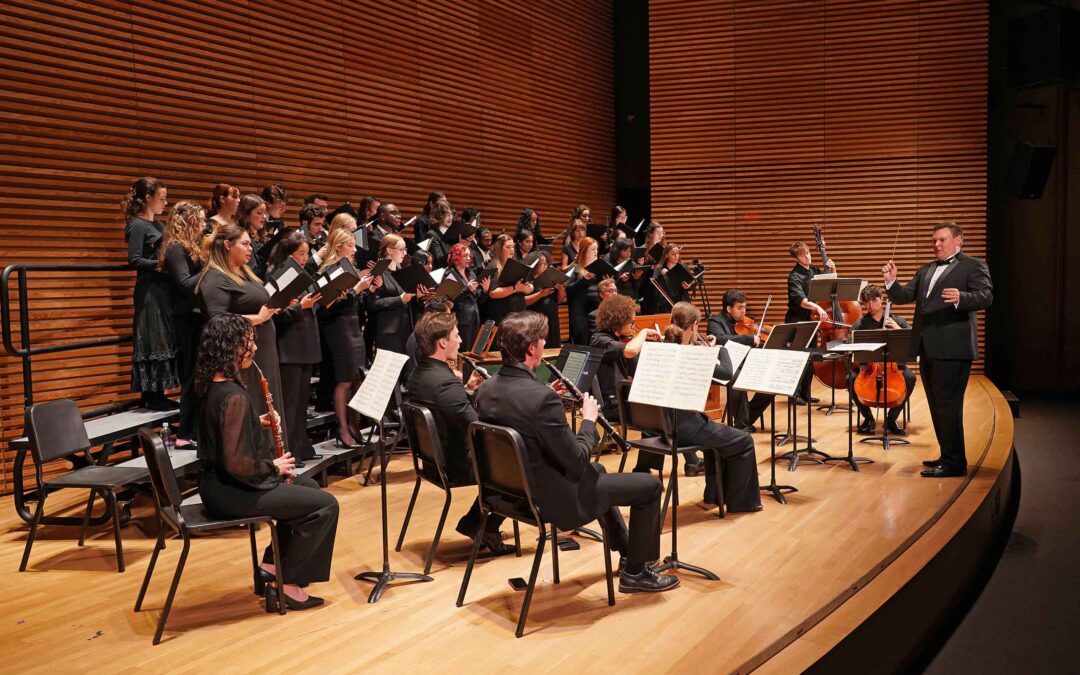
Michigan Muse Fall 2026 > Maximizing Podium Time
Maximizing Podium Time: Campus Ensembles Provide DMA Conducting Students with Abundant Opportunities to Lead
By Marilou Carlin
For aspiring conductors, the key to perfecting their art is to lead ensembles as often as possible. Whether orchestra, band, or choir, the hands-on practice of planning, rehearsing, and performing concerts is the heart and soul of a conductor’s professional development.
“Unlike any other musician, a conductor can only practice so much on their own,” said Rotem Weinberg (MM ’17, DMA ’20, orchestra conducting). “We need to conduct musicians in order to improve and develop a connection between our gestures and sound.”
Kenneth Sieloff (BM ’12, music education), a current doctor of musical arts (DMA) pre-candidate in choral conducting, agrees: “Conducting cannot be learned only through study; it requires repeated experience working with real people, responding to what they need, and adjusting in the moment.”
At Michigan, the select group of students who are enrolled in the DMA conducting program at any given time (usually three each in band, choir, and orchestra conducting) are given abundant opportunities for podium time. This includes the chance to guest conduct the School of Music, Theatre & Dance’s storied ensembles, such as the Symphony Band, Chamber Choir, and University Symphony Orchestra, which consist of SMTD student musicians and are led by SMTD faculty. They also may serve as associate conductors, in which they share, with other graduate and/or doctoral students, conducting duties for select SMTD ensembles, such as the Orpheus Singers.
But just as importantly, the DMA candidates, in their roles as graduate student instructors, also lead many of the university’s campus ensembles – those whose members are not music majors. This results in some of the most comprehensive professional training experiences of their degree program: they are involved in every aspect of preparing their ensemble for concerts as they synthesize all that they have previously studied and are continuing to learn about their art.
“This is where they get to implement the skills that they’re learning from their applied faculty, all the different technical things that they’re working on, and their knowledge and ability to ingest a score, and they’re putting it into practice in real time,” said Courtney Snyder, chair of the conducting department and associate director of bands. “So they’re able to improve on their own individual skill sets while also developing their rehearsal skills, all of which are important facets of conducting.”
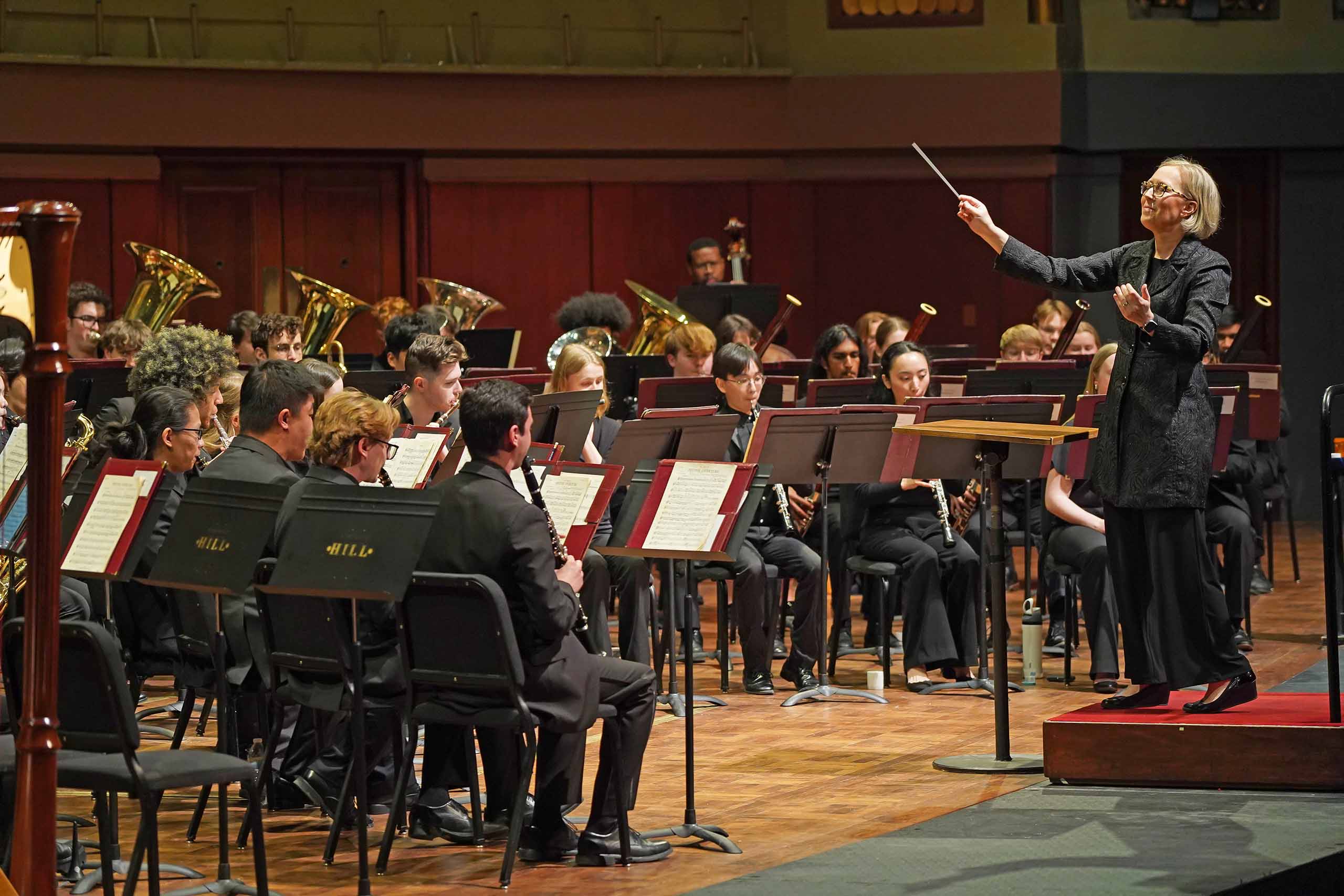
Conducting chair Courtney Snyder leads the Concert Band at Hill Auditorium, April 2026. Photo: Peter Smith
“Instilling a Lifelong Love of Music in Others”
Jen Hepp, now in year two of the three-year DMA program in band conducting, had the honor in her first year of leading a wind ensemble that features student musicians from across campus. “As lead director for the Campus Maize Band, I had the privilege of taking ownership over the ensemble, which is quite a rare opportunity for graduate conducting students generally,” she said. “I was able to serve as the ‘CEO’ of the ensemble and made decisions about repertoire and programming, the rehearsal structure, the pacing of the rehearsal cycle, and much more, allowing me to truly hone my director skills.”
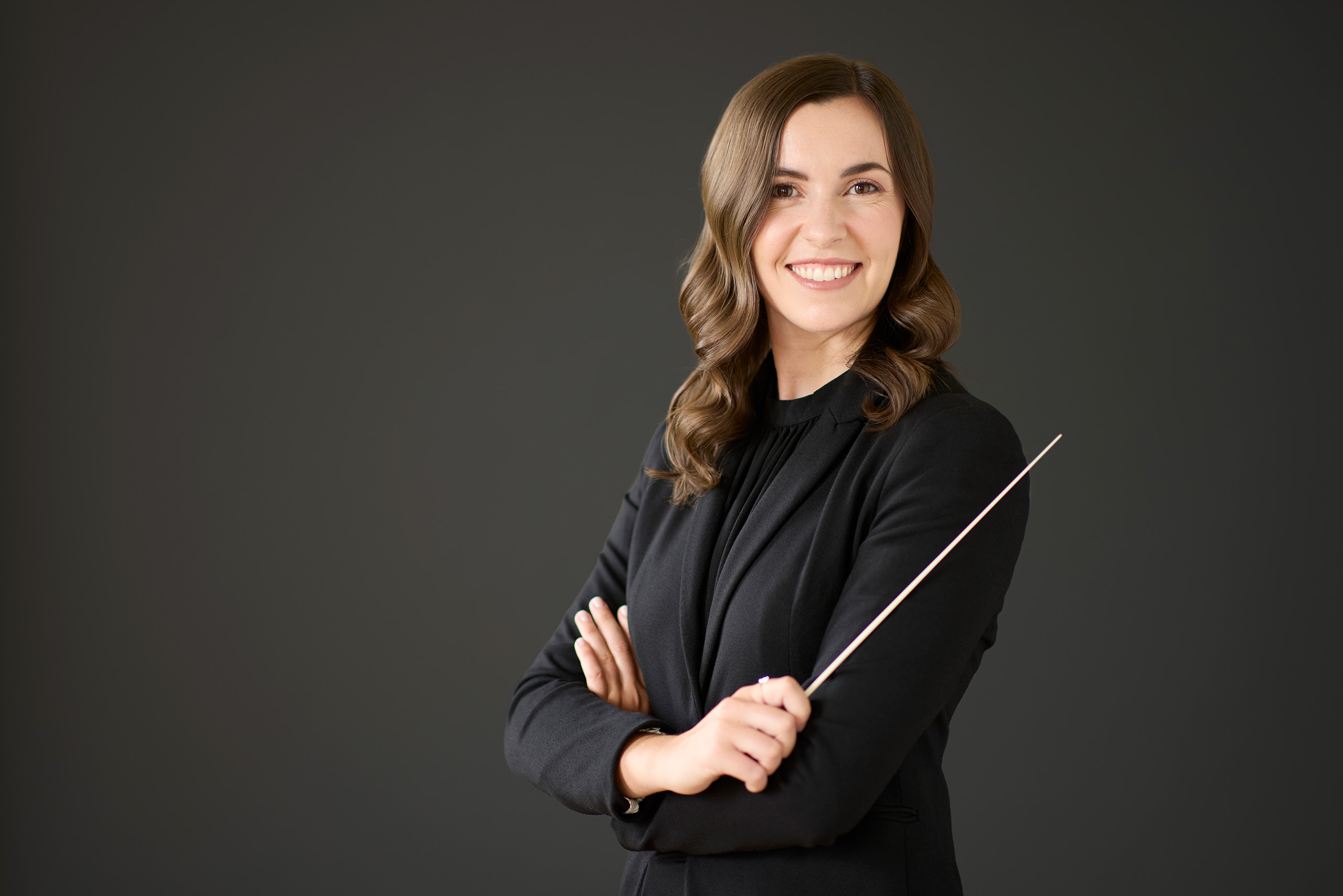
Jen Hepp
The Campus Maize Band is one of many U-M campus ensembles that are primarily for those who are not music majors; these students have previous music experience and participate in the ensembles for course credit. Most developed their love of music in high school ensembles and want to keep music active in their lives while pursuing other academic goals.
The ensembles provide that opportunity, and create a win-win-win paradigm: They allow conducting DMA candidates to take on the broad and demanding responsibilities of a music director; they give non-music majors the opportunity for an immersive, semester-long experience in music-making; and they further enhance the rich cultural landscape of U-M and Ann Arbor through their free performances.
“Leading the campus ensembles is especially meaningful because they are mostly made up of students who have not chosen to major in music, but still wish to keep playing their instrument, which I think is extraordinarily beautiful,” said Hepp. “I believe passionately in instilling a lifelong love of music in others, from cradle to grave – and the campus ensembles program here is the embodiment of this philosophy.”
Sieloff served as conductor of Arts Chorale last year, a choir for non-music majors. He said that the voluntary nature of the choir – the fact that the students choose to be there not for a degree requirement or curricular obligation, but because they simply want to sing with other like-minded students – inspired him as a conductor.
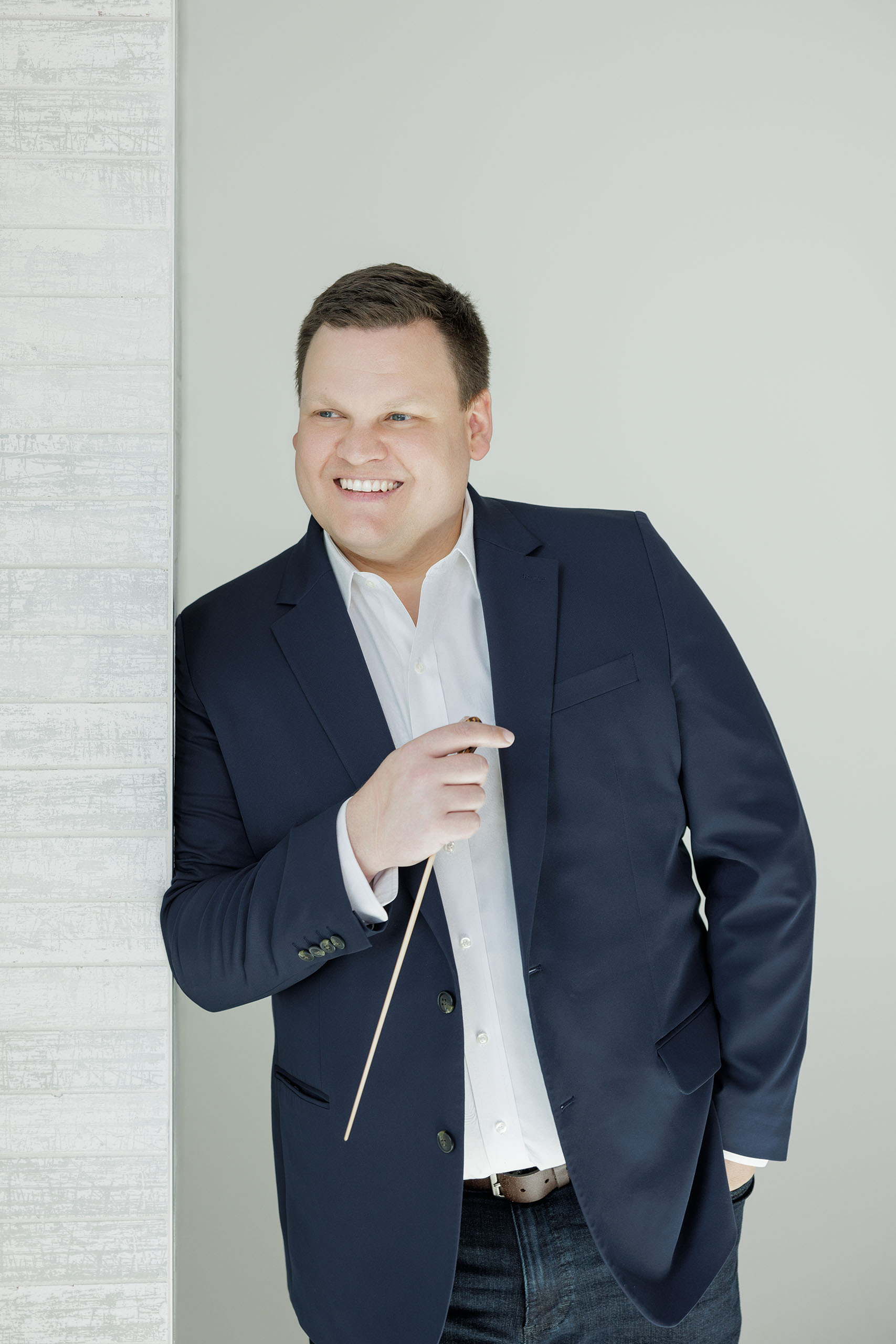
Kenneth Sieloff
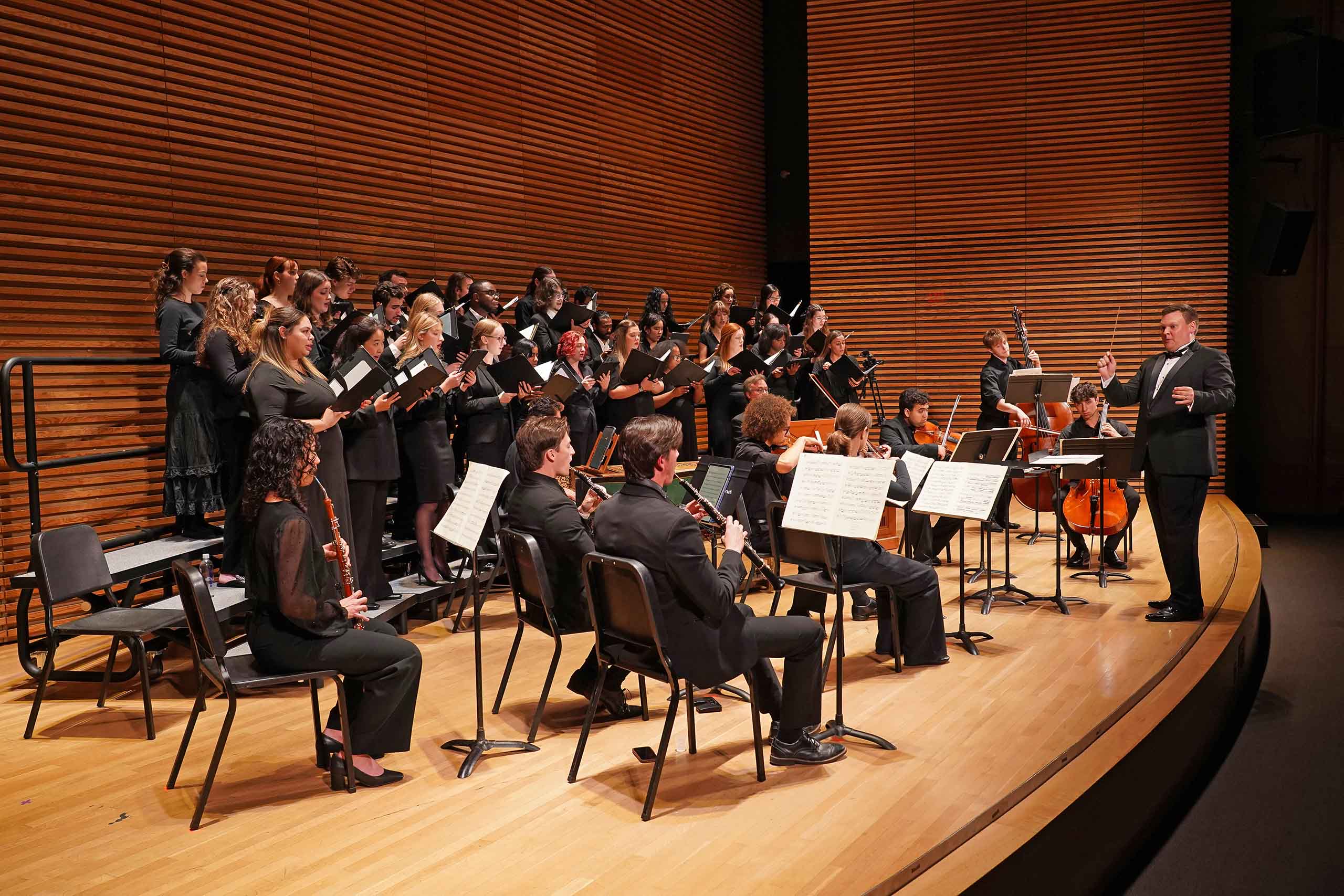
Kenneth Sieloff conducts the Orpheus Singers in Stamps Auditorium, October 2025. Photo: Peter Smith
“Members arrive because they want music, community, and artistic expression to be part of their lives, even amid demanding academic schedules, laboratories, research, internships, and other commitments,” he said. “Their choice to be present brings a particular energy, generosity, understanding, and sense of ownership to the ensemble. It also challenges me, as the conductor, to honor that choice by making each rehearsal purposeful, welcoming, musically ambitious, and worthy of the time they have elected to give.”
Leading the ensemble, he added, was uniquely instructive. “Each rehearsal gave me the opportunity to put into practice ideas and skills that I have studied diligently for years: gesture, score preparation, rehearsal pacing, vocal pedagogy, communication, programming, cultivation of ensemble sound, and fostering an environment of collaborative work.”
From the Focus of Rehearsals to the Expansive Nature of Concerts
The rehearsal schedules of the campus ensembles, which are usually about once a week, establish a long-term committed relationship between the musicians and the conductor. Snyder says rehearsals often loom larger than the concerts themselves in terms of the professional experience the DMA students gain.
“The rehearsals are really the bread and butter of the whole thing,” said Snyder. “That’s where you’re really connecting with the students and you’re polishing your chops to make sure you understand how to effectively and efficiently communicate.”
Hepp says that while concerts are rewarding, providing a payoff for all the preceding hard work, she often finds more joy throughout the rehearsal process, as she and the musicians work together to create a product they are proud of while also getting to know one another.
Still, the concert itself offers its own unique learning opportunities.
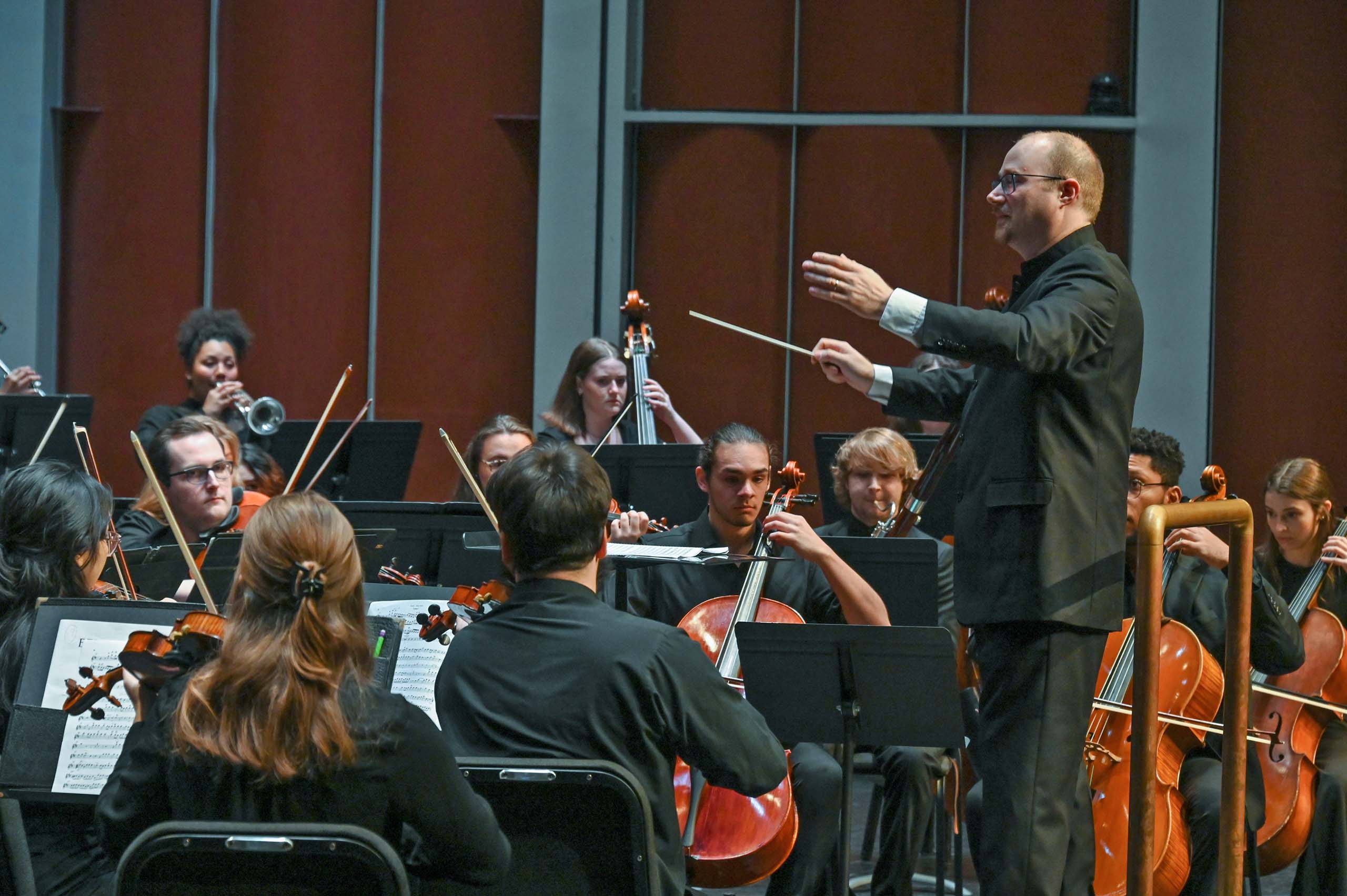
Rotem Weinberg conducts the West Virginia University Symphony Orchestra.
“While we put a lot of the infrastructure for the performance in rehearsals, conducting a concert brings everything up a notch – there is no stopping or going back, and the conductor must manage the group’s energy (and their own) so the music unfolds as intended,” said Weinberg.
The presence of an audience adds an entirely new element to the months of listening, communicating, problem-solving, encouraging, and building trust with fellow musicians, says Sieloff. He sees the concert as an act of communication between the performers and the audience.
“In rehearsal, we may be incredibly focused on a single vowel, a nuanced phrase, a transition, or a select few measures,” he said. “In performance, those individual decisions come together to communicate something much larger.”
U-M’s Diversity of Ensembles Makes for “an Incredible Lab”
In leading both campus ensembles and SMTD ensembles, the DMA candidates also gain fluency at shifting gears to accommodate different levels of musicianship, experience, and goals. This is a valuable asset for their future professional or academic careers where they may be engaged to conduct everything from a youth or community group to a professional ensemble. Snyder sees this dexterity as intrinsic to their success.
“They all need to be able to be comfortable in front of a professional group that has a high expectation and where they can match them musically, but also, have the skill to be able to make an amateur group sound the best that they are able to sound,” she said.
At Michigan, Weinberg not only conducted the Campus Philharmonia Orchestra and the Campus Symphony Orchestra, but was also selected by audition to serve as music director of the Michigan Pops Orchestra (MPO), a role he held for four years while studying for his master’s in music and DMA. This is a completely student-run and student-directed orchestra that members join not for credit, but purely for the joy of making music. As such, it has a highly social aspect to it, with many activities scheduled throughout the year, in addition to concerts.
“Leading both types of groups was incredibly instructive for me,” he said. “In terms of format, the campus orchestras taught me how to run an orchestra class and deal with decisions that collegiate instructors face, while the MPO required balancing fun and excellence, as well as guiding and collaborating with a student board. The similar parts between them were the conducting skills, rehearsal skills, designing the term-long rehearsal process, choosing balanced musical programs, and motivating students. Working with these groups for several years was an incredible lab that allowed me to hone all of these crucial musical and communication skills and prepared me for my current career as a collegiate orchestra conductor.”
Today, Weinberg is the director of orchestral activities and assistant professor of music at West Virginia University (WVU), where he conducts the WVU Symphony Orchestra and teaches graduate and undergraduate conducting.
In addition to the MPO, other unique U-M ensembles where DMA candidates serve as conductors are the Life Sciences Orchestra, comprising faculty, staff, students, alumni, and volunteers in U-M’s life sciences (including the entirety of Michigan Medicine and all of the medical and health schools), and the Michigan Youth Chamber Singers, featuring high school students. Sieloff led the Michigan Youth Chamber Singers in 2024, bringing him full circle: he was a member of that choir when he was in high school.
Gaining Essential Experience in the World of Marching and Athletic Bands
Of course, some of the most renowned of the non-music-major ensembles at U-M are the Michigan Marching Band and the Men’s and Women’s Glee Clubs – all of which include some SMTD students but largely consist of students from other U-M schools and colleges. The DMA students get opportunities to guest conduct these renowned ensembles, working with faculty music directors. They also gain experience in critical behind-the-scenes roles, as Sieloff has, working as an assistant conductor first with the Women’s Glee Club and, this year, with the Men’s.
The legendary Marching Band is led by John Pasquale, Donald R. Shepherd Clinical Professor of Conducting. During football season, Pasquale must begin each Monday rehearsing a new, strategically choreographed performance to be presented the following Saturday. Post-graduate band conductors work closely with him and with Richard Frey, lecturer and assistant director of bands, who says the experience is invaluable in preparing conductors for academic careers.
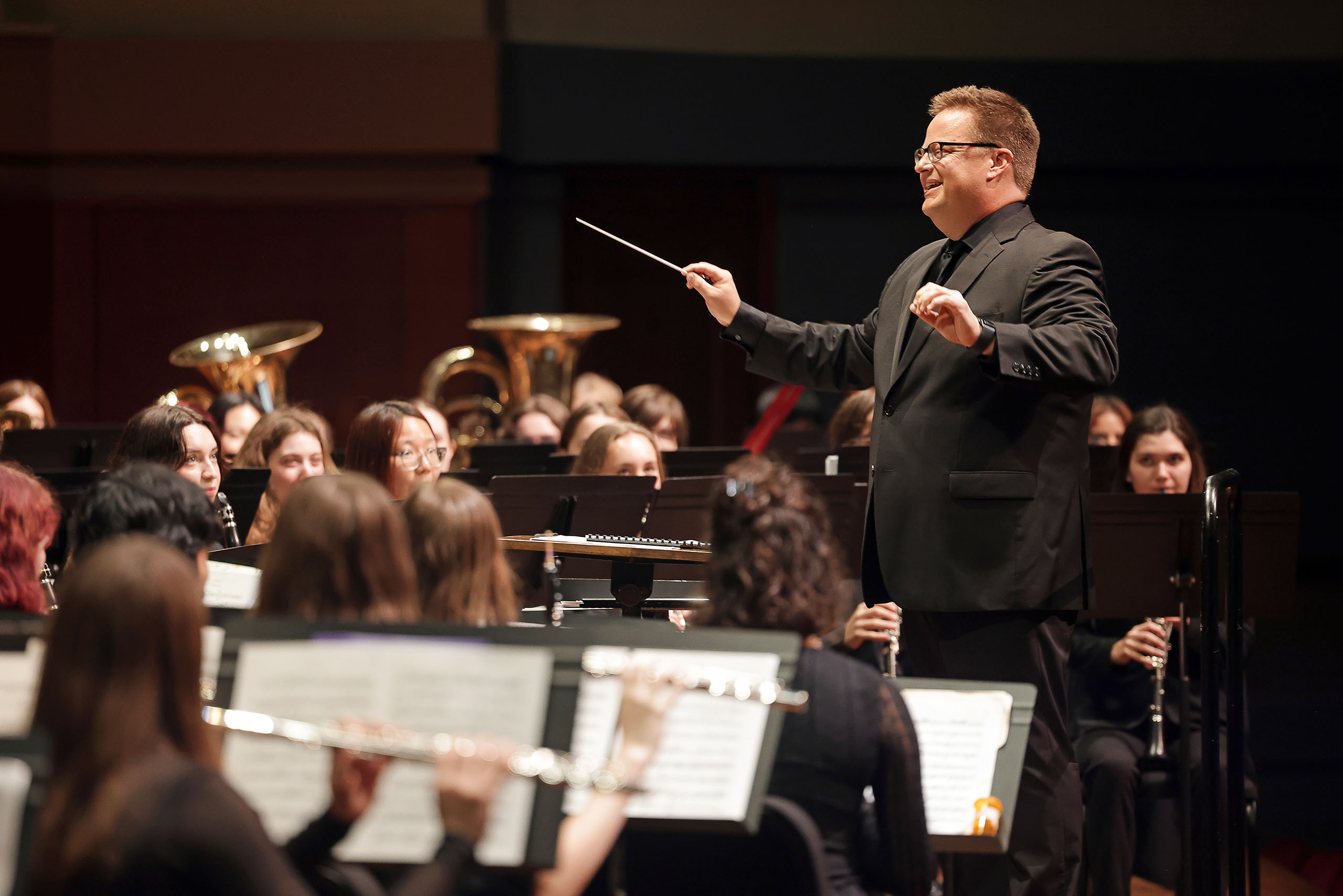
Richard Frey conducts at a campus and university bands concert, November 2024. Photo: Brenda Ahearn
“They’re actively teaching while also learning about all the logistics and the politics of communication with athletics and administration, both within SMTD and in the bigger university,” said Frey. “It’s a great immersion in experiencing what a big marching band program looks like.”
In addition, the DMA band conductors lead smaller athletic bands, also comprising non-music majors, that perform at other sports events. This year, Hepp is conducting the Basketball Band, an experience that will include traveling with the band to the NCAA Tournament and the Big 10 Tournament. Frey says the comprehensive experience that the conductors gain in running an athletic band program prepares them to step right into any academic role that will include that element. He also points out that while the graduate and post-graduate students are amassing critical skills, the school is benefiting from their own work experience.
“Having taught in the public schools before, they bring a wealth of different experiences to our students,” he said. “They’re learning how to be teachers and professors at the collegiate level, but they’ve already taught in some fashion, so their presence in the band program is such a critical component.”
“The Perfect Environment” for Developing Conductors
Weinberg says the sheer number of ensembles that exist at U-M is one of the things that makes the graduate and post-graduate conducting programs so appealing to students considering advanced degrees.
“The number of orchestras on the Michigan campus is matched only by a handful of universities worldwide,” he said. “That amount of activity is the perfect environment for a developing orchestral conductor. I could not have asked for a more rigorous, stimulating, and enriching experience to learn how to be a complete musician, conductor, and scholar.”
Hepp concurs. “The opportunities to conduct ensembles of a wide variety have been plentiful, and I am so thankful to have had so much invaluable experience making music with a broad spectrum of students on our campus,” she said. “Because of this, I feel much more prepared for whatever may come my way in my future job.”
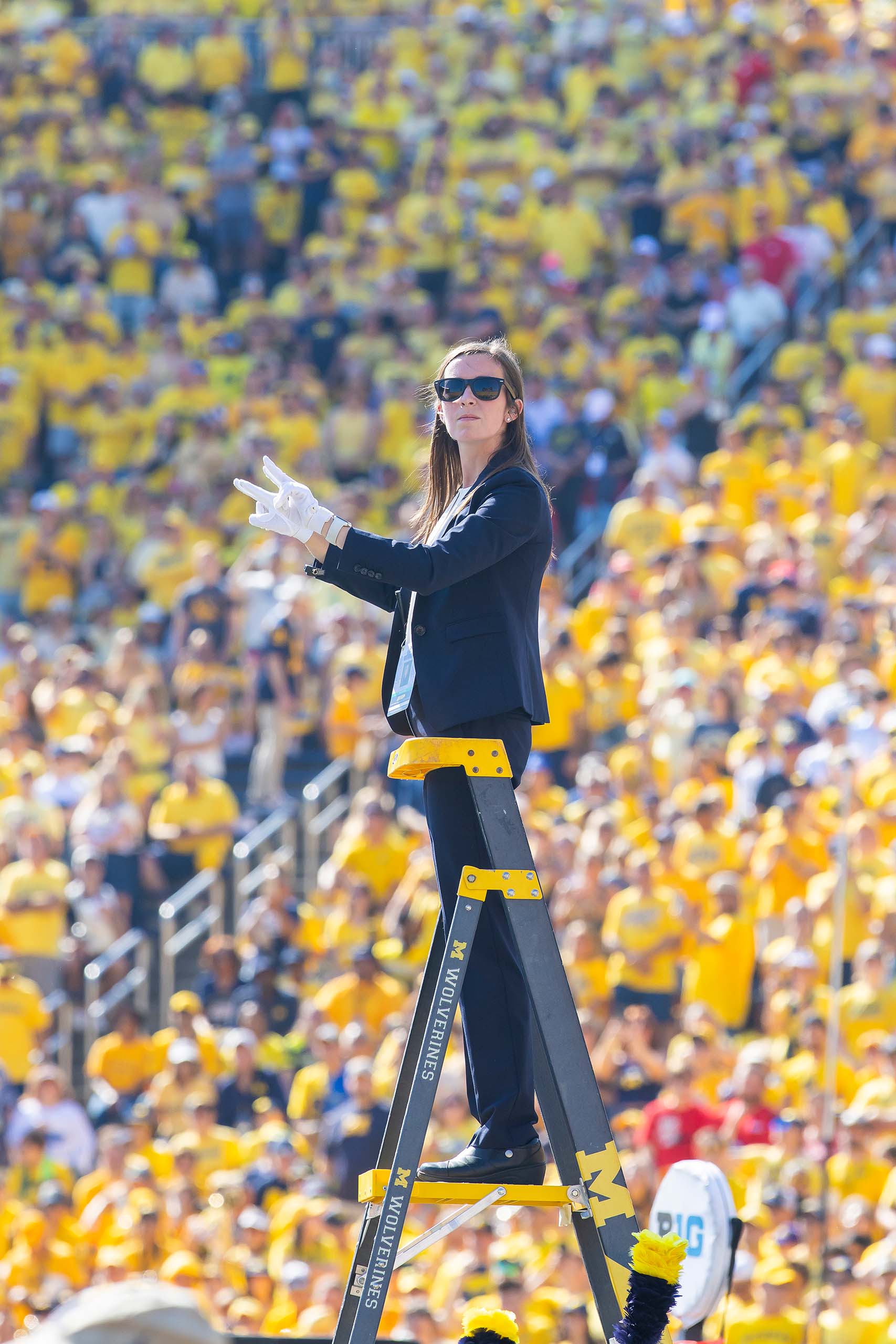
Jen Hepp conducts the Michigan Marching Band at the Big House, October 2025. Photo: MMB Photo & Video Crew