Following Heather L. Hodges’s fantastic guest post about the Gullah Geechee culture that the Gershwins and Heywards portray in Porgy and Bess, we turn to one of the opera’s most contended aspects: its treatment of the Gullah language. In this post, our managing editor, Andrew S. Kohler, explores how the work’s text came to be so far removed from Gullah, and how future performances may approach the inconsistent libretto so as to give Gullah culture and language the respect they are due.
The language of Porgy and Bess is a far cry from that of the Gullah community of Charleston that it depicts, and often has been criticized as racially disparaging. How to represent the speech community of Catfish Row is certainly a challenge for productions of the opera, and such an important aspect of a culture as its language deserves careful consideration and attention. I hope in this post to elucidate the conflict surrounding the libretto and to offer solutions for future performance. In exploring these complexities, I echo Heather L. Hodges’s post by suggesting that future performances of the work can be improved by consulting experts on the culture and language.
The question of language was a challenge for the Metropolitan Opera in their 2019–2020 production, which was the official premiere of the Gershwin Initiative’s new score, edited by Wayne Shirley. In particular, they were uncertain how to prepare the captions. Eric Grode reported in the New York Times that viewing the titles may increase the discomfort of the “outdated, sometimes derogatory dialect”—a typical objection to the libretto. Grode also described the text as being in “an idiomatic English that was long referred to as ‘Negro dialect,’” which he did not mention is now properly called African American Vernacular English (AAVE) or Black English. He passed over the salient fact that the people of Catfish Row should, in fact, be speaking Gullah, which is not a dialect but a language in its own right—more precisely, a creole language based in English that incorporates elements of African languages (Turner, pp. lix and 1; see also Ms. Hodges’s post). Gullah is a spoken and not written language, although it has been preserved in written form (Mille, p. 158).
Regrettably, Gullah culture is often omitted from the discourse surrounding Porgy and Bess, despite being the heart of the piece. As a result, discussions of the libretto’s language sometimes fall into the trap of categorically condemning the use of dialect or creole languages, rather than critiquing the opera’s inaccuracies in representing Gullah. Karl Thomas Rees wrote of the “offensive black dialect” that is “obviously racist,” and David Yearsley recently called the libretto “pidgin […] crude and inauthentic.” Like Grode, neither gives any further analysis, and again the word “Gullah” is conspicuously absent from their articles. Even the author of A Raisin in the Sun, the great Lorraine Hansberry, said that Black people “do not like to hear our intelligent […] stars speak in dialect, see them reduced to the level of Catfish Row” (quoted in Thompson, p. 54). While the larger issue of representation in the opera is highly nuanced, and the subject of a future post, it is dispiriting that Hansberry suggested that speaking in dialect is antithetical to intelligence, which is quite a different matter from criticizing the piece for incorrectly rendering Gullah. It is important not to conflate the use of language other than what linguists call Standard English with lack of intelligence—and to remember that Sporting Life’s use of the phrase “read in de Bible” establishes the community’s literacy.
There is a particular facet of the controversy surrounding Porgy and Bess that is usually overlooked: despite the significant fact of the opera’s White authorship, many of the objections that have been raised about it are congruent with debates about artistic representation of Blackness even by Black creators, and the matter of language is no exception. Harlem Renaissance author Zora Neale Hurston’s novel Their Eyes Were Watching God, published in 1937 (two years after the premiere of Porgy and Bess), is widely acclaimed today, but some critics have linked Hurston’s characters to minstrelsy, including in the use of AAVE (Taylor and Austen, 274). The eminent Black author Richard Wright wrote that Hurston’s novel “is not addressed to the Negro, but to a white audience whose chauvinistic tastes she knows how to satisfy,” in light of which his comment that Hurston’s “dialogue manages to catch the psychological movements of the Negro folk-mind in their pure simplicity” seems less than complimentary (“Between Laughter and Tears”). It is little wonder then that, according to Langston Hughes (Collected Works, Vol. 9, p. 450), an actress in Otto Preminger’s 1959 film of Porgy and Bess objected to “dat” and “dis” in the script.
What Is “Correct”?
Absent any discussion of how the residents of Catfish Row instead should be speaking, one wonders if critics of Porgy and Bess believe that the characters ought to use Standard English, which would itself be a gross misrepresentation of the community. In a recent podcast, Black linguist John McWhorter (an admirer of Porgy and Bess) noted that many people are under the mistaken impression that writing AAVE/Black English is tantamount to “depicting a Black person making grammatical errors, and therefore, Lord forbid a non-Black person do that”—although in reality “Black English is not mistakes.” McWhorter asks if such misconceptions are “important enough to depict Black people inaccurately on a regular basis” by having them always speak Standard English, and suggests that it is more important to consider how well a work represents speech than to focus on the author’s identity.
Porgy and Bess is different in that its language should be Gullah rather than AAVE, though the same principles apply. Unfortunately, even if the opera were truer to Gullah, it would be likely to draw similar criticisms due to widespread and wrongful disdain for speech that falls outside Standard English’s boundaries. In his pioneering work on Gullah, the Black linguist Lorenzo Dow Turner noted misconceptions about the language’s alleged crudity being “partly a survival of baby-talk which the white people […] found it necessary to use in communicating with the slaves” (p. 5) and quoted journalist A. E. Gonzales’s defamatory comments about the “[s]lovenly and careless speech” and “clumsy tongues” of the Gullah people (p. 6). The linguistics professor Katherine Wyly Mille observed that there is “stigma from the use of Gullah” (p. 158), and that the language is “usually viewed as detrimental to [its speakers’] advancement in school or in the workplace” (p. 157).
In How To Be an Antiracist, Ibram X. Kendi challenges such biases: “Assimilationists have always urged Africans in the Americas to forget the ‘broken’ languages of our ancestors and […] to speak ‘properly.’ […] The idea that Black languages outside Africa are broken is as culturally racist as the idea that languages inside Europe are fixed” (pp. 82–83; see also James Baldwin’s powerful defense of Black English). Barbadian poet Edward Kamau Brathwaite noted that the use of the word “dialect” in the context of creole languages is part of the problem:
The word ‘dialect’ […] carries very pejorative overtones. Dialect is thought of as ‘bad English’. Dialect is ‘inferior English’. Dialect is the language used when you want to make fun of someone. Caricature speaks in dialect. Dialect has a long history coming from the plantation where people’s dignity is distorted through their language […]. Nation language, on the other hand, is the submerged area of that dialect which is much more closely allied to the African aspect of experience […] (p. 13).
Brathwaite was writing about the Caribbean, but his words may be applied to the Gullah community of South Carolina. His statement also helps to explain the negative reaction to the language of Porgy and Bess, as its approach is markedly closer to what usually would be called “dialect” than to “national language,” potentially reflecting some of the misconceptions that Turner described.
While some criticism of the libretto of Porgy and Bess is borne of the same biases to which Kendi raises objections, that is not the full story. The case of the opera is different from Black writers who were aiming for accurate representations of a speech community, like Hurston in Their Eyes Were Watching God or Claude McKay in his poetry about Jamaica. The Gershwins’ and Heywards’ libretto is rather an approximation of Gullah meant to be understood by audiences ignorant of the language in the days before captions, and this constraint resulted in something very far removed from the real thing. Scholar Naomi André cogently has summarized the true difficulty of this aspect of the opera and its source materials: “What becomes tricky in terms of representation and performance is when someone [i.e., the Heywards and Gershwins] outside of the subordinated group [i.e., the Gullah Geechee people] approximates the structure and syntax of the non-standard version of the language and the result sounds and feels uncomfortable to those who know the true tradition” (p. 189). It is refreshing to read an assessment that affords due respect to linguistic traditions that have been maligned as inferior, illiterate, and illegitimate.
How the Language of Catfish Row Came to Be
The question now becomes how to approach the libretto of Porgy and Bess, which necessitates an examination of its genesis. First, it is worth noting that DuBose Heyward was the only one of the four creators who was proficient in Gullah, which undoubtedly contributed to its dilution in the opera. But ultimately, there is a straightforward reason why Porgy and Bess is far removed from the true language of Catfish Row: the creators’ concerns about comprehensibility. The language was simplified from the novel to the play, and again from the play to the opera. The various sources for the opera often do not agree with each other, and they are internally inconsistent as well. For example, several words often appear with two different spellings at various points in the score (“Lawd” here, “Lord” there), somewhat to the perplexity of singers and score-studiers. This fact evinces the degree of challenge the creators encountered in representing the language and highlights the opera’s issues of authenticity.
In 1927, Dorothy Heyward wrote an article about the language in the play Porgy (which had opened earlier that year) for the New York Times under the headline “‘Porgy’s’ Native Tongue.” She explained that her husband’s writing, as in his novel Porgy, “simplifies the dialect [sic] so that the running reader at least has a chance,” whereas his mother, Jane S. Heyward, was among the “sticklers for authenticity, writing down the Gullah exactly as it is spoken” (see this post for more about Jane Heyward). In adapting Porgy as a stage play, Dorothy and DuBose initially planned to begin with the characters speaking Gullah, for which DuBose gave lessons to the Northern actors. The opening stage directions specify:
The audience understands none of it. […] [I]t is a part of the picture of Catfish Row as it really is—an alien scene, a people as little known to most Americans as the people of the Congo. Gradually it seems to the audience that they are beginning to understand this foreign language. In reality, the “Gullah” is being tempered to their ears, spoken more distinctly with the African words omitted. (p. 3)
The authors’ expectation that the audience view the people of Catfish Row as an Other is striking, and in keeping with the exoticism in DuBose Heyward’s introduction to the play’s published text (pp. ix–x). It is this explicitly White framing of Porgy’s story in all of its incarnations (novel, play, and opera) that distinguishes it from the works of Black authors like Hurston, Wright, or McKay, and is at the heart of much of the criticism of the opera. As Ms. Hodges described in her post, performances that aim to present Gullah culture as accurately and respectfully as possible may serve as an effective antidote.
Alas, as Dorothy Heyward reported, early audiences of the play resented being denied “their inalienable right” to understand what was being said, perhaps because they had not been adequately informed about the Gullah culture that was being put on stage before them. And so, “the whole of the play became a translation,” with “the language […] so thoroughly tempered to the Northern ear that, should it ever fall on the astonished ear of Porgy’s prototype, he would never know what it was all about.” The text is closer to AAVE (although by no means adhering to its rules consistently), which Dorothy said is as distant from Gullah “as it is from the most conventional King’s English” (“‘Porgy’s’ Native Tongue”).
The Heywards’ approach by no means pleased everyone. After their deaths, Virginia Mixson Geraty, a White proponent of the Gullah language, read the play and was “[c]onfused and disconcerted” by its inaccurate language, and so she translated it into Gullah. In her foreword, Geraty wrote that the opening stage directions made her feel as though she “were actually there among the residents of Catfish Row,” but then came “the let down” of the first lines: “I can’t begin to describe my disappointment when I found that the dialogue was not written in the language which would have been used by the black people living in Catfish Row” (p. v). Geraty is among those who have sought to present Porgy’s story more closely to Gullah culture, similar to performances in Charleston that Ms. Hodges discussed in her post.
When it came time to write the libretto for Porgy and Bess the opera, DuBose Heyward tempered the Gullah language even further. Consider these changes to the first scene between the published text of the play and DuBose’s typescript libretto draft:
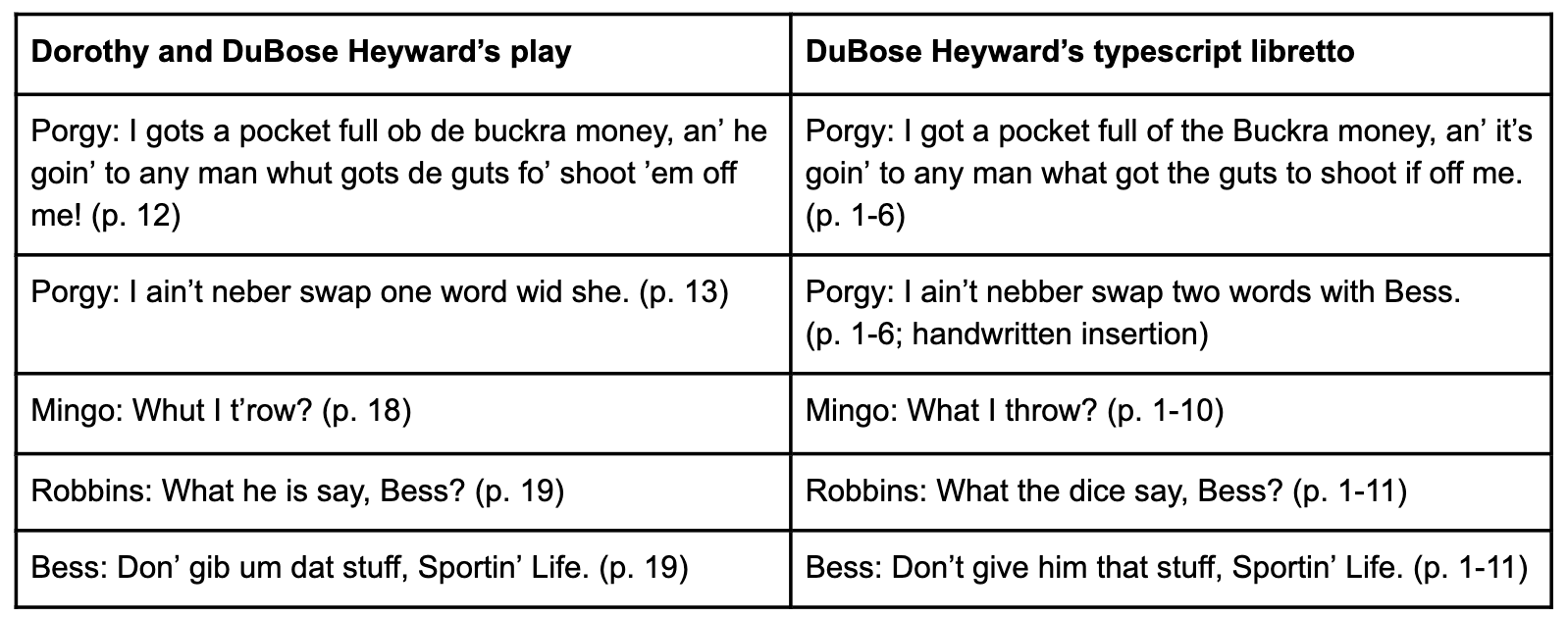
For the Gershwins’ part, Ira later described his approach to the lyrics he wrote for the opera: “It didn’t matter too much if dialect was exact or not, considering the stylized and characteristic music. All that was required was a suggestion of regional flavor.” He went on to grant certain license to performers, clearly aware of, and sensitive to, concerns about the work’s representation of Black language and culture: “[I]f the artist preferred—for personal literacy or racial righteousness—to enunciate any words formally rather than colloquially, that was all right” (Lyrics on Several Occasions, p. 82).
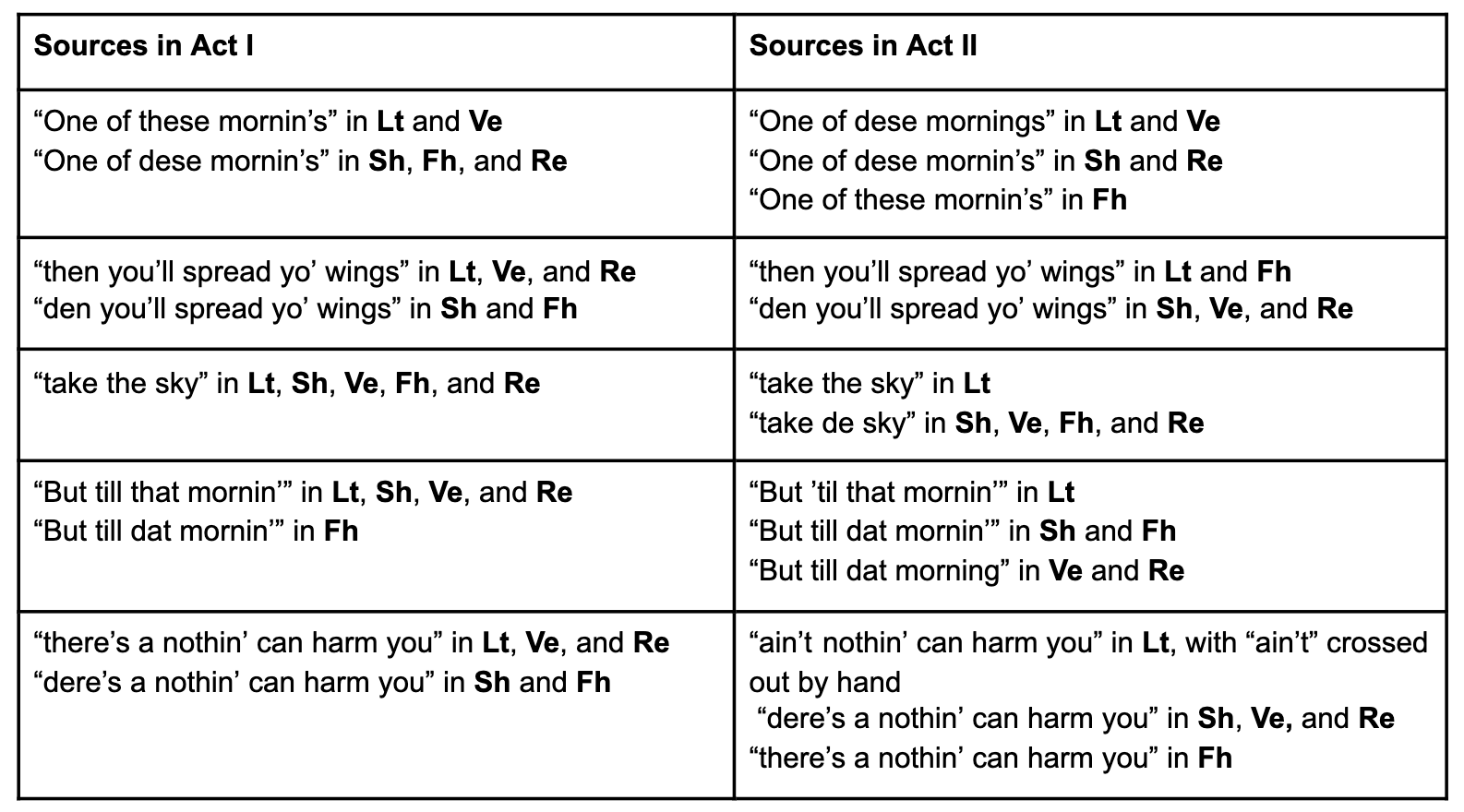
George initially stayed fairly close to DuBose Heyward’s typescript in composing his short-score draft of the opera, although notably changing the Gullah “Jedus” to “Jesus.” In preparing the orchestral score, however, George seems to have had something of a change of heart. While “Jesus” remains in his final version, he often changed the spelling of words like “that” and “these” to make the language more realistic. For example, Jake’s first line (which, in the play, is supposed to be the first words the audience can understand; p. 4) went from a complaint that “these bones don’t give me nothin’ but boxcars tonight” to “dese bones don’ give me.” George was anything but systematic: the opening of the second verse of “Summertime” in Act I is “One of these mornin’s” in DuBose Heyward’s typescript and in the first piano-vocal score, but it is “One of dese mornin’s” in George’s hand (in this case in both the short-score and orchestral manuscripts). Yet six measures later, we have “take the sky,” not “de sky,” in all sources. And more convoluted still, when Clara reprises the verse during the hurricane, the tables are turned—the opening line went from “dese” to “these” during orchestration, and now we have “take de sky” in all sources but the typescript! (See the table below for a full enumeration of these inconsistencies, and for a taste of the life of a critical editor.) Since we generally favor the spellings of the orchestral manuscript in our new edition, the new materials on the whole are closer to Gullah, albeit in a relatively small and inconsistent way. Still, it remains up to individual singers and music directors how to approach this aspect of the libretto.
Toward New Performance
The complicated history of the language of Porgy and Bess poses a challenge for performers. Again to invoke Ms. Hodges’s post, it is well within the capabilities of productions of Porgy and Bess to consult experts on Gullah culture, which includes treating the language with greater care. All of our critical editing aside, the best solution is likely to adjust the pronunciation so as to be as close to Gullah as possible. An effort to move from “dialect” to the Gullah language, and an explanation in the printed program and pre-performance lectures, would be an important gesture of respect for the real people whose culture will be depicted on stage.
Because Gullah is not a written language, it is necessary to consult its speakers. I owe much of my awareness to my friend and colleague Lenora Green-Turner, an expert in the language who holds a DMA from the University of Michigan. Dr. Green-Turner sang the roles of Lily Holmes and the Strawberry Woman in our 2018 test performance of Porgy and Bess, and for the latter character used the proper Gullah pronunciation skrawberry. I am enormously grateful for her important research on how to achieve a better representation of the language, which she has presented at the symposium for the Ann Arbor test performance and to enthusiastic response at the 2018 national meeting of the American Musicological Society. She notes that rendering the libretto entirely into Gullah is not possible, since doing so would involve alterations to syntax and vocabulary that would be incompatible with the musical score. There are, however, numerous adjustments to pronunciation that leave intact the words and music. These efforts do not necessarily contradict the creators’ intentions, as the language clearly was important to the Heywards. Given that Ira Gershwin opened the door to singing the words “formally rather than colloquially” based on how the singer felt about the language, it stands to reason that the same freedom should extend to rendering the text closer to Gullah—which is, in fact, the most respectful option. Let us hope that future productions avail themselves of the knowledge of Dr. Green-Turner, Ms. Hodges, and other experts!
The Inconsistent Sources of Porgy and Bess for “Summertime”
Lt = DuBose Heyward’s typescript draft for the libretto of Porgy and Bess (Library of Congress)
Sh = George Gershwin’s manuscript short score for the opera, i.e., essentially a piano score from which he then orchestrated (Library of Congress)
Ve = engraved vocal score, prepared by Dr. Albert Sirmay from Sh, used by singers from the 1935 premiere up through the availability of our new edition
Fh = George Gershwin’s manuscript full score (i.e., the orchestral score; Library of Congress)
Re = engraved orchestral rental score dating from approximately the early 1950s, rented to opera companies up until the availability of our new edition
Further Reading:
André, Naomi. “Complexities in Gershwin’s Porgy and Bess: Historical and Performing Contexts.” In The Cambridge Companion to Gershwin, edited by Anna Harwell Celenza, 182–96. Cambridge: Cambridge University Press, 2019.
Baldwin, James. “If Black English Isn’t a Language, Then Tell Me, What Is?” New York Times, July 29, 1979.
Brathwaite, Edward Kamau. History of the Voice. London: New Beacon Books, 1984.
Geraty, Virginia Mixson. Porgy: A Gullah Version. Translation of Porgy: A Play in Four Acts by Dorothy and DuBose Heyward. Charleston: Wyrick and Company, 1990.
Gershwin, Ira. Lyrics on Several Occasions: A Selection of Stage & Screen Lyrics Written for Sundry Situations; and Now Arranged in Arbitrary Categories, to Which Have Been Added Many Informative Annotations & Disquisitions on Their Why & Wherefore, Their Whom-For, Their How, and Matters Associative. New York: Alfred A. Knopf, 1959.
Green-Turner, Lenora. “Gullah Diction: Suggestions for Performing The Gershwins’ Porgy and Bess.” Presented at the University of Michigan, Ann Arbor, February 17, 2018. https://www.youtube.com/watch?v=zN31uLQ-4A0&list=PL8CFRK4E5UxIieA6nrR9Wbl4rVUKfwQz5
Grode, Eric. “‘Porgy and Bess’ Can Offend. Now Try Translating It Into Spanish.” The New York Times. October 3, 2019.
Heyward, Dorothy. “‘Porgy’s’ Native Tongue: A Dissertation on Gullah, the Negro Language of the Play.” New York Times, December 4, 1927, p. X2.
Heyward, Dorothy and DuBose Heyward. Porgy: A Play in Four Acts. New York: Doubleday, Doran & Company, Inc., 1928.
Heyward, DuBose. Porgy. Jackson: University of Mississippi Press, 2001.
Heyward, DuBose. Porgy and Bess Libretto (typescript draft). George and Ira Gershwin Collection, Library of Congress.
Hughes, Langston, edited by Christopher C. De Santis. The Collected Works of Langston Hughes, Vol. 9: Essays on Art, Race, Politics, and World Affairs. Columbia: University of Missouri Press, 2002.
Hurston, Zora Neale. Their Eyes Were Watching God. New York: First Perennial Classics, 1998.
Kendi, Ibram X. How To Be an Antiracist. New York: One World, 2019.
“John McWhorter on Linguistics, Music, and Race (Ep. 89 — Live at Mason).” March 11, 2020. https://medium.com/conversations-with-tyler/john-mcwhorter-tyler-cowen-linguistics-language-learning-7026a329ef32
McKay, Claude. The Dialect Poetry of Claude McKay. Freeport, NY: Books for Libraries Press, 1972.
McWhorter, John. “White Author, Black English. Problem?” November 10, 2020. https://slate.com/podcasts/lexicon-valley/2020/11/white-author-black-english
Mille, Katherine Wyly. Review of Porgy: A Gullah Version by Virginia Mixson Geraty, from the original play Porgy by Dorothy and DuBose Heyward. Journal of Pidgin and Creole Languages 7, no. 1 (1992): 157–64.
Peppis, Paul. “Salvaging Dialect and Cultural Cross-Dressing in McKay’s Constab Ballads.” Twentieth-Century Literature 59, no. 1 (Spring 2013): 37–78.
Rees, Karl Thomas. “Selling Blackness in the 1930’s [sic]: Comparing Audience Responses to Hughes’ Mulatto and Gershwin’s Porgy and Bess.” June 1, 2001. https://www.karlrees.com/academia/literary_criticism/selling_blackness_in_the_1930s_comparing_audience_responses_to_hughes_mulatto_and_gershwins_porgy_and_bess.html
Taylor, Yuval and Jake Austen. Darkest America: Black Minstrelsy from Slavery to Hip-Hop. New York: W. W. Norton, 2012.
Thompson, Era Bell. “Why Negroes Don’t Like ‘Porgy and Bess.’” Ebony 14, issue 12 (October 1959): 50–54.
Turner, Lorenzo Dow. Africanisms in the Gullah Dialect. Columbia, SC: University of South Carolina Press, 2002.
Wright, Richard. “Between Laughter and Tears.” Review of Waters Turpin’s These Low Grounds and Zora Neale Hurston’s Their Eyes Were Watching God. The New Masses, October 5, 1937.
Yearsley, David. “Porgy and Bess in the Time of BLM.” Counterpunch, July 24, 2020, https://www.counterpunch.org/2020/07/24/porgy-and-bess-in-the-time-of-blm/ .