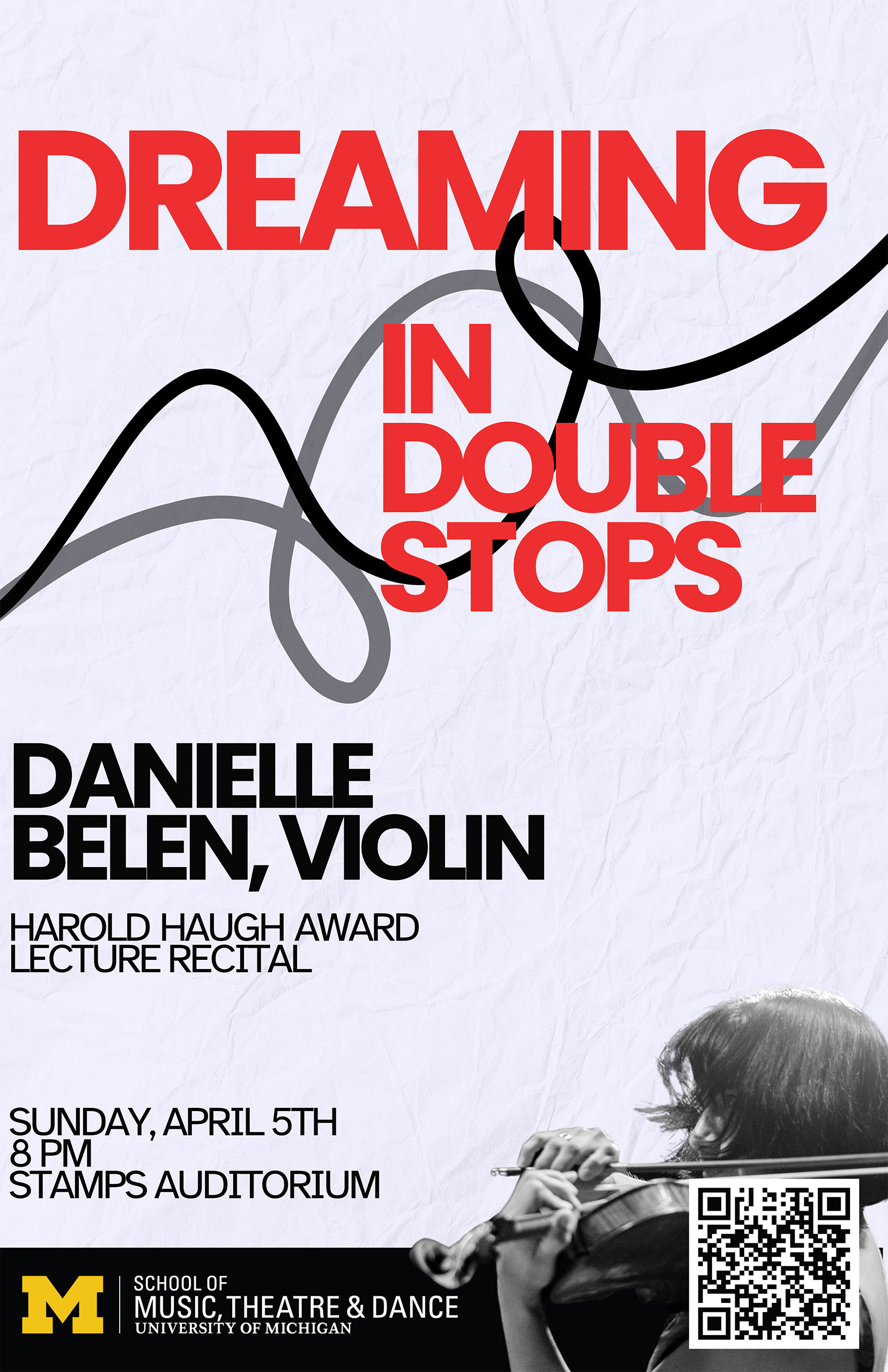
Last year, Danielle Belen, professor of music, received the Harold Haugh Award for excellence in studio teaching. As part of the award guidelines, Belen will present a lecture and recital on Sunday, April 5, at 8:00 pm, in Stamps Auditorium, located in the Walgreen Drama Center.
Called “Dreaming in Double Stops,” the presentation will explore Belen’s love of teaching the violin and will introduce an exciting project Belen and her students are embarking on.
Belen is particularly passionate about teaching the physical technique of playing the violin, exploring how human bodies interact with an inanimate object to create acoustical sound. “The physical act of playing the violin is so fascinating and so mystifying,” she said, “except that it all makes sense when you break it apart and figure it out.” A fundamental aspect of violin technique is mastering the double stop – gliding the bow across two strings at the same time, with a different finger on each string, producing a rich, full sound. “It’s incredibly warming and comforting,” Belen noted, “to hear this explosion of sound, almost like a choir coming out of this wiry instrument.” Not only do they produce a beautiful sound, playing double stops is also vitally important in helping violinists to build strength in their hands.
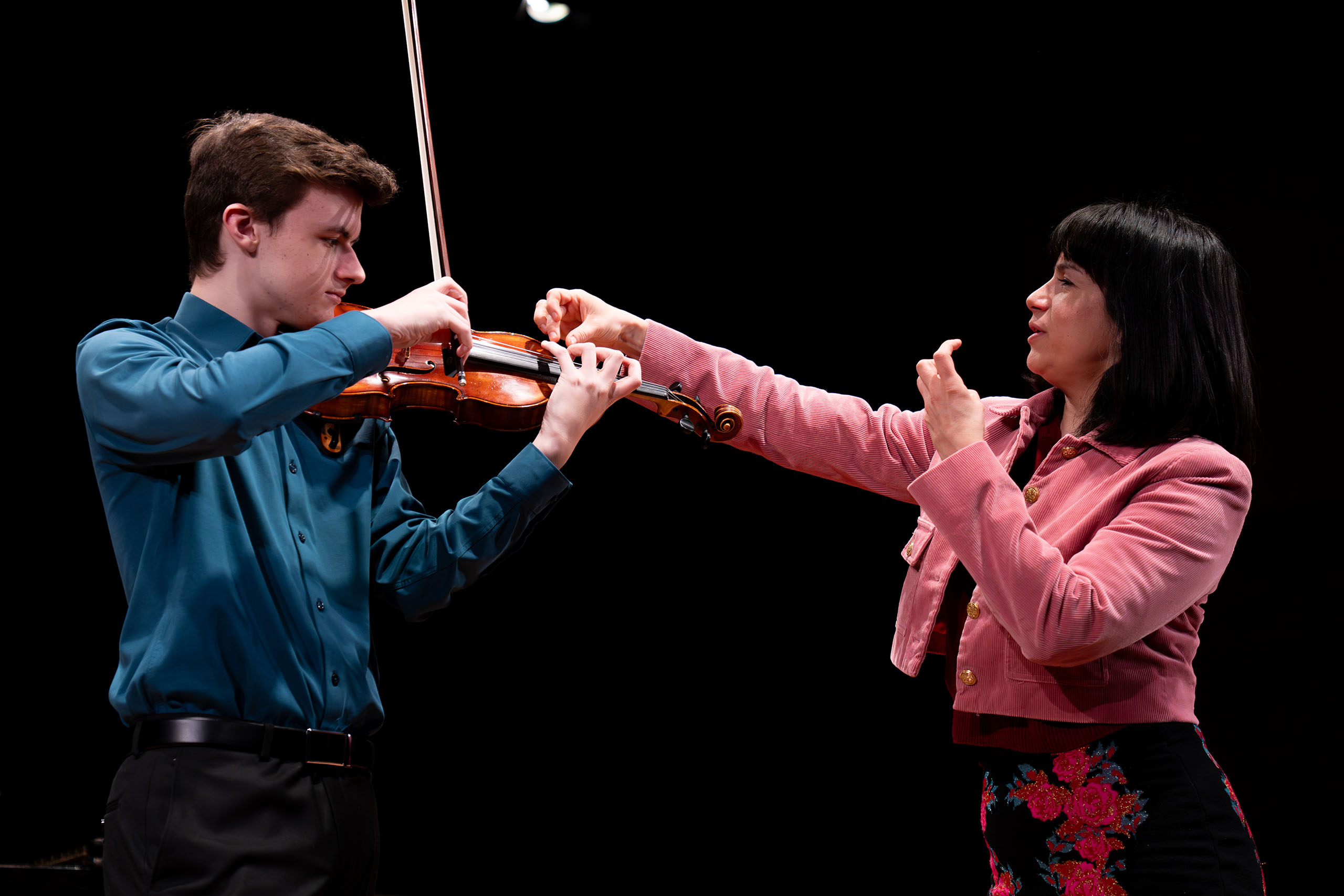
Danielle Belen guiding a student during the String Showcase, February 2026. Photo: Chris Boyes
Given the importance of double stops – what Belen referred to as “almost the spiritual center” of playing violin – she instructs her students to hone their double-stop skills using études, short instrumental compositions designed to help performers practice specific skills. Belen most often uses a book of études composed in the 19th century by Jakob Dont. These études “do the trick,” Belen said, but she envisioned the creation of a new set of études that would be more contemporary and musically exciting.
Initially, Belen had the idea to work with Jessie Montgomery, an acclaimed composer and accomplished violinist that Belen has known for years, to write new études, but given Montgomery’s busy schedule, Belen revised her idea. She launched a new project in which her students write new études based on Rhapsody no. 1 and Rhapsody no. 2, works composed by Montgomery and beloved by violinists. The students have spent months working on their compositions, with Belen guiding them and Montgomery mentoring them, with the ultimate goal of publishing them in a new book of études. Montgomery met with the students over Zoom and recently, during a residency at SMTD – which culminated with the premiere of her work Coincident Dances by the U-M Symphony Band – she met with them in person to hear their progress.
Montgomery’s music serves as perfect inspiration for a more contemporary and musically complex set of études, according to Belen. While many études are musically lovely, they are not often rich and layered works. And while Montgomery’s musical language is, Belen noted, “very accessible, at the same time, there is a lot more dissonance, and there are a lot more surprises in her music, harmonically, than these études that were written in the 1800s.”
At her lecture and recital on April 5, Belen will begin by discussing her love for technique and her methods for teaching double stops. She will then introduce the audience to the étude project her students have been working on, highlighting the steps along the way and Montgomery’s mentorship. Belen will begin by playing Montgomery’s Rhapsody no. 1, followed by students performing their compositions inspired by that work. Then students will perform their compositions based on Rhapsody no. 2, followed by a student performing that original work.
In addition to demonstrating to audience members what she considers her rightful obsession with technique, Belen wants to also reveal the impact this project has had on her students, as she works to prepare them to be musicians in a professional context. While composition is not a necessary skill for violin players, Belen has observed that their efforts in writing these works have made them better musicians and more capable people. She has noted the impact of her students seeing themselves in a different light. “We’re taking you seriously,” she said. “We’re listening to something you wrote, and we think it’s good.” She concluded, “This project is like a microcosm of so much that we believe in, in my studio, so that’s why I wanted to share it.”