
About the Production
Creative Team
Conductor Sahar Nouri
Director Chía Patiño
Assistant Conductor Nicholas Bromilow *†
Scenic Designer Jungah Han
Costume Designer Sammer Ali †,Ellie Van Engen †
Lighting DesignerHeather Gilbert
Hair & Makeup Designer Brittany Crinson
Chorus Director Gukhui Han †
Rehearsal Pianists/Coaches & Harpsichordists Arturo Fernandez †, Viktoria Sarkadi †
Diction Coach Timothy Cheek
Resident Dramaturg Karin Waidley
Resident Intimacy Choreographer and Cultural Consultant Raja Benz
Production Stage Manager Maya Liu †
Cast
Thursday/Saturday
Almaviva Thommy Long
Rosina, his wife Maitri White
Figaro Isaiah Liggins
Susanna Angela Bonello
Cherubino Camryn Nelson
Doctor Bartolo Aaron Levine
Marcellina Molly Levin
Don Basilio Stephen Riesen
Don Curzio William Fishwick
Barbarina Jamiyah Hudson
Antonio B’Nathaniel Orlu
Friday/Sunday
Almaviva Valdis Jansons
Rosina, his wife Christina Parson
Figaro Paul Leland Hill
Susanna Catherine Goode
Cherubino Grace Ryan
Doctor Bartolo Aaron Levine
Marcellina Delaney Finn
Don Basilio Regis Haynes
Don Curzio Keiwon X. Lambert
Barbarina Sofia Vazquez
Antonio Timothy Zajdela
Bridesmaids Allison Lange, Brooke Studebaker
Ensemble Jeremy Allen, Jack Bishop, Modestina Call, Melinda Carlisle, Abigail Eagan, Ryan Hughes, Haley Hunt, Allison Lange, Kya Leeson, Aileen Pereda, Ella Peters, Hunter Reid, Brooke Studebaker, Maxwell Vernon, Madeleine Wigent, Keen Williams, Gavin Young, Ibrahim Zeni
Orchestra
Kenneth Kiesler, director
Sahar Nouri, conductor
Nicholas Bromilow†, assistant conductor
Violin Maggie Brady**, Cameron Jeppson*, Noah Carr, Valerie Chen, Jayon Felizarta, Rebekah Geller, Felix Guggenheim, Sophia Heaton, Aidan Kreiger, Jerusha Taylor, Lauryn Varnell, Laur Yoon
Viola Emmanual Aguilera*, Jafrè Chase, Bryce Kayser, Shuyan Liu
Cello Gabriel Hennebury*, Maya Sauder, Niloufar Mirzanabi Khani
Double Bass Abimelec Guerra*, Troy Perkins
Flute Nathan Le, Dakota Olson
Oboe Abigail Bracken, Sara LeBlanc
Clarinet Justin Brown, Timothy Kulawiak
Bassoon Eli Hall, Heather Hippchen
Trumpet Whitney Corpany, Molly Weisberg
HornTrent Ice, Nicholas Valencia
Timpani Jonathan Wentzel
Harpsichord Arturo Fernandez (Thu/Sat), Viktoria Sarkadi (Fri/Sun)
**Concertmaster
*Principal
Production Staff
Assistant Director Joanna Percy
Assistant Dramaturg Penelope Clark
Scenic Design Assistants Hannah Kryzhan, Yuchen Ma
Lighting Design Assistant Morgan Gomes
Assistant Stage Managers Sarita Gankin, Ella Roch
Production Assistants Jeffrey Dunn, Kyungsun Min, Emily Peisner
Ensembles Coordinator Jonathan Mashburn
Sound Engineer Al Hurschman
Supertitles Brett Finley
Production Crews
Costumes Iliana Beauchamp, Katy Dawson, Sarita Gankin, Lucy Knas, Alex Li, Maya Liu, Rachel Pfeil, Isabella Pruter, Kayti Sanchez, Ellie Van Engen & 250/252/262 students
Lighting Eliza Anker, Morgan Gomes, Ethan Hoffman, Brandon Malin, Tate Zeleznik & 250/252/262 students
Paint Gretchen Brookes, Miles Hionis, Norah Klocke, Ren Kosiorowski, Yuchen Ma, Ceri Roberts, Seri Stewart^, Amber Walters, Landon Wouters, Angela Wu & 250/252/262 students
Scenery Kelly Burkel, Aiden Heeres, Soph Irfani, Ren Kosiorowski, Hannah Kryzhan, Josi Middaugh, Luke Moyer, Michael Russell, Nathaniel Steever & 250/252/262 students
Props Eliza Anker, Andy Blatt, Kendall Brisco, Laney Carnes, Brook Galsky, Alex Heskett, Sam McLaughlin, Tessie Morales, Leah Stchur, Reese Stevens & 250/252/262 students
Wigs/Hair/Makeup Gretchen Brookes, Christine Chupailo, Miles Hionis & 250/252/262 students
Production Management Shelby Holloway, Esther Hwang, Greta Steever
Running Crews
Light Board Operator Clayton Collins
Followspot Operators Natalie Bridgnell, Lilya Heidelbaugh, Leo Kupferberg
Supertitles Operator Cecelia Fornuto
Scenery Crew Ella Lewis, Sage Taylor, Salem Zhao
Scenery Crew/Deck Electrician Ethan Steiner
Props Crew Jiahe Duan, Sarah Hartmus, Anika Lopes
Wardrobe Crew Kaitlyn Dolan, Charlotte Murray, Marisa Redding, Kayti Sanchez^, Allie Sharpe
Hair & Makeup Crew Sophia Karaz, Ella Saliba
^Crew Head
Department of Voice & Opera and Concerts & Events
SMTD Leadership
David Gier, Dean
Paul Boylan Collegiate Professor of Music
Department of Voice & Opera
Chair Stephen West
Faculty Timothy Cheek, Stephanie Havey, Freda Herseth, Valdis Jansons, Caitlin Lynch, Rose Mannino, Stanford Olsen, Ana María Otamendi, Chía Patiño, Kirk Severtson, Matthew Thompson, Louise Toppin, Daniel Washington
Visiting Faculty Sahar Nouri
Concerts & Events Office
Director of Concerts and Events Paul Feeny
Head Performance Librarian & Licensing Manager Liz Nowland
Performance Librarian & Programs Manager Katie Klich
Coordinator: Event Scheduling Feagin Oliver
Percussion Program Manager Matt Jordan
Production Manager: Ticketed Events & Small Ensembles Jonathan Mashburn
Production Manager: Large Ensembles Kate Johnson
Daily Operations Coordinator Jimmy Stagnitti
Faculty Advisors
Costume Design Advisor Christianne Myers
Stage Management Advisor Jenn Rae Moore
Staff Mentors
Staff Mentors Laura Brinker, Brittany Crinson, Patrick Drone, Chad Hain, Heather Hunter, Richard W. Lindsay, Beth Sandmaier
University Productions Administrative Staff
Executive Director Jeffrey Kuras
Administrative Specialist Christine Eccleston
Administrative Asst. Emily Erlich
Facilities Manager Shannon Rice
Performance Halls House Manager Kelley Krahn
Lead Backstage Operations Mgr. Dane Racicot
Sr. Backstage Operations Mgr. David Pickell
Backstage Operations Mgrs. Tiff Crutchfield, Yvette Kashmer, Brian Koepele, Robbie Kozub
University Productions Production Staff
Interim Production Manager Michelle Williams-Elias
Technical Director (Walgreen) Richard W. Lindsay Jr.
Theatrical Scenery Manager Chad Hain
Lead Scenic Carpenter Devin Miller
Scenic Carpenter Heather Udowitz
Charge Scenic Artist Beth Sandmaier
Assoc. Theatrical Paint Mgr. Madison Stinemetz
Lead Theatrical Properties Manager Patrick A. Drone
Assoc. Theatrical Properties Manager Danielle Keys
Properties Artisan Adam Ashlock
Theatrical Properties Stock and Tech Coord. Kat Kreutz
Theatrical Lighting Manager Heather Hunter
Assoc. Theatrical Lighting Manager Jorrey Calvo
Sr. Costume Shop Manager Laura Brinker
Asst. Costume Shop Manager Leslie Ann Smith
Lead Cutter/Draper Tj Williamson
Cutter/Drapers Sarah Havens, Lani Tortoriello
Stitchers Mag Grace, Rene Plante
Lead Costume Crafts Artisan Elizabeth Gunderson
Costume Stock Manager Theresa Hartman
Wardrobe Manager Alli Switalski
Theatrical Hair and Makeup Mgr. Brittany Crinson
Resources
- About the Performance
- About the Authors
- Synopsis
- Director's Note
- Dramaturg's Note
- About the Cast
- About the Creative Team
- Statement on the Anishinaabe Land Transfer
- Freedom of Expression Statement
- Download Program
Le nozze di Figaro premiered at the Burgtheater in Vienna on May 1, 1786, conducted by Wolfgang Amadeus Mozart.
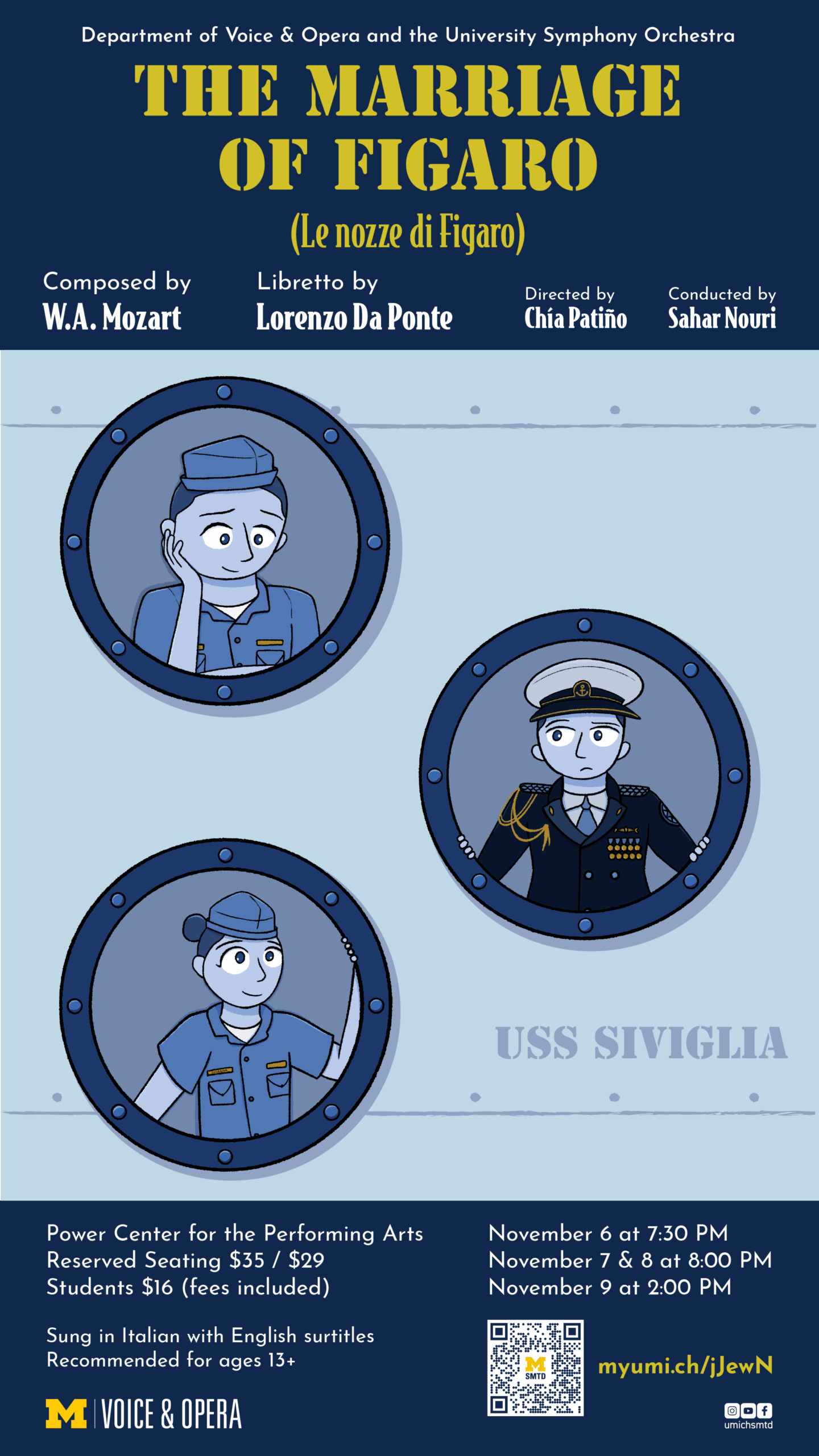
Setting: Onboard the USS Siviglia.
This performance will have one 20-minute intermission.
* Assistant conductor Nicholas Bromilow will conduct the performance on Saturday, November 8.
Le Nozzi di Figaro is presented by arrangement with Bärenreiter Verlag. ed. Ludwig Finscher (1930–2020)
Kassel: Bärenreiter Verlag, 1973. Plate BA 4565.
The performers in this production are students and faculty in the Department of Voice & Opera and the University Symphony Orchestra. The designers for this production are students, faculty, and/or guests of SMTD. Scenery, costumes, properties, sound, and lighting were realized by the students and staff of University Productions, the producing unit of SMTD. Thank you for supporting our educational mission.
Latecomers will be seated at a suitable break. As a courtesy to others, please turn off cellular phones and refrain from texting during the performance. Photography, audio recording, and videotaping of any kind are not permitted.
Wolfgang Amadeus Mozart (Composer) was born on January 27, 1756, in Salzburg, Austria. His father, Leopold Mozart, a noted composer, instructor, and the author of famous writings on violin playing, was then in the service of the archbishop of Salzburg. Leopold and Anna Maria, his wife, stressed the importance of music to their children. Together with his sister, Nannerl, Wolfgang received such intensive musical training that by the age of six he was a budding composer and an accomplished keyboard performer.
In 1762 Leopold presented his son as a performer at the imperial court in Vienna, Austria, and from 1763 to 1766 he escorted both children on a continuous musical tour across Europe, which included long stays in Paris, France, and London, England, as well as visits to many other cities, with appearances before the French and English royal families.
Mozart was the most celebrated child prodigy (an unusually gifted child) of this time as a keyboard performer. He also made a great impression as a composer and improviser (one who arranges or creates). In London he won the admiration of musician Johann Christian Bach (1735–1782), and he was exposed from an early age to an unusual variety of musical styles and tastes across Europe.
In the field of the string quartet Mozart produced two important groups of works that completely overshadowed any he had written before 1780: in 1785 he published the six Quartets (K. 387, 421, 428, 458, 464, and 465) and in 1786 added the single Hoffmeister Quartet (K. 499). In 1789 he wrote the last three Quartets (K. 575, 589, and 590), dedicated to King Frederick William (1688–1740) of Prussia, a noted cellist.
Mozart’s development as an opera composer between 1781 and his death is even more remarkable, perhaps, since the problems of opera were more far-ranging than those of the larger instrumental forms and provided less adequate models. The first important result was the German Singspiel entitled Die Entführung aus dem Serail (1782; Abduction from the Seraglio). Mozart then turned to Italian opera. Mozart produced his three greatest Italian operas: Le nozze di Figaro (1786; The Marriage of Figaro), Don Giovanni (1787, for Prague), and Cosi fan tutte (1790). In his last opera, The Magic Flute (1791), Mozart turned back to German opera, and he produced a work combining many strands of popular theater and including musical expressions ranging from folk to opera.—Excerpted from Opera Philadelphia
Lorenzo Da Ponte (Libretto) (born March 10, 1749, Céneda, near Treviso, Veneto [Italy]—died Aug. 17, 1838, New York, NY, US) was an Italian poet and librettist best known for his collaboration with Mozart. Taking up residence in Vienna (probably in 1780), he became official poet to the court of Emperor Joseph II and in that capacity wrote successful librettos for numerous musicians. It was there in 1783 that Da Ponte made the acquaintance of Wolfgang Amadeus Mozart and entered upon the finest period of his literary career. Three masterpieces appeared in rapid succession—Le nozze di Figaro (1786), Don Giovanni (1787), and Così fan tutte (1790). During the same period he achieved his greatest popular success with the libretto to Martín y Soler’s Una cosa rara (1787). —Excerpted from Britannica
Act I
In modern times, the waters are calm aboard the USS Siviglia, until… in a berth allocated by their superior, Figaro and Susanna, enlisted petty officers to Vice Admiral Almaviva and his wife Rosina, are preparing for their wedding that evening. Figaro is furious when he learns from his bride that Almaviva has tried to seduce her. He’s determined to have revenge on his superior. Dr. Bartolo appears with his former employee, Marcellina, who is equally determined to marry Figaro. She has a contract: Figaro must marry her or repay the money he borrowed from her. When Marcellina runs into Susanna, the two rivals exchange insults. Susanna returns to her room, and the vice admiral’s youngest petty officer, Cherubino, rushes in. Finding Susanna alone, he speaks of his love for all the women on the ship, particularly the wife of the vice admiral. When Almaviva appears, again trying to seduce Susanna, Cherubino hides, but when Don Basilio, senior chief musician, approaches, Almaviva conceals himself. Basilio tells Susanna that everyone knows that Cherubino has a crush on Almaviva’s wife. Outraged, the vice admiral steps forward, but he becomes even more enraged when he discovers Cherubino and realizes that Cherubino overheard his attempts to seduce Susanna. Figaro has assembled the ranks to sing the praises to their master. Put on the spot, Almaviva is forced to bless the marriage of Figaro and Susanna. To spite them and to silence Cherubino, Almaviva orders the naval petty officer to go stateside and join the army instead without delay. Figaro sarcastically sends Cherubino off into battle, while actually asking him to stay.
Act II
In her bedroom, the vice admiral’s wife, Rosina, mourns the loss of love in her life. Encouraged by Figaro and Susanna, she agrees to set a trap for her husband: they will send Cherubino, disguised as Susanna, to a rendezvous with the vice admiral that night. At the same time, Figaro will send Almaviva an anonymous note suggesting that his wife is having an assignation with another senior officer. Cherubino arrives, ready to help Figaro on his plan.
As Susanna steps away to get a dress, Almaviva knocks and is annoyed to find the door locked. Cherubino hides himself in the adjoining room, and Rosina lets her husband in. When there’s a sudden noise from behind the door, Almaviva is skeptical of his wife’s story that Susanna is in there. Taking his wife with him, he leaves to get tools to force the door. Meanwhile, Susanna, who has re-entered the room unseen and observed everything, helps Cherubino escape through a hatch before taking his place in the next room. When the vice admiral and his wife return, both are astonished when Susanna emerges from the room. Figaro arrives to begin the wedding festivities, but Almaviva questions him about the note that he received. Figaro successfully eludes questioning until Antonio, the hull maintenance technician, bursts in, complaining that someone has escaped through a hatch that drops onto his flowers. Figaro improvises quickly, feigning a limp and pretending that it was he who jumped. As soon as Antonio leaves, Bartolo, Marcellina, and Basilio appear, putting their case to Almaviva and holding the contract that obliges Figaro to marry Marcellina. Delighted, Almaviva declares that Figaro must honor his agreement and that his wedding to Susanna will be postponed.
INTERMISSION
Act III
Later that day on the bridge, Susanna leads on Almaviva with promises of a rendezvous that night. He is overjoyed but then overhears Susanna conspiring with Figaro. In a rage, he declares that he will have revenge. His wife, alone, recalls her past happiness. Marcellina, accompanied by her lawyer, Don Curzio, demands that Figaro pay his debt or marry her at once. Figaro replies that he can’t marry without the consent of his parents for whom he’s been searching for years, having been abducted as a baby. When he reveals a birthmark on his arm, Marcellina realizes that he is her long-lost son, fathered by Bartolo. Arriving to see Figaro and Marcellina embracing, Susanna thinks that her fiancé has betrayed her, but she is pacified when she learns the truth.
Synopsis
Rosina is determined to go through with the conspiracy against her husband, and she and Susanna compose a letter to him confirming the meeting with Susanna that evening on the flightdeck. Cherubino, now disguised, appears with his sweetheart, petty officer Barbarina, and also the daughter of Antonio. Antonio, who has found Cherubino’s cap, also arrives and reveals the young man. Almaviva is furious to discover that Cherubino has disobeyed him and is still on the ship. Barbarina punctures his anger, explaining to the vice admiral that when he attempted to seduce her, he promised her anything she desired. Now, she wants to marry Cherubino, and Almaviva reluctantly agrees. The ranks arrive to get Figaro and Susanna for their wedding. In the wedding ceremony, while dancing with the vice admiral, Susanna hands him the note, sealed with a pin, confirming their tryst that evening.
Act IV
At night on the flight deck, Barbarina despairs that she has lost the pin that the vice admiral has asked her to take back to Susanna as a sign that he’s received her letter. When Figaro and Marcellina appear, Barbarina tells them about the planned rendezvous between Almaviva and Susanna. Thinking that his bride is unfaithful, Figaro curses all women. He hides when Susanna and Rosina arrive, dressed in each other’s clothes. Alone, Susanna sings of love. She knows that Figaro is listening and enjoys making him think that she’s about to betray him with Almaviva. She then conceals herself—in time to see Cherubino try to seduce the disguised vice admiral’s wife. When the vice admiral arrives looking for Susanna, he chases the young petty officer away. Figaro, by now realizing what is going on, joins in the joke and declares his passion for Susanna in her disguise. Vice Admiral Almaviva returns to discover Figaro with his wife, or so he thinks, and explodes with rage. At that moment, the real Rosina steps forward and reveals her identity. Ashamed, the vice admiral asks her pardon. Ultimately, the entire crew celebrates the day’s happy ending.
La Folle Journée or The Crazy Day is the real title for the second play in Beaumarchais’s trilogy. In this play and opera, Figaro, the beloved character of his first play (The Barber of Seville) is getting married. It all looks good to him, as Count Almaviva (now married for seven years to our rebellious Rosina) has given him a great room to begin his new life…
It is harder to understand change when you are in the middle of its currents. In the seven years that passed between those two plays, Beaumarchais had gone through many of lives’ upheavals: he had lost a great fortune in various disputes, he had been thrown into jail, he had been publicly humiliated, and he had achieved great admiration through his actions and writings. He had been a spy and a supporter of the American Revolution and had his civil rights revoked and restored. All the money that he had lent in good faith to many ideals had been lost. He learned the power of words, money, and law; he had been able to use these forces and saw them misused. He was a skeptic and maybe a cynic, and instead of caring for Count Almaviva, he questioned him.
But we don’t question and are not willing to see that power has seduced Figaro as well. Count Almaviva had changed so dramatically, forgotten about love, kept Rosina in a new cage, and happily used his power to get who and what he wants. Would Figaro follow his steps? Is he a servant or a master? When the opera opens, we find Figaro measuring “the best room” available, but not the one that he deserves by rank. Happily, blindly, and proudly, he would accept a gift whose price was his soon-to-be wife, Susanna. When Susanna brings the problem to the table, Figaro doubts and shushes her, afraid of the consequences. And one wonders why he looks for revenge: is it for love or, as the countess tells us later, for pride?
Immediately after his wedding, not only does Figaro doubt Susanna again, but he is willing to destroy her and bring her to shame in public. So, does he really love her? Just like the count, he is defending his own honor, cost him what it may, correct or not.
Luckily for him, it is Susanna that will keep him on the right path, and just in time. When power corrupts, we are not willing to see it. If power corrupts us, we will give ourselves reasons and justify it, but we will not accept that we have been seduced. Are we prepared to get power and keep our essence intact? I would advise you not to do it—you may not recognize yourself. But this is the right moment to debate power. Who has it and how is it used? The necessity of law teaches us about fairness. We are in this boat together, and if its captain is lost, we will all be lost. Figaro needs a Susanna to keep him at his best by just loving him and seeing his fragility. She questions him and steers him back. The things we do for love can save us, while what we do for power can lose us. Who is, after all, guiding this boat?
-Chía Patiño, director
Mozart, Da Ponte, and Beaumarchais: Enlightenment Ideals and the (Lack of) Female Rivalry in the Figaro Plays
Jane Glover says this about the original 1786 Vienna audience of Le Nozze di Figaro in her wonderful book on Mozart’s women bearing the same title: “[They] should have felt utterly changed by their experience. They had been entertained by theatrical antics and beguiled by incomparable music; but they had also been shocked…it had been a damning indictment of their own society, which Mozart and Da Ponte had exposed in the most glaring of arc-lights. And what was especially remarkable was that this essentially murky tale of domestic mayhem, for all that it touched on much wider, universal issues, was told…with the greatest sympathy for the plight of women.” Though one might expect a vengeful relationship between Susanna and the Countess—as evidenced by the Count’s attempts to sleep with Susanna and the convention of rivalry between women common in opera buffa—these characters exhibit an unexpected camaraderie. This is seen in their plot against the Count, as they team up to reveal his hypocrisy rather than competing for his charms. And in the undertones of their jokes, rather than using biting wit to put down the other, this serves as a means to further their bond. Their friendship is non-hierarchical, unlike the men who posture over each other’s statuses and although Susanna’s rank differs greatly from the Countess’s; rather, they treat each other as if they were equals. This purposeful balancing is exhibited here in their staging and most explicitly rendered through the achingly beautiful “Letter Duet” of Act III. A scene from the 1994 film The Shawshank Redemption popularized the women’s duet when it was broad-cast over prison loudspeakers by Tim Robbins’s main character– the act of which overturns for a moment the harsh inequities for the prisoners, leaving them all in awe. So inspired, inmate Red, played by Morgan Freeman, narrates, “I have no idea to this day what those two Italian ladies were singing about. Truth is, I don’t want to know. I like to think they were singing about something so beautiful it can’t be expressed in words, and makes your heart ache because of it.” This iconic cinematic moment further demon-strates the uniqueness of this friendship, layered in song by Mozart’s and Da Ponte’s music, building from their origins in Beaumarchais’s female characters and his Figaro plays.
The Beaumarchais play that Mozart’s opera is adapted from, The Follies of a Day, also served as a biting criticism of power, lampooning the ruling aristocracy on the eve of the French Revolution. Count Almaviva portrays an aristocrat with indefi-nite power; he feels entitled to do as he pleases, armed with the arcane ‘droit de seigneur’, which can be observed through his attempts to seduce Susanna the day of her wedding and his treat-ment of those beneath him with similar disdain. Beaumarchais’s overarching political message got the play banned in France (under King Louis XVI) and Vienna (under Emperor Joseph II).
When Mozart and Da Ponte adapted it, they had to filter out much of the political commentary and explicit content before it was approved by Joseph II, also helped by the rousing success of Giovanni Paisello’s adaptation of Beaumarchais’s The Barber of Seville. Despite these toning down efforts, however, much of the political commentary remains, even if subtly. For instance, though there isn’t an explicit denunciation of aristocratic privilege, the opera still parodies through physical comedy the class system to a hyper-absurd extent. Moreover, though the opera continually recognizes the class differences between the characters, here portrayed in terms of rank, the lower class enlisted petty officers are more successful than their superiors in terms of wit and resolve. As it pertains to power dynamics, the opera also bears similarities to the Enlightenment era’s emphasis on rationalism, reasoning, and individual rights, as evidenced most prominently by Figaro’s resistance to the Count’s abuse of power. To that end, Figaro’s clever character, although not without critique, continually thwarts existing social hierarchies through his subversive, sometimes blatant rebellious actions. The music itself can also be viewed in an “enlightened” context, as it was created to represent the nature-oriented, beautiful aesthetics of the time. Yet Mozart and Da Ponte, supporters generally but wary of the potential vacu-ousness of the Enlightenment ideals, may have filled their music with subtle complexities to critique lofty proclamations without follow-through. In a broader sense, Susanna and the Countess represent overturning of real entrenched power systems, as, iron-ically, their characters coincided with the rise of influential women in the public realm of politics in Europe (e.g. Marie Antoinette and Catherine the Great), yet they still had to fight for every gain against fierce gender inequality in most aspects of their private and social lives.
–Penelope Clark and Karin Waidley
Jeremy Allen (Ensemble) Sophomore, BM Vocal Performance, Philadelphia, PA
Jack Bishop (Ensemble) Sophomore, BM Voice Performance, Marquette, MI
Angela Bonello (Susanna) Graduate Student, MM Voice Performance, Royal Oak, MI
Modestina Call (Ensemble) First-year, BM Voice Performance, Oxford, MI
Melinda Carlisle (Ensemble) Sophomore, BM Voice Performance/BM Choral Music Education, Plymouth-Canton, MI
Abigail Eagan (Ensemble) Sophomore, BM Voice Performance, Naperville, IL
Delaney Finn (Marcellina) Graduate Student, MM Voice Performance, West Bloomfield, MI
William Fishwick (Don Curzio) Graduate Student, MM Voice Performance
Catherine Goode (Susanna) Graduate Student, DMA Voice Performance, Friendswood, TX
Regis Haynes (Don Basilio) Graduate Student, MM Voice Performance, Detroit, MI
Paul Leland Hill (Figaro) Graduate Student, SM Voice Performance, Ogden, UT
Jamiyah Hudson (Barbarina) Senior, BM Voice Performance, Detroit, MI
Ryan Hughes (Ensemble) Junior, BM Voice Performance/BM Choral Music Education, Philadelphia, PA
Haley Hunt (Ensemble) Sophomore, BM Voice Performance, Monaca, PA
Valdis Jansons (Almaviva) See creative team bios
Keiwon X. Lambert (Don Curzio) Graduate Student, MM Voice Performance, Detroit, MI
Allison Lange (Bridesmaid) Senior, BM Voice Performance, Pelham, NY
Kya Leeson (Ensemble) First-year, BM Voice Performance, Zeeland, MI
Molly Levin (Marcellina) Junior, BM Voice Performance, Bloomfield Hills, MI
Aaron Levine (Doctor Bartolo) Graduate Student, MM Voice Performance, Wellington, FL
Isaiah Liggins (Figaro) Junior, BM Voice Performance
Thommy Long (Almaviva) Alumnus, MM Voice Performance, Mesa, AZ
Camryn Nelson (Cherubino) Graduate Student, MM Voice Performance, Maple Grove, MN
B’Nathaniel Orlu (Antonio) Graduate Student, MM Voice Performance, Detroit, MI
Christina Parson (Rosina) Graduate Student, DMA Voice Performance, Falls Church, VA
Aileen Pereda (Ensemble) Sophomore, BM Voice Performance/PAME Minor, West Palm Beach, FL
Ella Peters (Ensemble) Senior, BMA Voice Performance/BA Linguistics, Alexandria, VA
Hunter Reid (Ensemble) Junior, BM Voice Performance/BA International Studies, Scotts Valley, CA
Stephen Riesen (Don Basilio) Graduate Student, DMA Voice Performance, Westland, MI
Grace Ryan (Cherubino) Graduate Student, MM Voice Performance, Chicago, IL
Brooke Studebaker (Bridesmaid/Ensemble) Senior, BM Voice Performance/Choral Music Education Minor, Howell, MI
Sofia Vazquez (Barbarina) Graduate Student, MM Voice Performance, Virginia Beach, VA
Maxwell Vernon (Ensemble) Junior, BM Voice Performance/Ross Business Minor, Ankeny, IA
Maitri White (Rosina) Graduate Student, Voice Performance, Marquette, MI
Madeleine Wigent (Ensemble) Sophomore, BM Voice Performance, Singapore
Keen Williams (Ensemble) Junior, BM Voice Performance, Tallahassee, FL
Gavin Young (Ensemble) Sophomore, BM Voice Performance, Belton, TX
Timothy Zajdela (Antonio) Graduate Student, MM Voice Performance
Ibrahim Zeni (Ensemble) First-year, BM Voice Performance
Sammer Ali (Costume Designer) is a junior in the BFA design and production program with a concentration in costume design. She is a multicultural costume designer from Houston, Texas, and she is happy to be working in opera again alongside many of her good friends. Sammer thanks Ellie Van Engen for her guidance and collaboration, Christianne Myers for her wisdom and support, and Molly Levin for her Italian pronunciation corrections! Select costume credits include: assistant CD, Les Misérables (Theatre Under the Stars); assistant CD, Carrie (HITS Theatre); CD shadow, Private Lives (Alley Theatre); assistant CD, Turn of the Screw (UProd), 33 Variations (Basement Arts), This Is Our Youth (RA Productions), The Effect (Basement Arts), and Orion and the Goatman (Basement Arts). Instagram: @sammeraliCD
Nicholas Bromilow (Assistant Conductor) is a British conductor pursuing a doctor of musical arts degree in orchestral conducting at U-M. He is music director of the Michigan Pops Orchestra and the Life Sciences Orchestra, and he has conducted the Campus Philharmonia Orchestra, the Department of Voice & Opera’s production of Kevin Puts’s Elizabeth Cree, and the University of Michigan Gilbert & Sullivan Society’s 2025 production of HMS Pinafore. He has also served as assistant conductor of the Jackson Symphony Orchestra (MI). In the UK, Nicholas has founded and directed ensembles dedicated to presenting classical music beyond traditional venues. Projects in his hometown of Bristol have included performances in Motion Nightclub, beneath the wings of the Concorde at the Aerospace Museum, and in the vaults of Temple Meads Station. Upcoming highlights for 2025–26 include The Nutcracker with iBallet studio and a guest appearance with the Prince George’s Philharmonic (Washington, DC).
Timothy Cheek (Diction Coach) has served as diction coach for the University of Michigan Opera Theatre for over 30 years. He has written six books on singing in Czech, utilized worldwide by opera companies, singers, coaches, and conductors, and wrote the book Perfect Italian Diction for Singers, co-authored with Anna Toccafondi. He has also served as series editor for Rowman & Littlefield’s lyric diction book series. As collaborative pianist, he has performed in eighteen countries on four continents. Recent activity includes the release in 2025 of his Czech vocal music CD with ArcoDiva, Apple Train, with singers Adam Plachetka, Olga Jelínková, and others. Recent work as vocal coach includes work as head coach/pianist at the Prague Summer Nights Young Artists Music Festival, where he looks forward to his ninth year—and more Mozart operas!—in 2026.
Brittany Crinson (Hair & Makeup Designer) is the manager of the Wigs, Hair, and Makeup Studio for all of UProd. She takes on the roll of designing for each production. Crinson spent several years in Chicago building her portfolio and skill set as a wig, hair, and makeup designer. She is thrilled to be back for her 2nd full year at U-M. Break legs, cast and crew of Figaro!
Heather Gilbert (Lighting Designer) is a new faculty member in lighting design at SMTD and is thrilled to be here. Her work includes the Broadway productions of Little Bear Ridge Road, Dead Outlaw, Good Night and Good Luck, Cult of Love, Parade, and The Sound Inside. She has been nominated for three Tony Awards as well as Drama Desk and Outer Critics Circle Awards for this work. Gilbert also worked in the many theatres of Chicago over the course her career, from Steppenwolf to the many storefronts. Her work has also been seen in many regional theaters including the Guthrie, Berkeley Rep, Actors Theatre of Louisville, Studio Theatre in DC, and many more.
Gukhui Han (Chorus Director) is currently pursuing the doctor of musical arts degree in choral conducting with Dr. Eugene Rogers at the University of Michigan. Trained first as a pianist, Han discovered her passion for conducting through collaborative work with choirs, singers, and many inspiring conductors. Before joining the U-M community, Han served as choir director at California State University, Los Angeles; conducting teacher at the Los Angeles Children’s Chorus; and staff pianist at Chapman University and California State University, Long Beach. Her piano and conducting career includes recognition as a finalist in the Wigmore Hall Song Competition and participation in the Aspen Music Festival, SongFest, the Franz-Schubert-Institut in Austria, and Chorus America’s Conducting Academy. She is grateful to Kenneth Griffiths, Alan Smith, and Robert Istad, mentors who have guided and inspired her artistic path. Having recently moved from California, she, her husband Chris, and their cat Tiki, are enjoying Michigan’s beautiful seasons.
Jungah Han (Scenic Designer) is a New York-based freelance set designer, specializing in theatre, film, and television. Her work spans a wide range of artistic mediums, with recent design credits including Chiaroscuro: A Light and Dark Skin Comedy (Flea Theatre), My Onliness (Sibiu International Theater Festival), The Duat (Philadelphia Theatre Company), Disinform (American Opera House), A Little Night Music (Power Center), and Grand Horizon and The Chinese Lady (Tipping Point Theatre). In addition to her freelance work, Han has also contributed as an associate and assistant set designer for several Broadway and international productions, such as Lempicka (Longacre Theatre), The Thanksgiving Play and Kite Runner (Helen Hayes Theatre), and Jagged Little Pill (national tour). Han received her MFA from the David Geffen School of Drama at Yale. She currently serves as an executive committee member at the Nam Center for Korean Studies and as a scenic design exam review committee member for USA 829. Visit her website at www.jungahhan.com for more details.
Valdis Jansons (Almaviva) is an assistant professor in the Department of Voice & Opera. He is a baritone, vocal educator, conductor, and stage director assistant. After making his opera debut in 2002 and winning numerous international singing competitions, Jansons has performed worldwide in repertoire spanning early Mozart, contemporary opera, jazz, and musical theatre. With more than 50 leading roles in his repertoire, Jansons is a sought-after artist for his ability to portray challenging and vocally demanding eponymous characters, such as Britten’s Billy Budd, Tchaikovsky’s Eugene Onegin, Szymanowsky’s King Roger, Mozart’s Don Giovanni, and Verdi’s Macbeth and Rigoletto. Jansons’s Don Giovanni was featured in the New York Times Global Arts Guide. His appearances at Teatro Carlo Felice in Genoa in Mozart’s The Magic Flute and as soloist baritone in Orff’s Carmina Burana at Teatro San Carlo in Naples are regularly showcased on Italian television. In addition, his appearances in Mozart’s La Finta Semplice, Verdi’s I Lombardi alla prima crociata, and the musical theatre show Oz on the Road by Bruno Coli have been released on DVD. Jansons received a BM and MM from Conservatorio Arrigo Boito di Parma, Italy, and an MM and DMA at the University of California, Santa Barbara. Additionally, he attended Accademia Rossiniana in Pesaro, Italy; Accademia Pucciniana in Torre del Lago, Italy; and Verbier Festival Summer Academy in Verbier, Switzerland.
Maya Liu (Production Stage Manager) is a senior pursuing a degree in theatre design and production with a minor in music. Previous credits include University Productions’ Hänsel und Gretel (PSM), A Few Good Men (ASM), Orpheus in the Underworld (ASM), and Titanic (Asst. Wardrobe Manager); Wolf Trap Opera’s Seven Deadly Sins (SM), Silent Night (ASM), and La Bohème (PA); U-M Dept. of Musical Theatre’s Color Cabaret 2024 (SM); Michigan OPEN’s Painless (PSM); Aspen Opera Theater & VocalARTS 2025 Titles Manager. Upcoming: Washington National Opera’sAmerican Opera Initiative (PA). With love to her family, her “board of directors,” and everyone who has loved her into her now.
Sahar Nouri (Conductor) joins the U-M School of Music, Theatre & Dance as visiting faculty and guest conductor for Mozart’s Le nozze di Figaro. A proud alumna of U-M, she holds a bachelor of music degree in piano performance and a specialist in music degree in vocal coaching and opera. An Iranian conductor and pianist, Nouri currently serves as music director of Lamont Opera Theatre and associate professor at the University of Denver. She has also been chorus master and assistant conductor at Opera Colorado since 2016. Her 2025–26 season includes La traviata with Sacramento Philharmonic & Opera, Die Zauberflöte at the Prague Summer Nights Festival, and La traviata and Madama Butterfly with Opera Colorado. Nouri has been part of the music staff at leading institutions including San Francisco Opera, Houston Grand Opera, and Opera Parallèle. Fluent in multiple languages, she has studied in Czechia, Italy, and Austria. A former violinist, she performed with the Tehran Philharmonic Orchestra and received national recognition in Iran for both violin and piano performance.
Chía Patiño (Stage Director) is a stage director and composer born and raised in Ecuador. Her recent work includes the world premiere of The House on Mango Street at the Glimmerglass Music Festival, The Turn of the Screw as her first show for SMTD, La Fille du Régiment for Opera Colorado, La Tragedie de Carmen for the Chautauqua Opera Company, and Don Giovanni for the Aspen Music Festival.
Ellie Van Engen (Costume Designer) is a senior in the BFA design and production program with a concentration in costume design and a minor in gender & health. She is thrilled to be designing her first opera with such an amazing team. With a special thanks to her co-designer Sammer Ali for her incredible talent and support through this process. Costume design credits: Julius Caesar (UProd), The Government Inspector (Department of Musical Theatre studio production). Assistant costume design credits: Pericles (Santa Cruz Shakespeare), Attempts on Her Life (Rude Mechanicals), The Cherry Orchard (UProd), People Are Things (directing thesis), and Horse Girls (Basement Arts). Instagram: @ellievecostume | website: www.ellievanengen.com
Anishinaabeg gaa bi dinokiiwaad temigad manda Michigan Kichi Kinoomaagegamig. Mdaaswi nshwaaswaak shi mdaaswi shi niizhawaaswi gii-sababoonagak, Ojibweg, Odawaag, minwaa Bodwe’aadamiig wiiba gii-miigwenaa’aa maamoonjiniibina Kichi Kinoomaagegamigoong wi pii-gaa aanjibiigaadeg Kichi-Naakonigewinning, debendang manda aki, mampii Niisaajiwan, gewiinwaa niijaansiwaan ji kinoomaagaazinid. Daapanaming ninda kidwinan, megwaa minwaa gaa bi aankoosejig zhinda akiing minwaa gii-miigwewaad Kichi-Kinoomaagegamigoong aanji-daapinanigaade minwaa mshkowenjigaade.
The University of Michigan is located on the traditional territory of the Anishinaabe people. In 1817, the Ojibwe, Odawa, and Bodewadami Nations made the largest single land transfer to the University of Michigan. This was offered ceremonially as a gift through the Treaty at the Foot of the Rapids so that their children could be educated. Through these words of acknowledgment, their contemporary and ancestral ties to the land and their contributions to the University are renewed and reaffirmed.
Thank you for attending this program. The University of Michigan strives to create a truly open forum, one in which diverse opinions can be expressed and heard. You can see our full Freedom of Expression policy at smtd.umich.edu/FOE