
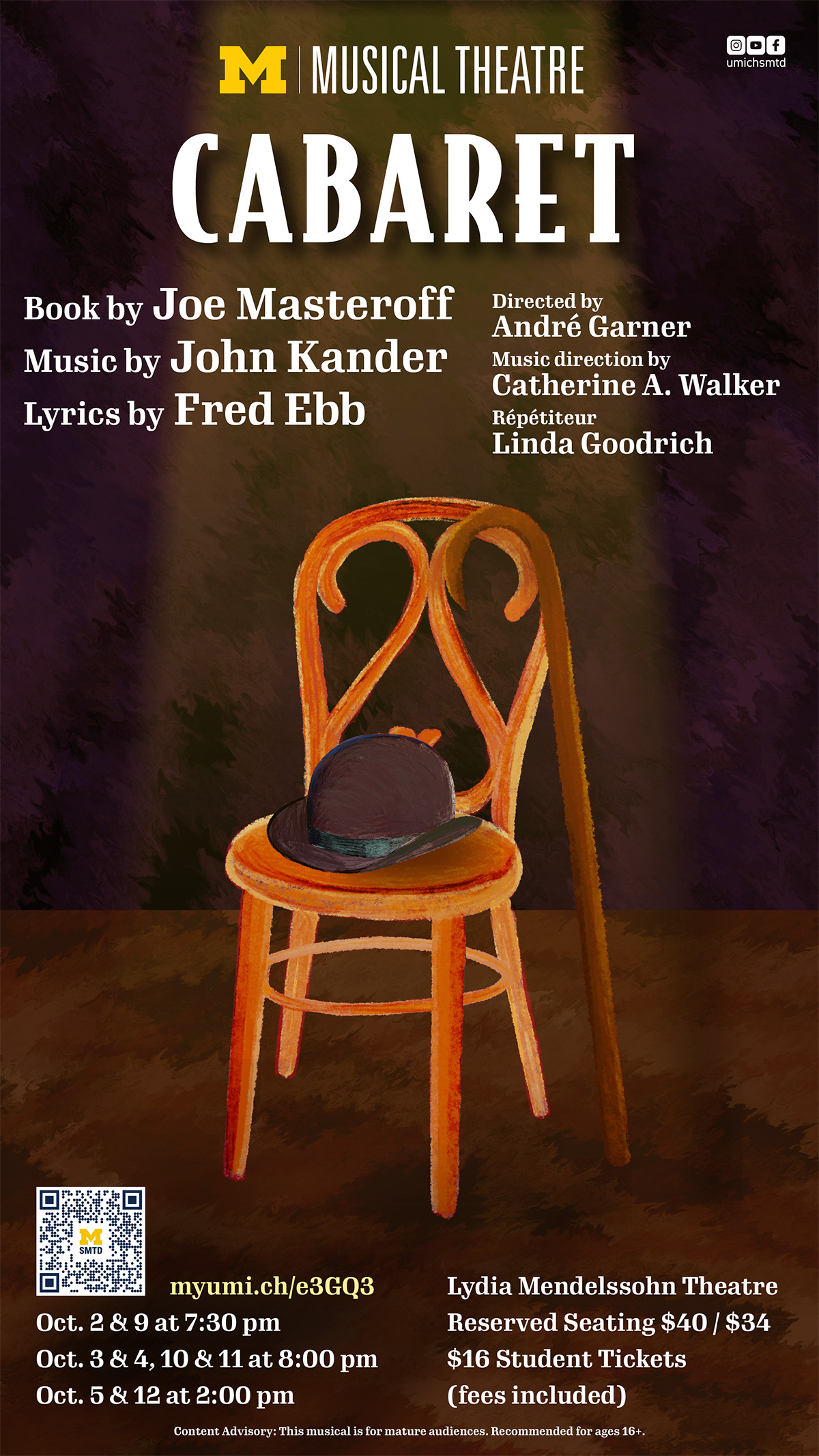
About the Production
Creative Team
Director André Garner
Music Director Catherine A. Walker
Choreographer Tanya Birl-Torres ‡
Repetiteur Linda Goodrich ‡
Scenic Designer Kevin Judge
Costume Designer Kayti Sanchez †
Lighting Designer Ethan J. Hoffman †
Sound Designer Matt Berman ‡
Hair & Makeup Designer Brittany Crinson
Fight Choreographer Lewis Jackson †
Dramaturg Karin Waidley
Resident Intimacy Choreographer and Cultural Consultant Raja Benz
Cultural Consultant Caroline Helton
Production Stage Manager Kathleen Stanton-Sharpless †
Cast
Emcee Zoltan Berencsi
Sally Bowles Nova Brown
Clifford Bradshaw Tsumari Patterson
Ernst Ludwig Oliver Boomer
Fraulein Schneider Caroline Patterson
Fraulein Kost Ella Thomas-Montgomery
Herr Schultz Fabian Rihl
Max/Officer Gabriel Sanchez
Kit Kat Girls
Rosie Liana Wise
Lulu Christine Chupailo
Frenchie Avery Ramsey
Texas Kristabel Kenta-Bibi
Fritzie Emily Murakami
Helga Kate Player
Kit Kat Boys
Hans Anderson Zoll
Bobby Ian Rubin
Victor Kai Sachon
Herman/Gorilla/Bodyguard Burke Brickner
Rudy/Bodyguard Kiran Szymkowiak
Ensemble Burke Brickner, Christine Chupailo, Ezra Elias Frazier, Kristabel Kenta-Bibi, Gabrielle Lieberman, Emily Murakami, Kate Player, Avery Ramsey, Ian Rubin, Kai Sachon, Gabriel Sanchez, Kiran Szymkowiak, Liana Wise
Dance Captain/Backstage Singer Sarah Zampella
Kit Kat Swings Ezra Elias Frazier, Gabrielle Lieberman
Understudies
Sally U/S Avery Ramsey
Fraulein Schneider U/S Kristabel Kenta-Bibi
Emcee U/S Anderson Zoll
Herr Schultz U/S Ian Rubin
Fraulein Kost U/S Sarah Zampella
Orchestra
Catherine A. Walker Piano/Conductor
Andrew Bishop Reed 1
Oliver Bishop Reed 2
Trombone Michael Gerace
Violin Sita Yetasook
Cello Travis Kulwicki
Guitar/Banjo Taylor Nelson
Bass Abimelec Guerra Mercado
Percussion Joe Mowatt
Synthesizer & Accordion Ethan Swanson
Special thanks to:
Trumpet Christopher Gerace
Reeds Donald Schweikert
Trombone Ben Lafo
Assistants to the Creative Team
Assistant Director Quincy Hampton †
Assistant Music Director Ethan Swanson †
Hair & Makeup Design Assistant Gretchen Brookes †
Scenic Design Assistant Ceri Roberts †
Assistant Dramaturg Addison Stone †
Assistant Dramaturg Tate Zeleznik †
Production Crew
Assistant Stage Managers Katie Kutzko†, Greta Steever†
Sound System Technician Al Hurschman ‡
Sound Microphone Tech Jamie Hurschman
Assistant Wardrobe Supervisor Aspen Kinomoto †
Running Crews
Light Board Operator Jasmine Coates
Follow Spot Operators Bennett Smith, Emmett Victorson
Deck Electrician Nico Thom
Microphone Assistants Zara Exconde, Wendell Remy
Scenery Crew Gabi Bradley, Noor Choudhury, Norah Klocke, Heath Thompson
Properties Crew Eva Berney, Sean Wodzanowski, Zeke Zaharoni
Wardrobe Crew Patricio Alvarado, Addison Bohne, Chip Dukes, Olivia Mitchell, Emily Weddle^
Hair and Make-up Crew Cydney Armwood, Riley Hahn, Miles Hionis^, Sophia Leverett‡ SMTD Guest † SMTD Student ^ Crew Head
Shop Crews
Costumes Iliana Beauchamp, Katy Dawson, Sarita Gankin, Lucy Knas, Alex Li, Maya Liu, Rachel Pfeil, Isabella Pruter, Kayti Sanchez, Ellie Van Engen & Theatre 250/252/262 students
Lighting Eliza Anker, Morgan Gomes, Ethan Hoffman, Brandon Malin, Tate Zeleznik & Theatre 250/252/262 students
Paint Gretchen Brookes, Miles Hionis, Ren Kosiorowski, Yuchen Ma, Ceri Roberts, Seri Stewart^, Amber Walters, Landon Wouters, Angela Wu & Theatre 250/252/262 students
Scenery Kelly Burkel, Ren Kosiorowski, Aiden Heeres, Hannah Kryzhan, Josi Middaugh, Michael Russell, Nathaniel Steever, Lauren Streng, Eliza Vassalo & Theatre 250/252/262 students
Props Eliza Anker, Andy Blatt, Kendall Brisco, Laney Carnes, Brook Galsky, Tessie Morales, Leah Stchur, Reese Stevens & Theatre 250/252/262 students
Wigs/Hair/Makeup Gretchen Brookes, Christine Chupailo, Miles Hionis & Theatre 250/252/262 students
Production Management Shelby Holloway, Esther Hwang, Greta Steever
Department of Musical Theatre
SMTD Leadership
David Gier, Dean
Paul Boylan Collegiate Professor of Music
Department Chair
Cynthia Kortman Westphal
Department Manager/Artistic Administrator
Kathryn Pamula
Walgreen Events Manager
Nickie Smith
Studio and Performance Manager
Arie Shaw
Walgreen Office Coordinator
Tyler Brunsman
Faculty
Raja Benz, Jessica Bogart, Tyler Brunsman, Vincent J. Cardinal, Jason DeBord, Ron De Jesús, Maurice Draughn, Tyler Driskill, André Garner, Caroline Helton, Eiji Miura, Sydney Morton, Chelsea Packard, Sara Randazzo, Lynne Shankel, Catherine A. Walker, Ann Evans Watson, Cynthia Kortman Westphal
Professors Emeriti
Linda Goodrich, Mark Madama, Melody Racine, Brent Wagner
Faculty Advisors
Lighting Design Advisor Jess Fialko
Costume Design Advisor Sarah M Oliver
Stage Management Advisor Jenn Rae Moore
Staff Mentors
Staff Mentors Laura Brinker, Brittany Crinson, Patrick Drone, Chad Hain, Heather Hunter, Richard W. Lindsay, Beth Sandmaier
University Productions Administrative Staff
Executive Director Jeffrey Kuras
Administrative Specialist Christine Eccleston
Administrative Asst. Emily Erlich
Facilities Manager Shannon Rice
Performance Halls House Manager Kelley Krahn
Lead Backstage Operations Mgr. Dane Racicot
Sr. Backstage Operations Mgr. David Pickell
Backstage Operations Mgrs. Tiff Crutchfield, Yvette Kashmer, Brian Koepele, Robbie Kozub
University Productions Production Staff
Interim Production Manager Michelle Williams-Elias
Technical Director (Walgreen) Richard W. Lindsay Jr.
Theatrical Scenery Manager Chad Hain
Lead Scenic Carpenter Devin Miller
Scenic Carpenter Heather Udowitz
Charge Scenic Artist Beth Sandmaier
Assoc. Theatrical Paint Mgr. Madison Stinemetz
Lead Theatrical Properties Manager Patrick A. Drone
Assoc. Theatrical Properties Manager Danielle Keys
Properties Artisan Adam Ashlock
Theatrical Properties Stock and Tech Coord. Kat Kreutz
Theatrical Lighting Manager Heather Hunter
Assoc. Theatrical Lighting Manager Jorrey Calvo
Sr. Costume Shop Manager Laura Brinker
Asst. Costume Shop Manager Leslie Ann Smith
Lead Cutter/Draper Tj Williamson
Cutter/Drapers Sarah Havens, Lani Tortoriello
Stitchers Mag Grace, Rene Plante
Lead Costume Crafts Artisan Elizabeth Gunderson
Costume Stock Manager Theresa Hartman
Wardrobe Manager Alli Switalski
Theatrical Hair and Makeup Mgr. Brittany Crinson
Resources
Musical Numbers
Act 1
WILLKOMMEN…………………………………………Emcee, Sally, and the Kit Kat Girls
WELCOME TO BERLIN……………………………Emcee
SO WHAT?……………………………………………….Fraulein Schneider
DON’T TELL MAMA………………………………..Sally and the Kit Kat Girls
MEIN HERR……………………………………………….Sally and the Kit Kat Girls
PERFECTLY MARVELOUS……………………..Sally and Cliff
TWO LADIES……………………………………………Emcee and Helga, Fritzie
IT COULDN’T PLEASE ME MORE…………Herr Schultz and Fraulein Schneider
TOMORROW BELONGS TO ME……………Emcee and Male Ensemble
MAYBE THIS TIME…………………………………..Sally
MONEY………………………………………………………Emcee, Kit Kat Girls and Boys
MARRIED………………………………………………….Herr Schultz and Fraulein Schneider (Arranged by Catherine A. Walker)
FRUIT SHOP DANCE
TOMORROW REPRISE…………………………..Kost, Ernst & Guests
Act 2
KICK LINE NUMBER………………………………..Emcee, Kit Kat Girls
MARRIED REPRISE…………………………………Herr Schultz
IF YOU COULD SEE HER………………………..Emcee
WHAT WOULD YOU DO?……………………..Fraulein Schneider
I DON’T CARE MUCH……………………………..Emcee
CABARET………………………………………………….Sally
FINALE………………………………………………………Company
- About the Performance
- About the Authors
- About the Cast
- About the Creative Team
- Dramaturg's Note
- Director's Note
- Statement on the Anishinaabe Land Transfer
- Freedom of Expression Statement
- Download Program
Setting: Berlin, Germany, late 1920s / early 1930s.
There will be one intermission.
The performers in this production are students in the Department of Musical Theatre. The designers for this production are students, faculty, and/or guests of SMTD. Scenery, costumes, properties, sound, and lighting were realized by the students and staff of University Productions, the producing unit of SMTD. Thank you for supporting our educational mission.
Latecomers will be seated at a suitable break. As a courtesy to others, please turn off cellular phones and pagers and refrain from texting during the performance. Photography, audio recording, and videotaping of any kind are not permitted.
The original Broadway production opened on November 20, 1966, at the Broadhurst Theatre in New York City.
CABARET is presented by arrangement with Concord Theatricals.
Fred Ebb & John Kander (music & lyrics) For nearly five decades, composer John Kander and lyricist Fred Ebb have been one of Broadway’s preeminent songwriting teams, the longest-running music-and-lyrics partnership in Broadway musical history. They are the Rodgers and Hart and Hammerstein of the second half of the twentieth century. They’ve given the world some of the great creations of the American musical stage: Cabaret, Chicago, Kiss of the Spider Woman and nearly a dozen more, ranging from The Act to Zorba. Their scores have a breathtaking ability to capture the flavor of a specific time and place, with gutsy music brimming with vitality and brilliantly droll, penetrating lyrics. They’ve tackled serious, challenging subjects—Nazism, abortion, murder, capital punishment, prison torture, greed, corruption—with an originality and fearlessness rarely seen in popular entertainment. “Kander and Ebb combine razzmatazz with a political conscience, and make brazen spirits seem a kind of moral courage,” said David Richards in The Washington Post. They’ve been rewarded with Tonys on Broadway, Oscars in films, and Emmys on television. They’ve written for the great musical performers of our day: Lauren Bacall, Joel Grey, Gwen Verdon, Frank Sinatra, Robert Goulet, Chita Rivera, and Barbra Streisand.
—Courtesy of the Kennedy Center
Joe Masteroff (book) Born in 1919 in Philadelphia, Joe Masteroff had only one dream from infancy: to write for the theatre. After the essential lonely childhood and four-year stint in the Air Force, he came to New York to face his future: book writer or book seller? Luckily, luck intervened. Before long he had three shows on Broadway bearing his name: The Warm Peninsula starring Julie Harris, and two musicals, She Loves Me and Cabaret, for which he was the book writer. His other work included the libretto for 70, Girls, 70 and Desire Under the Elms and book and lyrics for Six Wives and Paramour. Thanks to indulgent parents, the New Dramatists, Hal Prince and many others, Joe Masteroff retired and lived in subdued luxury until his death in 2018.
—Courtesy of Concord Theatricals
Zoltan Berencsi (Emcee) Senior, BFA Musical Theatre, Johns Creek, GA
Oliver Boomer (Ernst Ludwig) Senior, BFA Musical Theatre/Minor in Musical Theatre Composition, Traverse City, MI
Burke Brickner (Herman/Gorilla/Bodyguard) Junior, BFA Musical Theatre, New York, NY
Nova Brown (Sally Bowles) Senior, BFA Musical Theatre/Minors in Mandarin and Performing Arts Management & Entrepreneurship, Miami, FL
Thank you for attending this program. The University of Michigan strives to create a truly open forum, one in which diverse opinions can be expressed and heard. You can see our full Freedom of Expression policy at smtd.umich.edu/FOE
Freedom of Expression Statement
Christine Chupailo (Lulu/Ensemble) Junior, BFA Musical Theatre/ Minor in Design and Production: Wigs, Hair, and Makeup Design, Rochester, MI
Ezra Elias Frazier (Kit Kat Swing/Ensemble), Junior, BFA Musical Theatre, Minneapolis, MN
Kristabel Kenta-Bibi (Texas/Fraulein Schneider U/S) Senior, BFA Musical Theatre/Double Minor in Political Science and Performing Arts Management & Entrepreneurship, Glastonbury, CT
Gabrielle Lieberman (Ensemble/Kit Kat Swing) Sophomore, BFA Musical Theatre, Miami, FL
Emily Murakami (Fritzie/Two Ladies/Ensemble) Junior, BFA Musical Theatre/Minor in Movement Science, Toronto, Ontario
Caroline Patterson (Fraulein Schneider) Senior, BFA Musical Theatre, Pasadena, CA
Tsumari Patterson (Clifford Bradshaw) Junior, BFA Musical Theatre, Snellville, GA
Kate Player (Helga/Two Ladies/Ensemble) Junior, BFA Musical About the Cast
Matt Berman (Sound Design) travels as the sound designer for Kristin Chenoweth. His most recent Broadway sound design was for Chenoweth’s For the Girls at the Nederlander Theater. His international touring with stars such as Chenoweth, Liza Minnelli, Alan Cumming, and Elaine Paige has allowed him to design for such iconic venues as Royal Albert Hall, the Paris Opera, Carre Theater (Amsterdam), the Sporting Club (Monte Carlo), the Acropolis, the Amphitheater (Taormina, Sicily), the Sydney Opera House, and, closer to home, the Hollywood Bowl, Alice Tully Hall, the Metropolitan Opera, and Carnegie Hall. Other Broadway credits include: Kristin Chenoweth’s “My Love Letter to Broadway” at the Lunt Fontanne, the Tony Award-winning “Liza’s at the Palace,” “Bea Arthur on Broadway” at the Booth Theater, Nancy LaMott’s “Just in Time for Christmas,” and “Kathy Griffin Wants a Tony” at the Belasco Theater.
Tanya Birl-Torres (Choreographer) is a NYC-based theatre maker and embodied systems change facilitator. Choreography credits include: The world premiere of Midnight in the Garden of Good and Evil (Goodman Theater), How I Learned What I Learned (OSF), Peter and the Star Catcher (OSF), Twelfth Night (The Public Theater), The Red Letter Plays (The Signature Theater), As You Like It (The Guthrie Theater). She was 2024 Hi-Arts Critical Breaks artist in residence, 2023 MAP fund and NoMAA grantee for her original choreo-play A Play in Three Movements, 2023 NewYorker4NY honoree in feature of “Women breaking glass ceilings & exercising their voice in NYC & beyond.” She currently serves as the social practice artist in residence at the Shed in NYC for her new work, The Zora Project, where she is directing, choreographing, and envisioning a cosmic theatrical offering to the legacy of Zora Neale Hurston. @sohumanity
Brittany Crinson (Hair & Makeup Designer) is the wigs, hair, and makeup studio manager for all of UProd, taking on the role of designing for each production. Crinson spent several years in Chicago building her portfolio and skill set as a wig, hair, and makeup designer. She is thrilled to be back for her 2nd full year at UMich.
André Garner (Director) is an assistant professor of musical theatre. Directing (and co-directing) credits: Titanic, Songs for a New World, Detroit ’67, Marcus; or the Secret of Sweet, and Dutchman. Acting credits include: Broadway: Dr. Seuss’ How the Grinch Stole Christmas, The Music Man, Marie Christine, Grease. Off-Broadway: Little Ham, From My Hometown. National tours: The Color Purple, Dreamgirls, Joseph and the Amazing Technicolor Dreamcoat, Miss Saigon, A Chorus Line (International). Select regional theatre: Pipeline (Indiana Repertory Theatre), Abyssinia (Goodspeed Opera House), Children of Eden (The Ford’s Theatre). Garner has collaborated with notable directors such as Susan Stroman, Graciela Daniele, and Ruben Santiago Hudson.
Linda Goodrich (Repetiteur) has directed and choreographed throughout the United States, Europe, and Japan. She conceived, directed, and choreographed several new works: Walk on Through, with music and lyrics by Gavin Creel; Hotel California, with music by the Eagles; Dance with Me, featuring the music of Air Supply; Gibson Fleck; A Good Boy. She choreographed world premieres of Everything’s Ducky and the adaptation of Good News!, licensed by MTI. Tours: Cabaret (Europe), Singin’ in the Rain (US and Japan). International: Theatre Carre (Amsterdam), Music Theatre International (Italy). NY theatre: Metropolitan Museum of Art Live Arts Series, Radio City Music Hall, Carnegie Hall, MCC, Signature Theatre, NY Musical Theatre Festival. Regional Theatre: Goodspeed Opera House, Papermill Playhouse, Walnut Street Theatre, TheatreWorks Palo Alto, Cincinnati Playhouse, the Repertory Theatre of St. Louis, the 5th Ave. Theatre, MTWichita, and Sacramento Bway Series. Professor emeritus U-M, SDC. www.lindagoodrich.com
Ethan J. Hoffman (Lighting Designer) is a senior pursuing a BFA in theatre design & production with a concentration in lighting design at U-M. Design credits include Oklahoma! (Encore Musical Theatre Company), A Chorus Line (MUSKET), and Stop Kiss (Rude Mechanicals). Assistant design credits include Ethan Stiefel’s Spirit of the Highlands (American Repertory Ballet), Jorden Morris’s Giselle (Orlando Ballet), Messiah in America (Millennial® Choirs and Orchestra), West Side Story (Encore Musical Theatre Company), Turn of the Screw (UProd), The Opposite of Killing (UProd), Flying Home (UProd), ReQuest (UProd), Mabanza (UProd), and The Cherry Orchard (UProd). Upcoming designs include the University of Michigan Dance Concert 2026. ethanhoffman.com
Lewis Jackson III (Fight Choreographer) is a senior BFA acting major with a minor in education for empowerment. This is his first time choreographing stage combat scenes for the stage. He is overjoyed to have had the opportunity to work with a brilliant team of collaborators and a rockstar cast! Performance credits include: A Few Good Men (UProd), The Cherry Orchard (UProd), Blood at the Root (senior directing thesis), The Sign in Sidney Brustein’s Window (senior directing thesis), Much Ado About Nothing (Shakespeare tour), Funny Girl (MUSKET), Animal Farm (Rude Mechanicals), The Bubbly Black Girl Sheds Her Chameleon Skin (independent production), Of Thee I Sing (Gershwin Initiative), Eurydice (Basement Arts), and The Visit (Basement Arts). @l.jackson810
Kevin Judge (Scenic Designer) is an associate professor at U-M. Credits include the Broadway production of Irena’s Vow and many other shows in New York City including Laugh It Up, Stare It Down (The Cherry Lane Theatre), Anthem (Baryshnikov Arts Center), Lovesick, The Revival, and FUBAR with Project Y, and Frankenstein (37 ARTS). He has worked at the Cincinnati Playhouse in the Park, La Jolla Playhouse, Delaware Theater Company, and Wellfleet Harbor Actors Theater.In addition to his theatre designs, Judge is a set designer on over 150 episodes of television, working on shows including The Chosen (Lionsgate), The White House Plumbers (HBO), For Life (ABC), Manifest (NBC), Jessica Jones (Netflix), Blindspot (NBC), and The Americans (FX). He was the associate designer on over 40 theatre productions with Alexander Dodge including the Tony Award-nominated A Gentleman’s Guide to Love and Murder and Present Laughter. He received his MFA from the University of California, San Diego.
Kayti Sanchez (Costume Designer) is a proud Latina from South Florida. She is a senior BFA design & production major and Latino/a studies minor. CD (U-M): Blood at the Root, A Few Good Men, The Wolves. Broadway: Here Lies Love (CD Intern). Regional: Virgin, Mother, Whore (CD; LATA winner for Best Costume Design). Assistant CD (U-M): Twelfth Night, Elizabeth Cree. Love and gratitude to her community,family, the costume shop, Sarah, and the whole Cabaret team. Azucar! kaytisanchez.com
Kathleen Stanton-Sharpless (Production Stage Manager) is a senior getting their BFA in design & production, with a concentration in stage management. Past U-M credits include A Few Good Men (PSM), Jesus Christ Superstar (PSM), Falsettos (PSM), The Grown Ups (PSM), and Imogen Says Nothing (ASM). Regional credits include Best for Baby (ASM), All the Little Boxes (ASM), The Importance of Being Earnest (ASM), Ruinous Gods (ASM), and The Witnesses (PA). They are so happy to open their very last UProd with such an amazing company. Shoutout to their stellar team, Greta, Katie, Morgan, Brady, and Jack! Special thanks to their family, thank you for your support through it all.
Catherine A. Walker (Music Director/Conductor) is a professor in the Department of Musical Theatre. U-M: A Little Night Music, Bernarda Alba, Me & My Girl, A Man of No Importance, The Light in the Piazza, Les Misérables, A Little Night Music, Bat Boy, Crazy for You, Little Women, Gibson Fleck, Brigadoon, Evita, Ella Minnow Pea, 42nd Street, Big River. Professional: Music supervisor for Rent at the Orb Theatre in Tokyo, Japan. Other credits include a visiting professorship at Mahidol University, Bangkok, Thailand; teaching artist and vocal coach with Michael Feinstein Great American Songbook Academy; 5th Avenue Theatre Summer Professional Intensive; Farmers Alley Theatre; the Derby Dinner Playhouse; The Barn Theatre; Island Center Productions, St. Croix; 3-D Productions, New York. Walker is a Certified Master Teacher in the Estill Voice Training System and an active clinician, vocal coach, and author.
When designer Kevin Judge told the cast that the set would include curtains from the Mendelssohn Theatre dating back to 1929, the time in which Cabaret takes place, there was a collective gasp as all imagined how this material blend of past and present adorning our Kit Kat Klub would connect the “then” with the “now,” the contemporary actors with their historical counterparts. We wondered what lives hidden within the folds of these fabrics were about to be revealed? What stories suspended there were about to be told? Who was hiding behind this cascading felt? And how might the curtains’ resurrection help us better understand the cautionary tale we were about to experience as it swayed and teetered above us, bringing a distant past crashing back to life?
The Golden Era of the Weimar
Unrolling the heavy curtain of history that covers Weimar Germany, one mostly unveils this time as one of devastation, of unheeded warning, obscuring any hope or promise that may have been. Most productions of Cabaret echo this sentiment, tending to play the ending—what happened on January 30, 1933, when the Nazis took power—rather than relishing the time of the musical in the years prior to that fateful day. Historian Eric D. Weitz acknowledges this: “Weimar Germany conjures up fears of what can happen when there is simply no societal consensus on how to move forward and every minor difference becomes a cause of existential political battles, when assassinations and street fights run rampant and minorities become the easy scapegoats of antidemocratic forces.” And certainly, unprecedented tragedy and horror ensued. But in this production, we hope you’ll also see a glimmer of the Golden Era of the Weimar—a glimpse of the great achievement that was: a highly liberal political order, substantial social programs, and cultural revolutions that greatly improved the lives of ordinary Germans. During this time, women won the right to vote, Germany had a lively free press, and ideas were hatched “for creating the flourishing and harmonious society of the future, from nudism to communism.” Sex therapists and popular activists alike advocated for the rights of all to find a fulfilling life, a political and a sexual one. And it is a microcosm of these changing times that you’ll see on display in the flourishing and frolicking cabaret! We hope you enjoy the show!
The Queer Culture of the Berlin Cabarets
Sometimes Christopher Isherwood, author of The Berlin Stories, which Cabaret is sourced from, is seen only in the shadows as his story was eclipsed from the time when the first curtain came up on the musical in 1966. But Isherwood’s writing is the wellspring and backbone of the tale and the inspiration for Cliff. Isherwood came to Berlin in large part because of the sexual freedom that the city was known for during the Weimar period. Despite Paragraph 175 being enacted in 1871, criminalizing homosexuality among men, distinctly modern articulations of gender and sexuality started to emerge through cultural representations in the Weimar Republic of Germany, especially including in and on display at the cabaret. In Weimar cabarets, drag performance was a common attraction, most notably at the Eldorado, which was a prominent Queer cabaret during the Weimar Republic and a main inspiration for what has been fictionalized as the Kit Kat Klub in Cabaret. By the later 1920s, Berlin was filled with over 160 Queer bars and social spaces. “It was in the Weimar era that several characteristic components of twentieth-century gay and lesbian liberation were first put to use in the context of mass democracy,” states Laurie Marhoefer in Sex and the Weimar Republic. Weimar Berlin introduced the first gender-affirming surgeries in the world, and it was Weimar Germany where many modern ideas of gender and especially trans and non-binary language developed. Much of this research and thinking comes from the Institute for Sexual Research, which was opened in 1919 by Magnus Hirshfeld, who had previously established what is credited to be the world’s first LGBTQ+ rights organization in 1897. Hirshfeld’s institute would ultimately fall victim to one of the earliest and largest Nazi book burnings, just months after Hitler came to power, where roughly 12,000 books and records of Queer history were destroyed. Among the books engulfed in flames was Heinrich Heine’s Almansor, which famously reads, “Where they burn books, in the end they will burn humans too.” Around the same time, the aforementioned Eldorado was closed and converted into a Nazi SA headquarters. In 1935, Paragraph 175 was revised to make it easier to persecute a greater quantity of Queer people. Following this, large numbers of gay and trans people were put in prison and concentration camps.
The Complacent and the Complicit
Not wanting to draw back the curtains is how Sally and Cliff dance and sing through life—for a time, until what is occurring in Berlin is undeniable. Cabaret is a cautionary tale. But it is more than this. Theatre reflects and refracts, pulling back the curtain on how things once were, while letting the world that is stream in. Isherwood wrote, “Berlin had affected me like a party at the end of which I didn’t want to go home.” We all know how this story ended. So what will we do with a now that also hangs in the balance—teetering and billowing like fabric in the wind, like our democracy, like the valuing of difference—once the curtain descends on Cabaret, and we all walk back into the light of day?
-Composed by Team Dramaturgy: Tate Zeleznik and Karin Waidley
Christopher Isherwood’s Berlin Stories captures a society on the edge—Berlin in the late 1920s, a city bursting with art, desire, decadence, and denial. Cabaret, born from these stories, asks us to step into the Kit Kat Klub, where music and laughter drown out the world outside. But as the show unfolds, the shadows lengthen, and the joy becomes fragile. At its core, Cabaret is not just about nightlife in Weimar Germany—it is about what happens when a society turns away from reality, when people convince themselves that politics is someone else’s problem. Fascism does not arrive with a crash; it creeps in slowly, gaining ground while individuals look away, distracted by pleasure, fear, or the hope that things will somehow resolve themselves.
In this story, we witness how fascism crushes the “others” of society: queer people, Jewish communities, immigrants, people of color, and anyone who does not fit the rigid mold of authoritarian ideology. The Emcee’s glittering grin, Sally’s reliance on living “for the moment,” and even Fraulein Schneider’s heartbreaking pragmatism all reveal the dangerous choices of complicity, survival, and denial.
Cabaret reminds us that entertainment can be a mask—and sometimes a weapon—but it cannot shield us forever from the consequences of intolerance. As we watch the cabaret lights dim, we are left with the question: when faced with injustice and hatred, will we sing louder to drown it out, or will we stand against it before it’s too late?
—André Garner, director
Anishinaabeg gaa bi dinokiiwaad temigad manda Michigan Kichi Kinoomaagegamig. Mdaaswi nshwaaswaak shi mdaaswi shi niizhawaaswi gii-sababoonagak, Ojibweg, Odawaag, minwaa Bodwe’aadamiig wiiba gii-miigwenaa’aa maamoonjiniibina Kichi Kinoomaagegamigoong wi pii-gaa aanjibiigaadeg Kichi-Naakonigewinning, debendang manda aki, mampii Niisaajiwan, gewiinwaa niijaansiwaan ji kinoomaagaazinid. Daapanaming ninda kidwinan, megwaa minwaa gaa bi aankoosejig zhinda akiing minwaa gii-miigwewaad Kichi-Kinoomaagegamigoong aanji-daapinanigaade minwaa mshkowenjigaade.
The University of Michigan is located on the traditional territory of the Anishinaabe people. In 1817, the Ojibwe, Odawa, and Bodewadami Nations made the largest single land transfer to the University of Michigan. This was offered ceremonially as a gift through the Treaty at the Foot of the Rapids so that their children could be educated. Through these words of acknowledgment, their contemporary and ancestral ties to the land and their contributions to the University are renewed and reaffirmed.
Thank you for attending this program. The University of Michigan strives to create a truly open forum, one in which diverse opinions can be expressed and heard. You can see our full Freedom of Expression policy at smtd.umich.edu/FOE