
Detailed Content Advisory (Contains Spoilers)
At the end of ACT I, there is a mass shooting event that takes place in an office setting. In accordance with this event, there will be intense visual and sound effects like the use of a simulated firearm, loud gunshots, the presence of blood and live and recorded screams.
The intermission will immediately follow this event. If you are in distress, please see our mental health coordinator, Raja Benz, who will be on hand during intermission.
There is also a wellness insert in the program, providing campus and community support resources, which you can take with you.
If you decide that you would no longer like to attend the performance, please use this form to request a refund, exchange, or to donate your ticket(s).
Additional context: during the performance, characters will discuss death by suicide and other forms of violence, sometimes in flippant, casual and/or glorifying ways. Language also includes casual racist, homophobic, misogynistic, ableist and other disparaging comments. Characters also generally reference past actual mass shooting events and residual trauma. There is a depiction of the effects of PTSD, such as a panic attack and other manifestations, in at least one of the characters.
About the Production
Creative Team
Director Judith Moreland ‡
Scenic Designer Talia Lev †
Lighting Designer Kathy A Perkins ‡
Costume Designer Sarah M Oliver
Hair & Makeup Designer Brittany Crinson
Sound Designer Kate Hopgood ‡
Dramaturg Karin Waidley
Voice & Speech Coach Jeremy Sortore
Intimacy and Cultural Consultant Raja Benz
Production Stage Manager Justin Comini †
Cast
Kendra/Jenna Salem Zhao
Ani/Sasha/Callie Siobhán McGroarty
Dean/Devin Hayden Steiner
Gloria/Nan Sarah Josefina Hartmus
Miles/Shawn/Rashaad Mateo St. Remy
Lorin Milo Bustany
U/S Ani/Sasha/Callie Emily Kauderer
U/S Gloria/Nan Zoe Papadakis
U/S Dean/Devin/Lorin Lucas Somers
Assistants to the Creative Team
Assistant Director Kendall Brisco
Assistant Stage Manager Chloe Deutschman †
Associate Dramaturg Brook Galsky †
Assistant Dramaturg Kendal Bazerman †
Lighting Design Assistant Shelby Holloway †
Costume Design Assistant Xiaoxiao Lu ‡
Production Crew
Lead Electrician Eliza Anker
Assistant Stage Manager Chloe Deutschman
Production Assistants Adilynn Cardenas, Vera Alonzo, Jiayun (Wonda) Qian
Running Crew
Light Board Operator Soph Irfani
Deck Electrician Gavin Young
Sound Operator Eric Liang
Deck Crew (Scenery) Alex Heskett, E. Holmes
Deck Crew (Props) Bea Gibbons, Catalina Vigil
Deck Crew (Props/Video) Sydney Hoahning
Wardrobe Crew Sloane O’Neill, Meera Sankar, Ellie Van Engen^
Wig Crew Sophia Santos-Ufkes
Backup Crew Alyanna Carriedo, Jamaur Houston, Lindsay Susten
^ Crew Head
Shop Crews
Theatrical Lighting Eliza Anker, Morgan Gomes, Ethan Hoffman, Brandon Malin, Tate Zeleznik & Theatre 250/252/262 students
Painting Gretchen Brookes, Kelly Burkel, Miles Hionis, Ren Kosiorowski, Bill Lewis, Ceri Roberts, Greta Steever, Seri Stewart, Amber Walters, Landon Wouters, Angela Wu & Theatre 250/252/262 students
Props Eliza Anker, Andy Blatt, Kendall Brisco, Laney Carnes, Brook Galsky, Tessie Morales, Leah Stchur, Reese Stevens & Theatre 250/252/262 students
Scenery Kelly Burkel, Ren Kosiorowski, Aiden Heeres, Hannah Kryzhan, Josi Middaugh, Michael Russell, Nathaniel Steever, Lauren Streng, Eliza Vassalo & Theatre 250/252/262 students
Costumes Iliana Beauchamp, Katy Dawson, Sarita Gankin, Lucy Knas, Alex Li, Maya Liu, Rachel Pfeil, Isabella Pruter, Kayti Sanchez, Ellie Van Engen & Theatre 250/252/262 students
Wigs/Hair/Makeup Gretchen Brookes, Christine Chupailo, Miles Hionis & Theatre 250/252/262 students
Production Management Shelby Holloway, Esther Hwang, Greta Steever
Department of Theatre & Drama
SMTD Leadership
David Gier, DeanPaul Boylan Collegiate Professor of Music
Department of Theatre & Drama
Department Chair Dr. Tiffany Trent
Department Manager/Artistic Administrator Kathryn Pamula
Walgreen Events Manager Nickie Smith
Studio and Performance Manager Arie Shaw
Walgreen Office Coordinator Tyler Brunsman
Performance/Directing Christina Traister (Head of Performance), Halena Kays (Head of Directing), Daniel Cantor (Head of Acting), Raja Benz, Mark Colson, Antonio Disla, Holly Hughes, Tzveta Kassabova, Geoffrey Packard, Jeremy Sortore, Malcolm Tulip, Tiffany Trent
Design/Production Kevin Judge (Head of D&P), Jess Fialko, Heather Gilbert, Jungah Han, Jenn Rae Moore, Christianne Myers, Sarah M. Oliver
Theatre Studies/Playwriting Mbala Nkanga (Head of Theatre Studies), José Casas, Shavonne Coleman, Antonio C. Cuyler, Antonio Disla, Jenna Gerdsen, Amy E. Hughes, Holly Hughes, Jason Fitzgerald, Petra Kuppers, Ashley Lucas, Jay Pension, Rogério Pinto, Alexis Riley, Emilio Rodriguez, Karin Waidley
Arts Management Paul Bonin-Rodriguez, Antonio C. Cuyler, Aaron Dworkin, Afa Dworkin, Ken Fischer, Gala Flagello, Andrew Kuster, Jonathan Kuuskoski, Kari Landry, Robin Myrick, Jay Pension, Jesse Rosen, Omari Rush, Anna Sampson
Interarts Scott Crandall, Holly Hughes, Tzveta Kassabova, Malcolm Tulip
Professors Emeriti Alan Billings, Peter W. Ferran, Jessica Hahn, Philip Kerr, Priscilla Lindsay, Janet Maylie, Vincent Mountain, John Neville-Andrews, OyamO, Leigh Woods
Faculty Advisors
Scenic Design Advisor Kevin Judge
Stage Management Advisor Jenn Rae Moore
Staff Mentors
Staff Mentors Laura Brinker, Brittany Crinson, Patrick Drone, Chad Hain, Heather Hunter, Richard W. Lindsay, Beth Sandmaier
University Productions Administrative Staff
Executive Director Jeffrey Kuras
Administrative Specialist Christine Eccleston
Administrative Asst. Emily Erlich
Facilities Manager Shannon Rice
Performance Halls House Manager Kelley Krahn
Lead Backstage Operations Mgr. Dane Racicot
Sr. Backstage Operations Mgr. David Pickell
Backstage Operations Mgrs. Tiff Crutchfield, Yvette Kashmer, Brian Koepele, Robbie Kozub
University Productions Production Staff
Interim Production Manager Michelle Williams-Elias
Technical Director (Walgreen) Richard W. Lindsay, Jr.
Theatrical Scenery Manager Chad Hain
Lead Scenic Carpenter Devin Miller
Scenic Carpenter Heather Udowitz
Charge Scenic Artist Beth Sandmaier
Assoc. Theatrical Paint Mgr. Madison Stinemetz
Lead Theatrical Properties Manager Patrick A. Drone
Assoc. Theatrical Properties Manager Danielle Keys
Properties Artisan Adam Ashlock
Theatrical Properties Stock and Tech Coord. Kat Kreutz
Theatrical Lighting Manager Heather Hunter
Assoc. Theatrical Lighting Manager Jorrey Calvo
Sr. Costume Shop Manager Laura Brinker
Asst. Costume Shop Manager Leslie Ann Smith
Lead Cutter/Draper Tj Williamson
Cutter/Drapers Sarah Havens, Lani Tortoriello
Stitchers Mag Grace, Rene Plante
Lead Costume Crafts Artisan Elizabeth Gunderson
Costume Stock Manager Theresa Hartman
Wardrobe Manager Alli Switalski
Theatrical Hair and Makeup Mgr. Brittany Crinson
Resources
- About the Performance
- About the Author
- About the Cast
- About the Creative Team
- Statement on the Anishinaabe Land Transfer
- Director's Note
- Dramaturg's Note
- Freedom of Expression Statement
- Wellness Insert
- Download Program
Setting: The Midtown offices of an American magazine, circa the 2010s.
There will be one intermission.
The performers in this production are students in the Department of Theatre & Drama. The designers for this production are students, faculty, and/or guests of SMTD. Scenery, costumes, properties, sound, and lighting were realized by the students and staff of University Productions, the producing unit of SMTD. Thank you for supporting our educational mission.
Latecomers will be seated at a suitable break. As a courtesy to others, please turn off cellular phones and pagers and refrain from texting during the performance. Photography, audio recording, and videotaping of any kind are not permitted.
Gloria premiered Off-Broadway at the Vineyard Theatre, New York City, on May 28, 2015 in preview, officially opening on June 17.
GLORIA is presented by arrangement with Dramatists Play Service, Inc.
Branden Jacobs-Jenkins (playwright) is an American playwright best known for his plays that deal with matters of identity and history, including race and family legacies. In 2024 his play Appropriate won three Tony Awards. The following year Purpose, which debuted in Chicago in 2024 before moving to Broadway, was awarded the Pulitzer Prize for drama and the Tony for best new play. Jacobs-Jenkins’s back-to-back Tony wins made him the first Black playwright to achieve that honor. In 2016, his play Gloria, a workplace comedy about young staffers at a prestigious magazine, was nominated for a Pulitzer Prize for drama. That same year he won a Windham-Campbell Prize for literature and a MacArthur Fellowship.He was nominated again for a Pulitzer in 2018 for his drama Everybody, a contemporary take on Everyman, a 15th-century morality play that uses allegory to impart moral lessons on death and the fate of the human soul. Everybody was previously performed at the University of Michigan in 2023.
Bio courtesy of Brittanica
Milo Bustany (Lorin) Sophomore, BFA Acting/BS Cognitive Science, Santa Barbara, CA
Sarah Josefina Hartmus (Gloria/Nan) Senior, BFA Acting/Political Science minor, Rochester Hills, MI
Siobhán McGroarty (Ani/Sasha/Callie) Sophomore, BFA Acting, New York, NY
Mateo St. Remy (Miles/Shawn/Rashaad) Sophomore, BFA Acting/LSA, Norfolk, VA
Hayden Steiner (Dean/Devin) Senior, BFA Acting, San Diego, CA
Salem Zhao (Kendra/Jenna) Senior, BFA Acting, Shanghai, China
Justin Comini (Production Stage Manager) is a junior design and production major at the University of Michigan, concentrating in stage management. Favorite credits include the pre-Broadway workshops of WANTED and Real Women Have Curves; “Student Songs” at Lincoln Center (PA); Pippin at Vanguard Theater (PSM); Titanic at U-M (ASM); and the Bard Music Festival (ASM). Endless love to his blood and chosen family. @justincomini • justincomini.com
Brittany Crinson (Hair & Makeup Designer) is the wigs, hair, and makeup studio manager for all of UProd, taking on the role of designing for each production. Crinson spent several years in Chicago building her portfolio and skill set as a wig, hair, and makeup designer. She is thrilled to be back for her 2nd full year at U-M. Break legs, cast and crew of Gloria!
Kate Hopgood (Sound Designer) is thrilled to be working on Gloria. Broadway: Birthday Candles (Roundabout’s American Airlines Theater). Regional credits include: A Streetcar Named Desire (Flint Repertory Theatre); Mrs. Harrison (Williamston Theatre); Soft Target, Nora, 8 nights, Clyde’s, The Beauty Queen of Leenane (Detroit Public Theatre); Julius Caesar (PlayMaker’s Repertory Company); The Tempest, Richard III, Twelfth Night, Hamlet, Love’s Labour’s Lost (Michigan Shakespeare Festival). Chicago: Into That Darkness: The Corrosive Hours of Edgar Poe (The Edge Off Broadway); Love’s Labour’s Lost (Lifeline Theatre); Titus Andronicus (Babes with Blades); The Electric Baby, Wrens (Rivendell Theatre Ensemble).
Talia Lev (Scenic Designer) is a senior pursuing a BFA in design and production (scenic design concentration). She would like to thank University Productions for the opportunity to design this production as well as the audience for supporting the arts. She looks forward to designing the production of Semele in March. Previous credits include: Titanic (ASD), 2025 Power Center Dance Concert (SD), Twelfth Night (ASD), Julius Caesar (graphic designer), Hänsel und Gretel (deck crew head), The Turn of the Screw (deck crew head), The Cherry Orchard (ATD). tallevdesign.comAbout the Creative Team
Judith Moreland (Director) is a director whose credits include An Octoroon and My Body, No Choice (Fountain Theatre, Los Angeles); Cry It Out, Smart People, Between Riverside and Crazy, An Octoroon (Capital Stage, Sacramento); At the Table, Pictures from Home (virtual/The Road Theatre, North Hollywood); Intimate Apparel (University of Michigan); Everybody (The Art of Acting Studio, Hollywood); and Into the Woods, The Mineola Twins, and the original devised piece What Happened at the UCLA School of Theater, Film and Television, where she is a professor of theater. She was the voice and text director of Jitney (Oregon Shakespeare Festival), The Brothers Size, and Mountaintop (Geffen Playhouse, Los Angeles) and will return to OSF next year as voice and text director for their production of A Raisin in the Sun. judithmoreland.com
Sarah M Oliver (Costume Designer) is an associate professor of costume technology and design in the Department of Theatre & Drama. Design credits: (U-M) Our Oz, No Other, Hansel & Gretel, Orpheus in the Underworld, Arbor Falls, Don Giovanni, The Cunning Little Vixen, somebody’s children, and Nora: A Doll’s House; (regional) Music Academy, Kansas City Repertory Theatre, Kalamazoo Symphony Orchestra, Kansas City Actors Theatre, Unicorn Theatre, the New Theatre Restaurant, and Kansas University Opera. Costume construction credits: (international) MaiOui Dance, St. Lawrence Center for the Arts, Celebrity Cruises Quixotic Fusion, G&S Society Bermuda, Spanish Summer Dance Festival, Hong Kong Ballet, and Hong Kong Academy for Performing Arts; (New York) The Juilliard School, the Irish Repertory Theatre, and New York City Opera; (regional) Theatre Aspen, Des Moines Metro Opera, the Coterie Theatre, Gulfshore Playhouse, the Magic Theatre, Washington National Opera, and Crossroads Theatre.
Kathy A Perkins (Lighting Designer) has designed for Broadway, Off-Broadway, and regional theatres including American Conservatory Theatre, Arena Stage, Berkeley Repertory, Seattle Repertory, St. Louis Black Repertory, Goodman, Steppenwolf, Alabama ShakeAbout the Creative Team
speare Festival, New Federal Theatre, Mark Taper, Yale Repertory, Actors Theatre of Louisville, Two Rivers Theatre, and Playmakers Repertory. Internationally, she has designed in South Africa, Switzerland, Cuba, and Canada. She is the editor of seven anthologies focusing on women nationally and internationally and a senior editor of the Routledge Companion to African American Theatre and Performance. Perkins is the recipient of numerous research and design awards, including Ford Foundation, Fulbright, National Endowment for the Humanities, the Henry Hewes Design Award, and an NAACP Image Award. She received 2019 ATHE Career Achievement in Academic Theatre, and the 2021 USITT Distinguished Achievement Award for both Education and Lighting Design. Perkins is a graduate of Howard University and the University of Michigan, where she is excited to return.
Jeremy Sortore (Voice & Speech Coach, he/him) is an associate professor in the Department of Theatre & Drama. Regional: American Repertory Theater, Utah Shakespeare Festival, Colorado Shakespeare Festival. Member, National Alliance of Acting Teachers; associate faculty, Theatrical Intimacy Education; associate teacher
Anishinaabeg gaa bi dinokiiwaad temigad manda Michigan Kichi Kinoomaagegamig. Mdaaswi nshwaaswaak shi mdaaswi shi niizhawaaswi gii-sababoonagak, Ojibweg, Odawaag, minwaa Bodwe’aadamiig wiiba gii-miigwenaa’aa maamoonjiniibina Kichi Kinoomaagegamigoong wi pii-gaa aanjibiigaadeg Kichi-Naakonigewinning, debendang manda aki, mampii Niisaajiwan, gewiinwaa niijaansiwaan ji kinoomaagaazinid. Daapanaming ninda kidwinan, megwaa minwaa gaa bi aankoosejig zhinda akiing minwaa gii-miigwewaad Kichi-Kinoomaagegamigoong aanji-daapinanigaade minwaa mshkowenjigaade.
The University of Michigan is located on the traditional territory of the Anishinaabe people. In 1817, the Ojibwe, Odawa, and Bodewadami Nations made the largest single land transfer to the University of Michigan. This was offered ceremonially as a gift through the Treaty at the Foot of the Rapids so that their children could be educated. Through these words of acknowledgment, their contemporary and ancestral ties to the land and their contributions to the University are renewed and reaffirmed.
There are few things more exhilarating than entering the world of a Branden Jacobs-Jenkins play. Each one is a jewel: unique, multifaceted, sometimes hard and unforgiving, but always with the ability to dazzle.
Gloria checks all those boxes. And like most of his plays, it’s also really funny—until it’s not.
This play is a cautionary tale about what happens when people are more concerned about getting ahead than showing compassion to those around them. Jacobs-Jenkins said that in creating Gloria, “…I was also drawing on some events I kept seeing in the news over and over again…(e)vents that still show up—and seem to be showing up with even more frequency.”
His insights about the desperate and despicable behavior humans sometimes resort to are, unfortunately, as true today as they were when he wrote the play ten years ago. I hope Gloria will remind us of the importance of learning from our mistakes and to practice forgiveness and empathy wherever and whenever we can.
—Judith Moreland, director
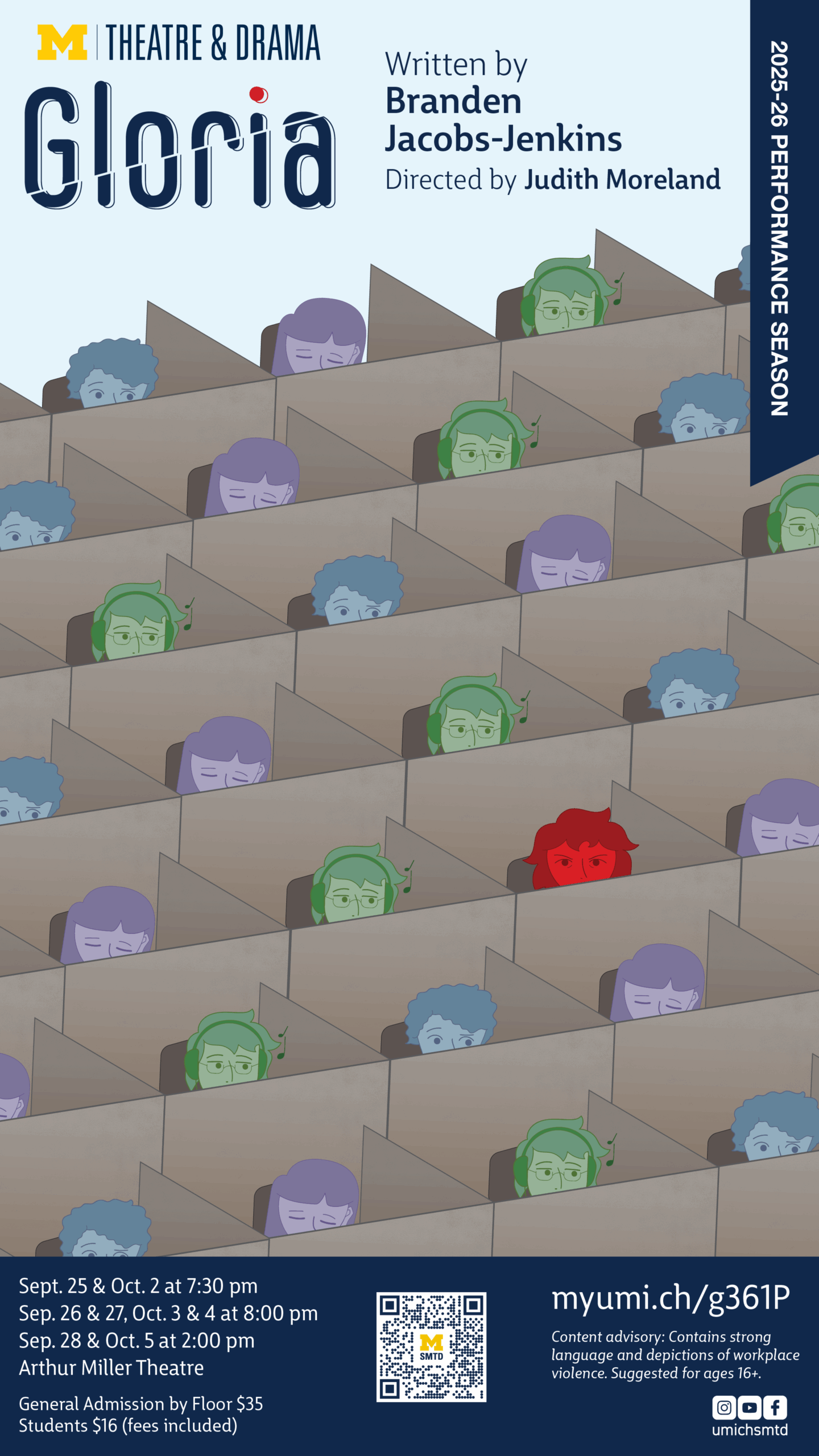
Gloria is set against the backdrop of the 2010s magazine industry, inspired loosely by playwright Branden Jacobs-Jenkins’s own experience working for The New Yorker. We find our cast of characters in devalued positions as assistants, interns, and fact checkers, low in the hierarchy of the office. They face tedious work and difficult deadlines without the prestige, salary, or satisfaction that the actual editors receive. As they fear aging and stagnancy, ambition drives them towards a better future while their industry is collapsing and contrasting with the new shifts that the rise of the internet has brought about.
As the events of the story unfold, the audience grapples with complex questions. How do we respond to tragedy? How do we learn from the unimaginable? In Gloria, trauma affects each of the characters, and despite it being unnamed in the script, we can likely conclude that several are left with immense mental distress, such as post-traumatic stress disorder, or PTSD. A disorder formerly characterized as soldier-only “shell shock” is masterfully portrayed by Jacobs-Jenkins as several overlapping, potentially overwhelming symptoms. Characters re-experience traumatic events in their minds, avoiding situations that remind them of what happened, entering heightened and activated states, and feeling deeply guilty and apathetic at the same time, all possible symptoms of PTSD. However, the world Gloria exists in is not as accepting and acknowledging of mental health struggles as today’s world, and thus, these characters thrash for relative comfort in an environment that insists they just move on or make a quick buck out of it.
There is also a spiritual lens through which the story can be viewed; while Buddhism is only referenced briefly in the script, it provides a thread that weaves throughout the character arcs and the show as a whole. One of the important tenets of Buddhism is samsara, the cycle of suffering. In Gloria, characters are stuck in an environment that is difficult to break out of, prolonging their presence in this state. Only by following the path to nirvana (a transcendent state without suffering or desire) can one escape it, which mirrors these characters’ ultimate goal. Parts of this path include being fully present in each moment, doing intentionally good action, and living a moral and ethical life. As characters heal from the fallout of the events of the play, Jacobs-Jenkins illustrates how their process follows or veers from these guidelines as they hope to eventually find peace. There are also examples of karma throughout, how the intentions and choices we make color the future, and how in Buddhism (and more subtly in life), people are “reborn,” continuing in a new realm or body with the same suffering until a change is made.
In line with this concept, Jacobs-Jenkins includes “doubling,” or having an actor play more than one character during a play, as a key part of his dramaturgy. Doubling here serves as a way to show the consequences of not learning from past mistakes. Every character is “reborn” as a new version of themselves that perhaps is unable or refuses to change when an inciting event has happened—an opportune moment for realignment—and in the world of Gloria, it seems that only the characters that learn a life lesson are able to move on.
It is in these complexities, gray areas, and evolutions that the characters and stories of Gloria jump off the page. While the characters are contextualized by their different journeys, perspectives, and backgrounds, this play remains touching and timeless no matter when or where it is performed. We hope you enjoy the show!
—Kendal Bazerman and Brook Galsky
See our lobby display online at https://gloriaumich.carrd.co
Thank you for attending this program. The University of Michigan strives to create a truly open forum, one in which diverse opinions can be expressed and heard. You can see our full Freedom of Expression policy at smtd.umich.edu/FOE
Although there are moments of comedy in Gloria, we take the content and what happens in this play very seriously. Some of the events or discussions may be upsetting or unsettling. If you experience distress and are seeking support, the QR codes on this page link to different resources that you can have immediate access to.