
Performance Programs
Content Advisory
About the Production
- Creative Team
- Cast of Characters by Play
- Production Staff
- Faculty Advisors
- Running Crew
- Production Crews
- Department Faculty & Staff
- University Productions Staff
- Department of Advancement Staff
- From the Director
- from the Dramaturgy Team
- About the Author
- About the Cast
- About the Creative Team
- About the Production
- Statement on the Anishinaabe Land Transfer
- Freedom of Expression Policy
Director
Malcolm Tulip
Scenic Designer
Yuchen Ma†
Costume Designer
Christianne Myers
Lighting Designer
Jess Fialko
Sound Designer
Katie Hopgood
Hair & Makeup Designer
Brittany Crinson
Faculty Production Dramaturg
Jennifer Buckley
Resident Dramaturg
Karin Waidley
Voice & Speech Coach
Jeremy Sortore
Resident Intimacy Choreographer & Cultural Consultant
Raja Benz
Production Stage Manager
Lindsay Robert†
Quad
Cast of Characters
1 White: Zoe Papadakis
2 Yellow: Miranda Bourne
3 Blue: Caedmon Kephart
4 Red: Ellie Mayfield
Percussionist: Michael Gould
Production History
Quad was first transmitted in Germany by Suddeutscher Rund-funk in 1982 under the title Quadrat 1+2. It was first transmitted by BBC2 on 16 December 1982. First published by Faber and Faber, London, in 1984.
Rockaby
Cast of Characters
Woman: Amelia Fontaine
Production History
Written in English in 1980. First performed in Buffalo, New York in 1981 with Billie Whitelaw as W and V, directed by Alan Schneider, produced by Dan Labielle. First published by Grove Press in 1981.
Act Without Words II
Cast of Characters
A: Cameron Wilson
B: Lucas Somers
Production History
Written, according to Beckett, at about the same time as Act Without Words I (1956). Translated from the French by the author and first published in New Departures, Vol. 1 (Summer, 1959). First performed probably at the Institute of Contemporary Arts, London, on 25 January 1960.
Footfalls
Cast of Characters
May: Sam Mutabaruka
Mother’s Voice: Rachael Valdez
Production History
Written in English. Begun in March 1975 and substantially completed by November of that year. First published by Grove Press, New York, in 1976. First performed at the Royal Court Theatre, London, on 20 May 1976.
What Where
Cast of Characters
BAM: Lucas Somers
BEM: Raymond Ocasio IV
BIM: Cameron Wilson
BOM: Caedmon Kephart
Production History
The premiere of this play took place at the Harold Clurman Theatre, New York, on 15 June 1983. First published in the United States in Evergreen Review, 1984.
Come and Go
Cast of Characters
Flo: Sam Mutabaruka
Vi: Rachael Valdez
Ru: Miranda Bourne
Production History
Written in English early in 1965. First published in French by Editions de Minuit, Paris, in 1966. First published in English by Calder and Boyars, London, in 1967. First produced as Kommen und Gehen, translated by Elmar Tophoven, at the Schiller-Theatre Werkstatt, Berlin, on 14 January 1966. First performed in English at the Peacock Theatre, Dublin, on 28 February 1968 and subsequently at the Royal Festival Hall, London, on 9 December 1968.
Catastrophe
Cast of Characters
Director: Raymond Ocasio IV
Assistant: Amelia Fontaine
Protagonist: Lucas Somers
Production History
Written in French in 1982. First performed at the Avignon Festival in 1982. First published in the United States in the New Yorker, 1983.
Play
Cast of Characters
Woman 1: Zoe Papadakis
Woman 2: Ellie Mayfield
Man: James Parascandola
Production History
Written in English in late 1962-3. First published in German, as Spiel, in Theater Heute (July 1963). First published in English by Faber and Faber, London, in 1964. First performance was of Spiel, translated by Erika and Elmar Tophoven, at the Ulmer Theater, Ulm-Donau, on 14 June 1963. First performed in Britain by the National Theatre Company at the Old Vic Theatre, London, on 7 April 1964.
Assistant Stage Manager: Patrick McCaffity
Assistant Director: Adèle Vincent
Assistant Costume Designer: Addison Bohne
Student Assistant Dramaturg: River Strasner
Production Assistant: Zee Perea
Scenic Design Advisor: Kevin Judge
Stage Management Advisor: Jenn Rae Moore
Light Board Operator: Phoenix Aragon
Sound Operator: Tatum Noud
Scenery Crew: Jack Belmonte and Erika Serres
Props Crew: Yutong Wu
Wardrobe Crew: Payton Cottrill^, Kira Martinez-Baltimore, and Sadiesimone Tappan
Hair & Makeup Crew: Ryan Berger, Gretchen Brookes^, and Violeta Neuman
Costumes: Sammer Ali, Iliana Beauchamp, Sarita Gankin, Lucy Gardner, Kate Goldman, Lucy Knas, Carmen Lauchu, Rachel Pfeil, Isabella Pruter & 250/252/262 students
Lighting: Eliza Anker, Miles Borgsdorf, Clayton Collins, Tate Zeleznik & 250/252/262 students
Paint: Gretchen Brookes, Kelly Burkel, Norah Klocke, Ren Kosiorowski, Hannah Kryzhan, Tatum Noud, Ceri Roberts, Greta Steever, Seri Stewart^, Amber Walters^ & 250/252/262 students
Production Management: Justin Comini and Greta Steever
Props: Patricio Alvarado Murillo, Abigail Baden, Kendall Brisco, Brook Galsky, Alex Heskett, EE Holmes, Banks Krause, Samantha McLaughlin, Leah Stchur, Reese Stevens, Rachael Valdez & 250/252/262 students
Scenery: Kelly Burkel, Aiden Heeres, Soph Irfani, Percy Kent, Josi Middaugh, Nathaniel Steever & 250/252/262 students
Wigs, Hair & Makeup: Gretchen Brookes^, Christine Chupailo, Riley Hahn, Olivia Mitchell, Elby Shader & 250/252/262 students
David Gier, Dean
Paul Boylan Collegiate Professor of Music
Department Chair
Tiffany Trent
Department Manager/Artistic Administrator
Kathryn Pamula
Walgreen Events Manager
Nickie Smith
Studio and Performance Manager
Arie Shaw
Walgreen Office Coordinator
Mary Toth
Acting/Directing
Christina Traister (Head of Performance), Halena Kays (Head of Directing), Daniel Cantor (Head of Acting), Raja Benz, Mark Colson, Antonio Disla, Holly Hughes, Tzveta Kassabova, Geoffrey Packard, Jeremy Sortore, Malcolm Tulip, Tiffany Trent
Design/Production
Kevin Judge (Head of Design & Production), Jess Fialko, Heather Gilbert, Jungah Han, Jenn Rae Moore, Christianne Myers, Sarah M. Oliver
Theatre Studies/Playwrighting
José Casas (Head of Theatre Studies), Shavonne Coleman, Antonio C. Cuyler, Antonio Disla, Jenna Gerdsen, Amy E. Hughes, Holly Hughes, Jason Fitzgerald, Petra Kuppers, Ashley Lucas, Mbala Nkanga, Jay Pension, Rogério Pinto, Alexis Riley, Emilio Rodriguez, Karin Waidley
Interarts
Scott Crandall, Holly Hughes, Tzveta Kassabova, Malcolm Tulip
Arts Management
Paul Bonin-Rodriguez, antonio c. cuyler, Aaron Dworkin, Afa Dworkin, Ken Fischer, Gala Flagello, Andrew Kuster, Jonathan Kuuskoski, Kari Landry, Robin Myrick, Jay Pension, Jesse Rosen, Omari Rush, Anna Sampson
Professors Emeriti
Alan Billings, Peter W. Ferran, Jessica Hahn, Philip Kerr, Priscilla Lindsay, Janet Maylie, Vincent Mountain, John Neville-Andrews, Nancy Uffner, Leigh Woods
University Productions Administrative Staff
Executive Director
Jeffrey Kuras
Administrative Specialist
Christine Eccleston
Administrative Assistant
Emily Erlich
Arts Facilities and Booking Manager
Shannon Rice
Performance Hall House Manager
Kelley Krahn
Lead Backstage Operations Manager
Dane Racicot
Backstage Operations Manager
Charles Briggs, Tiff Crutchfield, Yvette Kashmer, Brian Koepele, and Robbie Kozub
University Productions Production Staff
Director of Productions
Aaron Keller
Associate Production Manager
Michelle Williams-Elias
Technical Director
Richard Lindsay
Interim Theatrical Scenery Manager
Devin Miller
Costume Stock Manager
Theresa Hartman
Scenic Carpenter
Heather Udowitz
Charge Scenic Artist
Beth Sandmaier
WDC Charge Artist
Madison Stinemetz
Lead Theatrical Properties Manager
Patrick Drone
Associate Properties Manager
Dani Keys
Properties Carpenter/Artisan
Adam Ashlock
Properties Stock & Tech Coordinator
Kat Osos
Theatrical Lighting Manager
Heather Hunter
Associate Lighting Manager
Jorrey Calvo
Theatrical Sound Manager
Katie Hopgood
Costume Shop Manager
Laura Brinker
Assistant Costume Shop Manager
Leslie Ann Smith
Lead Cutter/Draper
TJ Williamson
Cutter/Draper
Sarah Havens and Lani Tortoriello
Stitcher
Mag Grace and Rene Plante
Lead Costume Crafts Artisan
Elizabeth Gunderson
Wardrobe Manager
Meredith Miller
Hair & Makeup Studio Manager
Brittany Crinson
Department of Advancement
Development
Chief Advancement Officer
Ericka Bigelow
Major Gifts Officer
Megan Anderson Cook
Director of Development, Marching & Athletic Bands
Kimberly Baumgartner
Development and Alumni Engagement Coordinator, Michigan Marching Bands
Tamara Rosinski
Manager of Annual Giving
Gretchen Pleuss
Assistant Director of Development, Stewardship
Jessica Woodman
Development Generalist
Alison Bur
Marketing & Communications
Director of Marketing, Communications & Campaign Strategy
Beth Miller
Marketing & Communications Director for Ticketed Performances
Sarah Erlewine
Brand Manager
Brandon Monzon
Communications Manager
Judy Galens
Video and Multimedia Manager
Chris Boyes
Digital Content Specialist
Tracy Payovich
Multimedia Specialist
Robert Coelius
Graphic Designer
Rachel (Ray) Salazar
Marketing Coordinator
Liam Crnkovich
Digital Communications Manager, Marching & Athletic Bands
Madeline Rosenbaum
Beckett captured my attention at an early age, my enthusiasm fanned by my grammar school English teacher Peter Sampson. I was lucky to see Godot before reading it; experiencing it before studying it. Maybe more so than with other plays, his work lives off the page. As I read and saw more of his plays and dug into his prose, I was thrilled by the structure and musicality of the language that are inseparable from meaning. I came to recognize how the text is supported by vast networks of meanings, references both concrete and suggested. In seeking to understand his work(s), I found myself having a larger education. I gained much by performing Beckett and recording short prose pieces. One is connected to the writer as his words vibrate in one’s body, revealing other levels of meaning. I want my students to experience and learn from this. Many know or are aware of Waiting for Godot, Happy Days, Krapp’s Last Tapes, perhaps have encountered Endgame, but the works in Time Passes will not be as familiar. I see this as akin to an evening of chamber music. Watch, listen, and absorb.
–Malcolm Tulip, director
The Irish-born Samuel Beckett (1906-1989) experimented relentlessly with every medium for which he wrote: page, stage, television, and film. Deeply knowledgeable about music, painting, dance, and movies (especially the silent-era classics), Beckett drew on all these arts while creating the striking images and rhythms of his plays. Time Passes presents eight short pieces written in the later part of his career, after the success of the tragicomedy Waiting for Godot (1953), when Beckett was paring his drama down to its bones – producing spare but powerful images, sounds, and movements.
Beckett is often associated with Theatre of the Absurd, a term popularized in the 1960s to describe postwar dramatists whose work confronted the apparent instability or meaninglessness of human existence. Beckett himself did not embrace the label, and his plays resist easy categorization. “Absurd” does not necessarily mean the total abandonment of content and structure. Instead, Beckett’s worlds often operate according to strange but rigorously defined rules. Characters repeat actions, wait for something that may never arrive, half-remember past events, or find themselves trapped inside behaviors and patterns they seem unable to escape.
That tension between order and helplessness is one of the threads connecting these eight pieces. Beckett’s characters cannot set the terms for their own lives, but neither are they simply passive. They move, speak, remember, resist, obey, repeat, and sometimes attempt to intervene in those systems. The question becomes: what does agency look like when almost everything is beyond one’s control?
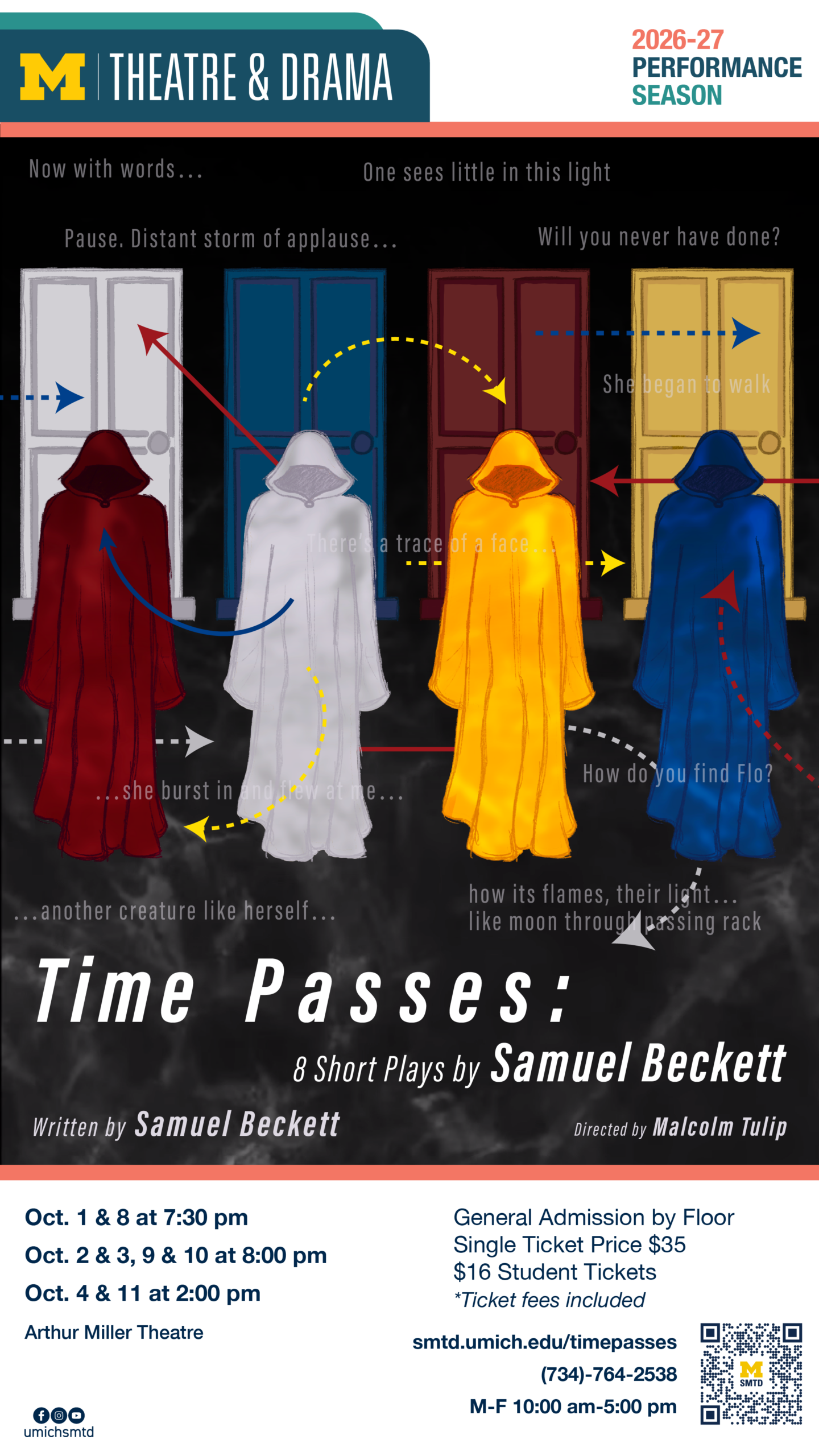
This question takes many forms across Time Passes. The figures in Quad pace through an exhaustive series of precise and seemingly predetermined courses, swerving only to avoid a central point (and a collision). In Rockaby, a woman recounts fragments of a lonely life while sitting in a rocking chair that moves mechanically. The movement is comforting and unsettling at once: the rocking offers both care and confinement. In Act Without Words II, two men are repeatedly prompted into action by an external force – a goad, of the type used to herd animals. Their daily routines appear almost mechanical, suggesting that even the simplest human decisions can be shaped by forces outside the self. And in Footfalls, a woman spends her days and nights pacing a hallway, driven by the relentless demands of her own “poor mind.”
Other pieces explore control through relationships. In What Where, the recorded voice of one character sets off a series of offstage torture sessions in which all the others become, at some point, perpetrators and victims. Come and Go places three women inside an intimate ritual of memory, absence, and return. Their movements and exchanges are quiet, but what they choose not to say is as significant as what they reveal. In Catastrophe, a domineering theatre director and his subservient assistant work on the final scene of an unnamed show, manipulating the shivering body of a silent performer so as to dictate – or so they think – their audience’s emotional response. In the final piece, Play, it’s not a director but rather a merciless spotlight that prescribes onstage behavior: its beam prompts three probably-dead people who once lived a love triangle to recount pieces of their tawdry tale.
Beckett lived and wrote during an exceptionally violent century that prompted him to ask hard questions about agency – questions he asked not only in his work, but also in his life. As an Irish citizen who had settled in France in the late 1930s, he could have waited out World War II in safety after the Nazis invaded and established the authoritarian Vichy government. Instead he chose to stay with his partner Suzanne Dechevaux-Dumesnil in Paris, where they both joined the French Resistance. After their cell was betrayed by a double agent, Sam and Suzanne were forced to flee from Paris, mostly on foot, to the free zone in southeastern France. There they hid, but they also continued their Resistance work.
Traces of Beckett’s political concerns surface in several of these plays – most obviously in What Where, which alludes to a form of torture that French colonial forces used in Vietnam and Algeria, and in Catastrophe, in which the bullying director also serves in some kind of political role outside the theatre. But other plays draw from Beckett’s personal life and those of his family members: he named the compulsive walker of Footfalls after his own mother, May, who shared with her son a tendency toward anxiety and insomnia, while the woman of Rockaby resembles his grandmother.
Although Beckett has been called “the last modernist,” his later work shares elements with postmodern theatre. These plays do not give us a straightforward narrative, clearly defined characters, or a world that behaves according to familiar rules. The mechanics of performance become part of the performance itself: a spotlight can determine when a character speaks; a prescribed path can structure an entire piece; and a play can critique theatre and spectatorship more generally. The boundary between the story being told and the machinery used to tell it begins to blur.
This makes Time Passes as much an experience of theatre as it is a collection of stories. Across the eight pieces, Beckett reduces performance to its most basic elements: body, voice, sound, light, and space. Movement can replace dialogue. Silence can become an event. Repetition can take the place of narrative progression. Beckett’s use of sound, movement, color, and lighting gives each piece its own visual and rhythmic language while connecting them as a group.
Time Passes gives us eight strange, precisely drawn worlds, inviting us to trace our own patterns of thought and behavior within them.
To visit the Time Passes site, which offers more details about Beckett’s life and each of the plays, please follow this link for more information: timepassesumich.carrd.co
Written by Benjamin Strong, Samuel Beckett Society
Samuel Barclay Beckett (Writer) was born without difficulty at Cooldrinagh in Foxrock, County Dublin, on 13 April 1906, but grew old enough to fill the air with many different cries. He was the second of two sons of a middle-class Protestant couple (his father managed a surveying firm) and grew up away from the rebellion waged nearby. Though quite energetic, he enjoyed even as a small boy the quiet of solitude. He studied at Earlsfort House in Dublin, and then at Portora Royal School in Enniskillen (where Oscar Wilde had gone) where he first began to learn French, one of the two languages in which he would write. A well-rounded athlete, Beckett excelled especially in cricket, tennis, and boxing in his school days.
Though he continued with sports, his attention turned increasingly to academics when at 17 he entered Trinity College, choosing French and Italian as his subjects. Beckett enjoyed the vibrant theatre scene of post-independence Dublin, preferring revivals of J.M. Synge plays. Moreover, he had the opportunity to watch American films and discover the silent comedies of Buster Keaton and Charlie Chaplin that would crucially influence his interest in the vaudevillian tramp.
After graduation, Beckett traveled to Paris where he first met the fellow Dubliner who would become a seminal influence and close friend, James Joyce. In addition to acting as one of Joyce’s favoured assistants in the construction of the Work in Progress (later to be titled Finnegans Wake), Beckett began writing himself, inspired by the vibrant Parisian literary circle. In 1930, he published his first poem, “Whoroscope,” winning a reward of ten pounds in a poetry competition. Shortly after, he published his brief but groundbreaking Proust, a study of the recently deceased author whom Beckett admired so much; the work at once illuminated its subject but also helped the fledgling and unsure artist shape his own aesthetic. When he returned to Dublin later that year to lecture at Trinity, Beckett tentatively started writing his first novel – which would later be mined for the collection More Pricks Than Kicks (1934).
Beckett was restless in his teaching posts, and his reluctance to settle down in a respectable career worried his family, especially his mother from whom he became estranged for several years. Returning to Paris in 1932, he wrote his first novel, Dream of Fair to Middling Women. While reminiscent in its digressive tendencies of Fielding and Sterne, Dream was also highly autobiographical, a powerful indication that Beckett was emerging from Joyce’s shadow and developing his own voice. Out of money, he went back to Dublin and then moved temporarily to London where he worked on much of his next novel, Murphy. Still without a steady source of income (his works were not selling, and Murphy, which had been turned down by dozens of publishers, would not appear until 1938), he moved constantly for the next few years before settling permanently in Paris in 1937.
Walking home late one night with some friends, Beckett was nearly killed when he was stabbed by a “pimp.” In hospital, Joyce looked after his young friend, paying his expenses and bringing around numerous visitors. Recuperating, Beckett also received attention from a French acquaintance, Suzanne Deschevaux-Dusmesnil, who would soon become his life companion (and wife, though not until 1961). When Paris was invaded in 1941, Beckett and Suzanne joined the Resistance. Later they were forced to flee when their cell was betrayed, leaving their apartment only hours before the Gestapo arrived. They took refuge in Rousillion, in the south of France, where Beckett worked on a farm in exchange for room and board. There he continued work on a novel he had begun in Paris, Watt. After the Germans were defeated and the couple returned to Paris in 1945, Beckett travelled to Ireland to visit his mother. He claimed to have had while sitting in her room an artistic revelation: “I became aware of my own folly. Only then did I begin to write the things I feel.” And only then did Beckett begin to write primarily in French, finding greater linguistic possibilities in a language that he famously said had no style. In his second language, he enjoyed a period (1947-1950) that is certainly his most prolific and that many consider his finest. His first French novel, Mercier et Camier – which, with its wandering duo, minimalist style, and insistence on repetition, predicts the concerns and form of Waiting for Godot – was not published until years later. In this time, he also wrote his famous novel trilogy (Molloy, Malone Dies, The Unnamable). Also, in 1947, he wrote his first play, Eleutheria, which he would not allow to be published during his lifetime and which, after his death, became a cause of great controversy when Beckett’s American publisher, Barney Rosset, released an English translation against the wishes of the Beckett estate. In 1948-49, he also wrote Waiting for Godot. Its production in Paris in January 1953, by the director and actor Roger Blin (with whom Beckett would develop a lifelong friendship), brought the artist his first real public success both in and outside of France.
In the 1950s and 1960s, Beckett’s playwriting continued with a series of masterpieces, including Endgame, Krapp’s Last Tape, and Happy Days. He involved himself in various productions of his plays across Europe and in the United States, wrote his first radio plays, and created remarkably innovative prose fiction, including the epic How It Is (1961) and the haunting The Lost Ones (1970). Worldwide appreciation of his work growing, he received in 1969 the Nobel Prize (the third Irishman of the century to be so honored). Characteristically, he was unhappy with the increased public attention that accompanied the prize and in response to a demand for a new work chose instead to release the still unpublished Mercier and Camier. At this time, he also underwent successful operations on his eyes to correct the cataracts that had been plaguing him for years.
The 1970s were a less prolific period, though he managed some new projects, including television plays for the BBC, and continued to interest himself in productions of his theatrical works. In 1977 he began the autobiographical Company and in the early 1980s crafted more prose pieces (including Ill Seen Ill Said and Worstward Ho) as well as more plays (including Rockaby and Ohio Impromptu). His last major work, the prose fiction Stirrings Still, was written in 1986.
In the same year, Beckett began to suffer from onsetting emphysema. After his first hospitalization, he wrote in bed his final work, the poem “What Is the Word.” Moved into a nursing home, Le Tiers Temps, his deteriorating health prevented him from writing, and his efforts were given instead to translation of his works. Suzanne died on 17 July 1989, and Beckett followed her on 22 December. He is buried in Montparnasse Cemetery in Paris.
Miranda Bourne (2 Yellow, Ru) is a sophomore BFA acting major from St. Johns, Michigan. She is excited to be part of this production and grateful to share the stage with such a talented cast!
Amelia Fontaine (Woman, Assistant) is a senior BFA acting major at the University of Michigan and a recent graduate of the Royal Academy of Dramatic Art study abroad program. Her most recent credits include: John Proctor Is the Villain, The Effect, Much Ado About Nothing, Measure for Measure, and Day of Absence. She has so much gratitude for the education the University of Michigan has provided for her and can’t wait to showcase that hard work in this production.
Caedmon Kephart (3 Blue, BOM) is a sophomore BFA acting major. This is his first UProd production, and he could not be more excited to be a part of such a unique piece of theatre.
Ellie Mayfield (4 Red) is a sophomore acting major and an art history minor from Atlanta, Georgia. She is so excited to be making her UProd debut in Time Passes!
Raymond Ocasio IV (BEM, Director) is a senior BFA acting major at the University of Michigan. Recent credits include Uncle Vanya, The Cherry Orchard, A Few Good Men, John Proctor Is the Villain, Wolf Play, and Titanic: The Musical. Regional credits include the Woodstock Playhouse (West Side Story, Newsies, Crazy for You, The Play That Goes Wrong) and Centenary Stage Company (Grease). He is also pursuing a minor in musical theatre composition and is thrilled to be a part of Time Passes. @raymondocasioiv
Zoe Papadakis (1 White) is a third-year acting major and is ecstatic to be a part of her second UProd production at the University of Michigan! Past productions include Marat/Sade (Simonne Evrard), Oklahoma! (Ado Annie), The Wolves (#14), and Golden Boy (Anna). Next semester, she will be studying Shakespeare at RADA in London. Special thanks to her family, BFA cohort, roommates, professors, and Jeff Berryman for their support.
Rachael Valdez (Mother’s Voice) is thrilled to be a part of this wonderful cast and creative team in her first UProd production at the University of Michigan. She is a transfer student from Southern California, and some of her previous roles include Sally Bowles in Cabaret, Ophelia in Hamlet, Claire in Ordinary Days, and Mary Wollstonecraft in We Shall Be Monsters.
Jennifer Buckley (Faculty Production Dramaturg) teaches courses in 19th–21st century drama, theatre, and performance in the U-M English Department, where she also serves as the director of graduate studies. Her current book project, Act Without Words: Speechless Performance on Modern Stages, includes a chapter on Samuel Beckett’s plays. Buckley is the author of Beyond Text: Theater and Performance in Print after 1900 (University of Michigan Press, 2019), which was granted the 2020 ATHE Outstanding Book Award, and is also the author of essays in several collections as well as articles and reviews published in MLQ, Modernism/modernity, Theatre Survey, Theatre Journal, TDR: The Drama Review, SHAW: The Journal of Bernard Shaw Studies, Theater, and Comparative Drama.
Jess Fialko (Lighting Designer) is a lighting, costume, and scenic designer. They are a clinical assistant professor of design in the Department of Theatre & Drama. Upcoming projects include production design for The Kids, a short film directed by Daniel Cantor, and Fawn, a dance-theatre work by Charli Brissey. Fialko is also the lighting designer/production manager for Vim Vigor Dance Company (Punchline, Dracula, The Long Fall). U-M, lighting designer: Natasha, Pierre, and the Great Comet of 1812; Men on Boats; Antigone; Prometheus: Beginnings; Imogen Says Nothing; No Other (choreographer Fangfei Miao, toured to Lyon, France); 7 Hours Difference Part II: Present Simple Tense (also performed at Sibiu International Theatre Festival). U-M, scenic designer: Moscow Moscow Moscow… U-M, costume designer: The Cherry Orchard. Regional credits: Theatreworks Colorado Springs, Colorado Springs Fine Arts Center, Colorado Springs Conservatory, Gibney Center, Riverside Theatre, Iowa Summer Repertory, Penobscot Theatre Company, Maples Repertory Theatre, Hollins University, University of Northern Iowa, Birmingham Children’s Theatre.
Katie Hopgood (Sound Designer) serves as the theatrical sound manager and mentor instructor for SMTD. Her compositions and sound designs span productions nationwide. Broadway: Birthday Candles (Roundabout). Regional: Mrs. Harrison (Williamston); Nora, 8 Nights, Clyde’s, Soft Target, The Beauty Queen of Leenane (Detroit Public Theatre); Julius Caesar (PlayMakers Rep); The Tempest, Richard III, Twelfth Night, Hamlet, Love’s Labour’s Lost (Michigan Shakespeare Festival). Chicago: Into That Darkness, The Corrosive Hours of Edgar Allan Poe (The Edge); Love’s Labour’s Lost (Lifeline); Titus Andronicus (Babes with Blades); The Electric Baby, Wrens (Rivendell).
Yuchen Ma (Scenic Designer) is a senior in the BFA design & production program at the University of Michigan, with a concentration in scenic design. He is grateful for the opportunity to serve as scenic designer and to collaborate with this brilliant team. His previous credits include assistant scenic designer for The Marriage of Figaro (2025, University Productions), scenic designer for Fairview (2026, Basement Arts), and set and props designer for Swallow Under the Eaves (2024), an honors history short film produced through the University of Michigan Department of Film. In summer 2025, he also studied in the props department for The Marriage of Figaro at the National Centre for the Performing Arts in Beijing, China. He looks forward to continuing to develop his work as a designer and pursuing future design opportunities with University Productions.
Christianne Myers (Costume Designer) is the Claribel Baird Halstead Collegiate Professor of Theatre & Drama at the University of Michigan, where she has designed more than 50 productions, most recently The Convent and Turn of the Screw. In southeast Michigan, her professional credits include numerous shows at the Purple Rose Theater as well as Detroit Public Theatre. Recent highlights there include Clyde’s, Blues for an Alabama Sky, and Here There Are Blueberries. New York credits: Running Man, Oedipus, American Dreams: Lost & Found; Theatreworks/USA; the Public Theatre and Ma-Yi Theater Company; Irondale Ensemble Project; Lincoln Center Institute; the Juilliard School. Regional Theatre: Santa Fe Opera, Florentine Opera, Indiana Rep, Vermont Stage, Clarence Brown Theatre, Syracuse Stage, and Opera Memphis.
Lindsay Robert (Production Stage Manager) is a stage manager from Ann Arbor, Michigan. She is currently a senior theatre design and production student at the University of Michigan with a specialization in stage management, as well as a minor in performing arts management. She prides herself on clear communication, quick problem solving, and an unwavering commitment to the collaborative spirit of live performance. She has also taken on the role of lighting designer for numerous projects throughout her career, while keeping stage management at the forefront. She thanks her mother for all her success!
Jeremy Sortore (Voice & Speech Coach) (he/him) is an associate professor in the Department of Theatre & Drama. Regional: American Repertory Theater, Utah Shakespeare Festival, Colorado Shakespeare Festival. Member, National Alliance of Acting Teachers; associate faculty, Theatrical Intimacy Education; associate teacher of Fitzmaurice Voicework; certified teacher of Knight-Thompson Speechwork; certified Vocal Combat Technique Trainer/Coach; PAVA-recognized vocologist; editorial board, Journal of Consent-Based Performance; associate editor, Voice & Speech Review. Education: Moscow Art Theater School/American Repertory Theater Institute at Harvard University. (http://www.JeremySortore.com)
Malcolm Tulip (Director) is an actor, director, playwright, and associate professor in the Department of Theatre & Drama. He has directed over 40 performances for SMTD. He produced and performed in eight original plays under the name of Prospero Theatre Co. As an actor he toured Europe and the USA with I Gelati and Theatre Grottesco. More recently he performed two duets with Amy Chavasse; narrated Peter Sparling’s Our Own American Document as a part of Graham100, a celebration of the centenary of the Martha Graham Dance Company; and premiered a solo performance piece, After Unica, with sound artist Cy Tulip, video artist Jeremy Hopgood, costume designer Christianne Myers, and set designer Vince Mountain. He has performed with percussionist Michael Gould and TanzTangente in Germany and the USA and with Quantum Theatre in Pittsburgh. Tulip studied dance and art at Goldsmiths College, University of London, and is a graduate of L’École Jacques Lecoq, Paris. He is also a member of American Actors Equity.
Latecomers & Video Disclaimer
Latecomers will be seated at a suitable break. As a courtesy to others, please turn off cellular phones and refrain from texting during the performance. Photography, audio recording, and videotaping of any kind are not permitted.
Licensing
ACT WITHOUT WORDS II, FOOTFALLS, ROCKABY, WHAT WHERE, PLAY, CATASTROPHE, and COME AND GO are presented by arrangement with Concord Theatricals on behalf of Samuel French, Inc.
QUAD is presented through arrangement with Georges Borchardt, Inc. All rights reserved. QUAD was originally written as a teleplay.
Student Disclaimer
The performers in this production are students in the Department of Theatre & Drama. The designers for this production are students, faculty, and/or guests of SMTD. Scenery, costumes, properties, sound, and lighting were realized by the students and staff of University Productions, the producing unit of SMTD. Thank you for supporting our educational mission.
Anishinaabeg gaa bi dinokiiwaad temigad manda Michigan Kichi Kinoomaagegamig. Mdaaswi nshwaaswaak shi mdaaswi shi niizhawaaswi gii-sababoonagak, Ojibweg, Odawaag, minwaa Bodwe’aadamiig wiiba gii-miigwenaa’aa maamoonjiniibina Kichi Kinoomaagegamigoong wi pii-gaa aanjibiigaadeg Kichi-Naakonigewinning, debendang manda aki, mampii Niisaajiwan, gewiinwaa niijaansiwaan ji kinoomaagaazinid. Daapanaming ninda kidwinan, megwaa minwaa gaa bi aankoosejig zhinda akiing minwaa gii-miigwewaad Kichi-Kinoomaagegamigoong aanji-daapinanigaade minwaa mshkowenjigaade.
The University of Michigan is located on the traditional territory of the Anishinaabe people. In 1817, the Ojibwe, Odawa, and Bodewadami Nations made the largest single land transfer to the University of Michigan. This was offered ceremonially as a gift through the Treaty at the Foot of the Rapids so that their children could be educated. Through these words of acknowledgment, their contemporary and ancestral ties to the land and their contributions to the University are renewed and reaffirmed.
Thank you for attending this program. The University of Michigan strives to create a truly open forum, one in which diverse opinions can be expressed and heard. You can see our full Freedom of Expression policy at smtd.umich.edu/FOE