
Wellness Guides
Physical Health Infographics
Reducing Injury Risk
Warmup & Cooldown
Hearing Health
Vocal Health
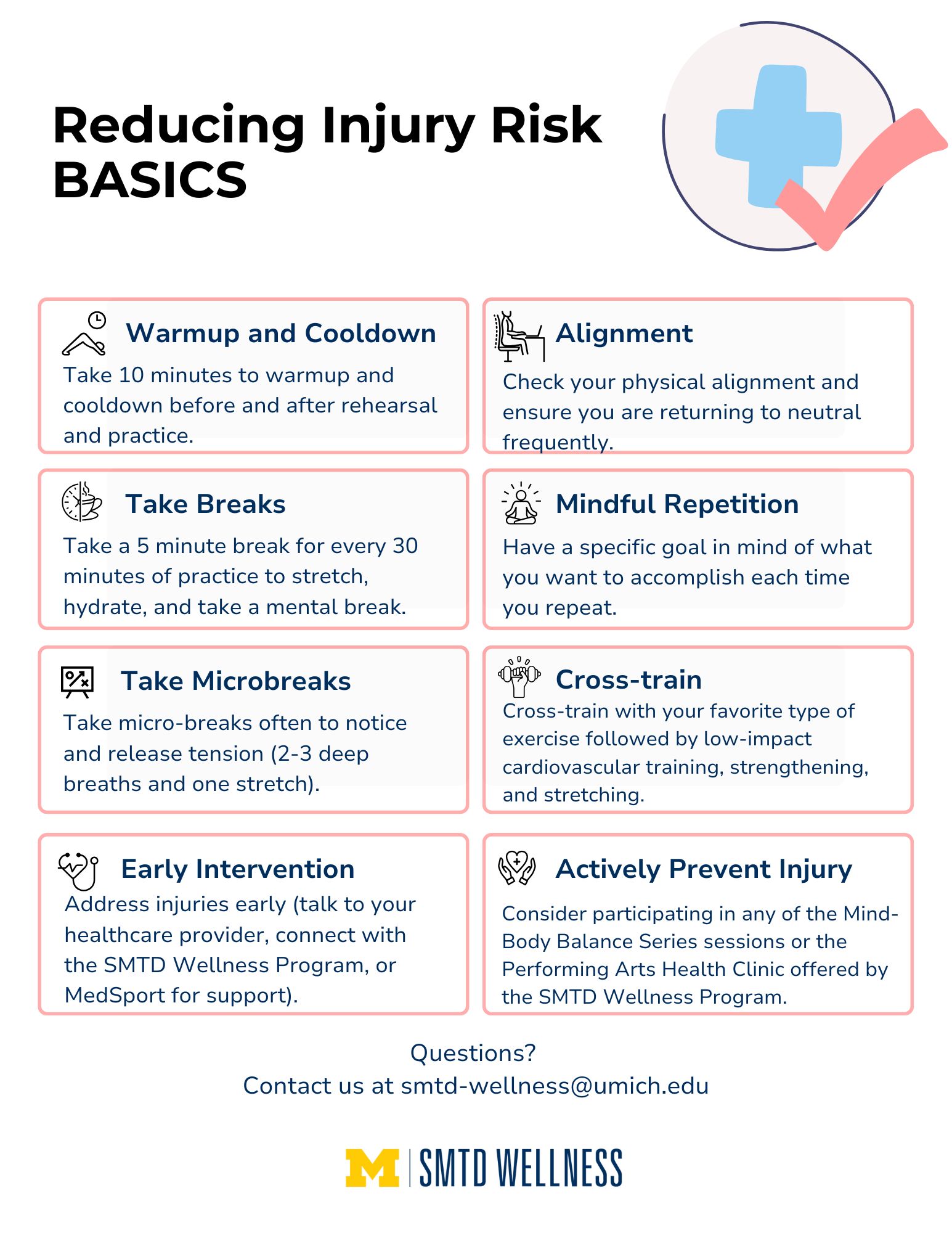
Reducing Injury Risk BASICS
- Warmup and Cooldown: Take 10 minutes to warmup and cooldown before and after rehearsal and practice.
- Alignment: Check your physical alignment and ensure you are returning to neutral frequently.
- Take Breaks: Take a 5 minute break for every 30 minutes of practice to stretch, hydrate, and take a mental break.
- Mindful Repetition: Have a specific goal in mind of what you want to accomplish each time you repeat.
- Take Microbreaks: Take micro-breaks often to notice and release tension (2-3 deep breaths and one stretch).
- Cross-train: Cross-train with your favorite type of exercise followed by low-impact cardiovascular training, strengthening, and stretching.
- Early Intervention: Address injuries early (talk to your healthcare provider, connect with the SMTD Wellness Program, or MedSport for support).
- Actively prevent injury: Consider participating in any of the Mind-Body Balance Series sessions or the Performing Arts Health Clinic offered by the SMTD Wellness Program.
Questions? Contact us at [email protected]
When to Use Ice, When to Use Heat
Ice vs. heat Treatment
ICE
- Ice calms damaged tissue and slows blood flow to reduce swelling and inflammation.
- Apply ice for no longer than 20 minutes at a time.
- Do NOT apply ice directly on the skin. Wrap ice in a towel or thin cloth.
- Use ice to treat ACUTE injuries, such as sprains, immediately after the injury.
HEAT
- Heat promotes muscle relaxation and alleviates pain by opening blood vessels to increase blood flow.
- Apply heat for no longer than 20 minutes at a time.
- Wait 48-72 hours after an acute injury to use heat.
- Use heat to loosen tight joints and muscles associated with CHRONIC conditions.
Additional information
- Alternate heat and ice for chronic conditions.
- Check skin for damage every 5 minutes (i.e. freezer burn-reddened/blistered skin).
- Do not use heat if you have no feeling in the affected body part.
- Use heat prior to self-massage, followed by movement and end with ice and stretching.
- When in doubt, use ice.
- Wait 1 hour in-between treatments.
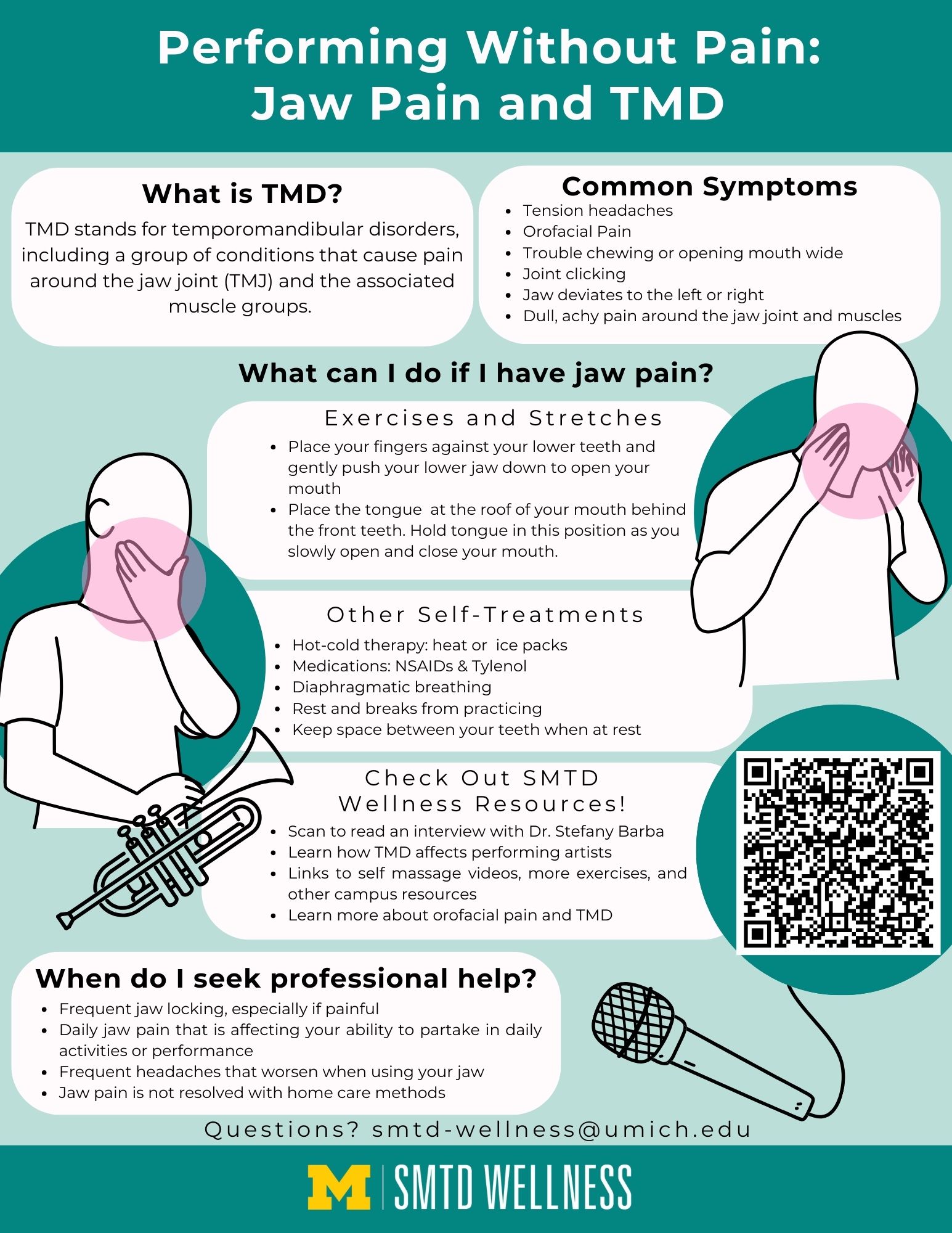
What is TMD?
TMD stands for temporomandibular disorders, including a group of conditions that cause pain around the jaw joint (TMJ) and the associated muscle groups.
Common Symptoms
- Tension headaches
- Orofacial Pain
- Trouble chewing or opening mouth wide
- Joint clicking
- Jaw deviates to the left or right
- Dull, achy pain around the jaw joint around the jaw joint and muscles
What can I do if I have jaw pain?
Exercises and Stretches
- Place your fingers against your lower teeth and gently push your lower jaw down to open your mouth.
- Place the tongue at the roof of your mouth behind the front teeth. Hold tongue in this position as you slowly open and close your mouth
Other Self-Treatments
- Hot-cold therapy: heat or ice packs
- Medications: NSAIDs & Tylenol
- Diaphragmatic breathing
- Rest and breaks from practicing
- Keep space between your teeth when at rest
Check Out SMTD Wellness Resources!
- Read an interview with Dr. Stefany Barba
- Learn how TMD affects performing artists
- Links to self-massage videos, more exercises, and other campus resources
- Learn more about orofacial pain and TMD
When do I seek professional help?
- Frequent jaw locking, especially if painful
- Daily jaw pain that is affecting your ability to partake in daily activities or performance
- Frequent headaches that worsen when using your jaw
- Jaw pain is not resolved with home care methods
Questions? [email protected]
- Warmup and Cooldown
- At least 10 minutes of active warm-up and 5 minutes of cool-down
- Dynamic (before or after practice) and static stretches (after practice)
- Active cardio to warm-up the body
- Posture and Technique
- Check in with your alignment
- Record yourself while you play or sing, evaluate your technique
- Schedule an appointment through the Performing Arts Health Clinic if pain or injury occurs
- Practice without the instrument
- Singing (for instrumentalists)
- Conducting
- Listen to recordings
- Clapping/chanting/rhythm syllables
- Mental practice
- Take Frequent Breaks
- Take a 5 minute break every 30 minutes
- Stretch, breathe, go for a walk
- Reduce static postures
- Avoid cramming
- Stress Management
- Practice mindfulness
- Engage in breathing exercises
- Make space in your day for rest, fresh air, or non-musical activities
- Release physical tension throughout the day; tension leads to injury
Read more on the Performing Well blog!
Questions? [email protected]
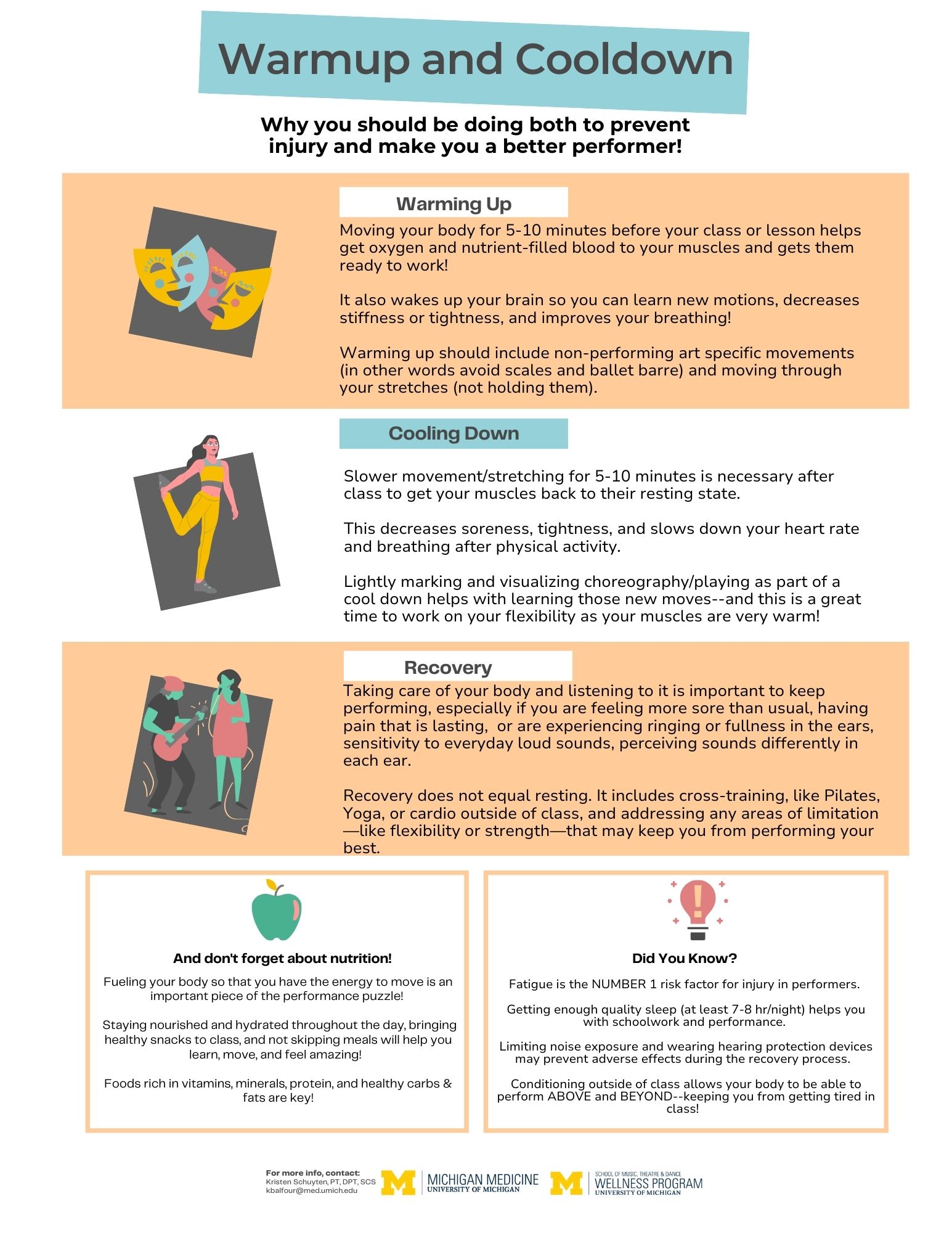
Warmup and Cooldown
Why you should be doing both to prevent injury and make you a better performer!
Warming Up
Moving your body for 5-10 minutes before your class or lesson helps get oxygen and nutrient-filled blood to your muscles and gets them ready to work!
It also wakes up your brain so you can learn new motions, decreases stiffness or tightness, and improves your breathing.
Warming up should include non-performing art specific movements (in other words avoid scales and ballet barre) and moving through your stretches (not holding them).
Cooling Down
Slower movement/stretching for 5-10 minutes is necessary after class to get your muscles back to their resting state.
This decreases soreness, tightness, and slows down your heart rate and breathing after physical activity.
Lightly marking and visualizing movement as part of a cool down helps with learning those new moves--and this is a great time to work on your flexibility as your muscles are very warm!
Recovery
Taking care of your body and listening to it is important to keep performing, especially if you are feeling more sore than usual, having pain that is lasting, or are experiencing ringing or fullness in the ears, sensitivity to everyday loud sounds, perceiving sounds differently in each ear.
Recovery does not equal resting. It includes cross-training, like Pilates, Yoga, or cardio outside of class, and addressing any areas of limitation—like flexibility or strength—that may keep you from performing your best.
And don’t forget about Nutrition!
Fueling your body so that you have the energy to move is an important piece of the performance puzzle!
Staying nourished and hydrated throughout the day, bringing healthy snacks to class, and not skipping meals will help you learn, move, and feel amazing!
Foods rich in vitamins, minerals, protein, and healthy carbs & fats are key!
Did you know?
Fatigue is the NUMBER 1 risk factor for injury in performers.
Getting enough quality sleep (at least 7-8 hours/night) helps you with schoolwork and performance.
Limiting noise exposure and wearing hearing protection devices may prevent adverse effects during the recovery process.
Conditioning outside of class allows your body to be able to perform ABOVE and BEYOND--keeping you from getting tired in class!
For more info, contact:
Kristen Schuyten, PT, DPT, SCS
[email protected]
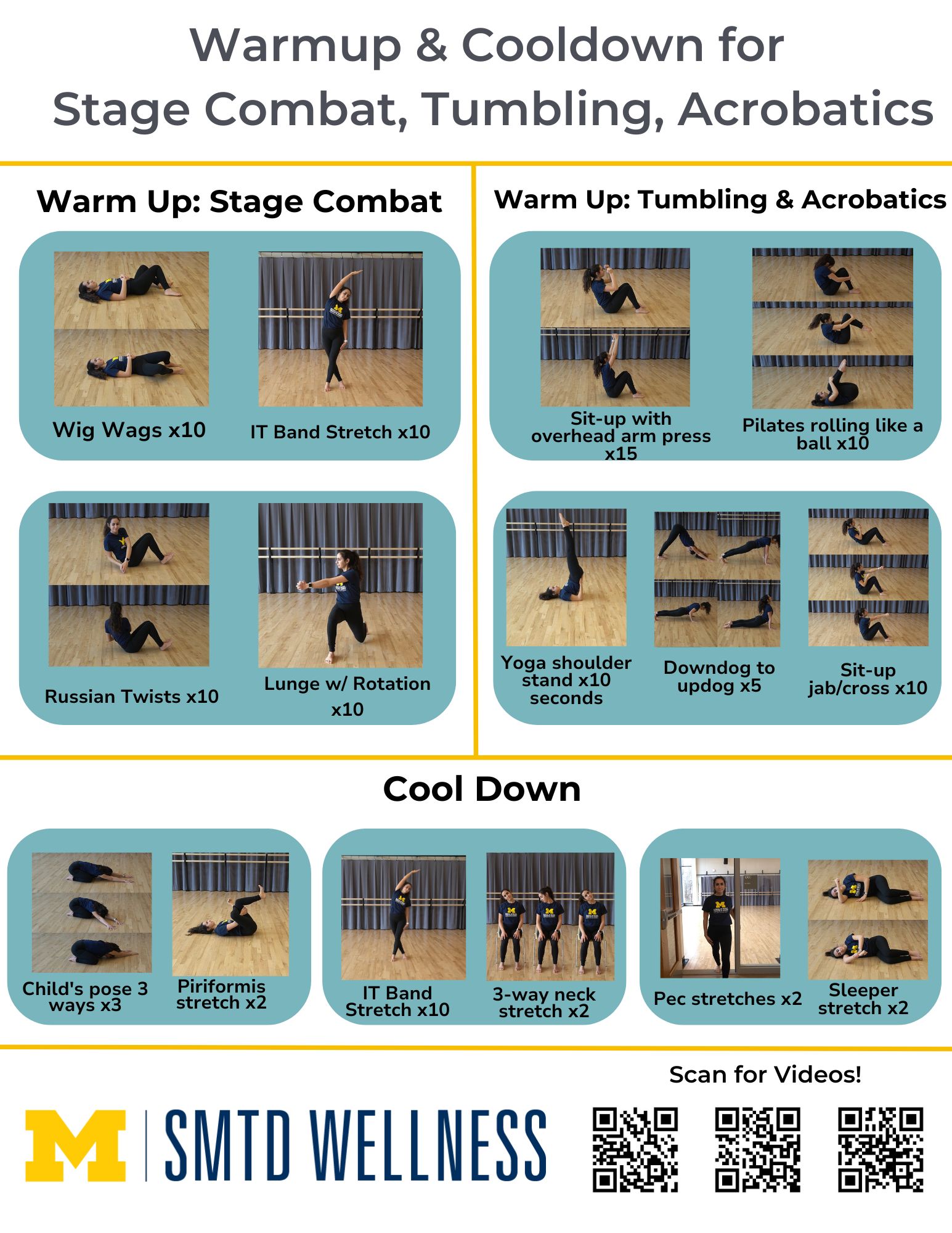
Warm up/Cool Down for Stage Combat, Tumbling, Acrobatics
Warm Up: Stage Combat
- Wig Wags x10
- IT Band Stretch x10
- Russian Twists x10
- Lunge with Rotation x10
Warm Up: Tumbling & Acrobatics
- Sit up with overhead arm press x15
- Pilates rolling like a ball x10
- Yoga shoulder stand x10 seconds
- Downdog to updog x5
- St-up jab/cross x10
Cool Down
- Child’s pose 2 ways x3
- Piriformis stretch x2
- IT Band Stretch x10
- 3-way neck stretch x2
- Pec stretches x2
- Sleeper stretch x2
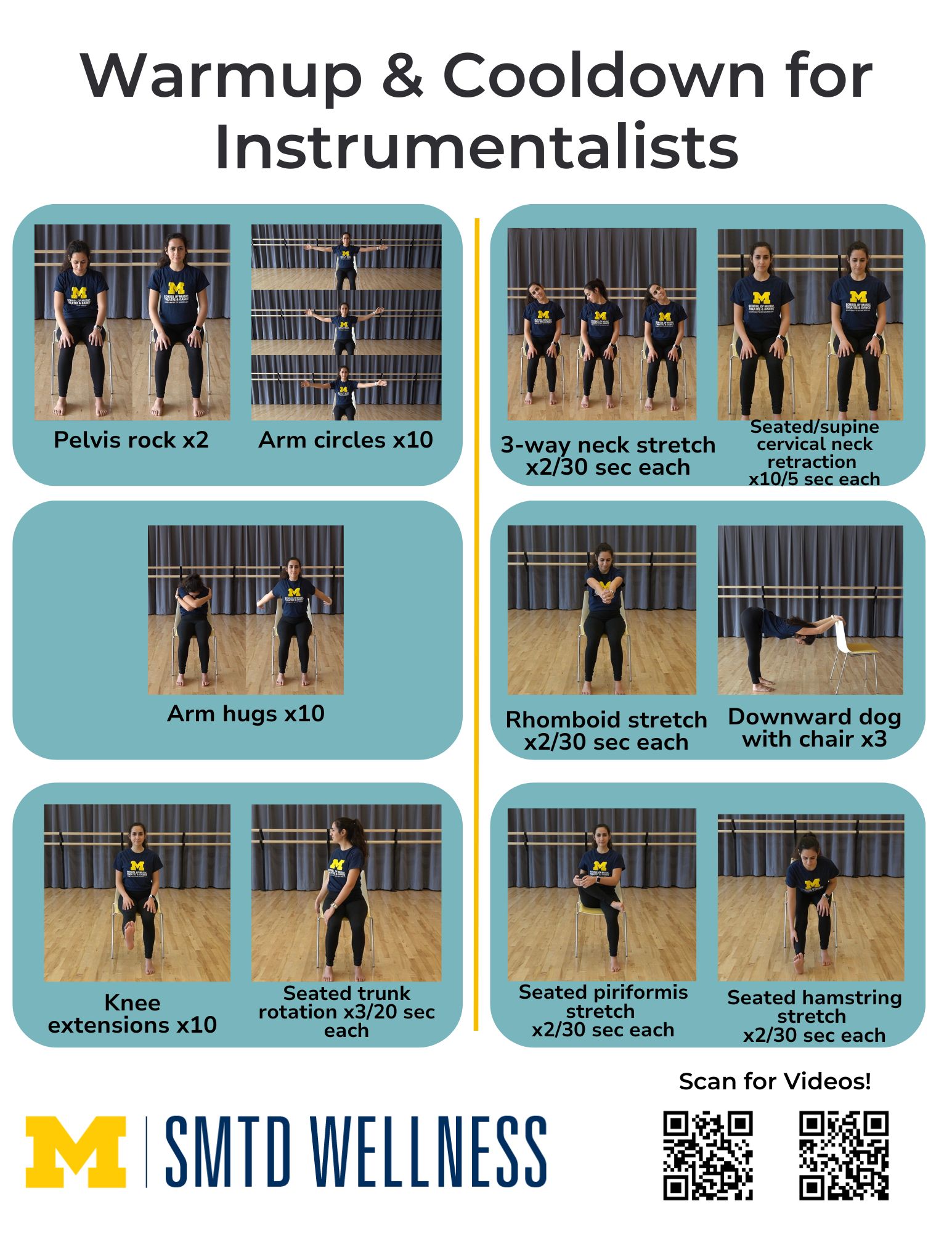
Warm up/ Cool down for Instrumentalists
Pelvis rock x2
Arm circles x10
Arm hugs x10
Knee extensions x10
Seated trunk rotation x3/20 sec each
3-way neck stretch x2/30 sec each
Seated/supine cervical neck retraction x10/5 sec each
Rhomboid stretch x2/30 sec each
Downward doc with chair x3
Seated piriformis stretch x2/30 sec each
Seated hamstring stretch x2/30 sec each
Quick Warmup for Instrumentalists: https://youtu.be/IBQBVYTO7Ok?si=Epvem1M_NrfmTktj
Quick Cooldown for Instrumentalists: https://youtu.be/_ZKqfz0s_hM?si=dzVhNbk7pSzvsePh
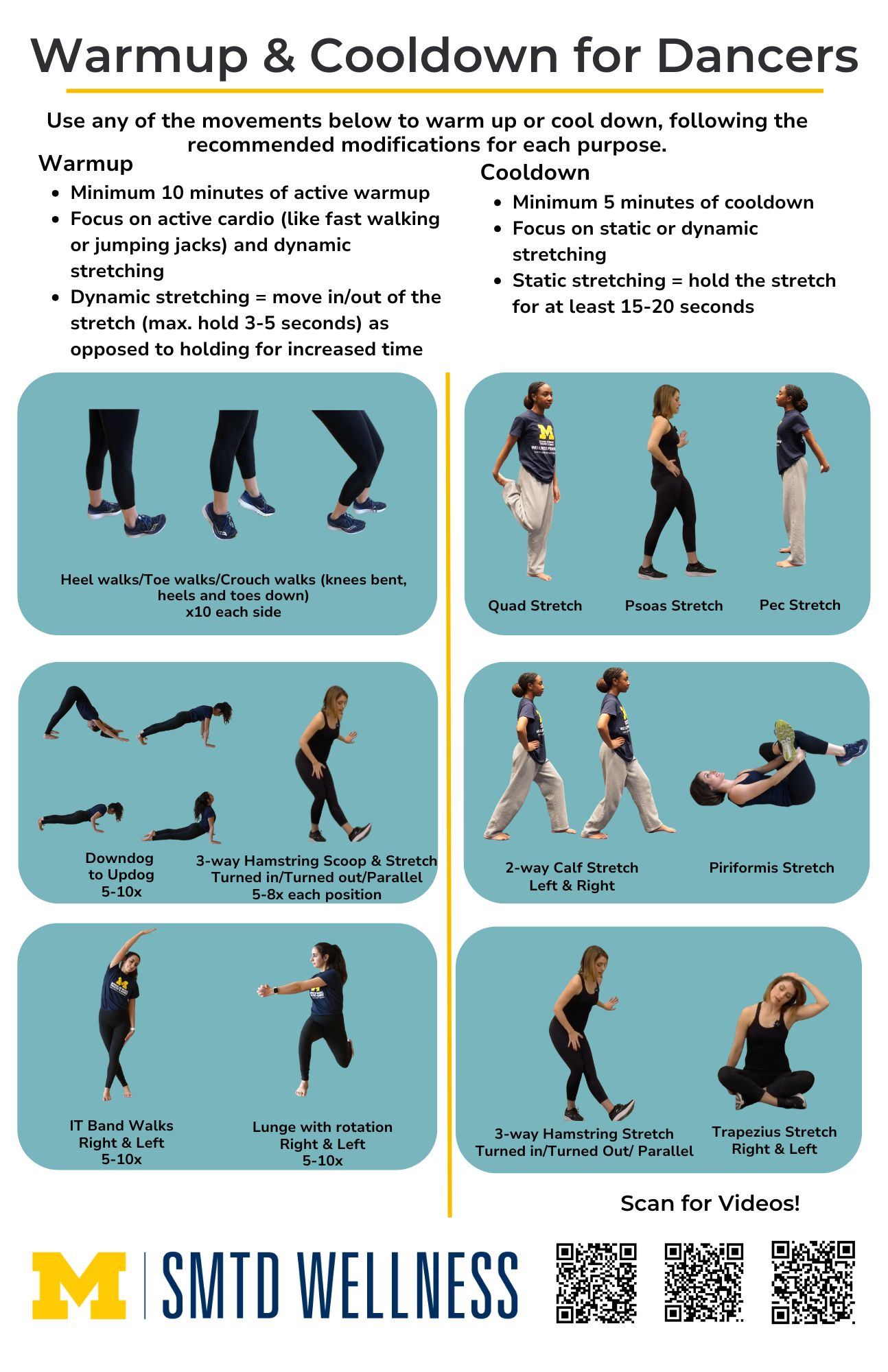
Warmup and Cooldown for Dancers
Use any of the movements below to warm up or cool down, following the recommended modifications for each purpose
Warmup
- Minimum 10 minutes of active warmup
- Focus on active cardio (like fast walking or jumping jacks) and dynamic stretching
- Dynamic stretching = move in/out of the stretch (max. hold 3-5 seconds) as opposed to holding for increased time
Heel walks/Toe walks/Crouch walks (knees bent, heels and toes down) x10 each side
Downdog to Updog 5-10x
3-way Hamstring Scoop & Stretch, Turned in/Turned out/Parallel 5-8x each position
IT Band walks right and left 5-10x
Lunge with rotation right and left 5-10x
Cooldown
- Minimum 5 minutes of cooldown
- Focus on static or dynamic stretching
- Static stretching = hold the stretch for at least 15-20 seconds
Quad Stretch
Psoas Stretch
Pec Stretch
2-way Calf Stretch left and right
Piriformis Stretch
3-Way Hamstring Stretch Turned in/Turned out/Parallel
Trapezius Stretch right and left
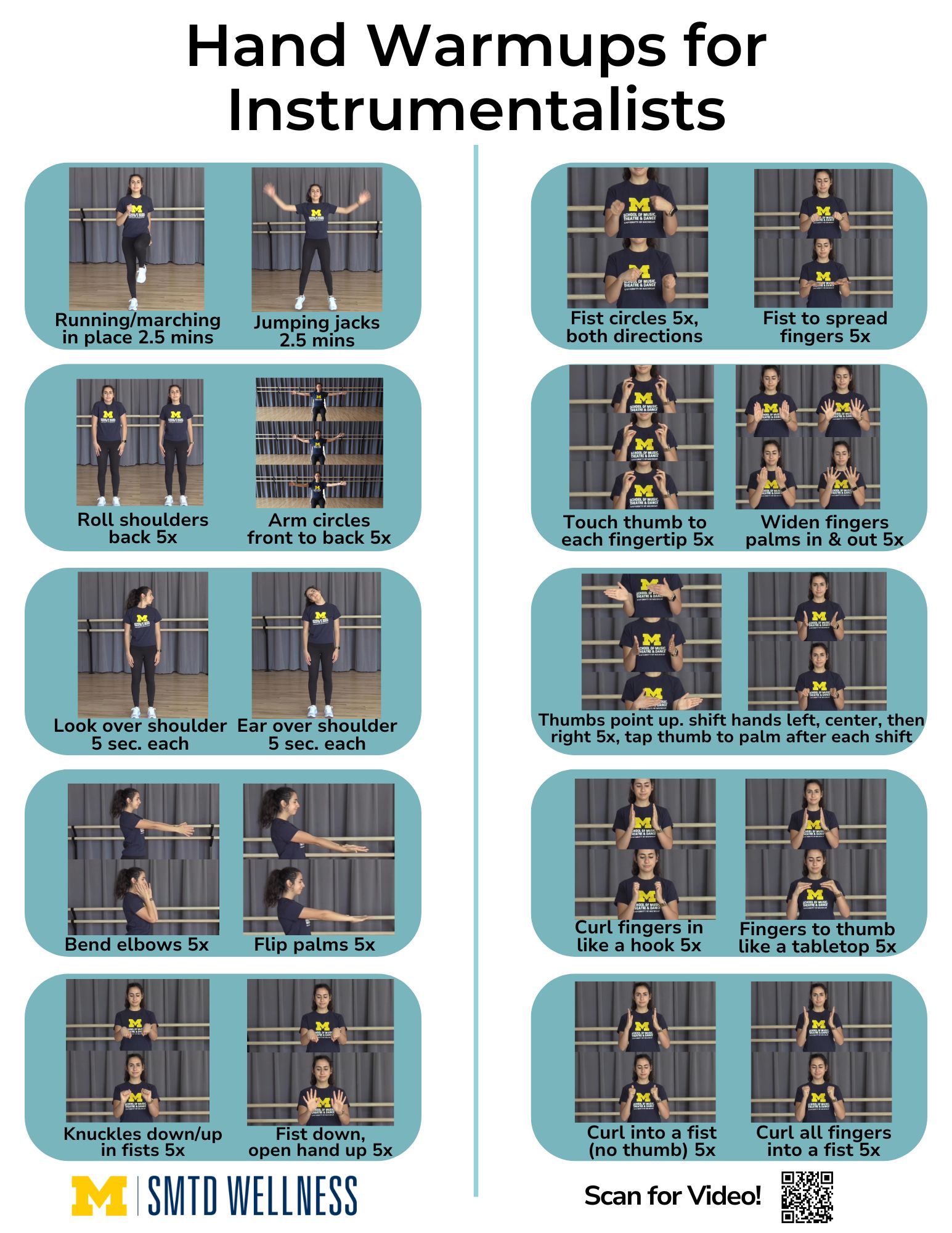
Hand Warm Ups for Instrumentalists
Running/marching in place 2.5 mins
Jumping jacks 2.5 mins
Roll shoulders back 5x
Arm circles front to back 5x
Look over shoulder 5 sec. each
Ear over shoulder 5 sec. Each
Bend elbows 5x
Flip palms 5x
Knuckles down/up in fists 5x
Fist down, open hand up 5x
First circles 5x, both directions
Fist to spread fingers 5x
Touch thumb to each fingertip 5x
Widen fingers palms in & out 5x
Thumbs point up, shift hands left, center, then right 5x, tap thumb to palm after each shift
Curl fingers in like a hook 5x
Fingers to thumb like a tabletop 5x
Curl into a fist (no thumb) 5x
Curl all fingers into a fist 5x
Video link: https://www.youtube.com/watch?v=CMQxS5YxFPM&list=PLVy2jdQD7GRzQ2_q6dTb6ojLoh28DEnfa&index=19
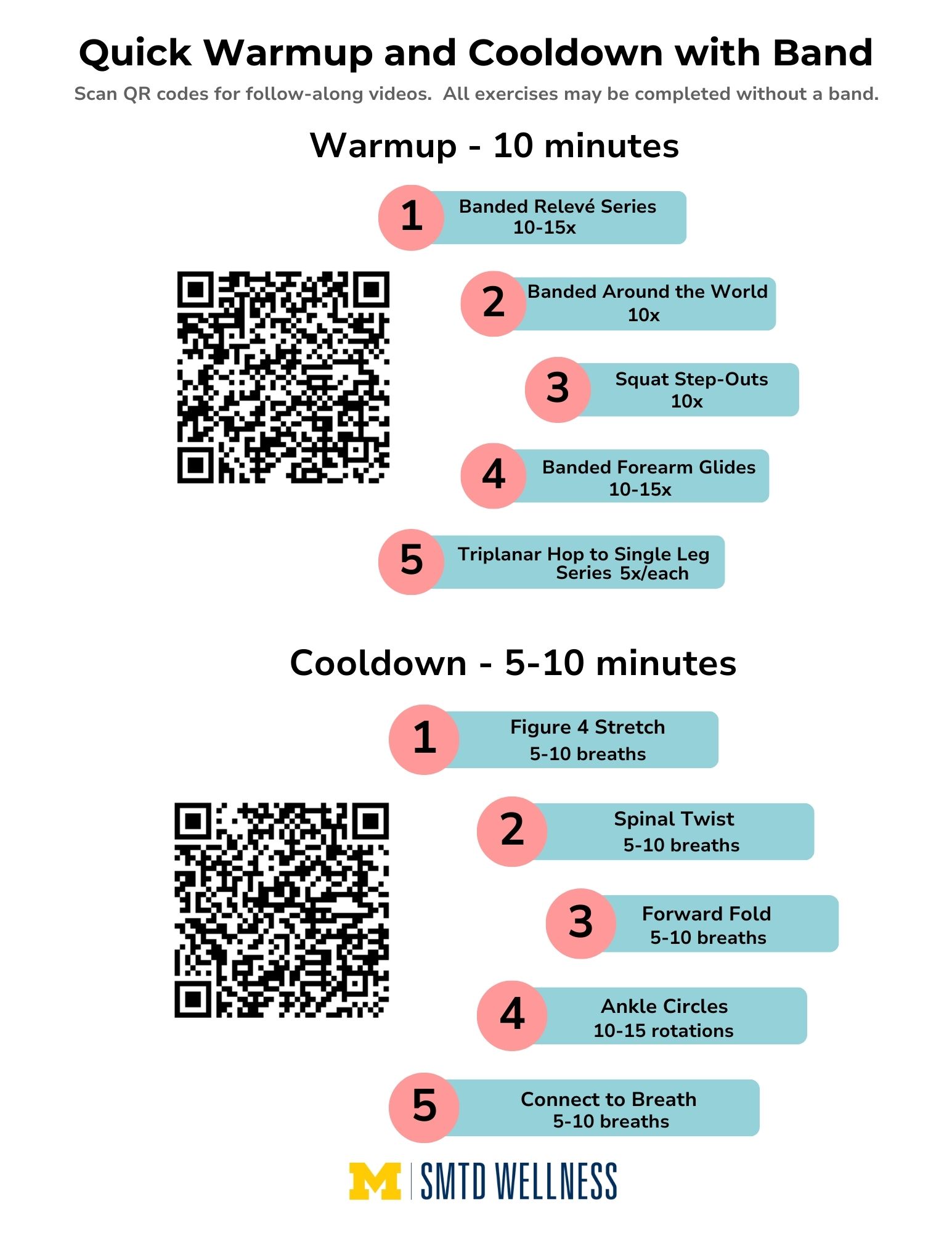
Quick Band Warmup
Scan QR codes for follow-along videos. All exercises may be completed without a band.
Warmup - 10 minutes
- Banded Releve Series 10-15x
- Banded Around the World 10x
- Squat Step Outs 10x
- Banded Forearm Glides 10-15x or 10 pushups if without a band
- Triplanar Hop to Single leg series 5x each
Video Link: Quick Band Warm Up
Cooldown 5-10 minutes
- Figure 4 Stretch 5-10 breaths
- Spinal Twist 5-10 breaths
- Forward Bend 5-10 breaths
- Ankle Circles 10-15 each way
- Connect to breath 5-10 breath cycles
Video Link: Simple Cooldown
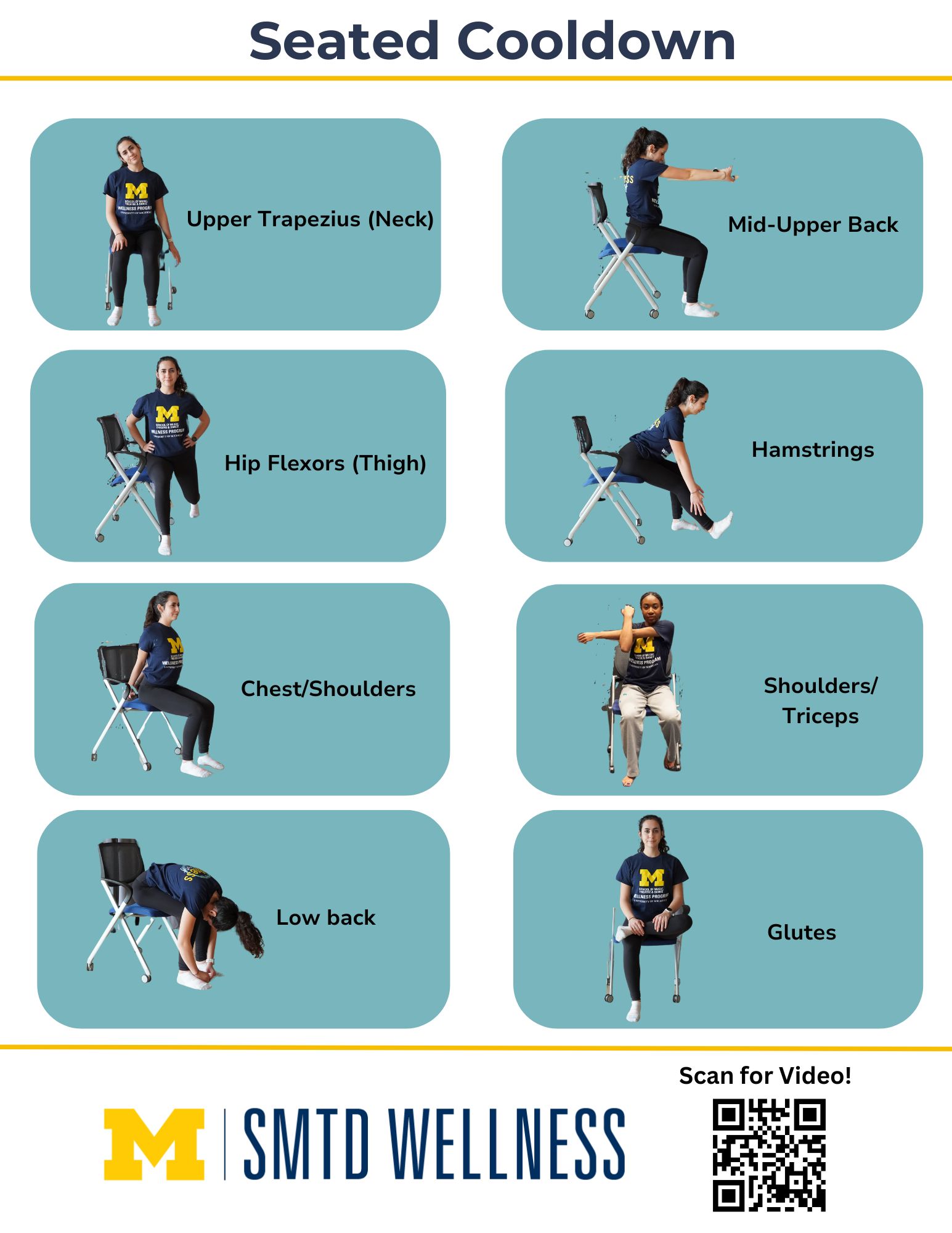
Seated Cooldown
Upper Trapezius (Neck)
Mid-Upper Back
Hip Flexors (Thigh)
Hamstrings
Chest/Shoulders
Shoulders/Triceps
Low Back
Glutes
Video link: https://www.youtube.com/watch?v=VPz-ZfvFm9o&list=PLVy2jdQD7GRzQ2_q6dTb6ojLoh28DEnfa&index=7
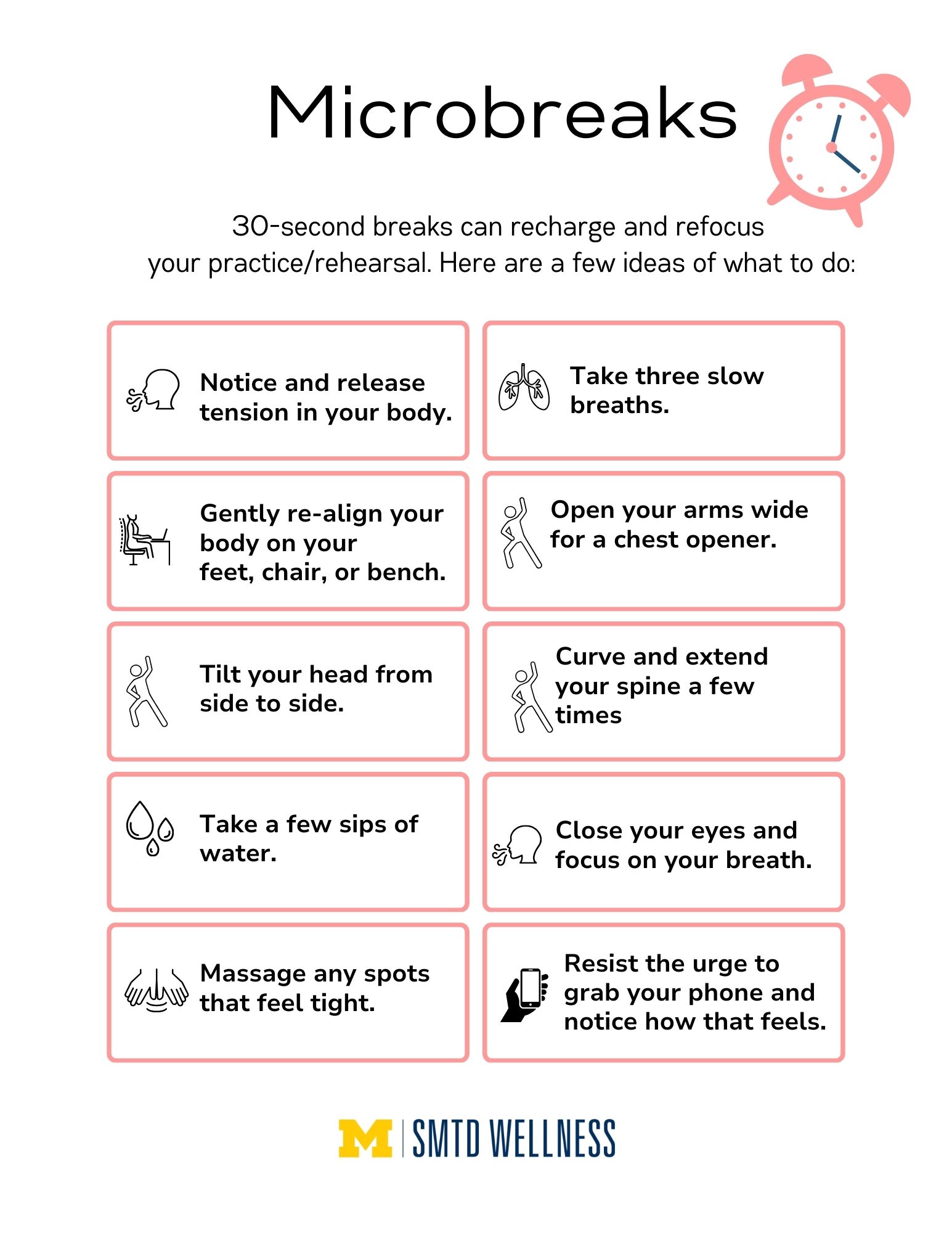
Take a Microbreak
30-second breaks can recharge and refocus your practice/rehearsal. Here are a few ideas of what to do:
- Notice and release tension in your body.
- Take three slow breaths.
- Gently re-align your body on your feet, chair, or bench.
- Open your arms wide for a chest opener.
- Tilt your head from side to side.
- Curve and extend your spine a few times.
- Take a few sips of water
- Close your eyes and focus on your breath.
- Massage any spots that feel tight.
- Resist the urge to check news or social media and notice how that feels.
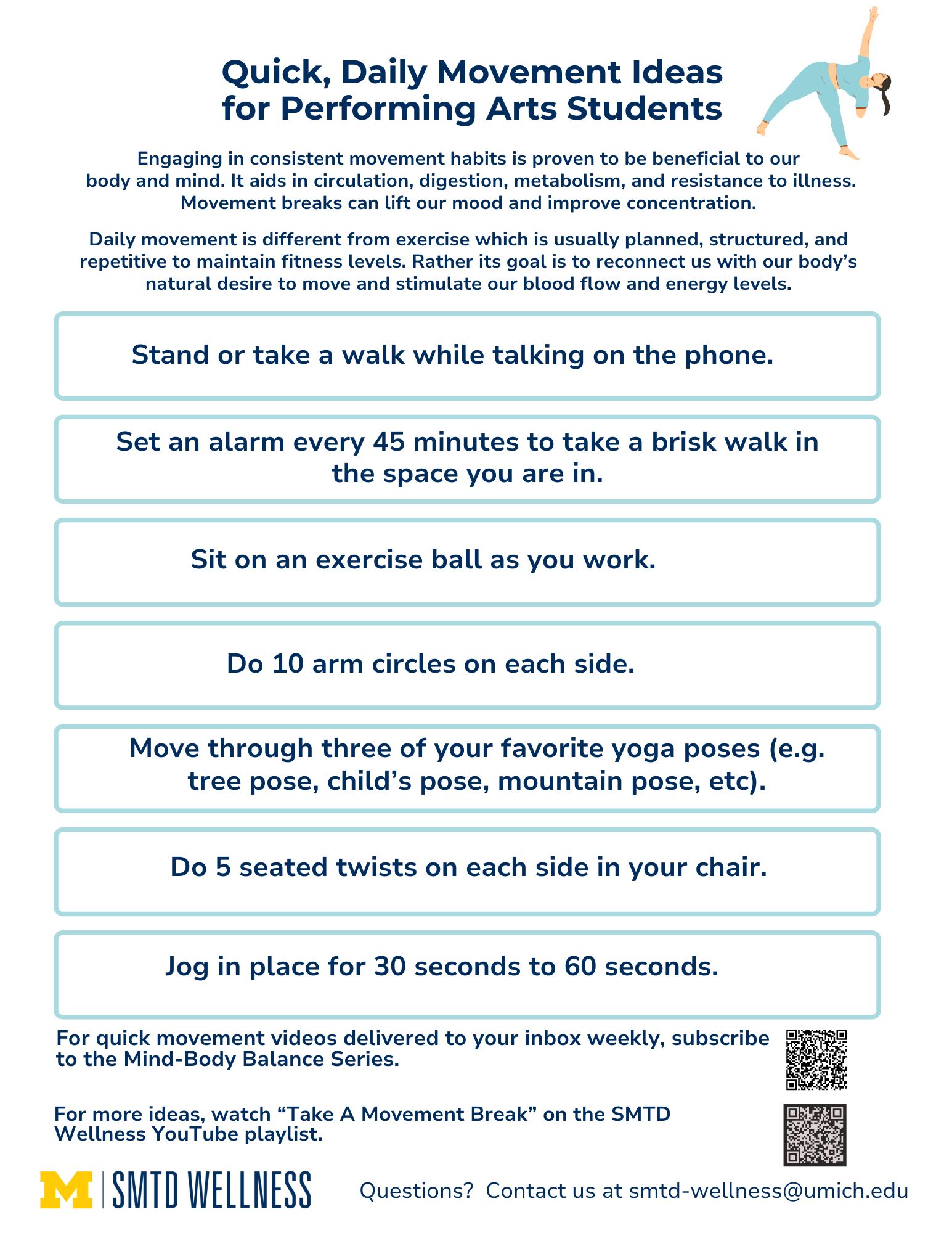
Quick, Daily Movement Ideas for Performing Artists
Engaging in consistent movement habits is proven to be beneficial to our body and mind. It aids in circulation, digestion, metabolism, and resistance to illness. Movement breaks can lift our mood and improve concentration.
Daily movement is different from exercise which is usually planned, structured, and repetitive to maintain fitness levels. Rather its goal is to reconnect us with our body’s natural desire to move and stimulate our blood flow and energy levels.
- Stand or take a walk while talking on the phone.
- Set an alarm every 45 minutes to take a brisk walk in the space you are in.
- Sit on an exercise ball as you work.
- Do 10 arm circles on each side.
- Move through three of your favorite yoga poses (e.g. tree pose, child’s pose, mountain pose, etc).
- Do 5 seated twists on each side in your chair.
- Jog in place for 30 seconds to 60 seconds.
For quick movement videos delivered to your inbox weekly, subscribe to the Mind-Body Balance Series.
For more ideas, watch “Take A Movement Break” on the SMTD Wellness YouTube playlist.
Questions? Contact us at [email protected]
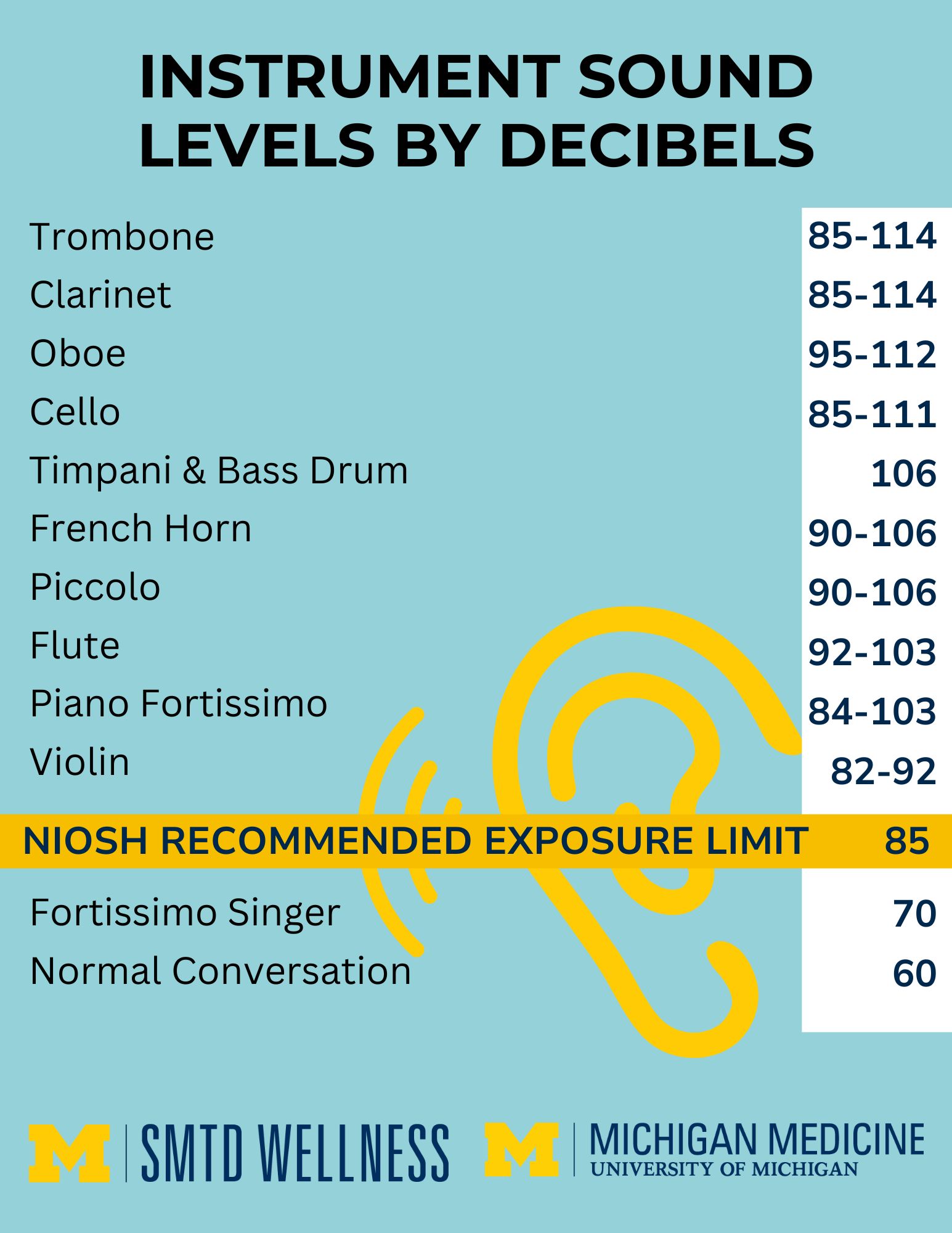
Instrument Sound Levels by Decibels
Trombone - 85-114
Clarinet - 85-114
Oboe - 95-112
Cello - 85-111
Timpani & Bass Dru - 106
French Horn - 90-106
Piccolo - 90-106
Flute - 92-103
Piano Fortissimo - 94-103
Violin - 82-92
NIOSH RECOMMENDED EXPOSURE LIMIT - 85
Fortissimo Singer - 70
Normal Conversation - 60
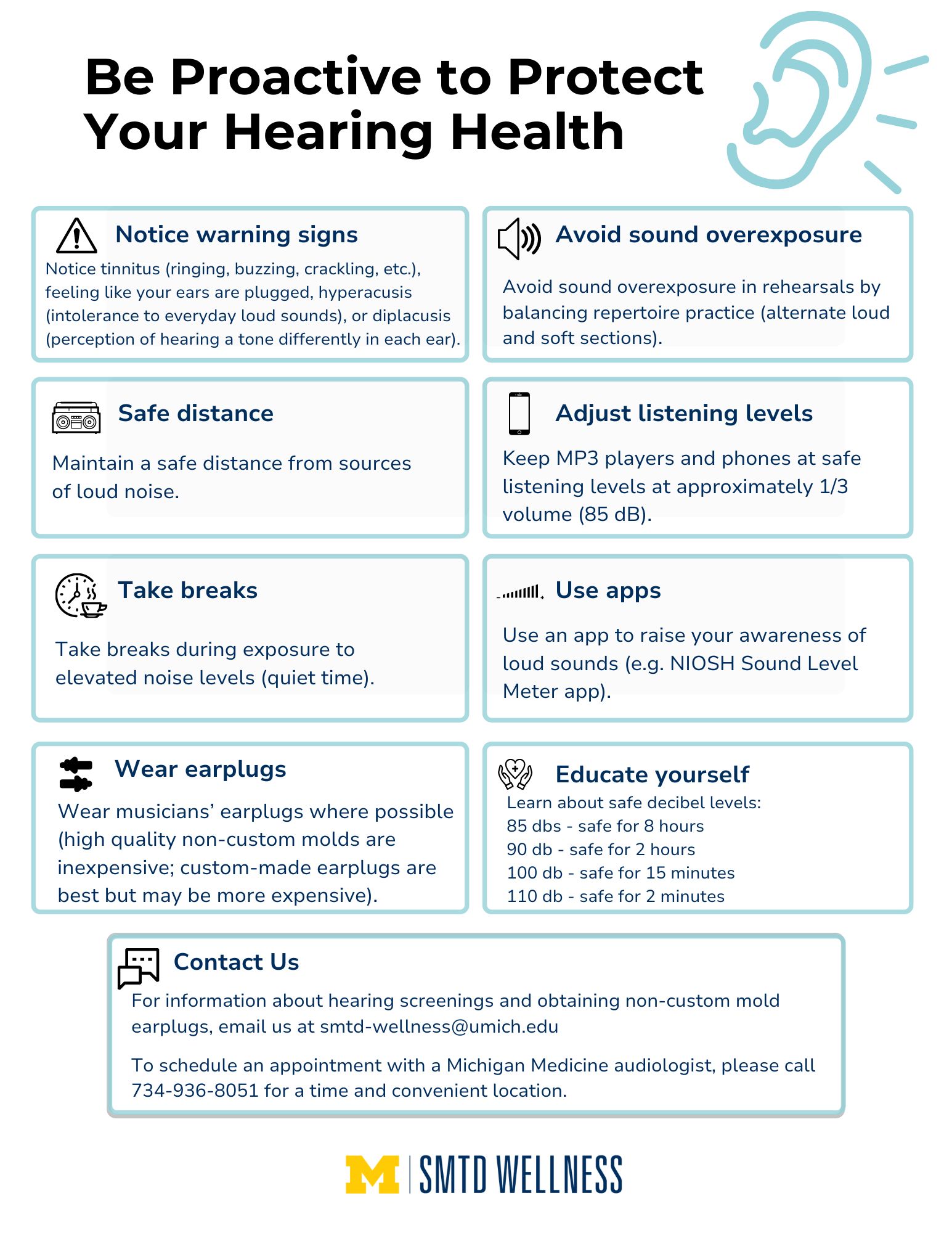
Be Proactive to Protect Your Hearing Health
- Notice warning signs: Notice tinnitus (ringing, buzzing, crackling, etc.), feeling like your ears are plugged, hyperacusis (intolerance to everyday loud sounds), or diplacusis (perception of hearing a tone differently in each ear).
- Avoid sound overexposure: Avoid sound overexposure in rehearsals by balancing repertoire practice (alternate loud and soft sections).
- Safe distance: Maintain a safe distance from sources of loud noise.
- Adjust listening levels: Keep MP3 players and phones at safe listening levels at approximately 1/3 volume (85 dB).
- Take breaks: Take breaks during exposure to elevated noise levels (quiet time).
- Use apps: Use an app to raise your awareness of loud sounds (e.g. NIOSH Sound Level Meter app).
- Wear earplugs: Wear musicians’ earplugs where possible (high quality non-custom molds are inexpensive; custom-made earplugs are best but may be more expensive).
- Educate yourself:
Learn about safe decibel levels:
85 dbs - safe for 8 hours
90 db - safe for 2 hours
100 db - safe for 15 minutes
110 db - safe for 2 minutes
Contact us:
For information about hearing screenings and obtaining non-custom mold earplugs, reach out:
Dr. Paola Savvidou, [email protected].
To schedule an appointment with a Michigan Medicine audiologist, please call 734-936-8051 for a time and convenient location.
How to Maximize Your Earplugs
- Insertion and Removal: Give yourself a few extra minutes prior to and after use to ensure good comfort and fit.
- Storage: Keep your earplugs in a place that is easy to remember, so wearing them is convenient and consistent.
- Adaptation: First use of the earplugs should be in a low-pressure environment, such as at home or during practice (e.g. not during a performance!). Our brains need time to adapt to new (and reduced) sound levels!
- Maintenance: The more regular the cleaning, the better! Wash your earplugs with mild soap and water.
- Your Earplugs: Settings with sound levels at or greater than 85 dBA (use NIOSH Sound Level Meter App on Smartphone) such as rehearsals, concerts, or sporting events.

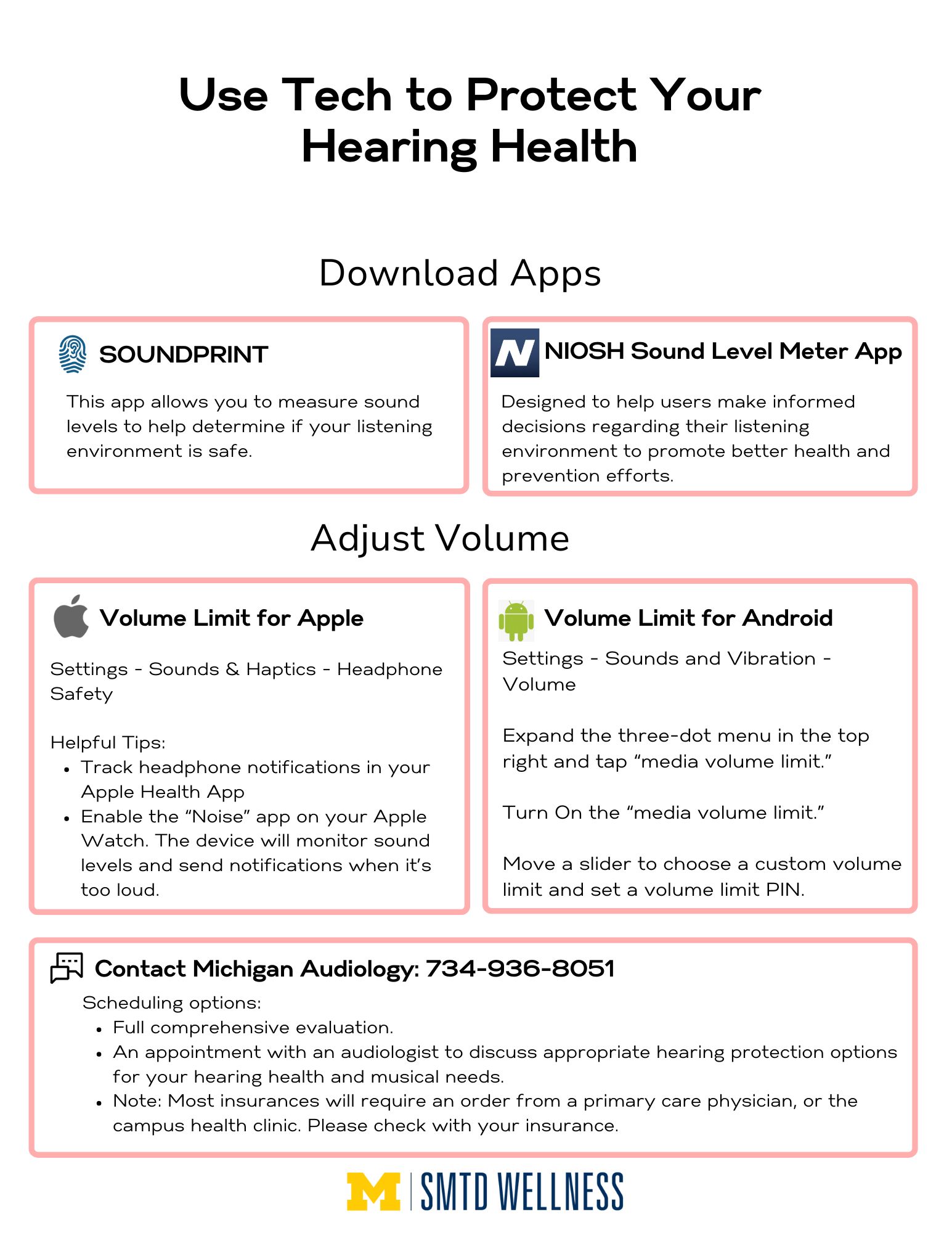
Use Tech to Protect Your Hearing Health
SOUNDPRINT: This app allows you to measure sound levels to help determine if your listening environment is safe.
NIOSH Sound Level Meter App: Designed to help users make informed decisions regarding their listening environment to promote better health and prevention efforts.
Adjust Volume
Volume Limit for Apple
Settings - Sounds & Haptics - Headphone Safety
Helpful Tips:
- Track headphone notifications in your Apple Health App
- Enable the “Noise” app on your Apple Watch. The device will monitor sound levels and send notifications when it’s too loud.
- This app allows you to measure sound levels to help determine if you listening environment is safe.
- Help promote quiet venues by submitting a sound measurement to help you and others find quiet and moderate spaces to hear and connect with others.
- Apple iOS: https://apps.apple.com/us/app/soundprint-find-a-quiet-place/id971189322
- Google Play: https://play.google.com/store/apps/details?id=com.soundprint&hl=en_US&gl=US
Volume Limit for Android
- Designed to help users make informed decisions regarding their listening environment to promote better health and prevention efforts.
- Apple iOS: https://apps.apple.com/us/app/niosh-slm/id1096545820
Contact Michigan Medicine Audiology: 734-936-8051
Scheduling options:
- Full comprehensive evaluation.
- An appointment with an audiologist to discuss appropriate hearing protection options for your hearing health and musical needs.
- Note: Most insurances will require an order from a primary care physician, or the campus health clinic. Please check with your insurance.
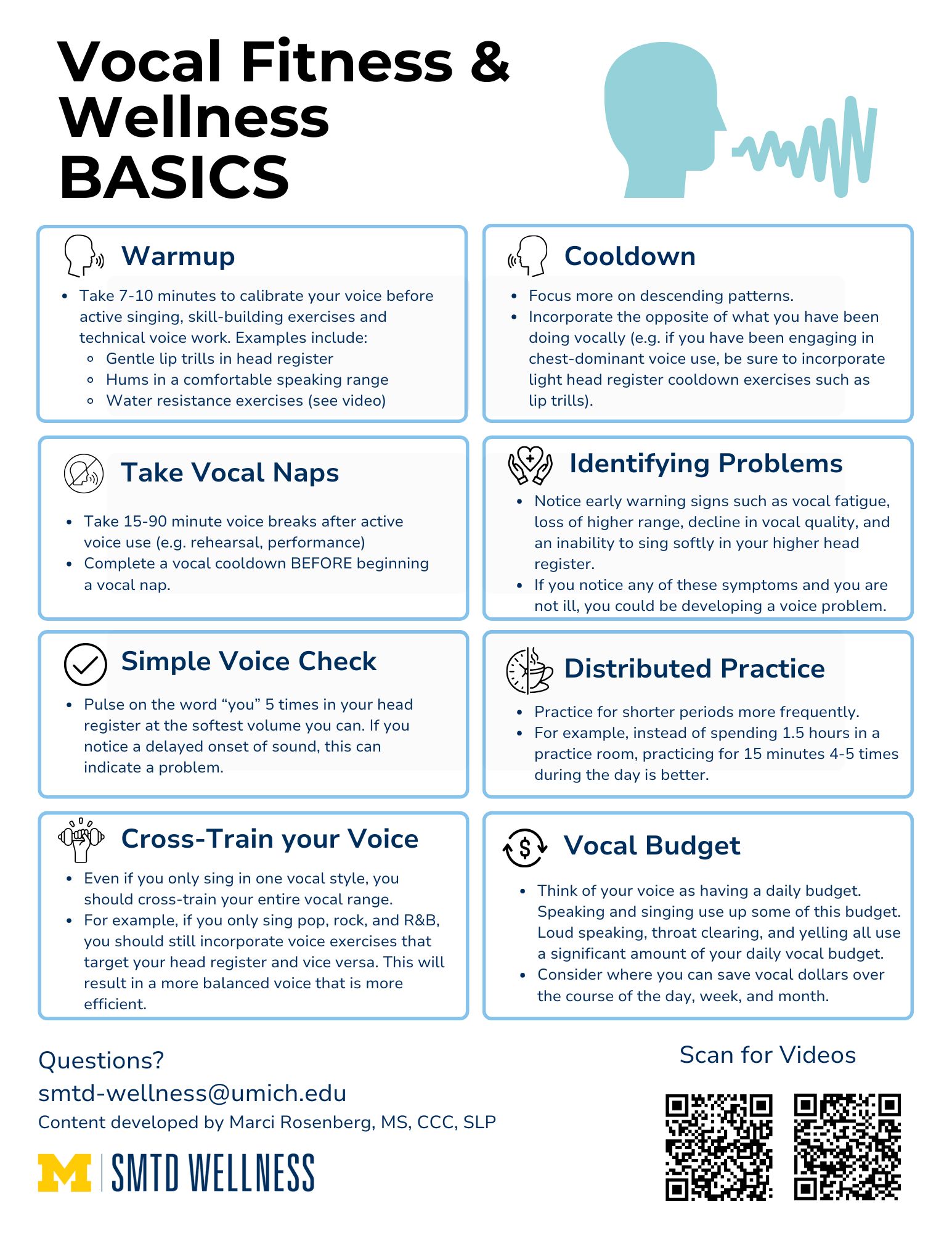
Vocal Fitness & Wellness BASICS
- Warmup
- Take 7-10 minutes to calibrate your voice before active singing, skill-building exercises and technical voice work. Examples include:
- Gentle lip trills in head register
- Hums in a comfortable speaking range
- Water resistance exercises (see video)
- Cooldown
- Focus more on descending patterns.
- Incorporate the opposite of what you have been doing vocally (e.g. if you have been engaging in chest-dominant voice use, be sure to incorporate light head register cooldown exercises such as lip trills).
- Take Vocal Naps
- Take 15-90 minute voice breaks after active voice use (e.g. rehearsal, performance)
- Complete a vocal cooldown BEFORE beginning a vocal nap.
- Identifying Problems
- Notice early warning signs such as vocal fatigue, loss of higher range, decline in vocal quality, and an inability to sing softly in your higher head register.
- If you notice any of these symptoms and you are not ill, you could be developing a voice problem.
- Simple Voice Check
- Pulse on the word “you” 5 times in your head register at the softest volume you can. If you notice a delayed onset of sound, this can indicate a problem.
- Distributed Practice
- Practice for shorter periods more frequently.
- For example, instead of spending 1.5 hours in a practice room, practicing for 15 minutes 4-5 times during the day is better.
- Cross-Train Your Voice
- Even if you only sing in one vocal style, you should cross-train your entire vocal range.
- For example, if you only sing pop, rock, and R&B, you should still incorporate voice exercises that target your head register and vice versa. This will result in a more balanced voice that is more efficient.
- Vocal Budget
- Think of your voice as having a daily budget. Speaking and singing use up some of this budget. Loud speaking, throat clearing, and yelling all use a significant amount of your daily vocal budget.
- Consider where you can save vocal dollars over the course of the day, week, and month.
Questions?
[email protected]
Content developed by Marci Rosenberg, MS, CCC, SLP
Links to YouTube videos:
Intro to Vocal Health Screenings
Quick Vocal Warm-ups and Cooldowns
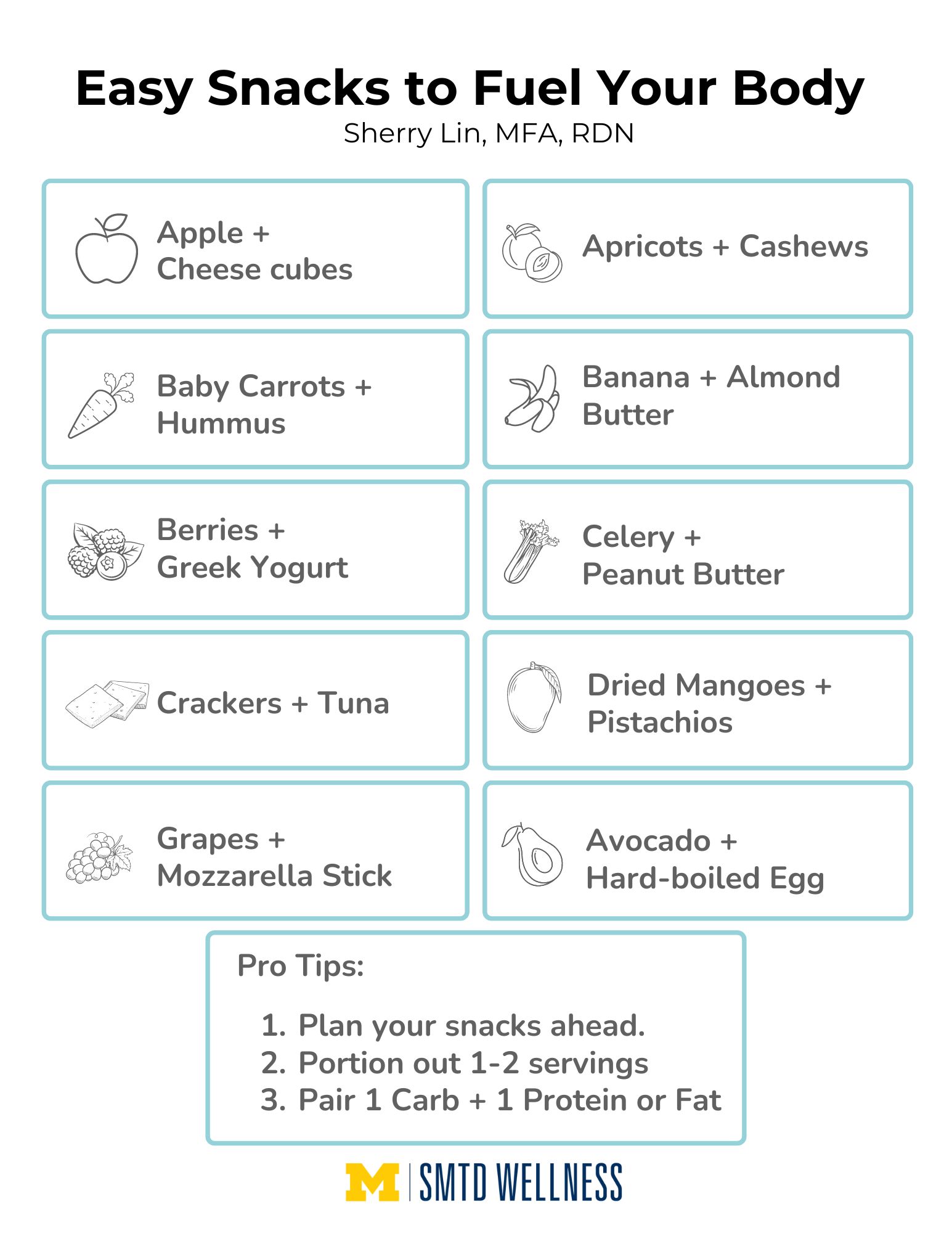
Easy Snacks to Fuel Your Body & Brain
Sherry Lin, MFA, RDN
- Apple + Cheese Cubes
- Apricots + Cashews
- Baby Carrots + Hummus
- Banana + Almond Butter
- Berries + Greek Yogurt
- Celery + Peanut Butter
- Crackers + Tuna
- Dried Mangoes + Pistachios
- Grapes + Mozzarella Stick
- Avocado + Hard-boiled egg
Pro Tips:
- Plan your snacks ahead
- Portion out 1-2 servings
- Pair 1 Carb + 1 Protein or Fat
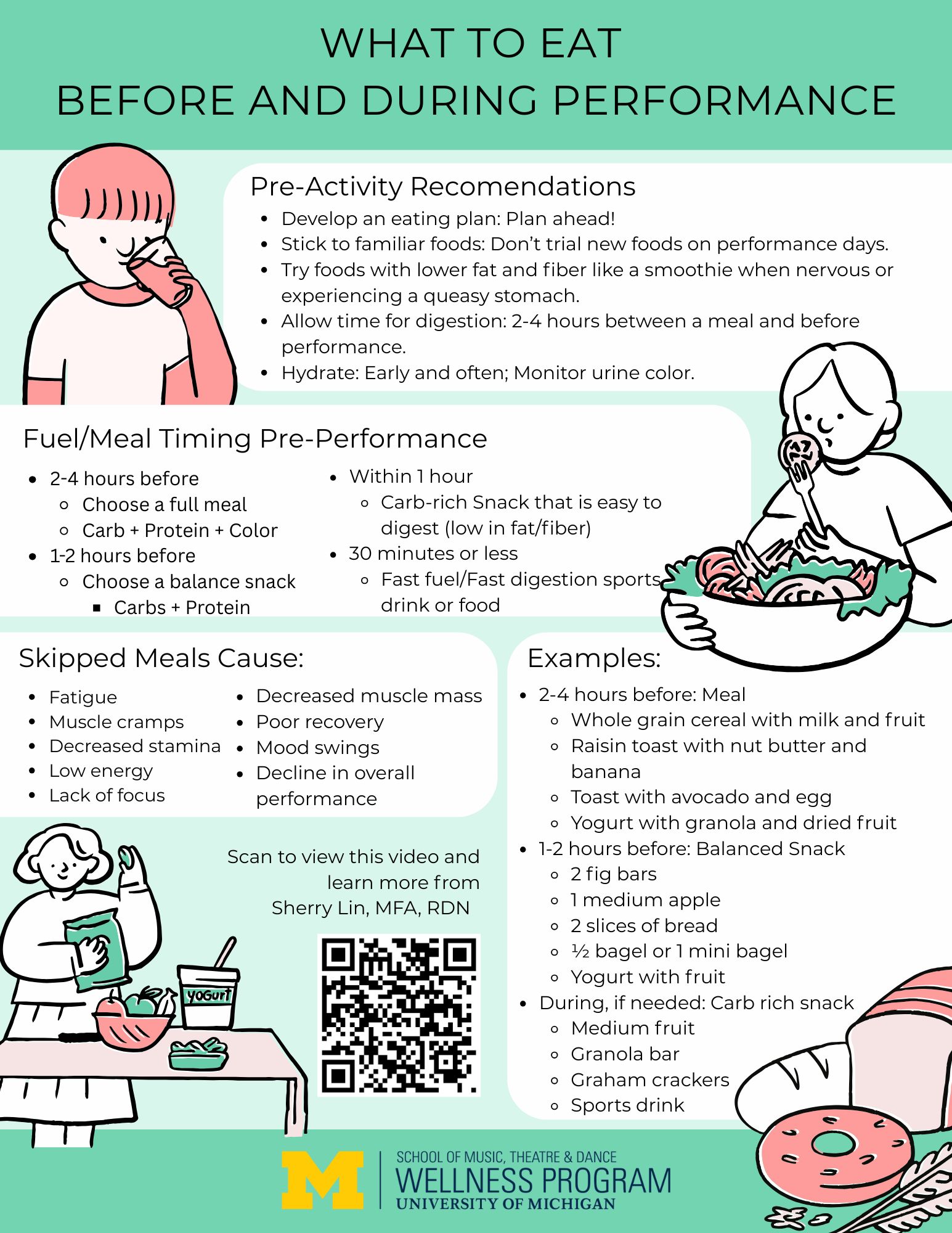
What to Eat Before and During Performance
Pre-activity recommendations
- Develop an eating plan
- Plan ahead!
- Stick to familiar foods
- Don’t trial new foods on performance days
- Try foods with lower fat and fiber like a smoothie when nervous or experiencing a queasy stomach
- Allow time for digestion
- 2-4 hours between a meal and before performance
- Hydrate
- Early and often
- Monitor urine color
Fuel/Meal Timing Pre-Performance
- 2-4 hours before
- Choose a full meal
- Carb + Protein + Color
- 1-2 hours before
- Choose a balance snack
- Carbs + Protein
- Choose a balance snack
- Within 1 hour
- Carb-rich Snack
- Easy to digest = low in fat/fiber
- Carb-rich Snack
- 30 minutes or less
- Fast fuel/Fast digestion sports drink or food
Skipped Meals Cause:
- Fatigue
- Muscle cramps
- Decreased stamina
- Low energy
- Lack of focus
- Decreased muscle mass
- Poor recovery
- Mood swings
- Decline in overall performance
Examples
- 2-4 hours before/Meal
- Whole grain cereal with milk and fruit
- Raisin toast with nut butter and banana
- Toast with avocado and egg
- Yogurt with granola and dried fruit
- 1-2 hours before/Balanced Snack
- 2 fig bars
- 1 medium apple
- 2 slices of bread
- ½ bagel or 1 mini bagel
- Yogurt with fruit
- English muffin
- During if needed/Carb rich snack
- Medium fruit
- Granola bar
- Graham crackers
- Sports drink
View this video to learn more from Sherry Lin, MFA, RDN.
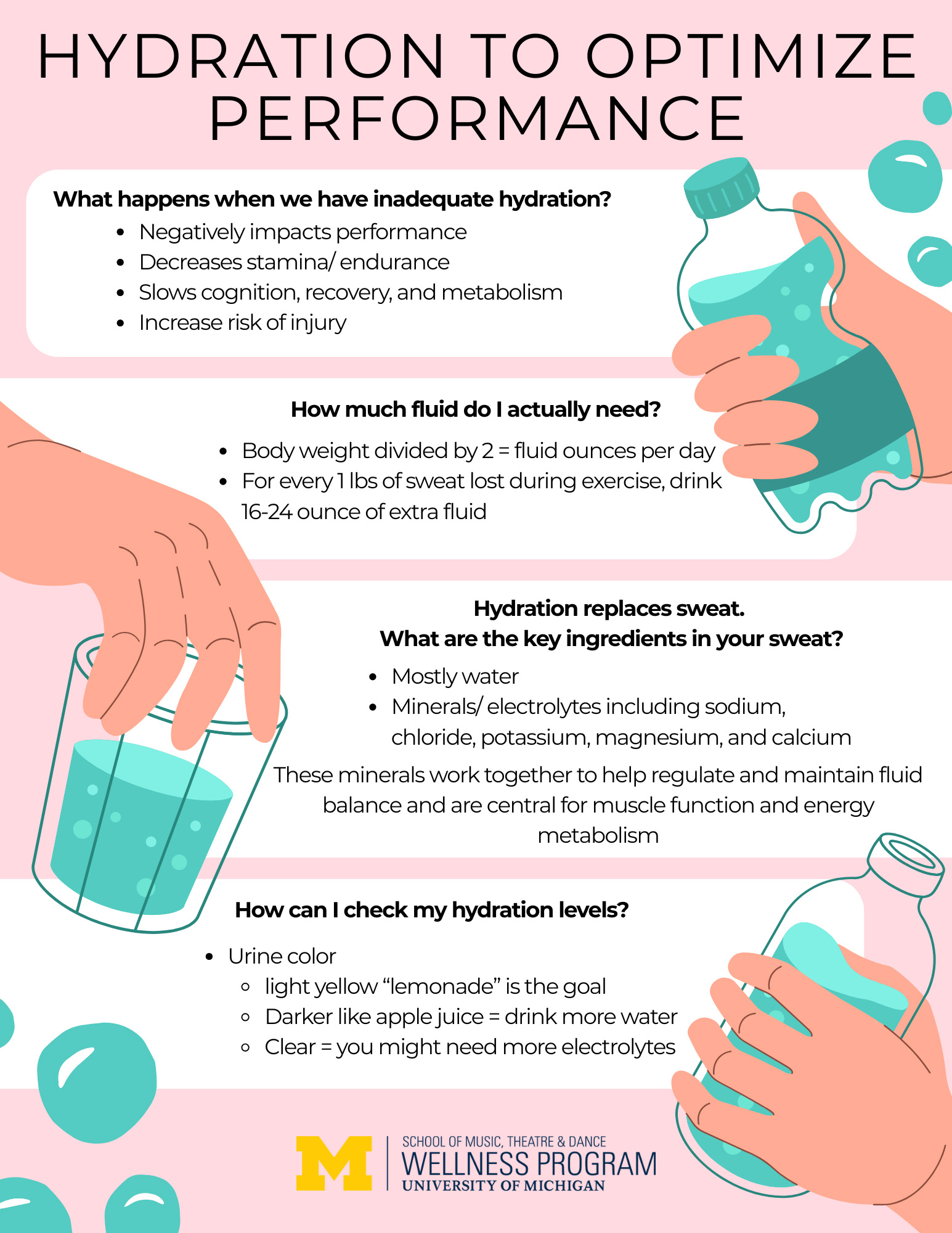
Hydration to Optimize Performance
What happens when we have inadequate hydration?
- Negatively impacts performance
- Decreases stamina/endurance
- Slows cognition, recovery and metabolism
- Increase risk of injury
How much fluid do I actually need?
- Body weight divided by 2 = fluid ounces per day
- For every 1 lbs of sweat lost during exercise, drink 16-24 ounce of extra fluid
Hydration is essentially replacing sweat. What are key ingredients in your sweat?
- Mostly Water
- Minerals/Electrolytes
- Sodium
- Chloride
- Potassium
- Magnesium
- Calcium
These minerals work together to help regulate and maintain fluid balance and are central for muscle function and energy metabolism.
How can I check my hydration levels?
- Urine color
- Light yellow “lemonade” is the goal
- Darker like apple juice=drink more water
- Clear=you might need more electrolytes
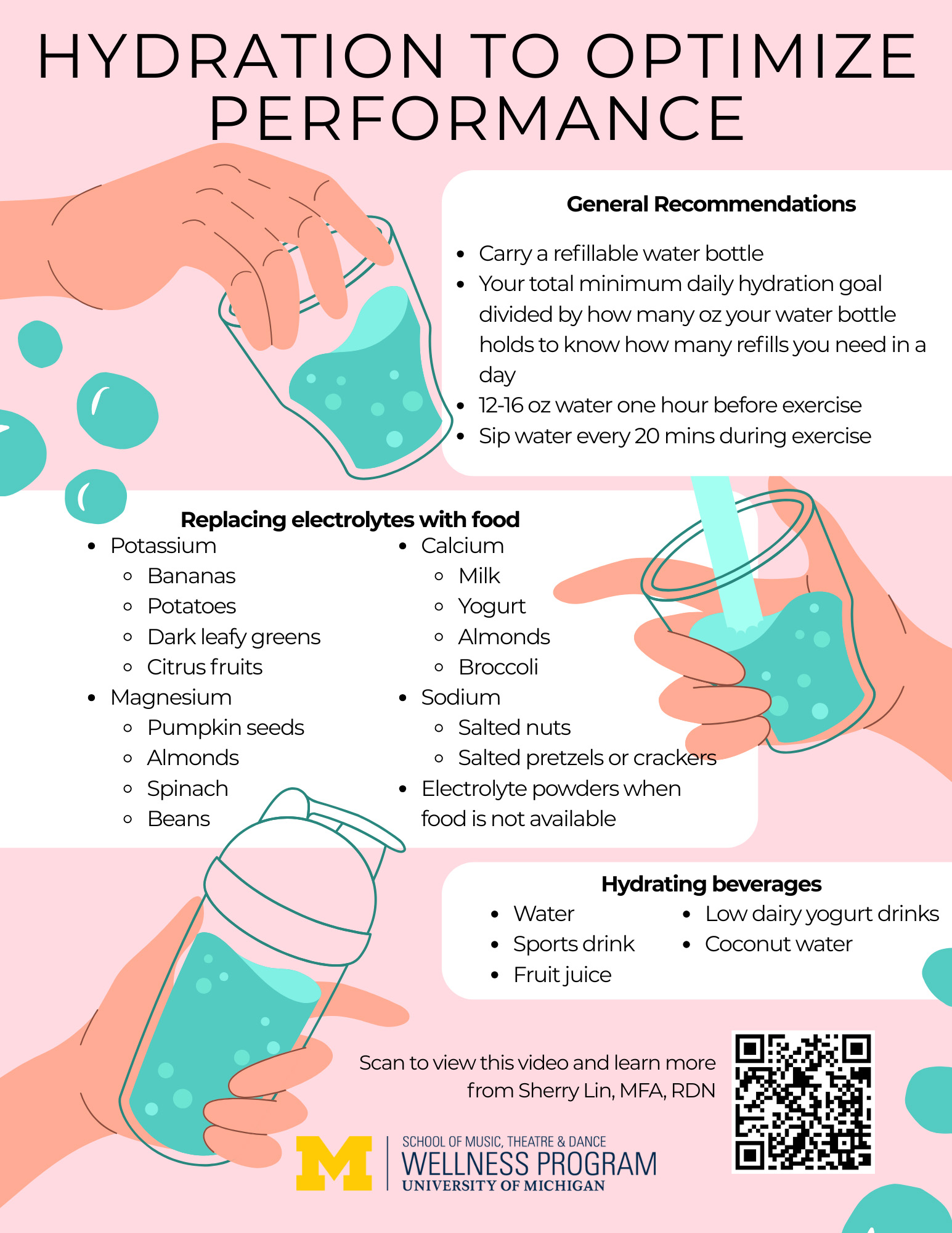
General Recommendations
- Carry a refillable water bottle
- Your total minimum daily hydration goal divided by how many ounces your water bottle holds to know how many refills you need in a day
- 12-16 ounces water one hour before exercise
- Sip water every 20 minutes during exercise
Replacing electrolytes with food
- Sodium
- Salted nuts
- Salted pretzels/crackers
- Potassium
- Bananas
- Potatoes
- Dark leafy greens
- Citrus fruits
- Magnesium
- Pumpkin seeds
- Almonds
- Peanut butter
- Spinach
- Beans
- Calcium
- Milk
- Yogurt
- Almonds
- Broccoli
- Electrolyte powders can be a helpful tool when food is not available
Hydrating beverages
- Water
- Sports drinks
- Fruit juice
- Low dairy yogurt drinks
- Coconut water
View this video to learn more from Sherry Lin, RDN, MFA
Mental Health Infographics
Performance Anxiety Exercises
- Emergency Focus Cue
Create a personally meaningful emergency focus cue to use when something goes awry on stage. This could be a very general cue that can be used with any performance or it could be specific to a particular one. Periodically repeat this cue to yourself as you practice or rehearse, particularly when you feel your mind start to wander. Write your emergency focus cue here: - Dealing With Distractions
Think about a past or upcoming performance. List five possible distractions which have happened to you before or during a practice or performance, or which could possibly happen in the future. These can include distracting situations, events, or thoughts. For each distraction, write out a strategy for how you can refocus yourself. Plan ahead. For each possible situation, what will be the best action for you to take?- Distractions:
- Strategies:
- Positive Affirmations
Think of an upcoming performance, formal or informal, and write two or three short sentences of affirmation which express what you want to think, feel, or do. Be sure to keep these sentences optimistic, but truthful and realistic, and construct them using first-person present tense. Try to avoid comparative statements in favor of those which foster personal satisfaction. Write your affirmations here:
Tips for Performance Anxiety
- Prepare: Preparation is important. Anxiety will be worse if you are feeling underprepared.
- Move: Move in ways that help you relieve physical tension before a performance (warmups, exercise, jumping jacks).
- Reframe: Reframe anxiousness to positive excitement.
- Beta Blockers: Beta blockers are often used to reduce symptoms of performance anxiety. While they may reduce physical symptoms, the mental and emotional symptoms are still present. As with any type of medication, beta blockers should only be used in consultation with a doctor and with a prescription.
- Nutrition: Consider what you eat and drink prior to a performance. Complex carbohydrates (such as whole grain pasta) are digested more slowly and can stave off hunger during a performance. Caffeine may increase nervousness so you might consider limiting your intake.
- Rehearse: Practice putting yourself in situations where you can practice performing even when you are nervous. The nerves will not go away. What we can do is notice them and be able to play even when we are having those symptoms. Come up with ideas for performing in progressively more stressful situations over time so you can build tolerance.
- Rest: Getting adequate sleep can help us manage stress and manage intense emotions more effectively. In the days leading up to a performance, clear out your schedule so you can be well rested.
10 Guided Mindfulness Prompts
- Mindfulness helps integrate the mind and body by directing attention to the present moment. It helps us notice patterns in our thoughts and actions, increasing our self-awareness.
- Find a comfortable seated position and choose one of the questions below. Take three deep breaths to allow the upper body to relax and the eyes to close. Reflect on the question for 2-3 minutes while continuing to take deep, mindful breaths. Take three deep breaths and gently reopen your eyes. Notice how you feel.
- What does being calm look like to you?
- What is at the core of your being as the person you are today? How can you strengthen your connection to this inner core?
- When was the last time you did something for the very first time?
- What messages are you giving your inner dialogue? How can you be gentle with yourself today?
- What was something difficult you faced today? How did you handle it?
- What is your current energy level? What is possible for you at this level?
- At this very moment, what do you need the most? How can you start to obtain it within the next five minutes, ten minutes, and thirty minutes?
- Which parts of your body are most affected by stress? What are some experiences that trigger these sensations? How can you approach yourself with kindness?
- Which activities are most engaging to you? Why do you think this is?
- Is there a specific moment you felt particularly present today?
Stress Relief Tips
- Take a deep breath: Deep breathing activates the parasympathetic nervous system which promotes relaxation. When you are feeling overwhelmed, breathe in for 4 seconds, hold for 2 seconds, then breath out for 6 seconds.
- Go for a walk outside: Walking boosts endorphins, which also reduces stress hormones. Walking in parks or green spaces allows us to feel “involuntary attention,” focusing on the space around us while also reflecting.
- Watch a funny or uplifting video: Laughter allows us to take in more oxygen-rich air, which stimulates our heart, lungs and muscles and increases endorphins.
- Make time for your hobbies: Remember the importance of balance. Prioritize making time for the things you love so you can refill YOUR cup.
- Eat a banana or potatoes: Both of these foods are rich in potassium and magnesium, which regulates blood pressure. They also boost serotonin helping us feel better.
- Visualize a positive scene: Guided imagery can allow us to feel a relaxation response. Make yourself comfortable and think of a peaceful landscape, something you’re excited about, or a future goal.
- Try yoga or meditation: Yoga helps improve strength, flexibility and balance while reducing body-wide inflammation. A consistent bedtime yoga routine is also proven to help you fall and stay asleep.
- Plan out your day: Set time frames for completing tasks throughout the day in a planner or a calendar. This can help feel like the day has a more dedicated structure.Try planning breaks into these tasks as well.
Self Care Infographics
Journal Prompts to Cope with Stress
- The things that help me the most right now are…
- A few things I can do for self-nourishment are..
- What words can I use to empower myself?
- What are three things that are going well for me now? Make a list of small wins.
Think about an activity, or a hobby you do that makes you feel expansive and lifts your mood. Describe how it makes you feel. Think about ways you can do this activity more often.
Find a comfortable seated position and breathe for a few moments. Notice which parts feel open and relaxed, and which ones feel tense. Write down the physical sensations you noticed. How can you let go of the tension you feel?
Self-Care for Illness-Prevention
Emily Hyssong, LMSW
Taking Care of Yourself Might Look Like…
- Listening to your body: notice your stress levels, tightness, tiredness, or tension.
- Managing stress levels.
- Saying “no” to extra responsibilities.
- Managing your time well.
- Finding outlets.
- Reaching out for support.
- Asking for help.
Not Taking Care of Yourself Might Look Like…
- Not eating & sleeping regularly.
- Not asking for what you need.
- Not practicing self-compassion.
- Ignoring your limits, over-scheduling, not taking breaks.
- Not setting boundaries with yourself and others.
Who to ask for help:
- People you trust
- CAPS/CAPS SMTD Counselor
- UHS
- Wolverine Wellness
- SMTD Wellness Program
Self-Care through Boundary-Setting
Emily Hyssong, LMSW
What are Boundaries?
- Guidelines, rules, limits that help you feel safe and comfortable in your relationships.
- They can define the relationship between you and everyone else around you.
- They can be physical, sexual, material, mental, and emotional based on our needs.
- They can be evolving, flexible, and based on context.
- They are all about communicating your needs for healthy interactions.
What does it sound like to communicate your boundaries?
- “I want to do my best work, and won’t be able to take that project on right now.” (work/time boundary)
- “I don’t feel comfortable sharing about that.” (emotional boundary)
- “I don’t want you to use my computer.” (material boundary)
- “I am not open to hugging at this point.” (physical boundary)
Remember..
Healthy boundaries are always determined by YOU and not by others. Not everyone may agree or understand your boundaries, but that doesn’t mean you shouldn’t have them.
“The root of self-care is setting boundaries: it’s saying no to something in order to say yes to your own, emotional, physical, and mental well-being” – Nedra Glover Tawwab
5 Simple Tips to Ground Yourself in the Present Moment
- FOCUS ON YOUR BREATH: Take deep, slow breaths. Pay attention to the sensation of the air entering and leaving your body. This can help center your mind and calm any anxiety.
- ENGAGE YOUR SENSES: Take a moment to really notice what’s around you. What do you see, hear, smell, taste, and feel? Engaging your senses brings your awareness into the present.
- BODY SCAN: Gently check in with each part of your body, from head to toe. Notice any tension or discomfort, and consciously release it. Pay special attention to your feet on the ground.
- USE GROUNDING OBJECTS: Hold onto something familiar, like a smooth stone, a piece of fabric, or anything that feels comforting. Focusing on its texture, weight, and temperature can help you reconnect with the here and now.
- MOVE MINDFULLY: Take a walk or stretch slowly. Focus on the movement of your body and how it feels to stretch or walk. This helps bring you back to your physical presence in the world.
Yoga Sequence: Rest & Recharge
Use any or all of this Yoga sequence to slow down, rest and recharge the body and the nervous system.
Tips for practice:
- Be gentle and take your time. Move slowly between the poses and take moments to pause in transition. Stay as long as you like.
- Focus on feeling the weight of your body resting on the floor.
- Allow your attention to gently rest on the movement and sensation of your breath.
- Restore the Breath: Fold a blanket or towel into a long low column and with the pelvis on the floor, lie back with the spine lifted by the blanket. Slowly allow your ribs and torso to receive the natural movement of your breath in your body.
- Unfurl the Upper Back: Prop yourself up with your elbows and forearms shoulder width apart. With the legs gently lengthening along the floor behind you, breathe into the opening of the upper back and collarbones.
- Soften the Chest: Roll up a blanket or towel and drape it behind your chest line as you soften the front of your body in a supported backbend.
- Elevate the Hips: Use a yoga block, folded blanket or pillow to elevate the hips. Legs can elevate, or choose to keep the feet on the ground.
- Release the Lower Back: Roll up a blanket or towel and place it horizontally under the front hips and pelvis. Let your legs fully release and slowly allow your breath to move and widen your lower back.
- Fully Rest: Roll up a blanket or towel and place it behind your knees or thighs. Surrender the weight of your body into the floor and enjoy some rest.
5 Tips for Managing Seasonal Affective Disorder
- Talk to Someone:When you feel that you may be holding on to a lot of things, try talking to someone, whether it be a friend, a parent, a sibling, or even a professional therapist.
- Sunlight: Even though the sun may not shine quite as bright in the cooler months, there are other ways to get some sun, such as sun lamps,located in the Music Library Well-being Corner or the DanceBuilding Personal Room.
- Eating Well: Part of feeling good is making sure you are eating a well-balanced diet. Make sure you are eating regularly and drinking enough water every day.
- Get moving: Exercise is scientifically proven to make us feel better mentally! Doing some sort of movement every day,whether it’s going to the gym or dancing in your room,taking a walk, or a few jumping jacks can help put you in a better mood for the day.
- Be Kind to Yourself: Struggling with depression is not easy in the slightest. It’s essential that we are giving ourselves grace during times that can be hard to manage.
For Instructors
Meditation Scripts for Classroom Use
Quick Body Scan
“Welcome! Let’s get started with a quick body scan as we transition to our class/lesson/rehearsal time. Place anything your holding in your hands (e.g. phones, tablets, pencils, instruments, etc.) on your table or on the floor. Lengthen your back and feel both feet on the floor. Let your gaze rest downward, or close your eyes if you are comfortable. Start to notice your breath… the inhalation… the exhalation… Notice your feet on the floor. Feel the weight of your body as it transfers to the ground. With your mind’s eye, travel up one leg, and then the other. Notice any sensations that are coming up.
Perhaps the feeling of your skin on your clothes, your muscles, the temperature around your skin. Shift your attention to your pelvis. Then slowly move up your spine. You might notice its shape, or the way it moves as you breathe. Notice your right shoulder, moving down your right arm all the way to your fingertips. Then the left shoulder, down your left arm down to the fingertips. Bring your attention to the back of your neck, and then your face. Notice the muscles in your face, your tongue, the pressure in your eyes. Move down to your chest.
Notice any movement in the ribs as you breathe. And finally come back to your breath, noticing movements in your belly as you breathe in and out [pause for a moment]. Gently open your eyes if they are closed and take a deeper breath.”
Breathing Meditation
“Welcome everyone! Let’s get started with a couple of breaths as we transition to our class time. Place anything you’re holding in your hands (e.g. phones, tablets, pencils, etc.) on your table or on the floor. Lengthen your back and feel both feet on the floor. Let your gaze rest downward, or close your eyes if you are comfortable. Start to notice your breath… the inhalation… the exhalation… As you breathe allow for a bit more space for the breath to fill your lungs. Allow the breath to be easy and gentle. A couple of more breaths in this way… [wait]
After the next exhale gently open your eyes if they are closed. Now that we have arrived in this moment, let’s continue with…”
Mindful Pause
“I recognize that everyone has busy days. Let’s take a moment for a mindful pause before moving on to the next item on our agenda. You may close your eyes if you are comfortable, or keep your gaze soft. Focus your attention either on your breath, or an object in the room, or the sounds you are hearing. Stay with what you chose to focus on for a few seconds, simply noticing, without trying to change anything [wait]. Take a deeper breath and gently open your eyes if they are closed.”
Motivational Interviewing Values & Strategies
Motivational Interviewing Values:
- Evocation: Exploring the person’s intrinsic motivation for change and allowing them space to come up with their own solutions.
- Acceptance: Affirming the person’s strengths and ability to make change.
- Partnership: Taking a collaborative approach towards finding solutions and supporting the person’s opinions, even if those are different from your own.
- Compassion: Understanding another person’s perspective without judgment and working towards the best outcome for that person.
Motivational interviewing Strategies:
- Open-ended questions
- Affirmations
- Reflections
- Summaries
Strategies for Supportive Conversations
Teaching with Wellness in Mind
- DISCUSS MENTAL HEALTH
- Give your students resources to manage performance anxiety, and discuss how they can expect to feel.
- Encourage students to share how they feel about their workload and schedule.
- Build trust with your students so they feel comfortable being transparent and honest.
- Inform your students of ways you can support their well-being.
- Let your students know if you are a mandated reporter.
GET TO KNOW YOUR STUDENTS
- Know your student as a person, beyond their artistic abilities.
- Check in with them at each lesson.
- Give your students a voice in their education.
- Make communication a priority.
BE UNDERSTANDING
- Recognize that you don’t know every student’s full story; they may be facing challenges you are not aware of.
- Approach each student with empathy.
- Music, theater, or dance may not be their main priority like it is for you – That is okay!
CREATE A SAFE LEARNING ENVIRONMENT
- Use preferred names and pronouns.
- Make your studio a safe place to make mistakes.
- Implement student accommodations.
- Choose works by diverse artists; representation is everything.
- Ask your students what they need – You don’t have to guess!
PROVIDE A CREATIVE OUTLET
- Include improvisation in your teaching.
- Assign musical compositions, writing monologues, or choreographing original dances.
INCORPORATE MINDFULNESS
- Promote positive self-talk.
- Incorporate breathing exercises.
- Guide warmup and cooldown stretch routines.
Key Elements of Support
- Body Language
- Maintain a calm demeanor.
- A tall, open posture communicates a willingness to listen.
- Keep a soft gaze and maintain eye contact if the student seems comfortable.
- Sit at an angle as opposed to across from the student.
- Nod to express understanding; remain neutral while the student is talking.
- Language
- As much as possible, listen without talking or reacting.
- “Uh-huh”
- Express empathy.
- “I hear you.”
- “That must be really tough on you.”
- “I’m sorry to hear about what you are going through.
- Avoid using “you” statements. Rephrase those as “I” statements instead.
- Keep the tone of your voice calm no matter what the student says.
- As much as possible, listen without talking or reacting.
Strategies for Supportive Conversations - Written Communication
- Written Communication
- Express both empathy and support in your email response.
- If possible, set up an in-person or Zoom meeting, or a phone call to better understand the situation and work together towards a solution.
- Consider offering 1-2 accommodation options, inviting the student to offer a different solution, if they’ve thought of one, or to choose between the ones you provided.
Student of Concern Folder - Dean of Students Office
Student of Concern Folder – Dean of Students Office
What Should I Do?
Every situation and student is unique:
- It’s an emergency: call 911 for situations that require immediate assistance.
- It’s a concern: For a student exhibiting concerning behavior or for a concern for a student’s well-being, contact the Dean of Students Office.
Student Life: Dean of Students
Contact
Phone: 734-764-7420
Email: [email protected]
Campus Location: 3100 Michigan Union
Office Hours: Mon.-Fri. 8:00 AM-5:00 PM
Website: deanofstudents.umich.edu
Who We Serve
Student: One-on-one support, care, and assistance
Student Group(s) or Organization(s): Support, care, and assistance
Faculty & Staff: Advice and consultation
Parents & Families: Information sharing, advice, and consultation
How the Dean of Students Office Can Help
The Dean of Students Office (DOS) works with students, student groups, faculty/staff, and parents/families whenever a critical incident occurs. A critical incident is an emergent need, situation, or life event that is impacting a student and is affecting their academic and personal well-being and success at U-M. DOS provides direct support and assistance to students who experience a critical incident, consults and connects with campus partners to gather more information and coordinate a response to a particular situation, and/or creates connections with campus and community resources that could be most helpful.
Confidentiality & Privacy
Information shared with a Dean of Students Office staff member, either verbally or in writing, will remain private. However, this information does not fall under the same confidentiality/privilege levels of a health care provider, psychotherapist/counselor, or other confidential campus resource. A Dean of Students Office staff member may need to consult with others in order to provide the best possible assistance to the student and have an obligation to report to the university information related to sexual misconduct and certain crimes. Confidential services are available at a variety of offices and are indicated on the resource list below.
WHEN IN DOUBT, REACH OUT.
Understanding a student’s level of distress is helpful when determining the type of response that may be needed. Below are levels of distress and ways you can help a student who is exhibiting concerning behaviors.
Levels of Distress (Information from University of Michigan Counseling & Psychological Services (CAPS)
Mild Distress
Behaviors that do not disrupt others but may indicate something is wrong and assistance could be needed. Behaviors may include:
- Serious grade problems or a change from passing grades to poor performance.
- Excessive absences, especially if the student has previously demonstrated consistent attendance.
- Unusual or markedly changed patterns of interaction (e.g., avoidance of participation, excessive anxiety when called upon, domination of discussions).
- Trouble managing stress successfully (e.g., a depressed, lethargic mood; very rapid speech; swollen, red eyes; marked change in personal dress and hygiene; falling asleep during class).
Moderate Distress
Behaviors that indicate significant emotional distress and/or reluctance or inability to acknowledge a need for help. Behaviors include:
- Repeated requests for special consideration such as deadline extensions, especially if the student appears uncomfortable or highly emotional while
- disclosing the circumstances prompting the request.
- New or repeated behavior that pushes the limits of decorum and that impacts others and/or the immediate environment.
- Unusual or exaggerated emotional responses that are obviously inappropriate to the situation.
Severe Distress
Behaviors that signify an obvious crisis and that necessitate emergency care. Examples include:
- Highly disruptive behavior (e.g. hostility, aggression, violence, etc.).
- Inability to communicate clearly (garbled, slurred speech; unconnected, disjointed, or rambling thoughts).
- Loss of contact with reality (seeing or hearing things which others cannot see or hear; beliefs or actions greatly at odds with reality or probability).
- Inappropriate communications (including threatening letters, e-mail messages, harassment).
Connecting with a Student of Concern
Often a staff or faculty person will be one of the first persons to find out a student is having personal problems that are interfering with their academic success or personal well-being.
How to help a student in mild or moderate distress
- Try to focus on an aspect of the problem that is manageable. Help the person recall constructive methods used in the past to cope; get the person to agree to do something constructive to change things.
- Do not promise not to tell anyone.
- Avoid easy answers such as “Everything will be alright.”
- Be accepting and respectful of what is said. Respect the student’s value systems, even if you don’t agree.
- Trust your insight and reactions. Let others know your concerns.
- Attempt to address the person’s needs and seek appropriate resources.
- Encourage the person to seek help. Refer them to campus resources like CAPS or the Dean of Students Office.
How to help a student experiencing severe distress
- Remain calm.
- Find someone to stay with the student while the appropriate resources are contacted.
- Remember that it is NOT your responsibility to provide the professional help needed for a severely troubled/disruptive student. You need only to make the necessary call and request assistance.
- When a student expresses a direct threat to themselves or others or acts in a bizarre, highly irrational or disruptive way, call the University of Michigan Police Department 734-763-1131 for immediate assistance.
Consider
- Has the student exhibited this behavior previously? Is the behavior non-threatening?
- Is there a concern for the student’s general
- well-being? Is the student exhibiting a high level of distress? Is their behavior impacting others?
- Is there an immediate threat to self and others? Have they shared specific or indirect plans of harm to self or others?
Response
- If there is an immediate threat, call 911. If there is a severe concern but it is not an emergency, call the University of Michigan Police Department 734-763-1131.
- Meet with the student to check in and address the student’s behavior. Connect the student with appropriate campus resources as necessary. See back of folder for options.
- When in doubt, refer to the Dean of Students Office (734-764-7420; [email protected]).
If you are worried about a student’s safety:
- In a private setting, voice your concerns to the student and describe the behavior or situation that is worrisome to you.
- If you are concerned the student may be feeling hopeless and is thinking about ending their life, ask if they are contemplating suicide. Asking about suicide does not lead the student to think or do more about it. It is important to remember talking about suicide is a warning sign that needs follow up. Seek help from one of the resources on campus for appropriate follow-up with the student.
- Offer yourself as a caring person until professional assistance has been obtained.
- Consult with others in your department/office about your experience.
Contact the Dean of Students Office at 734-764-7420 to discuss your concerns and develop a plan for additional follow-up and response. A DOS staff member can be reached via UMPD after regular business hours for emergency situations.
If a student is in crisis after regular business hours:
Dean of Students Office (DOS)
If an urgent situation has occurred for which immediate assistance is needed, you can connect with the Dean of Students Office staff member on call after regular business hours. Contact the University of Michigan Police Department (UMPD) at 734-763-1131 and ask to speak with the DOS staff member on call.
Counseling & Psychological Services (CAPS)
After-Hours Phone Line 734-764-8312 (Press 0)
If you believe a student should connect with a mental health provider immediately, connect them with the CAPS After Hours Phone Line. This service is an extension of CAPS and can assist a caller in any mental health crisis situation. Counselors can assist in accessing CAPS or other campus resources. CAPS is part of University Health & Counseling (UHC).
University of Michigan Police Department (UMPD)
734-763-1131 or 911
If you believe a student may harm themselves or others or is in an emergency situation for which immediate contact or assistance is necessary, call UMPD. UMPD can try to locate a student, make sure they are aware of campus and community resources, and transport them to the hospital if necessary.
Sexual Assault Prevention & Awareness Center (SAPAC)
24-hr Crisis Line 734-936-3333
If a student has been impacted by sexual misconduct, you can connect them with SAPAC which provides confidential crisis intervention, information, and referral for survivors and their friends and family members.
Resources
These may be helpful referrals for students you are assisting and supporting.
Counseling & Psychological Services (CAPS) *
Part of University Health & Counseling (UHC). Provides counseling and psychotherapy, preventative and educational programming, consultation, community engagement and outreach, and online resources to promote emotional well-being.
734-764-8312, caps.umich.edu
Concern: Student mental health
Student Accessibility & Accommodation Services (SAAS) / Services for Students with Disabilities (SSD)
Provides academic accommodations and support services, such as assistive technology, academic coaching, scholarships/funding, for students with disabilities.
734-763-3000, ssd.umich.edu
Concern: Student disability access and accommodations: Academics
Equity, Civil Rights, & Title IX (ECRT)
Provides support, resources, and education to promote a safe and non-discriminatory learning, living, and working environment for all members of the university community.
734-763-0235, ecrt.umich.edu
Concern: Reporting discrimination and/or harassment, sexual misconduct
Office of Student Conflict Resolution (OSCR)
Promotes a safe and scholarly community in which students navigate conflict in a peaceful, socially just, and self-reflexive manner through conflict resolution services and restorative justice interventions of Statement violations.
734-936-6308, oscr.umich.edu
Concern: Conflict resolution, Statement of Student Rights & Responsibilities violations
Office of Financial Aid (OFA)
Offers grants, scholarships, loans, and federal work-study funds to eligible entering and continuing students.
734-763-6600, finaid.umich.edu
Concern: Financial insecurity, financial aid eligibility
University Health Service (UHS) *
Part of University Health & Counseling (UHC). Provides integrated, evidence-based, and comprehensive clinical care. Nurse advice is available 24/7.
734-764-8320, uhs.umich.edu
Concern: Physical, Mental, and Sexual Health, Addiction Medicine, Eating and Body Image
Wolverine Wellness *
Campus well-being and health promotion offering well-being coaching, training, consultations, harm reduction resources, and recovery support.
734-763-1320, uhs.umich.edu/wolverine-wellness
Concern: Health and Well-being, Alcohol/Drug Use or Recovery
Office of the Ombuds *
A confidential resource that offers informal dispute resolution services, provides resources and referrals, and helps students consider options available to them.
734-763-3545, ombuds.umich.edu
Concern: Student complaints about the functioning of the university
Sexual Assault Prevention & Awareness Center (SAPAC) *
Provides educational and supportive services for the university related to sexual assault, intimate partner violence, sexual harassment, and stalking.
734-764-7771 (office), 734-936-3333 (24 hour crisis line), sapac.umich.edu
Concern: Survivor support
Well-being Collective
Critical incident response and student support in the Dean of Students Office is connected to the Well-Being Collective, which is a collaborative effort focused on making U-M a better place to live, work, and learn for students, faculty and staff by implementing a system- wide approach to supporting well-being across campus. Additional information about the Well-being Collective, including tools & resources, and how to get involved can be found at this website: wellbeing.umich.edu
* Indicates a confidential resource
Download as PDFCrisis Resources
Physical Injury Response
Acute Injury
What is an acute injury?
Sudden injury caused by an accident or sudden impact due to physical activity. These types of injuries can often be painful and overwhelming. Examples of acute injuries are muscle strains and sprains, joint dislocations and concussion.
Does the person have an injury that may limit class-participation?
- Joint pain without deformity
- Muscle spasm/strain
- Mild breathing concerns
If yes, contact UHS, 734-764-8320
Does the person have a quality of life-limiting injury?
- Bony deformity (fracture/dislocation); difficulty bearing weight
- Fainting and/or loss of consciousness
If yes, call 911.
Does the person have a potential life-threatening injury?
- Emergent, abnormal, and/or progressively worsening breathing concerns
- Head and/or spine injury
- Severe abdominal pain and/or pressure
- Chest pain
- Choking
- Severe psychological distress and/or thoughts of self/other harm
If yes, call 911.
Does the person have a suspected concussion AND have one or more of these RED FLAGS?
- Sudden worsening of symptoms
- Repetitive vomiting
- Severe headache
- Loss of consciousness
- Mid-line neck pain (spine)
- One pupil larger than the other
- Drowsiness or inability to wake up
- Slurred speech, weakness, numbness, or decreased coordination
- Convulsions or seizures (shaking or twitching)
- Unusual behavior, increased confusion, restlessness, or agitation
If yes, call 911.
If no, contact NeuroSport for assessment and return to activity guidelines, 734-930-7400.
Chronic Injury
What is a chronic injury?
A chronic condition causes symptoms and limitations in the body for at least 3 months, without any sign of improvement. Examples of chronic injuries are tendinosis, repetitive strain, and tennis elbow.
What is an overuse injury?
An overuse injury can be caused by improper technique, excessive practice/performance, inadequate rest, physical weakness and imbalance. Symptoms appear gradually over time. Examples of overuse injuries: tendinitis and stress fractures.
Does the person have an ongoing injury, or persistent symptoms that may be limiting class participation and performance?
If yes, contact MedSport (734-930-7400) or the SMTD Wellness Program for help connecting with the right resource ([email protected]).
All incidents that result in injury must be reported.
Injury Report Form for UM-Employees
Injury Report Form for Non-Employees
Questions? Contact [email protected]
Student Crisis Guide
Student Crisis Guide
Initial Assessment: Is the student:
- Highly disruptive (hostile, aggressive, violent)?
- Behaving inappropriately (threatening violence, harassment)?
- Unable to communicate clearly (garbled, slurred speech; disconnected, disjointed, or rambling thoughts)?
- Out of contact with reality (hallucinations; beliefs/actions greatly at odds with reality)?
- Emotionally distraught (e.g., having a panic attack)?
If YES:
- Is anyone in immediate danger?
- If Yes or Unsure:
- Call 911 or UM Department of Public Safety/Security: 734-763-1131
- If No: 2. Do you need outside assistance immediately?
- If Yes:
- Call the appropriate 24-hour service:
- Call 911 or UM-Department of Public Safety/Security: 734-763-1131
- Counseling & Psychological Services After-Hours: 734-764-8312 (Press 0)
- UM Sexual Assault Prevention and Awareness: 734-936-3333
- UM Psychiatric Emergency Services: 734-996-4747
- Contact the CAPS Counselor on Duty between 10:00AM–4:30PM, Monday–Friday:
- Call the Front Desk (734-764-8312) or visit the CAPS Central Campus Office (4th Floor Michigan Union). Staff will provide next steps which will include completing intake or basic information forms. At that point, you’ll be able to meet with a counselor as soon as possible.
- Examples of when to see the “Counselor on Duty”:
- Call the appropriate 24-hour service:
- If Yes:
- If Yes or Unsure:
- If you are not feeling safe.
- If someone close to you has died recently.
- If you have a difficult decision to make in the next 2–3 days.
- If you have been sexually assaulted within the past 72 hours.
- If you have been experiencing a lot of stress for a long time and need immediate support.
- Community, State, and National Resources:
- Suicide & Crisis Lifeline and Michigan Crisis & Access Line: 988
- The Trevor Lifeline: 1-866-488-7386
- SafeHouse Center: 734-995-5444
- Michigan Coalition to End Domestic and Sexual Violence, Sexual Assault Hotline: 855-864-2374 or 866-238-1454
- RAINN (Rape, Abuse & Incest National Network): 800-656-HOPE
- If No: 3. Is the person willing to accept help?
- If Yes:
- Based on the conversation with the person, call CAPS (Counseling & Psychological Services) at 734-764-8312.
- (If no, no further action is needed.)
- If Yes:
If NO:
- Contact or refer the student to an appropriate support resource:
- Counseling & Psychological Services (CAPS): caps.umich.edu, 734-764-8312
- SMTD Wellness Program: smtd.umich.edu/health-wellness, 734-764-7231
- Dean of Students Office Critical Incident Response & Support: [email protected], 734-764-7420
- Student Accessibility & Accommodation Services (SAAS) / Services for Students with Disabilities (SSD): ssd.umich.edu, 734-763-3000
- Equity, Civil Rights & Title IX (ECRT): ecrt.umich.edu, 734-763-0235
- Office of Student Conflict Resolution (OSCR): oscr.umich.edu, 734-936-6308
- Office of Financial Aid (OFA): finaid.umich.edu, 734-763-6600
- University Health Service (UHS): uhs.umich.edu, 734-764-8320
- Wolverine Wellness: umich.edu/wolverine-wellness, 734-763-1320
- Office of the Ombuds: ombuds.umich.edu, 734-763-3545
- Sexual Assault Prevention & Awareness Center (SAPAC): sapac.umich.edu, 734-764-7771 (office) or 734-936-3333 (24-hour crisis line)
- Well-being Collective: wellbeing.umich.edu
Note:
- For more information about responding to concerns, see the “Student of Concern” folder from the Dean of Students Office available at this website: https://smtd.umich.edu/backstage/wellness/education/wellness-guides/
- For more about addressing sexual assault, intimate partner violence, and stalking, see the “Our Community Matters” resource guide available here: https://www.dpss.umich.edu/docs/community-matters-brochure.pdf
- Campus Security Authority (CSA) and Individuals with Reporting Obligations (IRO) are required to report the incident in accordance with the Clery Act through this website: https://www.dpss.umich.edu/content/crime-safety-data/clery-compliance/mandatory-reporting/
Student of Concern Folder - Dean of Students Office
Student of Concern Folder – Dean of Students Office
What Should I Do?
Every situation and student is unique:
- It’s an emergency: call 911 for situations that require immediate assistance.
- It’s a concern: For a student exhibiting concerning behavior or for a concern for a student’s well-being, contact the Dean of Students Office.
Student Life: Dean of Students
Contact
Phone: 734-764-7420
Email: [email protected]
Campus Location: 3100 Michigan Union
Office Hours: Mon.-Fri. 8:00 AM-5:00 PM
Website: deanofstudents.umich.edu
Who We Serve
Student: One-on-one support, care, and assistance
Student Group(s) or Organization(s): Support, care, and assistance
Faculty & Staff: Advice and consultation
Parents & Families: Information sharing, advice, and consultation
How the Dean of Students Office Can Help
The Dean of Students Office (DOS) works with students, student groups, faculty/staff, and parents/families whenever a critical incident occurs. A critical incident is an emergent need, situation, or life event that is impacting a student and is affecting their academic and personal well-being and success at U-M. DOS provides direct support and assistance to students who experience a critical incident, consults and connects with campus partners to gather more information and coordinate a response to a particular situation, and/or creates connections with campus and community resources that could be most helpful.
Confidentiality & Privacy
Information shared with a Dean of Students Office staff member, either verbally or in writing, will remain private. However, this information does not fall under the same confidentiality/privilege levels of a health care provider, psychotherapist/counselor, or other confidential campus resource. A Dean of Students Office staff member may need to consult with others in order to provide the best possible assistance to the student and have an obligation to report to the university information related to sexual misconduct and certain crimes. Confidential services are available at a variety of offices and are indicated on the resource list below.
WHEN IN DOUBT, REACH OUT.
Understanding a student’s level of distress is helpful when determining the type of response that may be needed. Below are levels of distress and ways you can help a student who is exhibiting concerning behaviors.
Levels of Distress (Information from University of Michigan Counseling & Psychological Services (CAPS)
Mild Distress
Behaviors that do not disrupt others but may indicate something is wrong and assistance could be needed. Behaviors may include:
- Serious grade problems or a change from passing grades to poor performance.
- Excessive absences, especially if the student has previously demonstrated consistent attendance.
- Unusual or markedly changed patterns of interaction (e.g., avoidance of participation, excessive anxiety when called upon, domination of discussions).
- Trouble managing stress successfully (e.g., a depressed, lethargic mood; very rapid speech; swollen, red eyes; marked change in personal dress and hygiene; falling asleep during class).
Moderate Distress
Behaviors that indicate significant emotional distress and/or reluctance or inability to acknowledge a need for help. Behaviors include:
- Repeated requests for special consideration such as deadline extensions, especially if the student appears uncomfortable or highly emotional while
- disclosing the circumstances prompting the request.
- New or repeated behavior that pushes the limits of decorum and that impacts others and/or the immediate environment.
- Unusual or exaggerated emotional responses that are obviously inappropriate to the situation.
Severe Distress
Behaviors that signify an obvious crisis and that necessitate emergency care. Examples include:
- Highly disruptive behavior (e.g. hostility, aggression, violence, etc.).
- Inability to communicate clearly (garbled, slurred speech; unconnected, disjointed, or rambling thoughts).
- Loss of contact with reality (seeing or hearing things which others cannot see or hear; beliefs or actions greatly at odds with reality or probability).
- Inappropriate communications (including threatening letters, e-mail messages, harassment).
Connecting with a Student of Concern
Often a staff or faculty person will be one of the first persons to find out a student is having personal problems that are interfering with their academic success or personal well-being.
How to help a student in mild or moderate distress
- Try to focus on an aspect of the problem that is manageable. Help the person recall constructive methods used in the past to cope; get the person to agree to do something constructive to change things.
- Do not promise not to tell anyone.
- Avoid easy answers such as “Everything will be alright.©
- Be accepting and respectful of what is said. Respect the student’s value systems, even if you don’t agree.
- Trust your insight and reactions. Let others know your concerns.
- Attempt to address the person’s needs and seek appropriate resources.
- Encourage the person to seek help. Refer them to campus resources like CAPS or the Dean of Students Office.
How to help a student experiencing severe distress
- Remain calm.
- Find someone to stay with the student while the appropriate resources are contacted.
- Remember that it is NOT your responsibility to provide the professional help needed for a severely troubled/disruptive student. You need only to make the necessary call and request assistance.
- When a student expresses a direct threat to themselves or others or acts in a bizarre, highly irrational or disruptive way, call the University of Michigan Police Department 734-763-1131for immediate assistance.
Consider
- Has the student exhibited this behavior previously? Is the behavior non-threatening?
- Is there a concern for the student’s general
- well-being? Is the student exhibiting a high level of distress? Is their behavior impacting others?
- Is there an immediate threat to self and others? Have they shared specific or indirect plans of harm to self or others?
Response
- If there is an immediate threat, call 911. If there is a severe concern but it is not an emergency, call the University of Michigan Police Department 734-763-1131.
- Meet with the student to check in and address the student’s behavior. Connect the student with appropriate campus resources as necessary. See back of folder for options.
- When in doubt, refer to the Dean of Students Office (734-764-7420; deanofstudents@umich edu).
If you are worried about a student’s safety:
- In a private setting, voice your concerns to the student and describe the behavior or situation that is worrisome to you.
- If you are concerned the student may be feeling hopeless and is thinking
- about ending their life, ask if they are contemplating suicide. Asking about suicide does not lead the student to think or do more about it. It is important to remember talking about suicide is a warning sign that needs follow up. Seek help from one of the resources on campus for appropriate follow-up with the student.
- Offer yourself as a caring person until professional assistance has been obtained.
- Consult with others in your department/office about your experience.
Contact the Dean of Students Office at 734-764-74 to discuss your concerns and develop a plan for additional follow-up and response. A DOS staff member can be reached via UMPD after regular business hours for emergency situations.
If a student is in crisis after regular business hours:
Dean of Students Office (DOS)
If an urgent situation has occurred for which immediate assistance is needed, you can connect with the Dean of Students Office staff member on call after regular business hours. Contact the University of Michigan Police Department (UMPD) at 734-763-1131 and ask to speak with the DOS staff member on call.
Counseling & Psychological Services (CAPS)
After-Hours Phone Line 734-764- 31 (Press 0)
If you believe a student should connect with a mental health provider immediately, connect them with the CAPS After Hours Phone Line. This service is an extension of CAPS and can assist a caller in any mental health crisis situation. Counselors can assist in accessing CAPS or other campus resources. CAPS is part of University Health & Counseling (UHC).
University of Michigan Police Department (UMPD)
734-763-1131 or 911
If you believe a student may harm themself or others or is in an emergency situation for which immediate contact or assistance is necessary, call UMPD. UMPD can try to locate a student, make sure they are aware of campus and community resources, and transport them to the hospital if necessary.
Sexual Assault Prevention & Awareness Center (SAPAC)
24-hr Crisis Line 734-936-3333
If a student has been impacted by sexual misconduct, you can connect them with SAPAC which provides confidential crisis intervention, information, and referral for survivors and their friends and family members.
Resources
These may be helpful referrals for students you are assisting and supporting.
Counseling & Psychological Services (CAPS) *
Part of University Health & Counseling (UHC). Provides counseling and psychotherapy, preventative and educational programming, consultation, community engagement and outreach, and online resources to promote emotional well-being.
734-764-8312, caps.umich.edu
Concern: Student mental health
Student Accessibility & Accommodation Services (SAAS) / Services for Students with Disabilities (SSD)
Provides academic accommodations and support services, such as assistive technology, academic coaching, scholarships/funding, for students with disabilities.
734-763-3000, ssd.umich.edu
Concern: Student disability access and accommodations: Academics
Equity, Civil Rights, & Title IX (ECRT)
Provides support, resources, and education to promote a safe and non-discriminatory learning, living, and working environment for all members of the university community.
734-763-0235, ecrt.umich.edu
Concern: Reporting discrimination and/or harassment, sexual misconduct
Office of Student Conflict Resolution (OSCR)
Promotes a safe and scholarly community in which students navigate conflict in a peaceful, socially just, and self-reflexive manner through conflict resolution services and restorative justice interventions of Statement violations.
734-936-6308, oscr.umich.edu
Concern: Conflict resolution, Statement of Student Rights & Responsibilities violations
Office of Financial Aid (OFA)
Offers grants, scholarships, loans, and federal work-study funds to eligible entering and continuing students.
734-763-6600, finaid.umich.edu
Concern: Financial insecurity, financial aid eligibility
University Health Service (UHS) *
Part of University Health & Counseling (UHC). Provides integrated, evidence-based, and comprehensive clinical care. Nurse advice is available 24/7.
734-764-8320, uhs.umich.edu
Concern: Physical, Mental, and Sexual Health, Addiction Medicine, Eating and Body Image
Wolverine Wellness *
Campus well-being and health promotion offering well-being coaching, training, consultations, harm reduction resources, and recovery support.
734-763-1320, uhs.umich.edu/wolverine-wellness
Concern: Health and Well-being, Alcohol/Drug Use or Recovery
Office of the Ombuds *
A confidential resource that offers informal dispute resolution services, provides resources and referrals, and helps students consider options available to them.
734-763-3545, ombuds.umich.edu
Concern: Student complaints about the functioning of the university
Sexual Assault Prevention & Awareness Center (SAPAC) *
Provides educational and supportive services for the university related to sexual assault, intimate partner violence, sexual harassment, and stalking.
734-764-7771 (office), 734-936-3333 (24 hour crisis line), sapac.umich.edu
Concern: Survivor support
Well-being Collective
Critical incident response and student support in the Dean of Students Office is connected to the Well-Being Collective, which is a collaborative effort focused on making U-M a better place to live, work, and learn for students, faculty and staff by implementing a system- wide approach to supporting well-being across campus. Additional information about the Well-being Collective, including tools & resources, and how to get involved can be found at this website: wellbeing.umich.edu
* Indicates a confidential resource
Quick Reference Toolkits
Physical Health Resource Guide
Physical Health Toolkit
Nutrition Resource Guide
Mental Health & Well-being Resource Guide
Rehearsal Toolkit
Physical Health Resource Guide
Access ToolkitSMTD Resources
- Performing Arts Health Clinic and Screenings
Meet with a physical therapist and/or hand specialist to discuss any physical pain or injury, or for a postural assessment. - Hearing Screenings
Free hearing screenings for SMTD students, faculty, and staff, through a partnership with Michigan Audiology and Wayne State University. - Voice Screenings
The Vocal Health Center provides free voice screenings for any SMTD student who has concerns about their voice. - Mind-Body Balance Series
Free range of video/audio and in person classes from a weekly walking group, to self massage, yoga and more. - Wellness Courses for Credit
Intro to Alexander Technique, Wellness for the Performing Artist, Yoga for Performers - Wellness YouTube Playlist
Series of educational videos such as warm ups, cooldowns, stretching routines, and more.
UHS University Health Service
- How to Access Healthcare: https://uhs.umich.edu/appt
Unsure what to do about a health concern? Wondering if you need an appointment? This UHS page can help. - COVID-19 Testing: https://uhs.umich.edu/covid-testing
How and where to get tested. - Sexual Health: https://uhs.umich.edu/sexual-health
Resources and education for Sexual Health needs - Nurse Advice Line: https://uhs.umich.edu/advice
Free advice by phone on self-care and deciding where and when to go for health care, if needed.
Recreational Sports
- Rec Sports Offerings: https://recsports.umich.edu/
Students enrolled in at least one credit have free access to group fitness, personal training, intramural sports and more.
NeuroSport
- Concussions: https://www.uofmhealth.org/conditions-treatments/pediatric-brain-neurological/brain-neurological-conditions/concussion
Important concussion education and care information. - Education: https://concussion.umich.edu/education/
Common concussion symptoms and what to do if concussion is suspected.
Nutrition Resource Guide
Access ToolkitUM Nutrition Resources
- Food Resources for UM Students: Contains links to all food and nutrition resources provided by the University, the City of Ann Arbor, Washtenaw County, and Metro-Detroit.
- Maize & Blue Cupboard: Provides food, kitchen equipment, personal and household supplies, and food insecurity support.
- Michigan Dining: Provides information for M-Dining services, meal plans, nutrition and sustainability guidance.
- Nutrition Clinic (UHS): Nutrition services are provided by a Registered Dietitian Nutritionist (RDN) in a positive manner to support well-being. Considering health needs, culture, and lifestyle, the dietitian can assist you with a variety of nutrition-related concerns.
- School of Public Health Nutrition Counseling Center: Includes directions to the several campus and community resources devoted to helping you manage your overall well-being, including your mental and physical health.
- Campus Farm: The Campus Farm at Matthaei Botanical Gardens is a student-driven multi-stakeholder living learning lab for sustainable food systems work built around principles of food grown by students for students that are accessible to all Michigan Students.
- Mindful Eating Journal: This journal helps students reflect and practice mindful eating.
SMTD Resources
- Healthy Snacks: A list of healthy snack combinations that keep your energy up and your body nourished.
- SMTD YouTube Wellness Playlist
Educational videos on performance nutrition, hydration, balanced diet, and cooking demos.
Mental Health & Wellbeing Resource Guide
Access ToolkitSMTD Resources
- SMTD Wellness Program: Provides onsite services, educational programming, for-credit courses, and more.
- Embedded CAPS Counselor: Counseling and Psychological Services (CAPS) provides free and confidential psychological services for currently enrolled U of M students.
- Wellness Coaching: Amy West, Certified Health and Wellness Coach
- SMTD Peer-to-Peer Support Network: Brings together students interested in both giving nonjudgmental support to their peers and receiving support.
- SMTD Wellness YouTube Playlist: Series of educational talks on topics of interest to the performing artist.
- SMTD Wellness Guides: Infographics and Toolkits with a variety of health and well-being resources and interactive activites.
CAPS Counseling and Psychological Services
- Faculty Toolkit: Fostering a Campus Environment Supportive of Student Mental Health
- Faculty And Staff Guide For “Common Scenarios”
Tips and resources to guide you through interactions with students. - Silvercloud: Online, self-guided, interactive mental health resource that provides cognitive behavioral interventions.
- MiTalk:Site includes online screenings for depression and anxiety, skill-building tools for stress management and academic skills, as well as digitally recorded lectures, events, and workshops, and downloadable videos.
Well-being Collective
- Well-being Toolkit: Interactive, customizable and adaptable tools that promote a holistic and inclusive understanding of well-being.
- Continuum of Care: An array of public health informed mental health
Center for Research on Learning and Teaching
- Supporting Students Facing Mental Health Challenges
Clear data and steps to proactively support student well-being. - “HELP: MY STUDENTS ARE OVERWHELMED, AND SO AM I!”
Blog with context about our current times and how to navigate it
Eisenberg Family Depression Center
- Depression Toolkit: Information, tools, support, and resources to guide you through your mental health journey.
- College Mental Health Resources: Connecting students with initiatives and resources tailored to their unique needs.
- Athletes Connected: Find information specific to student-athletes around enhancing mental health, performance, and help-seeking.
- Campus Mind Works: Website created to support the mental health of UM students. Site provides quick access to support services through a searchable database.
University Health Service
- Nurse Advice Line: Free advice by phone on self-care and deciding where and when to go for health care, if needed.
- Appointments: Provide a variety of services for health and well being.
Wolverine Wellness
- Collegiate Recovery Program: Provides holistic, tailored support to Michigan students who are in recovery from alcohol or other drug problems.
- Wellness Coaching: Optimizing wellness for student success.
- Wellbeing Academy: Provides training for faculty, staff, and students in support of student well-being.
Dean of Students
- Resources To Support Students:Central place for students, parents, faculty, and staff to seek assistance in navigating the complex issues of campus life
Maize and Blue Cupboard
- Maize And Blue Cupboard:Offer food, kitchen and household supplies, and support for students facing food insecurity.
Spectrum Center
- Spectrum Center: Campus resource center dedicated to serving and supporting members of the University of Michigan’s LGBTQIA2S+ communities.
Services for Students with Disabilities
- Services For Students With Disabilities: Assist students, faculty, instructors, and staff in requesting, approving, and implementing disability-related accommodations.
Sexual Assault Prevention & Awareness Center
- Sexual Assault Prevention & Awareness Center: Offers prevention education, confidential support for survivors and trainings.
Multi-Ethnic Student Affairs
- Multi-Ethnic Student Affairs: Provides support and programming through celebrations, educational offerings, and building social capital through the lens of race and ethnicity.
Additional Resources
- Syllabus Statement For Wellbeing: Show your students you are interested in their wellbeing.
- Teaching Faculty To Support Student Mental Health
- Meditation Script For Classroom Use
- Instructors Part On Supporting Students Mental Health
- 4 Ways Faculty Can Be Allies For Students Mental Health
- University Of Wisconsin: Communicating With Students
Mental Health & Crisis Resources
- UM Psychiatric Emergency Services, 734-936-5900 (24 hours)
- Counseling and Psychological Services, 733-764-8312 (business hours & after hours)
- Washtenaw County CARES Crisis Services, 734-544-3050 (24 hours)
- Suicide & Crisis Lifeline, 988
- The Trevor Project, 1-866-488-7386
- National Domestic Violence Hotline, 1-800-799-7233
- University of Michigan Addiction Treatment Services, 734-764-0231
- UM Comprehensive Eating Disorders Program, 734-232-7531
- Sexual Assault Prevention and Awareness Center, 734-936-3333 (24 hours)
Faculty Mental Health Support
- Faculty And Staff Counseling And Consultation Office
- MHealthy, 734-647-7888
Physical Health Toolkit
Access ToolkitTopics
- Warmup & Cooldown
- Self-Massage
- Vocal Health
- Hearing Health
- Nutrition
Quick Warmup for Musicians
- Movements:
- Pelvis rock x2
- Arm circles x10
- Arm hugs x10
- Knee extensions x10
- Seated trunk rotation x3/ 20 sec each
- Guidelines:
- Minimum 10 minutes of active warmup
- Focus on active cardio and dynamic stretching
- Dynamic stretching = move in/out of the stretch (max. hold 3–5 seconds)
Image guide:
Warmup/Cooldown for Instrumentalists (Image)
Quick Cooldown for Musicians
- Guidelines:
- Minimum 5 minutes of cooldown
- Focus on static or dynamic stretching
- Static stretching = hold for 15–20 seconds
- Movements:
- 3-way neck stretch x2/30 sec each
- Cervical neck retraction x10/5 sec each
- Seated piriformis stretch x2/30 sec each
- Rhomboid stretch x2/30 sec each
- Downward dog with chair x3
- Seated hamstring stretch x2/30 sec each
Warmup for Stage Combat
- Wig wags x10
- IT band stretch x10
- Russian twists x10
- Lunge with rotation x10
Warmup for Tumbling & Acrobatics
- Sit-up with overhead arm press x15
- Pilates rolling like a ball x10
- Yoga shoulder stand – hold 10 sec
- Downdog to updog x5
- Sit-up jab/cross x10
Image guide:
Warmup/Cooldown for Stage Combat, Tumbling & Acrobatics (Image)
Cooldown for Stage Combat, Tumbling & Acrobatics
- Child’s pose (3 ways) x3
- Piriformis stretch x2
- IT band stretch x10
- 3-way neck stretch x2
- Pec stretches x2
- Sleeper stretch x2
Image guide:
Warmup/Cooldown for Stage Combat, Tumbling & Acrobatics (Image)
Self-Massage
Vocal Health: Warmup & Cooldown
Quick Vocal Warmups and Cooldowns video
Warmup (7-10 min before singing)
- Before skill building exercises, technical voice work, and active singing, take 7-10 minutes to calibrate your voice by performing:
- Gentle lip trills in the head register
- Hums in a comfortable speaking range
- Water resistance exercises (As seen is slide 14 video)
Cooldown
- Focus more on descending patterns
- Incorporate the opposite of what you have been doing vocally (e.g. if you have been engagign in chest-dominant voice use, be sure to incorporate light head register cooldown exercises such as lip trills)
Image guide:
Vocal Fitness and Wellness Basics (Image)
Vocal Health: Pacing
- Vocal Budget:
- Think of your voice as having a daily budget. Speaking and singing use up some of this budget. Loud speaking, throat clearing, and yelling all use a significant amount of your daily vocal budget.
- Consider where you can save vocal dollars over the course of the day, week, and month.
- Vocal Naps:
- Take 15-60 minute voice breaks after active voice use (e.g. rehearsal, performance)
- Complete a vocal cooldown BEFORE beginning a vocal nap
- Distributed Practice:
- Practice for shorter periods more frequently
- Example: Instead of spending 1.5 hours in a practice room, practicing for 15 minutes 4-5 times during the day is better.
- Cross-Training for Voice
- Even if you only sing in one vocal style, you should cross-train your entire vocal range.
- Example: If you only sing pop, rock, and R&B, you should still incorporate voice exercises that target your head register and vice versa. This will result in a more balanced voice that is more efficient
- Identifying Problems
- Notice early warning signs such as vocal fatigue, loss of higher range, decline in vocal quality, and an inability to sing softly in your higher head register.
- If you notice any of these symptoms and you are not ill, you could be developing a voice problem.
Hearing Health
- Notice warning signs
- Notice tinnitus (ringing, buzzing, crackling, etc.), feeling like your ears are plugged, hyperacusis (intolerance to everyday loud sounds), or diplacusis (perception of hearing a tone differently in each ear)
- Safe distance
- Maintain a safe distance from sources of loud noise
- Adjust listening levels
- Keep MP3 players and phones at safe listening levels at approximately ⅓ volume (85 dB).
- Avoid sound overexposure
- Avoid sound overexposure in rehearsals by balancing repertoire practice (alternate loud and soft sections)
- Take breaks
- Take breaks during exposure to elevated noise levels (quiet time).
- Wear earplugs
- Wear musicians’ earplugs where possible (high quality non-custom molds are inexpensive; custom-made earplugs are best but may be more expensive)
- Use apps
- Use an app to raise your awareness of loud sounds (e.g. NIOSH Sound Level Meter app).
- Educate yourself
- Learn about safe decibel levels:
- 85 db – safe for 8 hours
- 90 db – safe for 2 hours
- 100 db – safe for 15 minutes
- 110 db – safe for 2 minutes
- Learn about safe decibel levels:
- Contact us
-
- For information about hearing screenings and obtaining non-custom mold earplugs, email us at [email protected]
- To schedule an appointment with a Michigan Medicine audiologist, please call 734-936-8051 for a time and convenient location
Nutrition: Easy Snacks to Fuel Your Body
Pro Tips:
- Plan ahead
- Portion snacks (1–2 servings)
- Pair 1 carb + 1 protein or fat
Snack Combos:
- Grapes + Mozzarella Stick
- Apricots + Cashews
- Banana + Almond Butter
- Apple + Cheese Cubes
- Baby Carrots + Hummus
- Berries + Greek Yogurt
- Crackers + Tuna
- Celery + Peanut Butter
- Dried Mango + Pistachios
- Avocado + Hard-boiled Egg
Image guide:
Easy Snacks to Fuel Your Body (Image)
Questions?
Contact: [email protected]
Topics:
- Preparation
- Warmups and Cooldowns
- Take a Break
- Nutrition
- Mental Health
- Get Extra Support
Rehearsal Checklist:
Preparation
What do you need to transition into rehearsal? Take a moment to pause, do a quick warmup (even if the director starts with a group warmup), vocal exercises or whatever you personally need to get prepared.
Utilize Breaks
Resist the urge to grab your phone on breaks. Instead try to refocus on releasing tension, connecting to your breath, re-aligning your body, and enjoying a healthy snack.
Be Gentle with Yourself
The rehearsal room is a place of exploration. Trying new things can be scary and overwhelming. Give yourself permission to fail. That is what rehearsal is for.
Cooldown
What do you need to cooldown and transition out of rehearsal? Take time to physically stretch, hydrate, let the work stay in the room, and get some rest.
Get extra support
Utilize resources to set yourself up for success. Schedule an appointment with CAPS, a Wellness Coaching, the Performing Arts Health Clinic and more!
Register for SMTD Wellness services.
Warmup for Tumbling and Acrobatic Work Video
Microbreaks
30-second breaks can recharge and refocus your practice/rehearsal.
Here are a few ideas of what to do:
- Notice and release tension in your body
- Gently re-align your body on your feet, chair, or bench
- Tilt your head from side to side
- Take a few sips of water
- Massage any spots that feel tight
- Take three slow breaths
- Open your arms wide for a chest opener
- Curve and extend your spine a few times
- Close your eyes and focus on your breath
- Resist the urge to grab your phone and notice how that feels.
Wellness Guides:
https://smtd.umich.edu/wp-content/uploads/2024/07/Microbreaks-NEW.jpg
Nutrition
Optimal Performance Nutrition Video
Easy Snacks to Fuel Your Body
Pro Tips:
- Plan your snacks ahead
- Portion out 1–2 servings
- Pair 1 carb + 1 protein or fat
Snack Combos:
- Grapes + Mozzarella Stick
- Apricots + Cashews
- Banana + Almond Butter
- Apple + Cheese Cubes
- Baby Carrots + Hummus
- Berries + Greek Yogurt
- Crackers + Tuna
- Celery + Peanut Butter
- Dried Mango + Pistachios
- Avocado + Hard-boiled Egg
Wellness Guides:
https://smtd.umich.edu/wp-content/uploads/2024/07/Easy-Snacks-to-Fuel-Your-Body-NEW.jpg
Self-Care: How to
Taking care of yourself might look like…
- Listening to your body: notice your stress levels, tightness, tiredness, or tension
- Managing stress levels
- Saying “no” to extra responsibilities
- Managing your time well
- Finding outlets
- Reaching out for support
- Asking for help
Not taking care of yourself might look like…
- Not eating and sleeping regularly
- Not asking for what you need
- Not practicing self-compassion
- Ignoring your limits, over-scheduling, not taking breaks
- Not setting boundaries with yourself and others
Who to ask for help?
- People you trust
- CAPS/SMTD CAPS Embedded Counselor
- University Health Services
- Wolverine Wellness
- SMTD Wellness Program
Wellness Guides:
https://smtd.umich.edu/wp-content/uploads/2024/08/Self-Care-for-Illness-Prevention.pdf
Self-Care: Setting Boundaries
What are boundaries?
- Guidelines, rules, and limits that help you feel comfortable in relationships
- They can define the relationship between you and everyone else around you
- They can be physical, sexual, material, mental, and emotional based on our needs
- They can be evolving, flexible, and based on context
- They are all about communicating your needs for healthy interactions
What does it mean to communicate your boundaries?
- “I want to do my best work, and won’t be able to take that project on right now.” (work/time boundary)
- “I don’t feel comfortable sharing about that.” (emotional boundary)
- “I don’t want you to use my computer.” (material boundary)
- “I am not open to hugging at this point.” (physical boundary)
Wellness Guides:
https://smtd.umich.edu/wp-content/uploads/2024/08/Self-Care-through-Boundary-Setting.pdf
Self-Care: Setting Boundaries
Remember…
Healthy boundaries are always determined by YOU and not by others. Not everyone may agree or understand your boundaries, but that doesn’t mean you shouldn’t have them.
“The root of self-care is setting boundaries: it’s saying no to something in order to say yes to your own, emotional, physical, and mental well being.”
— Nedra Glover Tawwab
Mindfulness
Mindfulness helps integrate the mind and body by directing attention to the present moment.
It helps us notice patterns in our thoughts and actions, increasing our self-awareness.
Find a comfortable seated position and choose one of the questions below. Take three deep breaths to allow the upper body to relax and the eyes to close. Reflect on the question for 2–3 minutes while continuing to take deep, mindful breaths. Take three deep breaths and gently reopen your eyes. Notice how you feel.
For more mindfulness resources, visit: https://www.youtube.com/playlist?list=PLVy2jdQD7GRzQ2_q6dTb6ojLoh28DEnfa
10 Guided Mindfulness Prompts
- What does being calm look like to you?
- What is your current energy level? What is possible for you at this level?
- What is at the core of your being as the person you are today? How can you strengthen your connection to this inner core?
- At this very moment, what do you need the most? How can you start to obtain it within the next five minutes, ten minutes, and thirty minutes?
- When was the last time you did something for the very first time?
- Which parts of your body are most affected by stress? What are some experiences that trigger these sensations? How can you approach yourself with kindness?
- What messages are you giving your inner dialogue? How can you be gentle with yourself today?
- Which activities are most engaging to you? Why do you think that is?
- What was something difficult you faced today? How did you handle it?
- Is there a specific moment you felt particularly present today?
Wellness Guides:
https://smtd.umich.edu/wp-content/uploads/2024/08/Guided-Mindfulness-.pdf
Get Extra Support
Performing Arts Health Clinic
- Sign up to meet with a physical therapist to discuss any physical pain or injury.
SMTD Wellness Coaching
- Sign up for a 45-minute one-on-one wellness coaching appointment with SMTD Faculty and Mayo Clinic certified Health and Wellness coach Amy West in person at the Dance Building.
CAPS
- Schedule an appointment with Janelis Turner, SMTD Embedded CAPS Counselor:
[email protected] - https://caps.umich.edu/