
SMTD Backstage > Wellness Program > Wellness Guides > Physical Health Infographics
Physical Health Infographics
Reducing Injury Risk BASICS
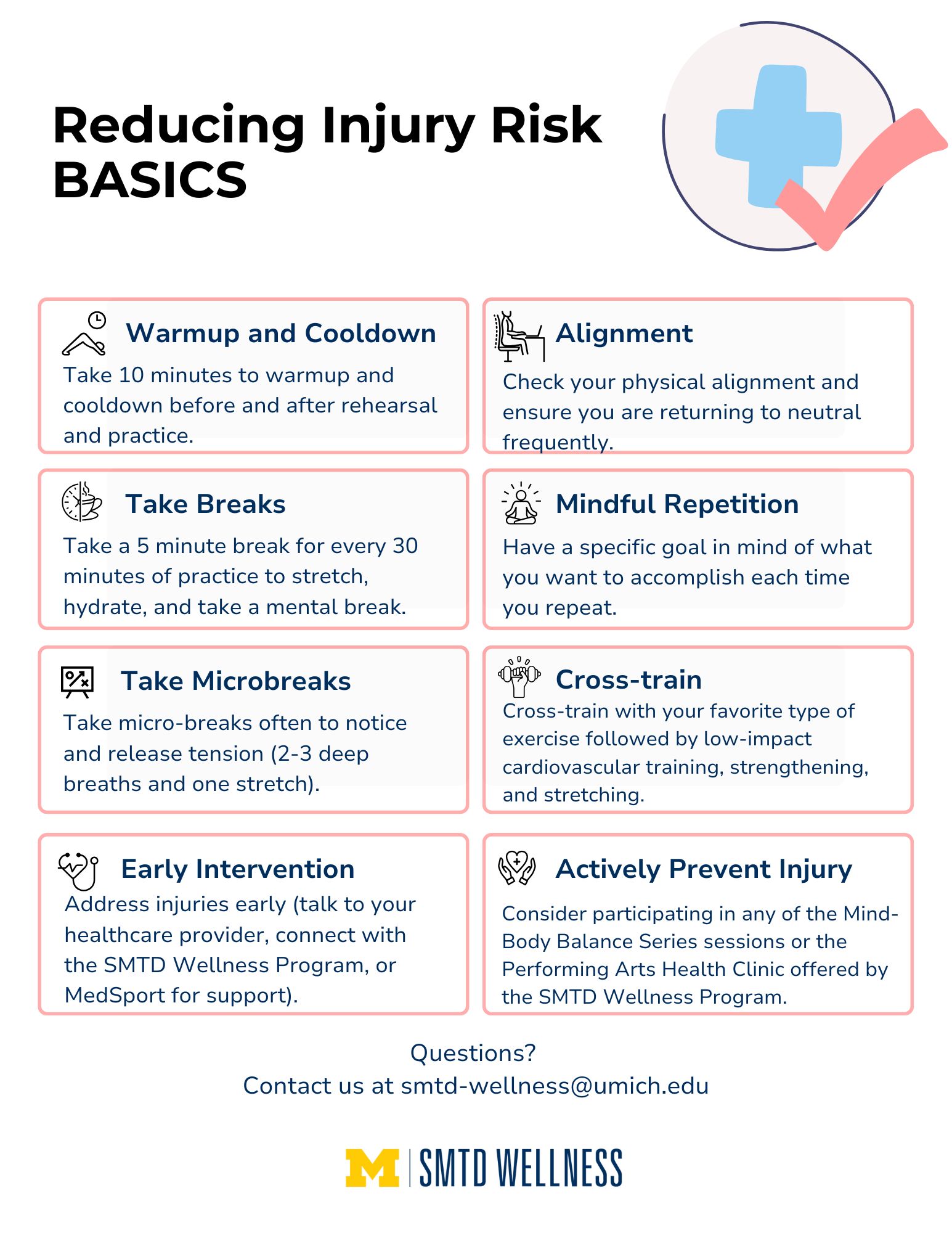
- Warmup and Cooldown: Take 10 minutes to warmup and cooldown before and after rehearsal and practice.
- Alignment: Check your physical alignment and ensure you are returning to neutral frequently.
- Take Breaks: Take a 5 minute break for every 30 minutes of practice to stretch, hydrate, and take a mental break.
- Mindful Repetition: Have a specific goal in mind of what you want to accomplish each time you repeat.
- Take Microbreaks: Take micro-breaks often to notice and release tension (2-3 deep breaths and one stretch).
- Cross-train: Cross-train with your favorite type of exercise followed by low-impact cardiovascular training, strengthening, and stretching.
- Early Intervention: Address injuries early (talk to your healthcare provider, connect with the SMTD Wellness Program, or MedSport for support).
- Actively prevent injury: Consider participating in any of the Mind-Body Balance Series sessions or the Performing Arts Health Clinic offered by the SMTD Wellness Program.
Questions? Contact us at [email protected]
Easy Snacks to Fuel Your Body & Brain
Sherry Lin, MFA, RDN
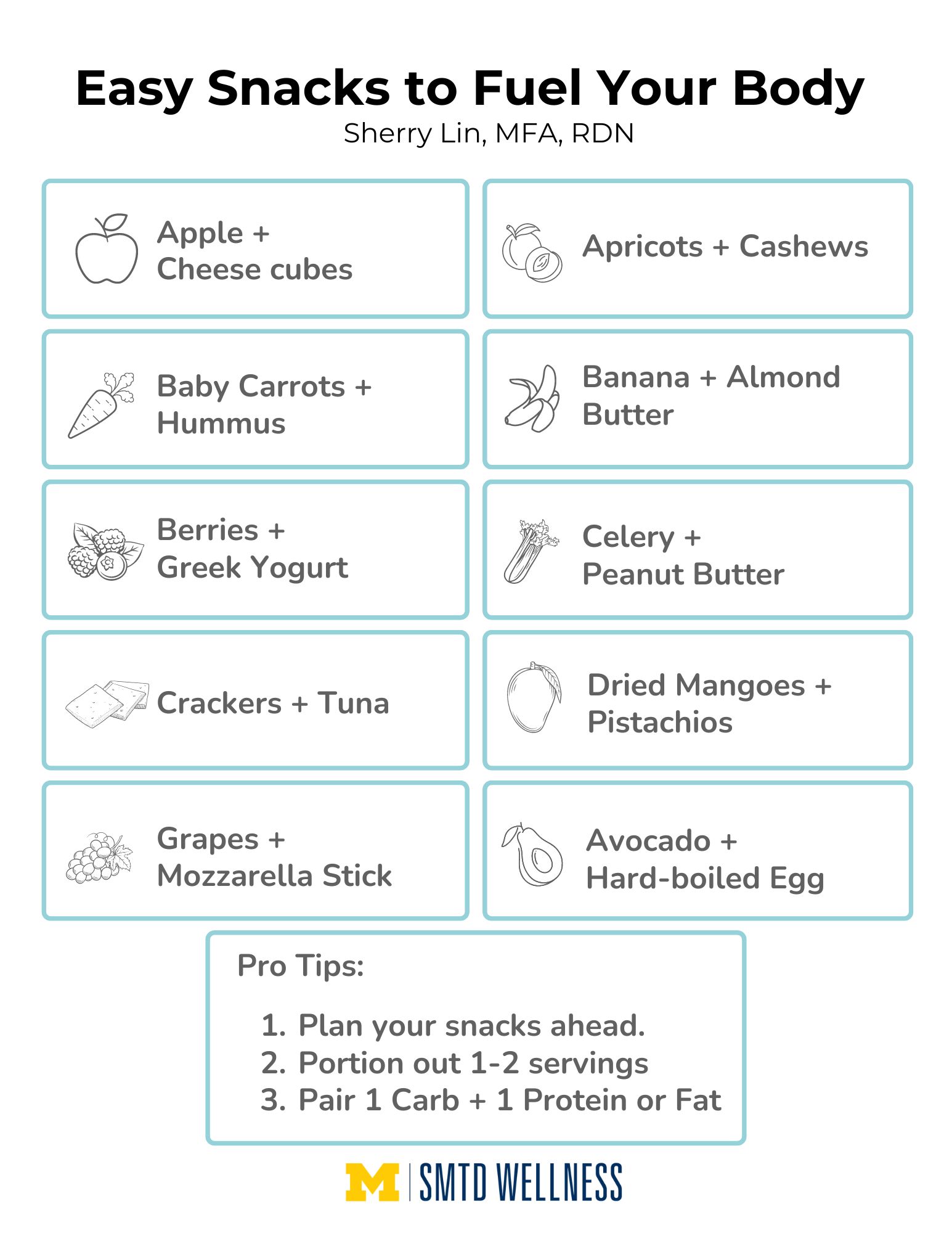
- Apple + Cheese Cubes
- Apricots + Cashews
- Baby Carrots + Hummus
- Banana + Almond Butter
- Berries + Greek Yogurt
- Celery + Peanut Butter
- Crackers + Tuna
- Dried Mangoes + Pistachios
- Grapes + Mozzarella Stick
- Avocado + Hard-boiled egg
Pro Tips:
- Plan your snacks ahead
- Portion out 1-2 servings
- Pair 1 Carb + 1 Protein or Fat
Take a Microbreak
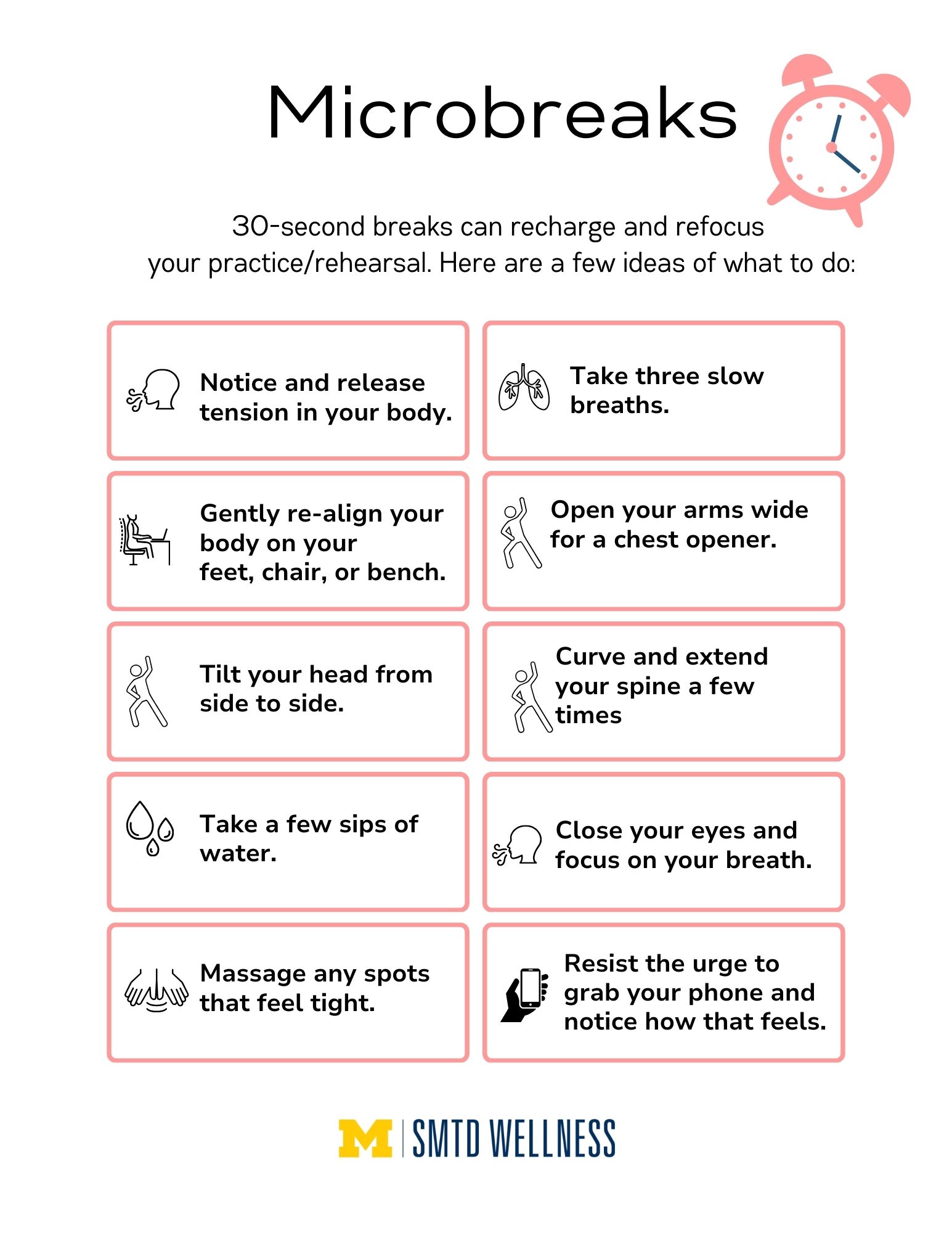
30-second breaks can recharge and refocus your practice/rehearsal. Here are a few ideas of what to do:
- Notice and release tension in your body.
- Take three slow breaths.
- Gently re-align your body on your feet, chair, or bench.
- Open your arms wide for a chest opener.
- Tilt your head from side to side.
- Curve and extend your spine a few times.
- Take a few sips of water
- Close your eyes and focus on your breath.
- Massage any spots that feel tight.
- Resist the urge to check news or social media and notice how that feels.
What to Eat Before and During Performance
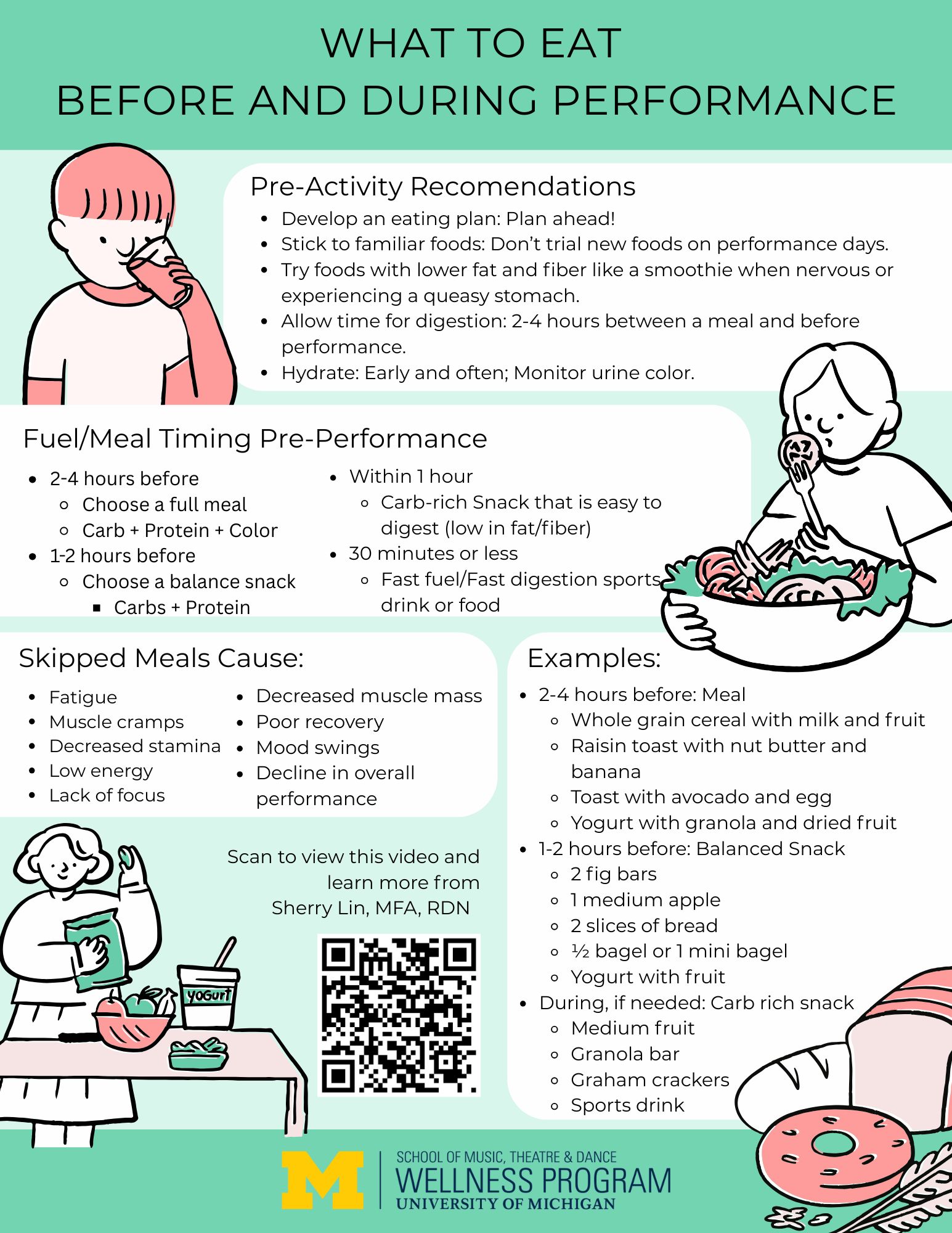
Pre-activity recommendations
- Develop an eating plan
- Plan ahead!
- Stick to familiar foods
- Don’t trial new foods on performance days
- Try foods with lower fat and fiber like a smoothie when nervous or experiencing a queasy stomach
- Allow time for digestion
- 2-4 hours between a meal and before performance
- Hydrate
- Early and often
- Monitor urine color
Fuel/Meal Timing Pre-Performance
- 2-4 hours before
- Choose a full meal
- Carb + Protein + Color
- 1-2 hours before
- Choose a balance snack
- Carbs + Protein
- Choose a balance snack
- Within 1 hour
- Carb-rich Snack
- Easy to digest = low in fat/fiber
- Carb-rich Snack
- 30 minutes or less
- Fast fuel/Fast digestion sports drink or food
Skipped Meals Cause:
- Fatigue
- Muscle cramps
- Decreased stamina
- Low energy
- Lack of focus
- Decreased muscle mass
- Poor recovery
- Mood swings
- Decline in overall performance
Examples
- 2-4 hours before/Meal
- Whole grain cereal with milk and fruit
- Raisin toast with nut butter and banana
- Toast with avocado and egg
- Yogurt with granola and dried fruit
- 1-2 hours before/Balanced Snack
- 2 fig bars
- 1 medium apple
- 2 slices of bread
- ½ bagel or 1 mini bagel
- Yogurt with fruit
- English muffin
- During if needed/Carb rich snack
- Medium fruit
- Granola bar
- Graham crackers
- Sports drink
View this video to learn more from Sherry Lin, MFA, RDN.
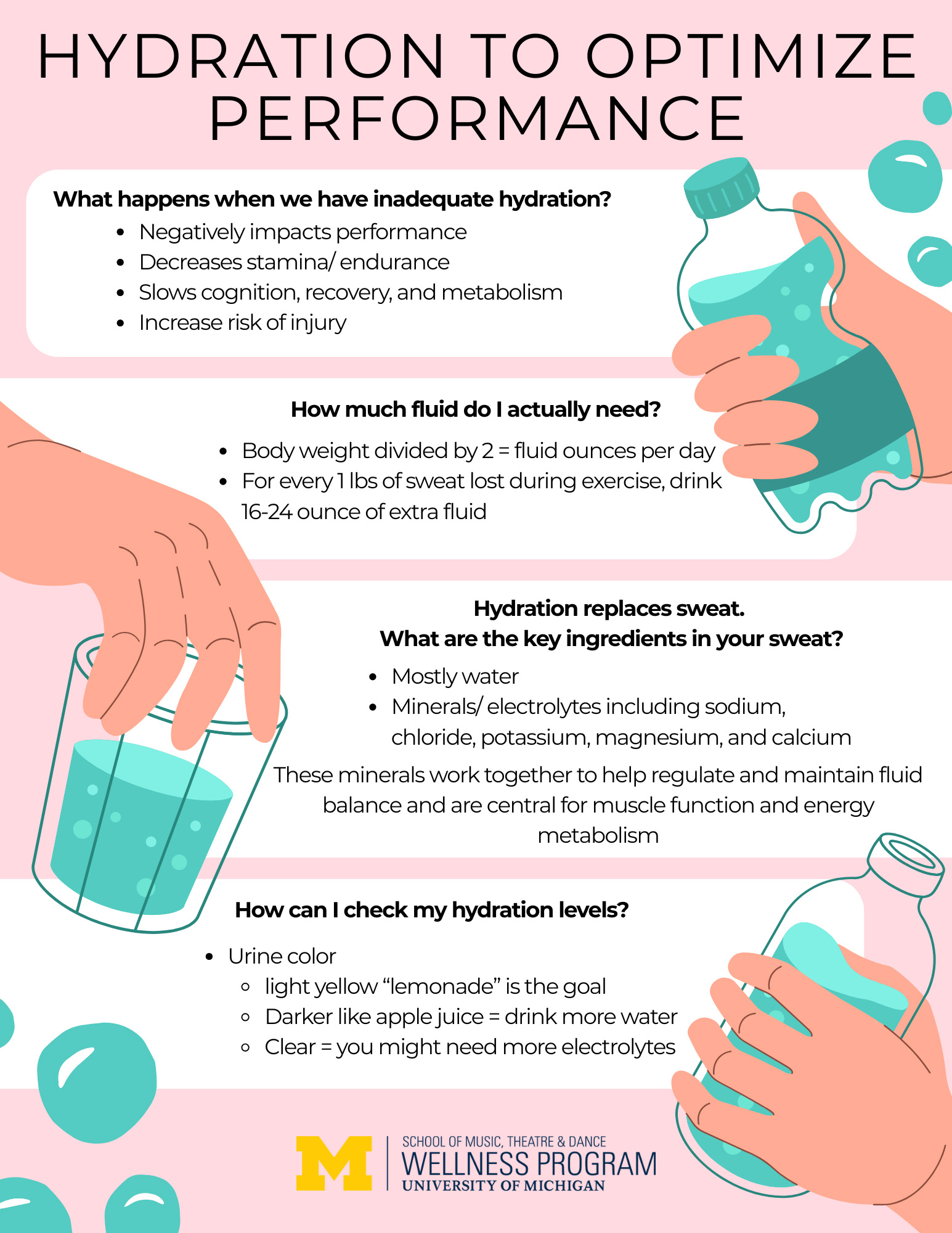
Hydration to Optimize Performance
What happens when we have inadequate hydration?
- Negatively impacts performance
- Decreases stamina/endurance
- Slows cognition, recovery and metabolism
- Increase risk of injury
How much fluid do I actually need?
- Body weight divided by 2 = fluid ounces per day
- For every 1 lbs of sweat lost during exercise, drink 16-24 ounce of extra fluid
Hydration is essentially replacing sweat. What are key ingredients in your sweat?
- Mostly Water
- Minerals/Electrolytes
- Sodium
- Chloride
- Potassium
- Magnesium
- Calcium
These minerals work together to help regulate and maintain fluid balance and are central for muscle function and energy metabolism.
How can I check my hydration levels?
- Urine color
- Light yellow “lemonade” is the goal
- Darker like apple juice=drink more water
- Clear=you might need more electrolytes
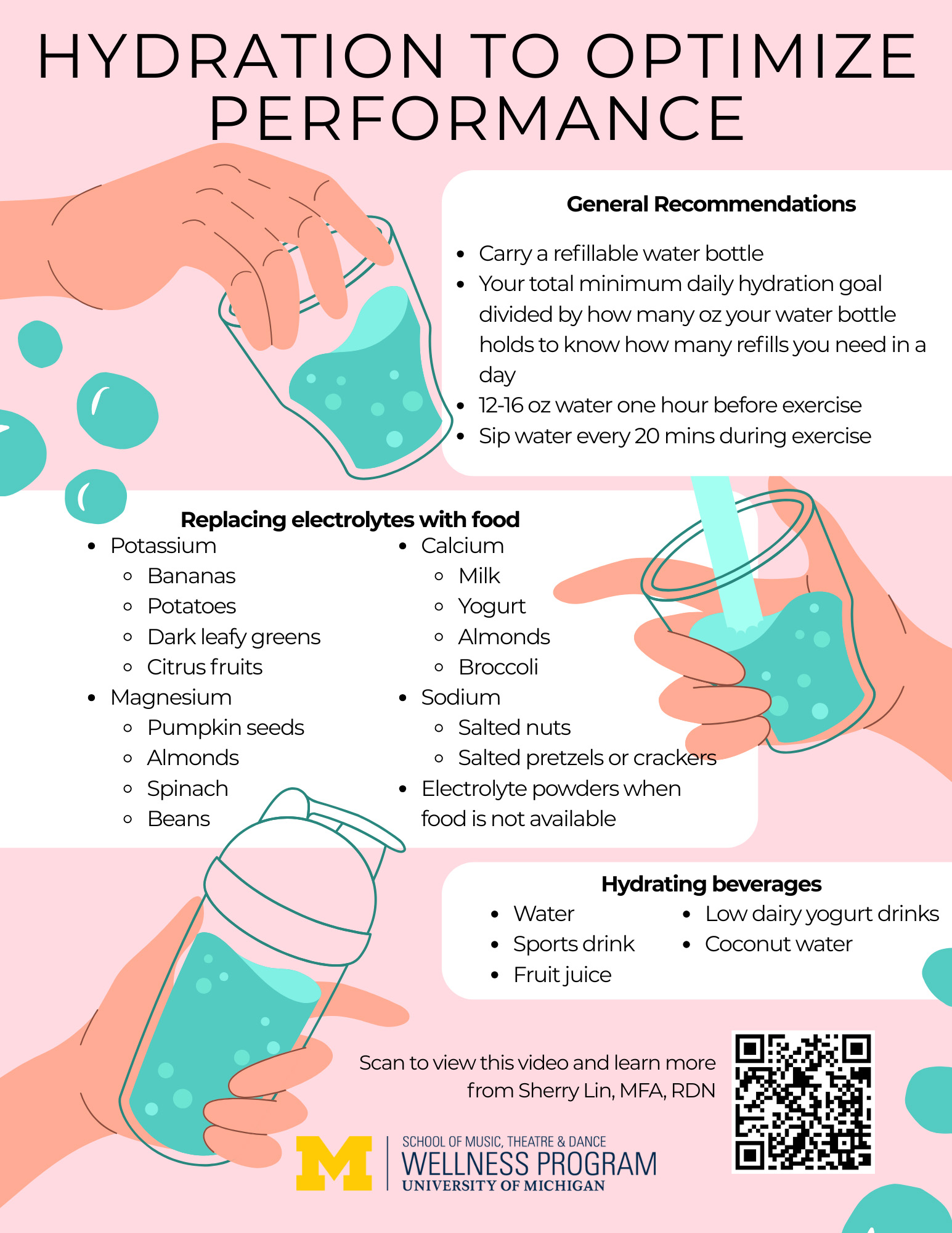
General Recommendations
- Carry a refillable water bottle
- Your total minimum daily hydration goal divided by how many ounces your water bottle holds to know how many refills you need in a day
- 12-16 ounces water one hour before exercise
- Sip water every 20 minutes during exercise
Replacing electrolytes with food
- Sodium
- Salted nuts
- Salted pretzels/crackers
- Potassium
- Bananas
- Potatoes
- Dark leafy greens
- Citrus fruits
- Magnesium
- Pumpkin seeds
- Almonds
- Peanut butter
- Spinach
- Beans
- Calcium
- Milk
- Yogurt
- Almonds
- Broccoli
- Electrolyte powders can be a helpful tool when food is not available
Hydrating beverages
- Water
- Sports drinks
- Fruit juice
- Low dairy yogurt drinks
- Coconut water
View this video to learn more from Sherry Lin, RDN, MFA
Warm Up & Cooldown – Accessible Text
Info on WHY you should be doing BOTH to prevent injury and make you a better performer!
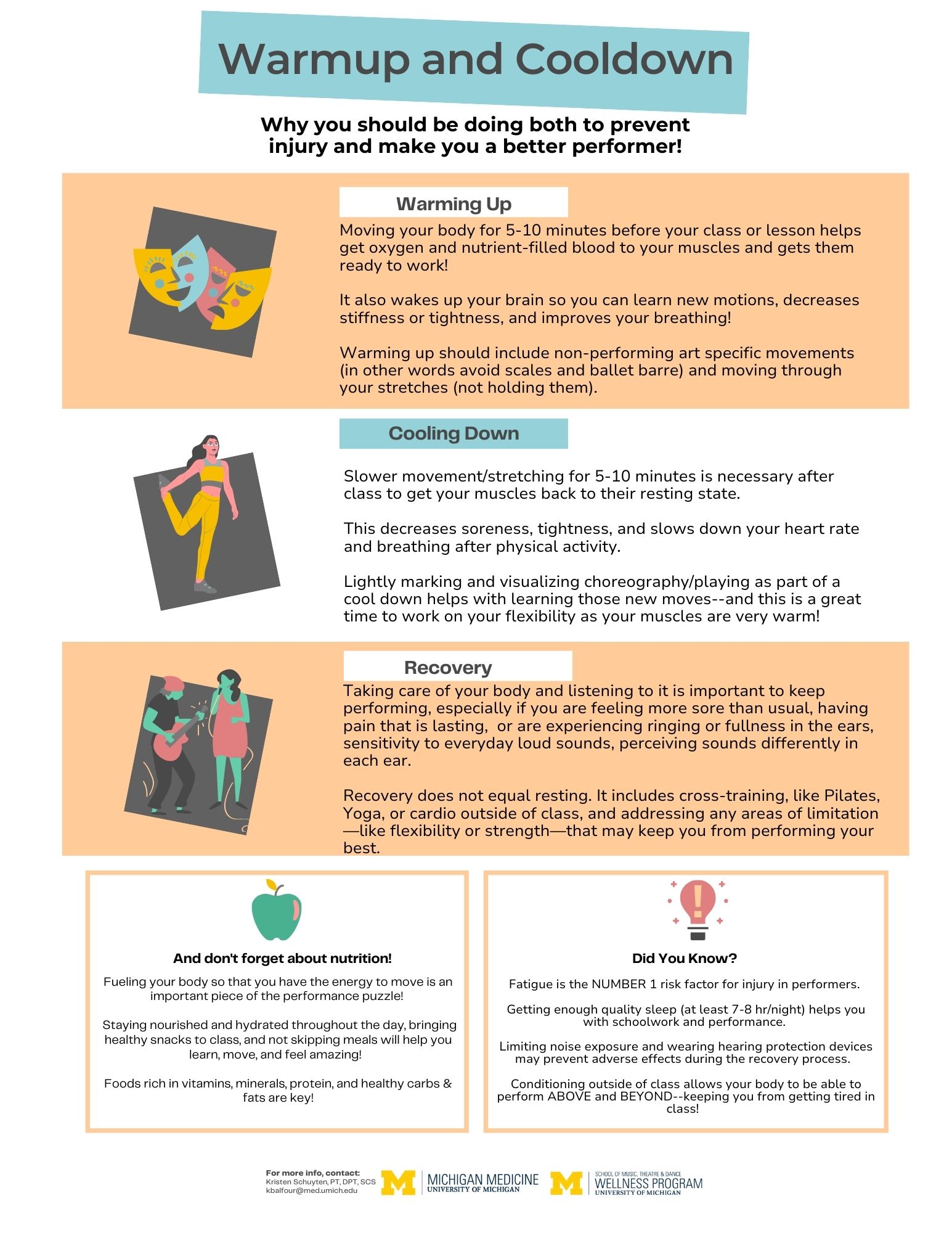
Warmup and Cooldown
Why you should be doing both to prevent injury and make you a better performer!
Warming Up
Moving your body for 5-10 minutes before your class or lesson helps get oxygen and nutrient-filled blood to your muscles and gets them ready to work!
It also wakes up your brain so you can learn new motions, decreases stiffness or tightness, and improves your breathing.
Warming up should include non-performing art specific movements (in other words avoid scales and ballet barre) and moving through your stretches (not holding them).
Cooling Down
Slower movement/stretching for 5-10 minutes is necessary after class to get your muscles back to their resting state.
This decreases soreness, tightness, and slows down your heart rate and breathing after physical activity.
Lightly marking and visualizing movement as part of a cool down helps with learning those new moves--and this is a great time to work on your flexibility as your muscles are very warm!
Recovery
Taking care of your body and listening to it is important to keep performing, especially if you are feeling more sore than usual, having pain that is lasting, or are experiencing ringing or fullness in the ears, sensitivity to everyday loud sounds, perceiving sounds differently in each ear.
Recovery does not equal resting. It includes cross-training, like Pilates, Yoga, or cardio outside of class, and addressing any areas of limitation—like flexibility or strength—that may keep you from performing your best.
And don’t forget about Nutrition!
Fueling your body so that you have the energy to move is an important piece of the performance puzzle!
Staying nourished and hydrated throughout the day, bringing healthy snacks to class, and not skipping meals will help you learn, move, and feel amazing!
Foods rich in vitamins, minerals, protein, and healthy carbs & fats are key!
Did you know?
Fatigue is the NUMBER 1 risk factor for injury in performers.
Getting enough quality sleep (at least 7-8 hours/night) helps you with schoolwork and performance.
Limiting noise exposure and wearing hearing protection devices may prevent adverse effects during the recovery process.
Conditioning outside of class allows your body to be able to perform ABOVE and BEYOND--keeping you from getting tired in class!
For more info, contact:
Kristen Schuyten, PT, DPT, SCS
[email protected]
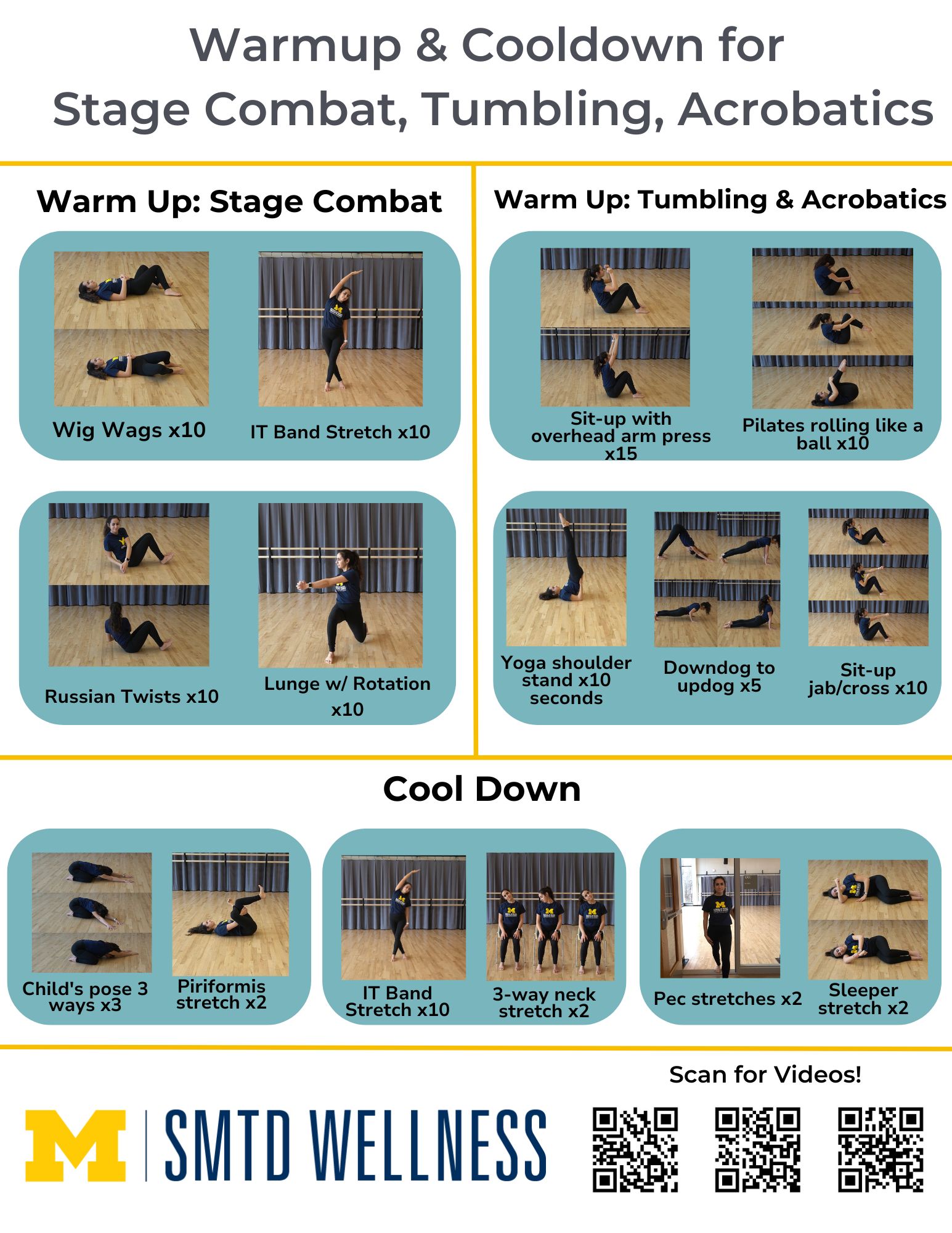
Warm up/Cool Down for Stage Combat, Tumbling, Acrobatics
Warm Up: Stage Combat
- Wig Wags x10
- IT Band Stretch x10
- Russian Twists x10
- Lunge with Rotation x10
Warm Up: Tumbling & Acrobatics
- Sit up with overhead arm press x15
- Pilates rolling like a ball x10
- Yoga shoulder stand x10 seconds
- Downdog to updog x5
- St-up jab/cross x10
Cool Down
- Child’s pose 2 ways x3
- Piriformis stretch x2
- IT Band Stretch x10
- 3-way neck stretch x2
- Pec stretches x2
- Sleeper stretch x2
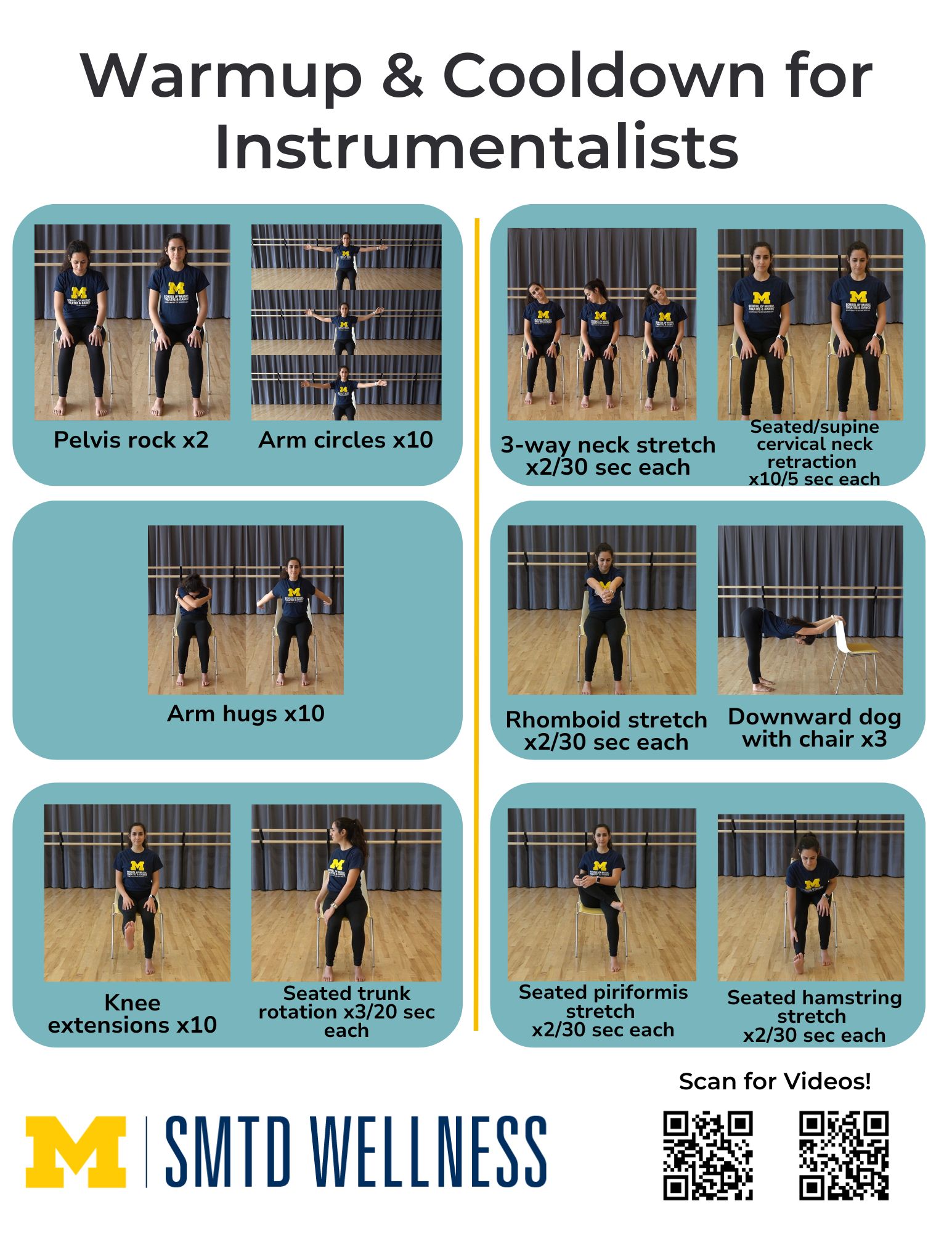
Warm up/ Cool down for Instrumentalists
Pelvis rock x2
Arm circles x10
Arm hugs x10
Knee extensions x10
Seated trunk rotation x3/20 sec each
3-way neck stretch x2/30 sec each
Seated/supine cervical neck retraction x10/5 sec each
Rhomboid stretch x2/30 sec each
Downward doc with chair x3
Seated piriformis stretch x2/30 sec each
Seated hamstring stretch x2/30 sec each
Quick Warmup for Instrumentalists: https://youtu.be/IBQBVYTO7Ok?si=Epvem1M_NrfmTktj
Quick Cooldown for Instrumentalists: https://youtu.be/_ZKqfz0s_hM?si=dzVhNbk7pSzvsePh
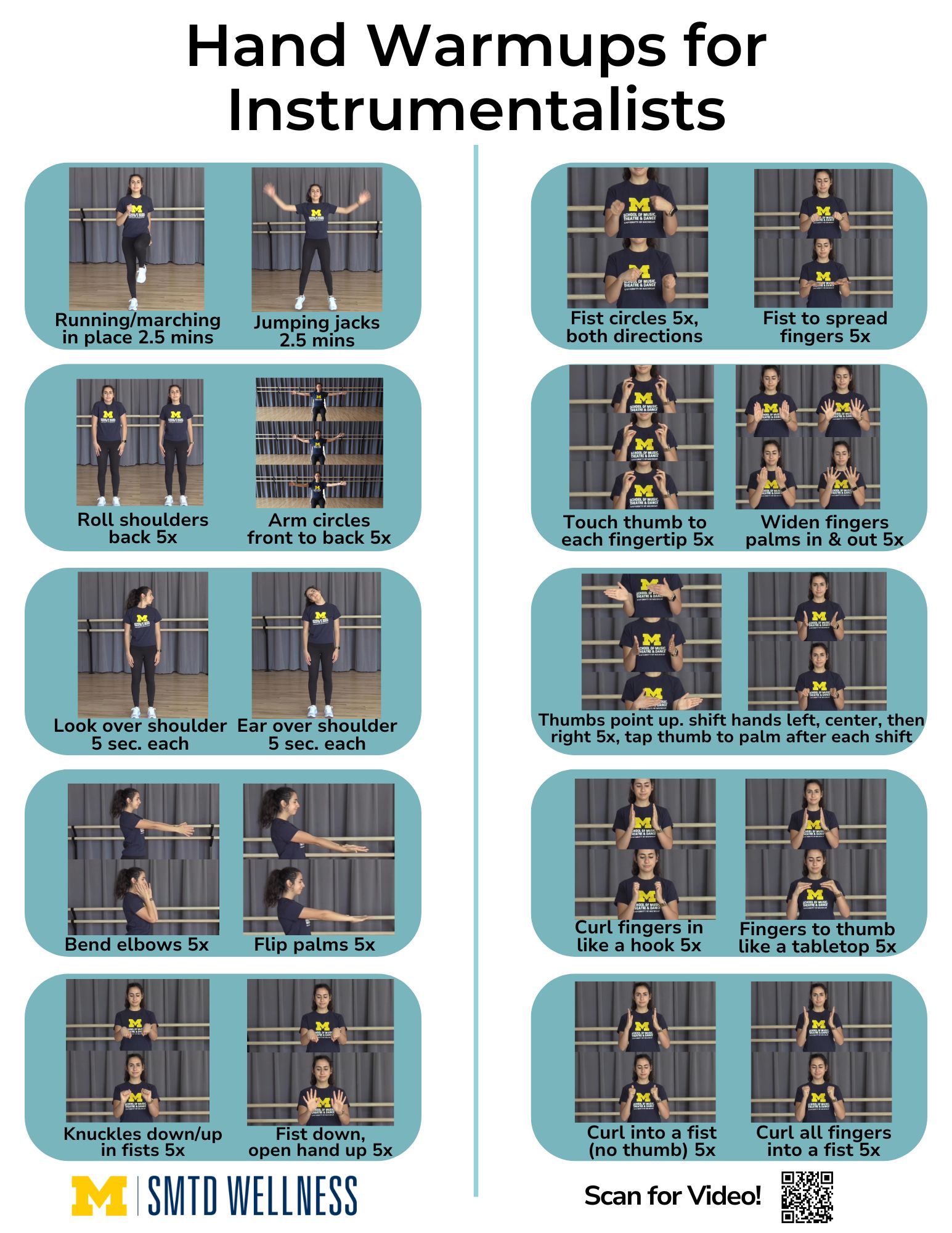
Hand Warm Ups for Instrumentalists
Running/marching in place 2.5 mins
Jumping jacks 2.5 mins
Roll shoulders back 5x
Arm circles front to back 5x
Look over shoulder 5 sec. each
Ear over shoulder 5 sec. Each
Bend elbows 5x
Flip palms 5x
Knuckles down/up in fists 5x
Fist down, open hand up 5x
First circles 5x, both directions
Fist to spread fingers 5x
Touch thumb to each fingertip 5x
Widen fingers palms in & out 5x
Thumbs point up, shift hands left, center, then right 5x, tap thumb to palm after each shift
Curl fingers in like a hook 5x
Fingers to thumb like a tabletop 5x
Curl into a fist (no thumb) 5x
Curl all fingers into a fist 5x
Video link: https://www.youtube.com/watch?v=CMQxS5YxFPM&list=PLVy2jdQD7GRzQ2_q6dTb6ojLoh28DEnfa&index=19
Quick Band Warmup
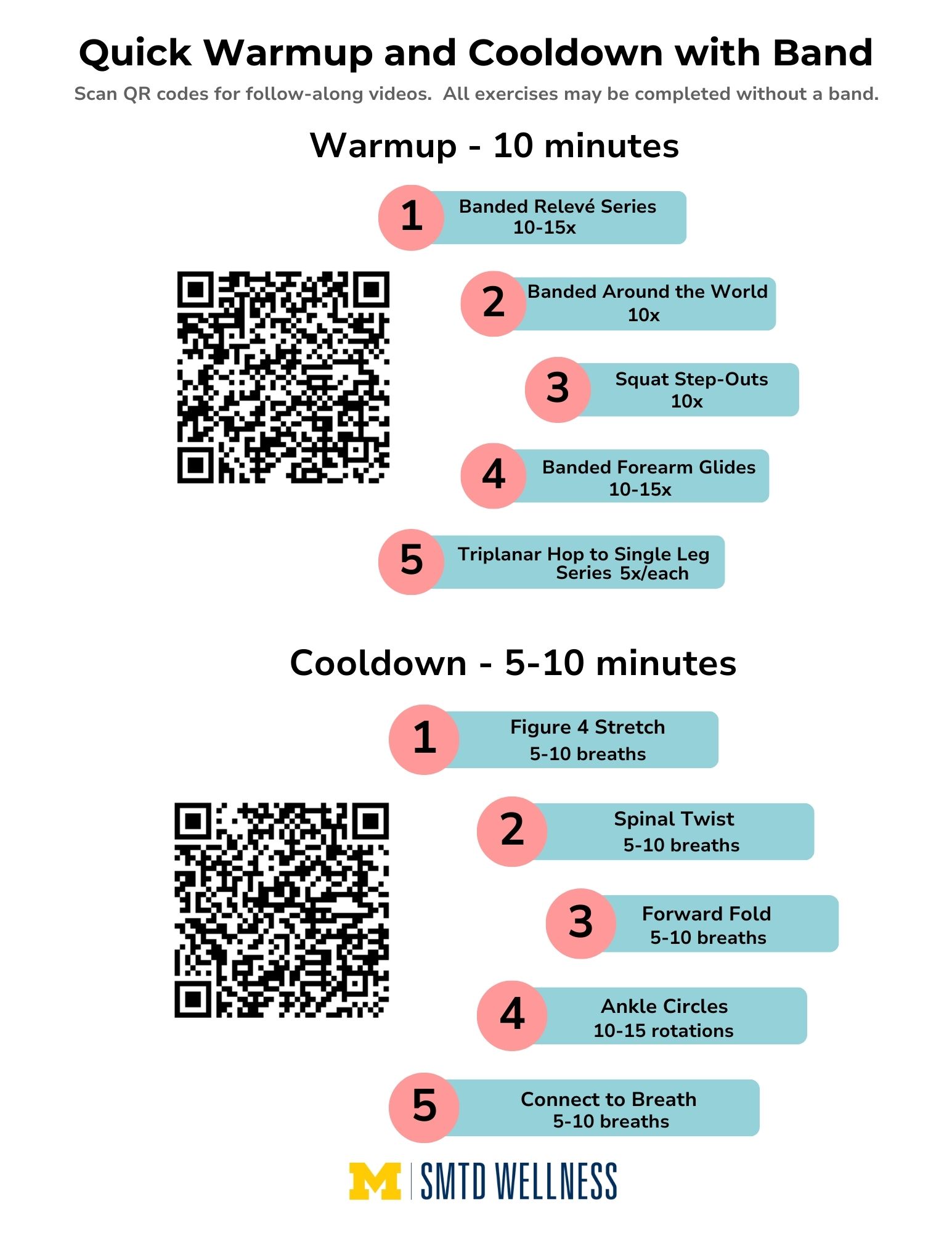
Scan QR codes for follow-along videos. All exercises may be completed without a band.
Warmup - 10 minutes
- Banded Releve Series 10-15x
- Banded Around the World 10x
- Squat Step Outs 10x
- Banded Forearm Glides 10-15x or 10 pushups if without a band
- Triplanar Hop to Single leg series 5x each
Video Link: Quick Band Warm Up
Cooldown 5-10 minutes
- Figure 4 Stretch 5-10 breaths
- Spinal Twist 5-10 breaths
- Forward Bend 5-10 breaths
- Ankle Circles 10-15 each way
- Connect to breath 5-10 breath cycles
Video Link: Simple Cooldown
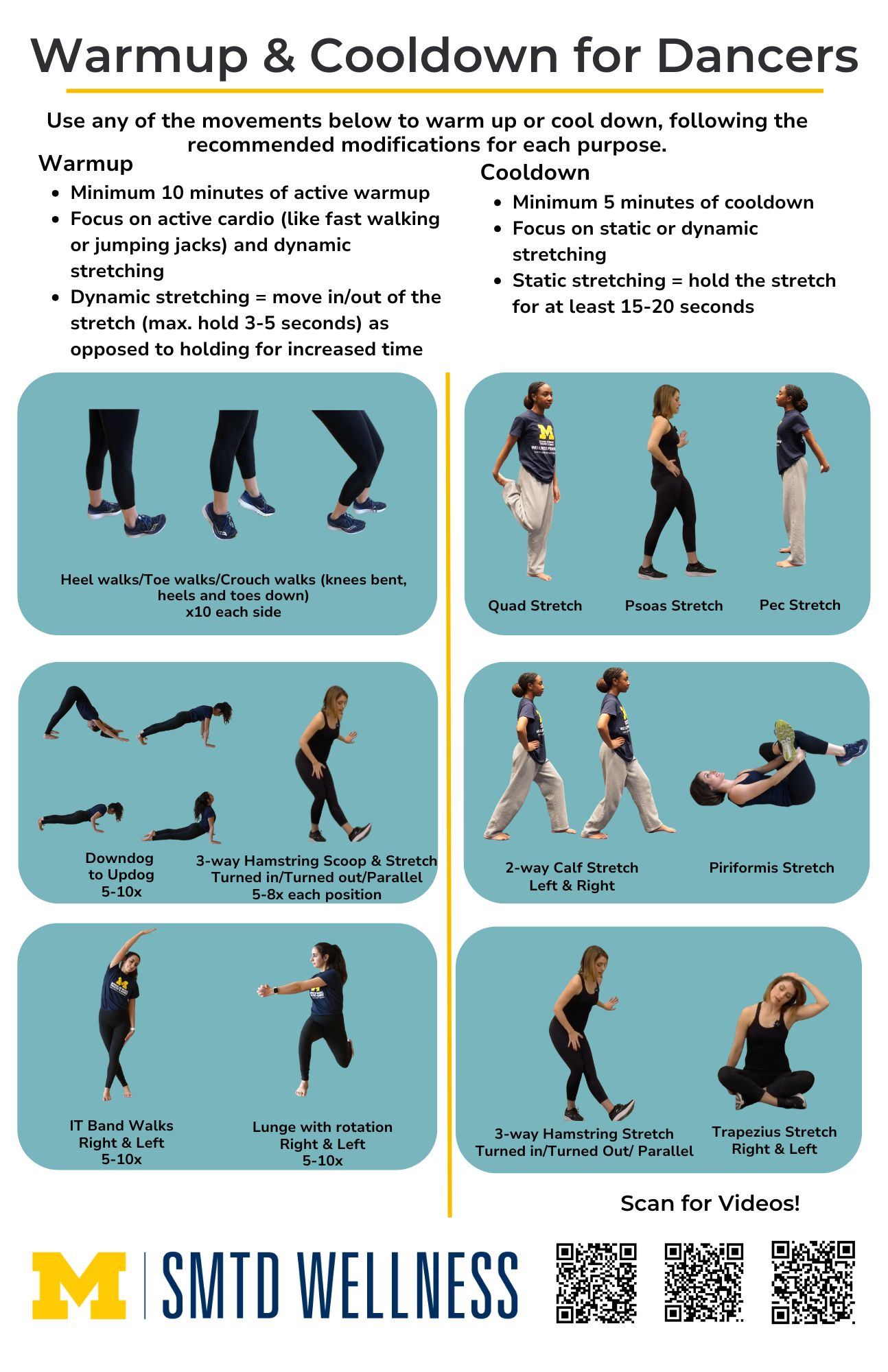
Warmup and Cooldown for Dancers
Use any of the movements below to warm up or cool down, following the recommended modifications for each purpose
Warmup
- Minimum 10 minutes of active warmup
- Focus on active cardio (like fast walking or jumping jacks) and dynamic stretching
- Dynamic stretching = move in/out of the stretch (max. hold 3-5 seconds) as opposed to holding for increased time
Heel walks/Toe walks/Crouch walks (knees bent, heels and toes down) x10 each side
Downdog to Updog 5-10x
3-way Hamstring Scoop & Stretch, Turned in/Turned out/Parallel 5-8x each position
IT Band walks right and left 5-10x
Lunge with rotation right and left 5-10x
Cooldown
- Minimum 5 minutes of cooldown
- Focus on static or dynamic stretching
- Static stretching = hold the stretch for at least 15-20 seconds
Quad Stretch
Psoas Stretch
Pec Stretch
2-way Calf Stretch left and right
Piriformis Stretch
3-Way Hamstring Stretch Turned in/Turned out/Parallel
Trapezius Stretch right and left
When to Use Ice, When to Use Heat
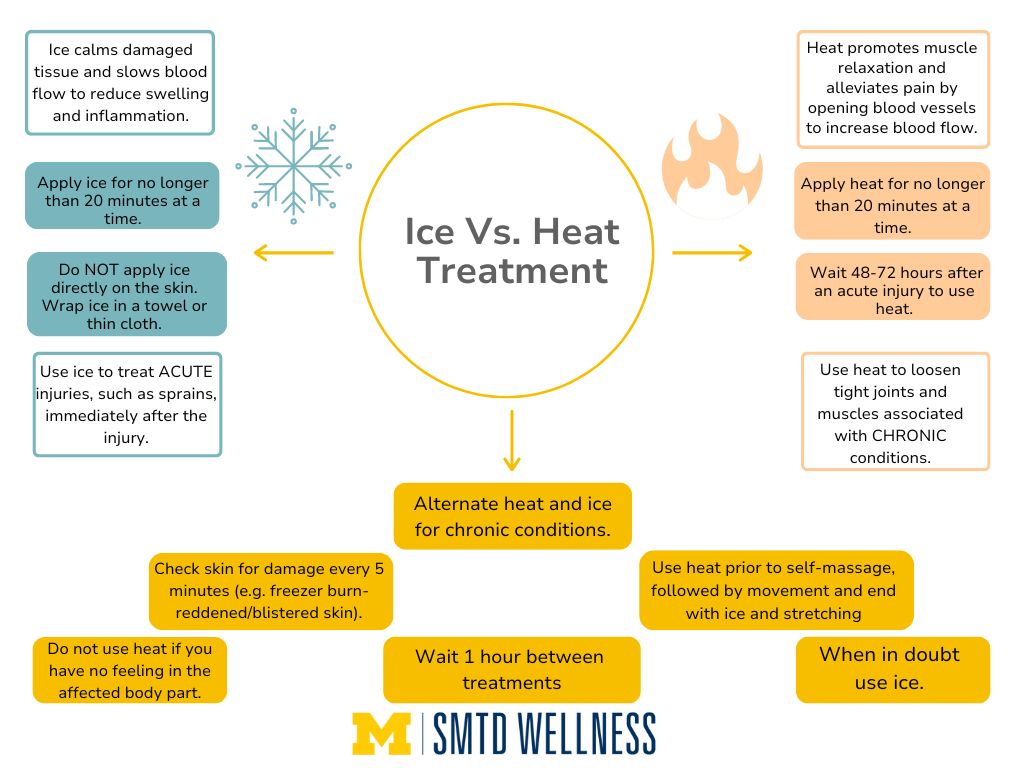
Ice vs. heat Treatment
ICE
- Ice calms damaged tissue and slows blood flow to reduce swelling and inflammation.
- Apply ice for no longer than 20 minutes at a time.
- Do NOT apply ice directly on the skin. Wrap ice in a towel or thin cloth.
- Use ice to treat ACUTE injuries, such as sprains, immediately after the injury.
HEAT
- Heat promotes muscle relaxation and alleviates pain by opening blood vessels to increase blood flow.
- Apply heat for no longer than 20 minutes at a time.
- Wait 48-72 hours after an acute injury to use heat.
- Use heat to loosen tight joints and muscles associated with CHRONIC conditions.
Additional information
- Alternate heat and ice for chronic conditions.
- Check skin for damage every 5 minutes (i.e. freezer burn-reddened/blistered skin).
- Do not use heat if you have no feeling in the affected body part.
- Use heat prior to self-massage, followed by movement and end with ice and stretching.
- When in doubt, use ice.
- Wait 1 hour in-between treatments.
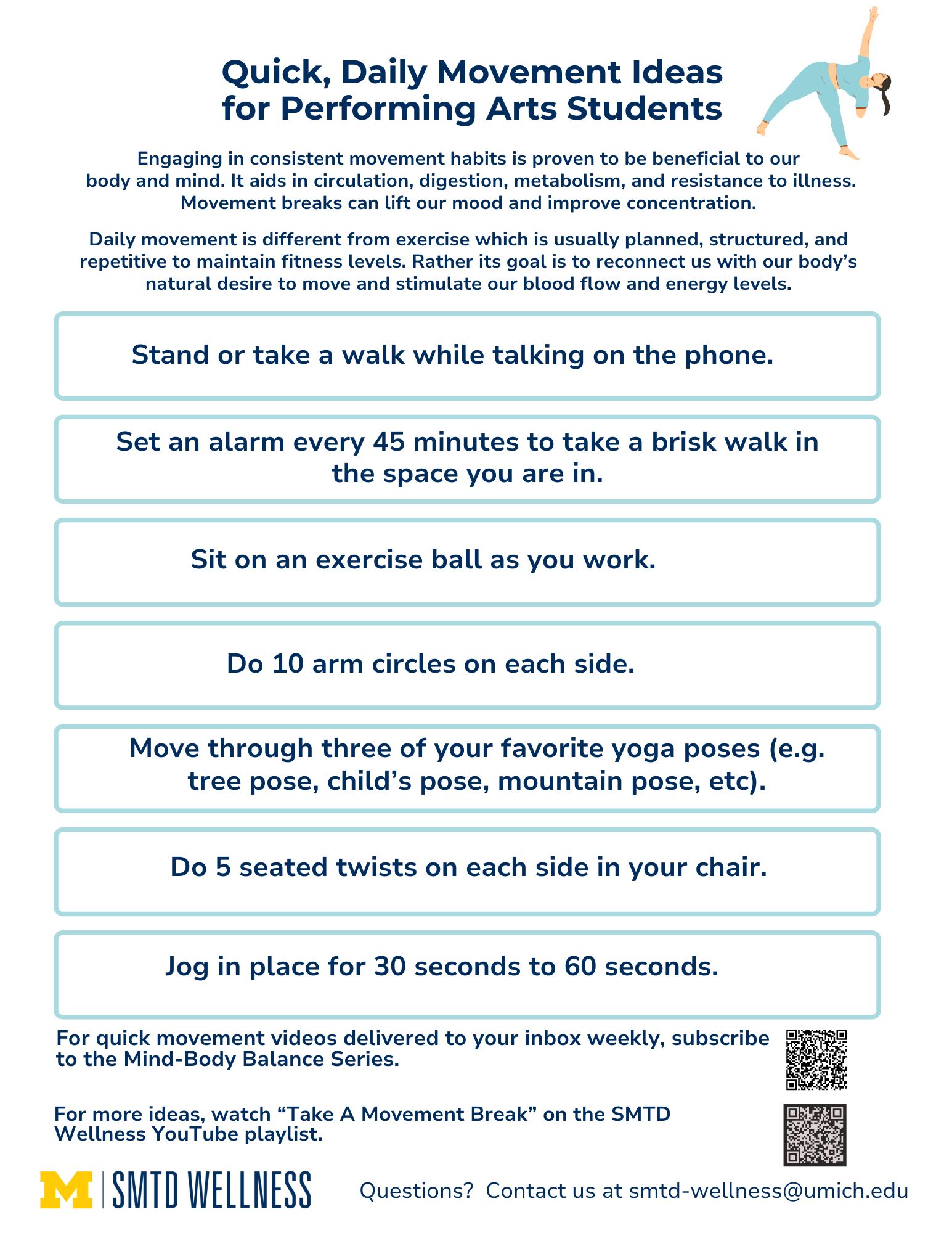
Quick, Daily Movement Ideas for Performing Artists
Engaging in consistent movement habits is proven to be beneficial to our body and mind. It aids in circulation, digestion, metabolism, and resistance to illness. Movement breaks can lift our mood and improve concentration.
Daily movement is different from exercise which is usually planned, structured, and repetitive to maintain fitness levels. Rather its goal is to reconnect us with our body’s natural desire to move and stimulate our blood flow and energy levels.
- Stand or take a walk while talking on the phone.
- Set an alarm every 45 minutes to take a brisk walk in the space you are in.
- Sit on an exercise ball as you work.
- Do 10 arm circles on each side.
- Move through three of your favorite yoga poses (e.g. tree pose, child’s pose, mountain pose, etc).
- Do 5 seated twists on each side in your chair.
- Jog in place for 30 seconds to 60 seconds.
For quick movement videos delivered to your inbox weekly, subscribe to the Mind-Body Balance Series.
For more ideas, watch “Take A Movement Break” on the SMTD Wellness YouTube playlist.
Questions? Contact us at [email protected]
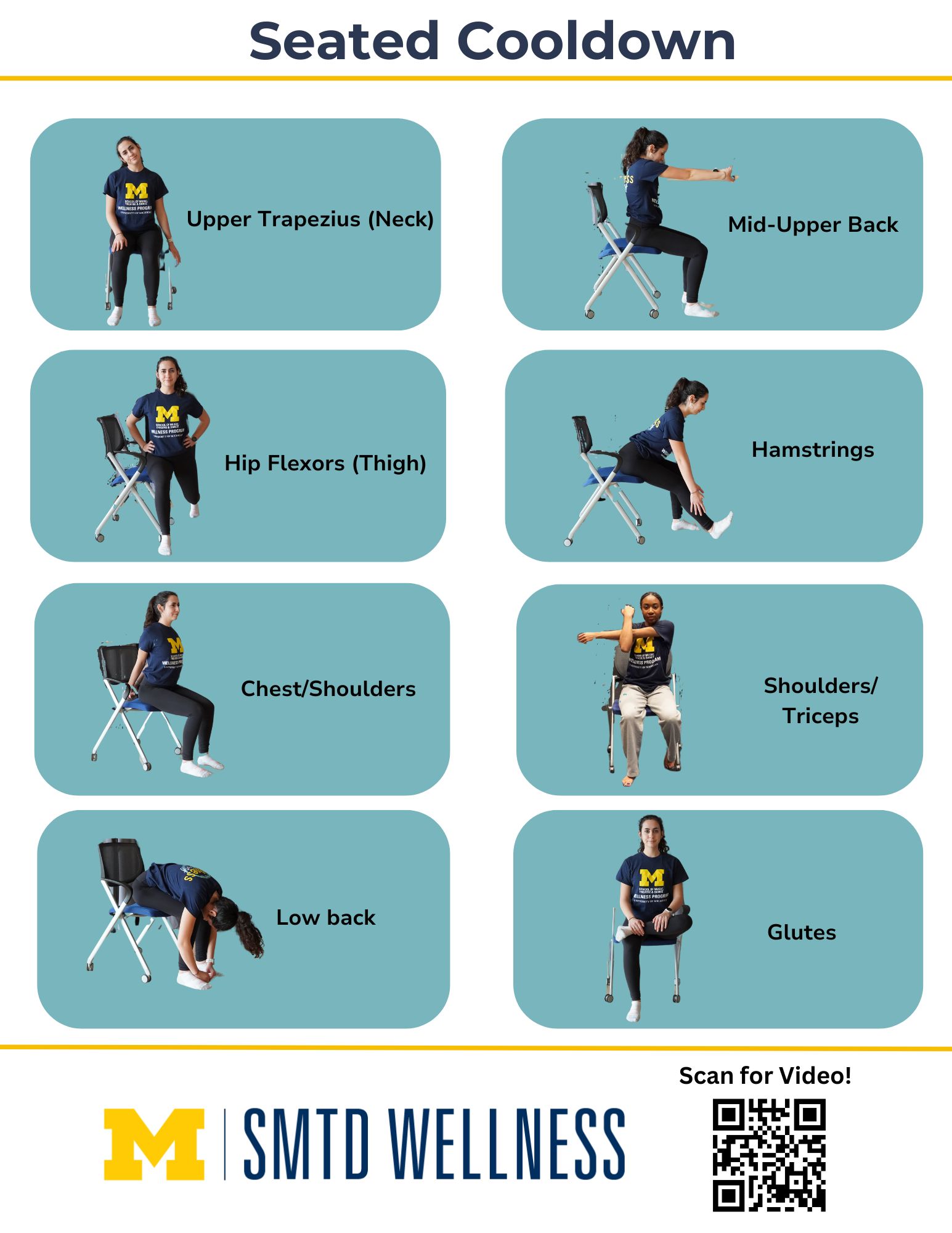
Seated Cooldown
Upper Trapezius (Neck)
Mid-Upper Back
Hip Flexors (Thigh)
Hamstrings
Chest/Shoulders
Shoulders/Triceps
Low Back
Glutes
Video link: https://www.youtube.com/watch?v=VPz-ZfvFm9o&list=PLVy2jdQD7GRzQ2_q6dTb6ojLoh28DEnfa&index=7
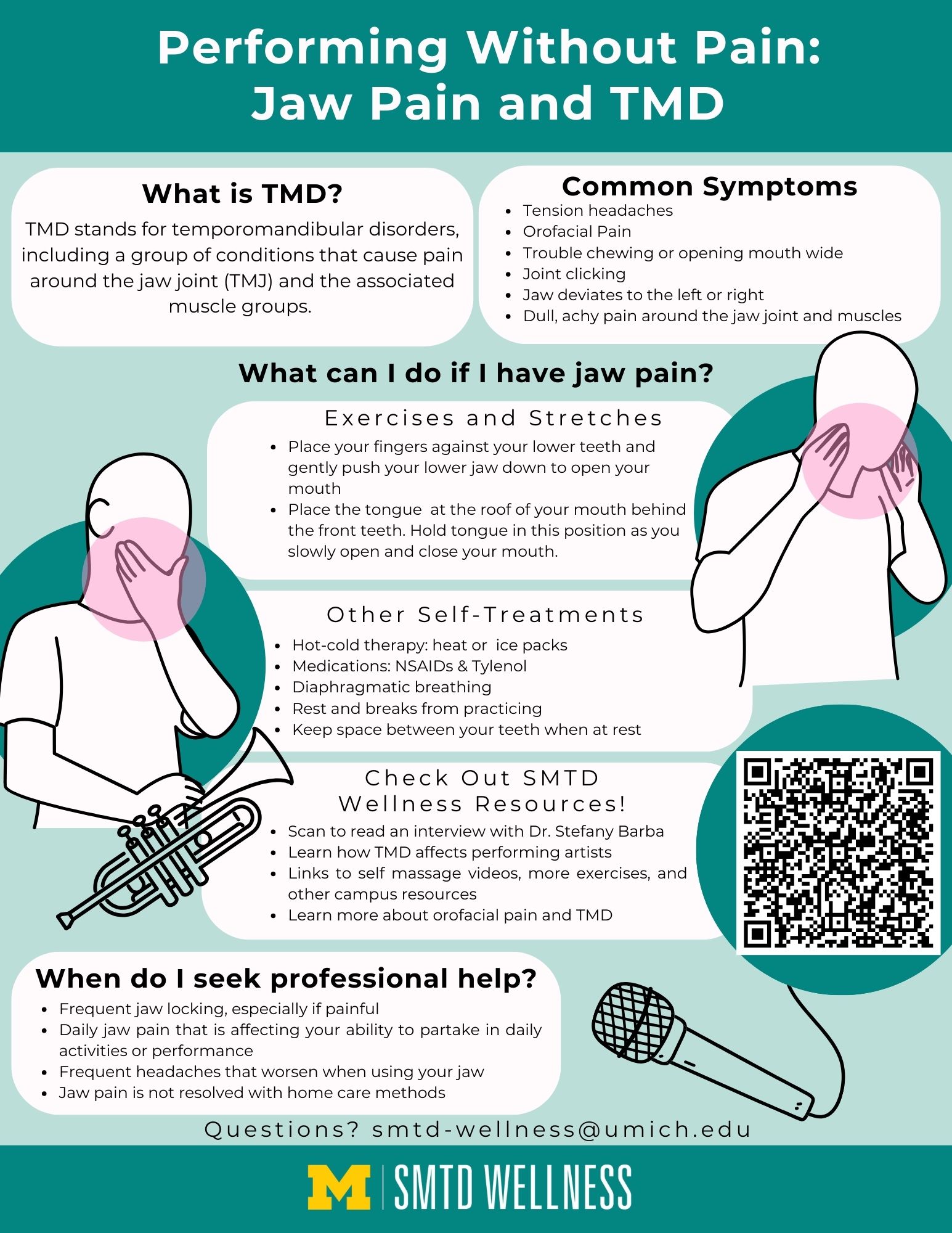
What is TMD?
TMD stands for temporomandibular disorders, including a group of conditions that cause pain around the jaw joint (TMJ) and the associated muscle groups.
Common Symptoms
- Tension headaches
- Orofacial Pain
- Trouble chewing or opening mouth wide
- Joint clicking
- Jaw deviates to the left or right
- Dull, achy pain around the jaw joint around the jaw joint and muscles
What can I do if I have jaw pain?
Exercises and Stretches
- Place your fingers against your lower teeth and gently push your lower jaw down to open your mouth.
- Place the tongue at the roof of your mouth behind the front teeth. Hold tongue in this position as you slowly open and close your mouth
Other Self-Treatments
- Hot-cold therapy: heat or ice packs
- Medications: NSAIDs & Tylenol
- Diaphragmatic breathing
- Rest and breaks from practicing
- Keep space between your teeth when at rest
Check Out SMTD Wellness Resources!
- Read an interview with Dr. Stefany Barba
- Learn how TMD affects performing artists
- Links to self-massage videos, more exercises, and other campus resources
- Learn more about orofacial pain and TMD
When do I seek professional help?
- Frequent jaw locking, especially if painful
- Daily jaw pain that is affecting your ability to partake in daily activities or performance
- Frequent headaches that worsen when using your jaw
- Jaw pain is not resolved with home care methods
Questions? [email protected]
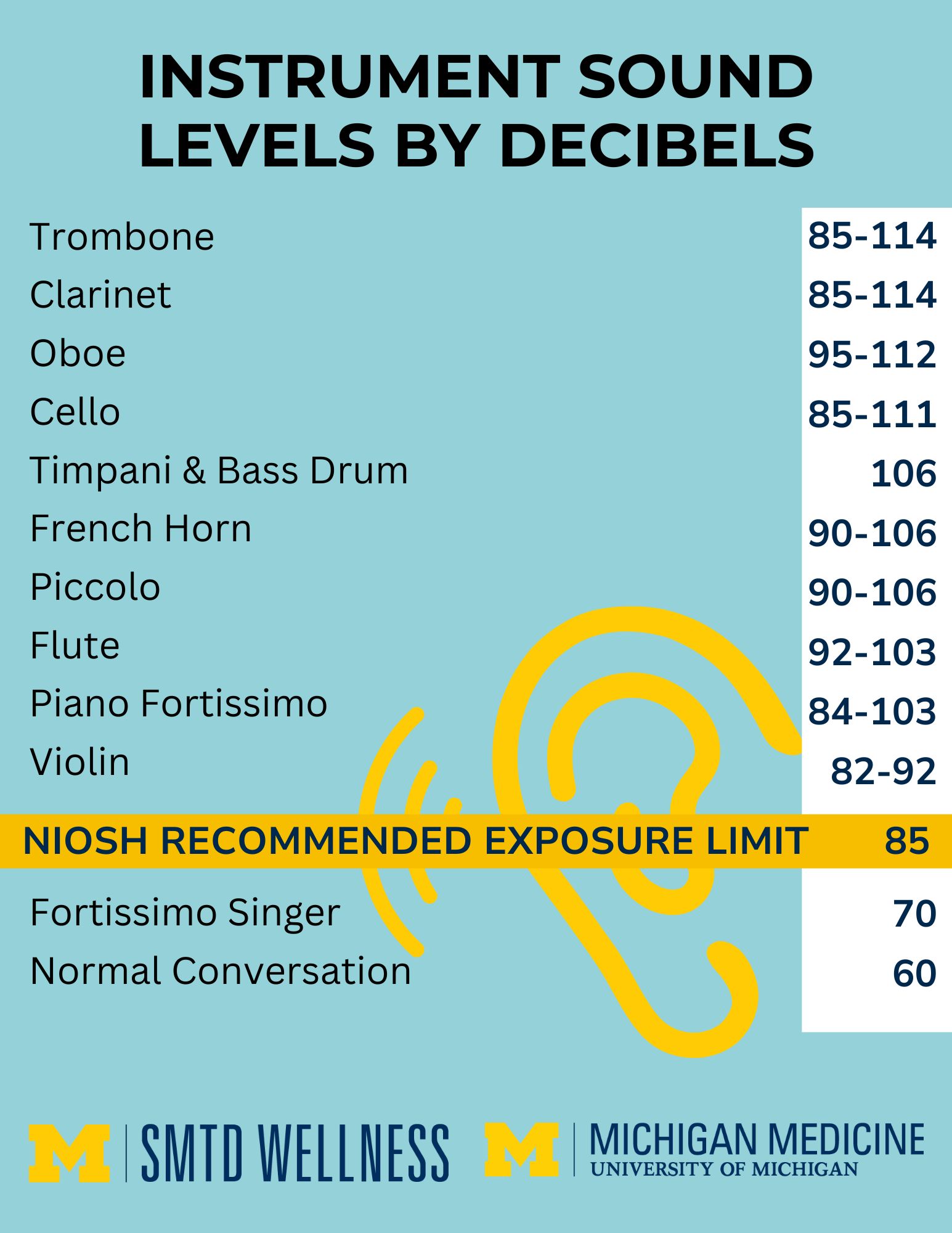
Instrument Sound Levels by Decibels
Trombone - 85-114
Clarinet - 85-114
Oboe - 95-112
Cello - 85-111
Timpani & Bass Dru - 106
French Horn - 90-106
Piccolo - 90-106
Flute - 92-103
Piano Fortissimo - 94-103
Violin - 82-92
NIOSH RECOMMENDED EXPOSURE LIMIT - 85
Fortissimo Singer - 70
Normal Conversation - 60
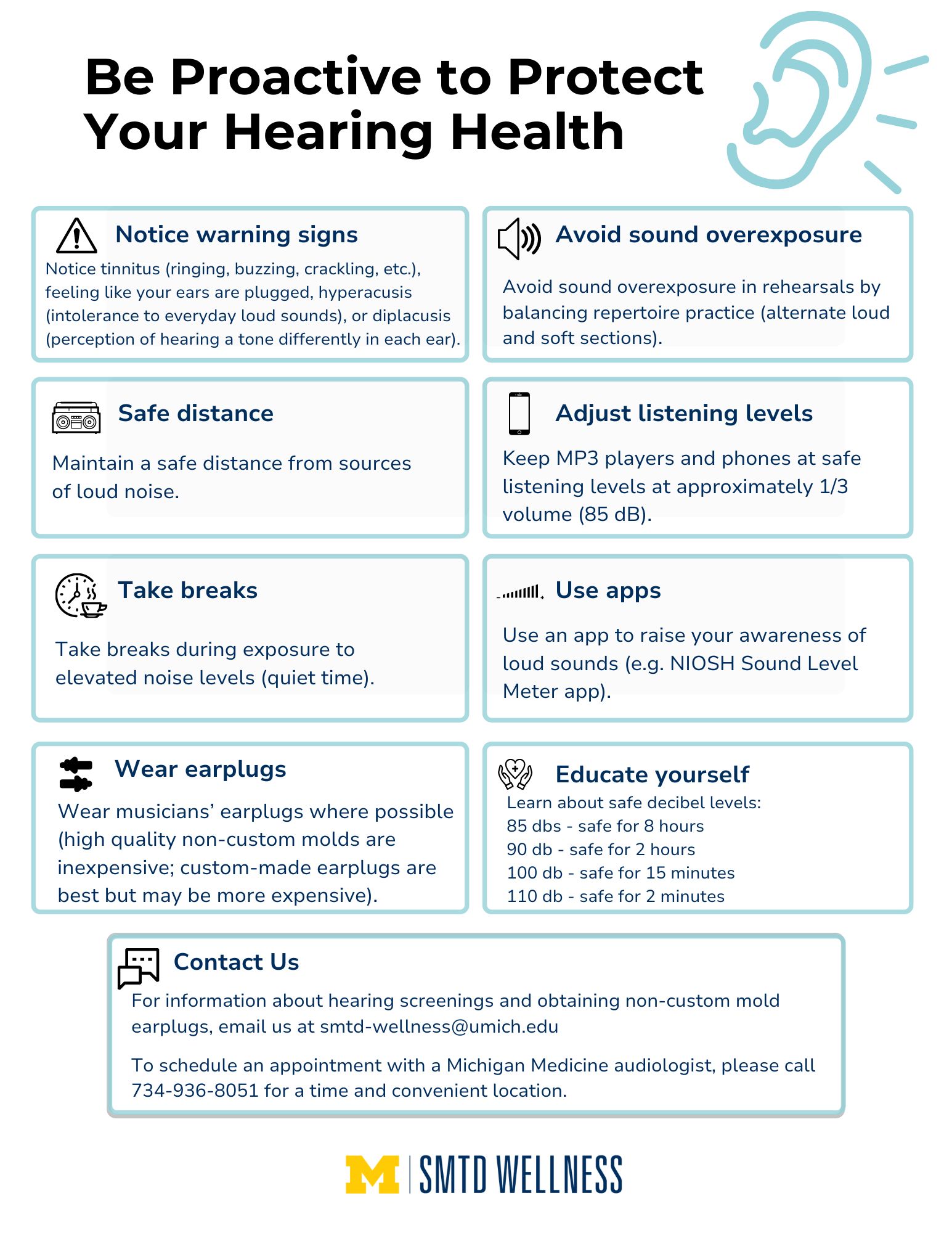
Be Proactive to Protect Your Hearing Health
- Notice warning signs: Notice tinnitus (ringing, buzzing, crackling, etc.), feeling like your ears are plugged, hyperacusis (intolerance to everyday loud sounds), or diplacusis (perception of hearing a tone differently in each ear).
- Avoid sound overexposure: Avoid sound overexposure in rehearsals by balancing repertoire practice (alternate loud and soft sections).
- Safe distance: Maintain a safe distance from sources of loud noise.
- Adjust listening levels: Keep MP3 players and phones at safe listening levels at approximately 1/3 volume (85 dB).
- Take breaks: Take breaks during exposure to elevated noise levels (quiet time).
- Use apps: Use an app to raise your awareness of loud sounds (e.g. NIOSH Sound Level Meter app).
- Wear earplugs: Wear musicians’ earplugs where possible (high quality non-custom molds are inexpensive; custom-made earplugs are best but may be more expensive).
- Educate yourself:
Learn about safe decibel levels:
85 dbs - safe for 8 hours
90 db - safe for 2 hours
100 db - safe for 15 minutes
110 db - safe for 2 minutes
Contact us:
For information about hearing screenings and obtaining non-custom mold earplugs, reach out:
Dr. Paola Savvidou, [email protected].
To schedule an appointment with a Michigan Medicine audiologist, please call 734-936-8051 for a time and convenient location.
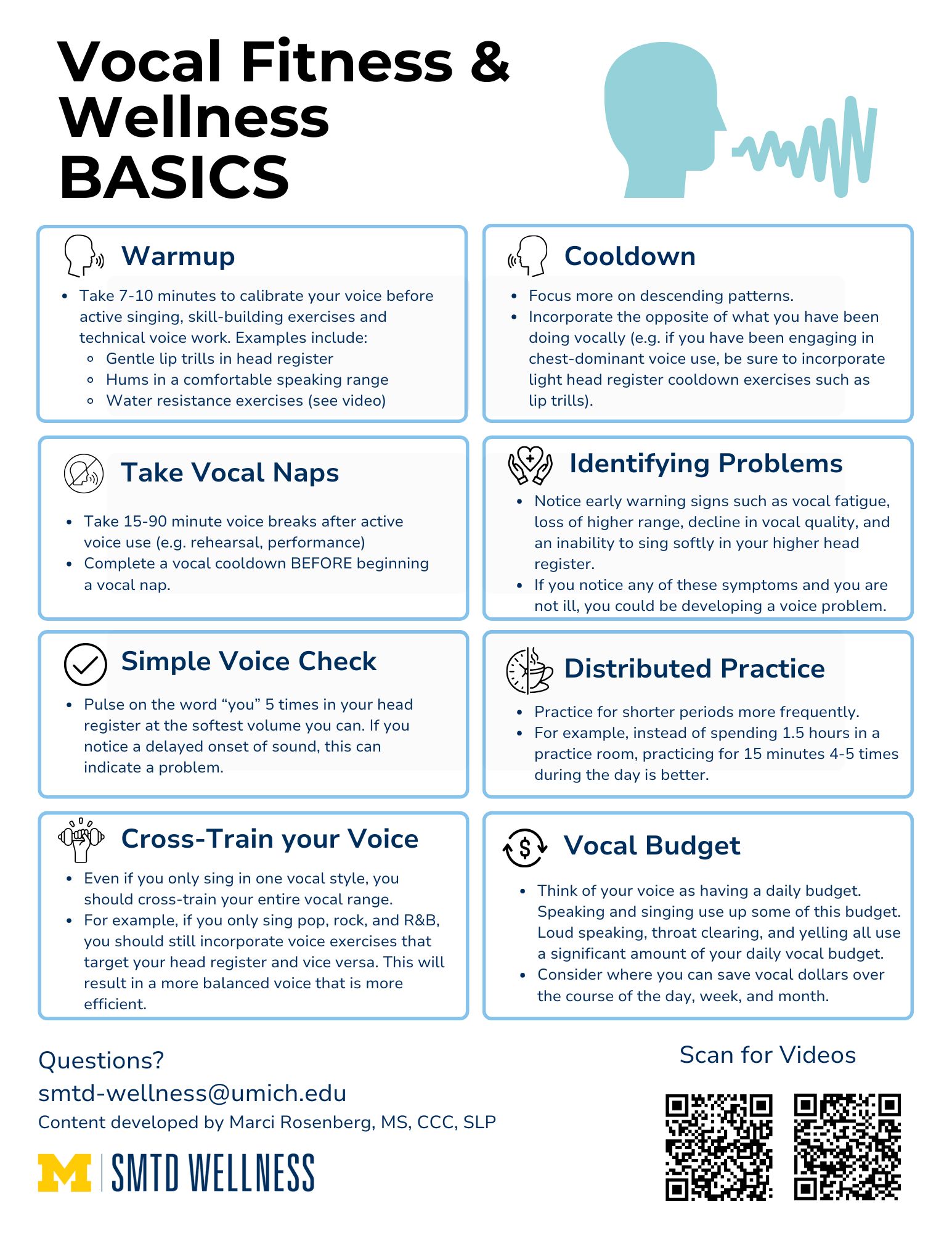
Vocal Fitness & Wellness BASICS
- Warmup
- Take 7-10 minutes to calibrate your voice before active singing, skill-building exercises and technical voice work. Examples include:
- Gentle lip trills in head register
- Hums in a comfortable speaking range
- Water resistance exercises (see video)
- Cooldown
- Focus more on descending patterns.
- Incorporate the opposite of what you have been doing vocally (e.g. if you have been engaging in chest-dominant voice use, be sure to incorporate light head register cooldown exercises such as lip trills).
- Take Vocal Naps
- Take 15-90 minute voice breaks after active voice use (e.g. rehearsal, performance)
- Complete a vocal cooldown BEFORE beginning a vocal nap.
- Identifying Problems
- Notice early warning signs such as vocal fatigue, loss of higher range, decline in vocal quality, and an inability to sing softly in your higher head register.
- If you notice any of these symptoms and you are not ill, you could be developing a voice problem.
- Simple Voice Check
- Pulse on the word “you” 5 times in your head register at the softest volume you can. If you notice a delayed onset of sound, this can indicate a problem.
- Distributed Practice
- Practice for shorter periods more frequently.
- For example, instead of spending 1.5 hours in a practice room, practicing for 15 minutes 4-5 times during the day is better.
- Cross-Train Your Voice
- Even if you only sing in one vocal style, you should cross-train your entire vocal range.
- For example, if you only sing pop, rock, and R&B, you should still incorporate voice exercises that target your head register and vice versa. This will result in a more balanced voice that is more efficient.
- Vocal Budget
- Think of your voice as having a daily budget. Speaking and singing use up some of this budget. Loud speaking, throat clearing, and yelling all use a significant amount of your daily vocal budget.
- Consider where you can save vocal dollars over the course of the day, week, and month.
Questions?
[email protected]
Content developed by Marci Rosenberg, MS, CCC, SLP
Links to YouTube videos:
Intro to Vocal Health Screenings
Quick Vocal Warm-ups and Cooldowns
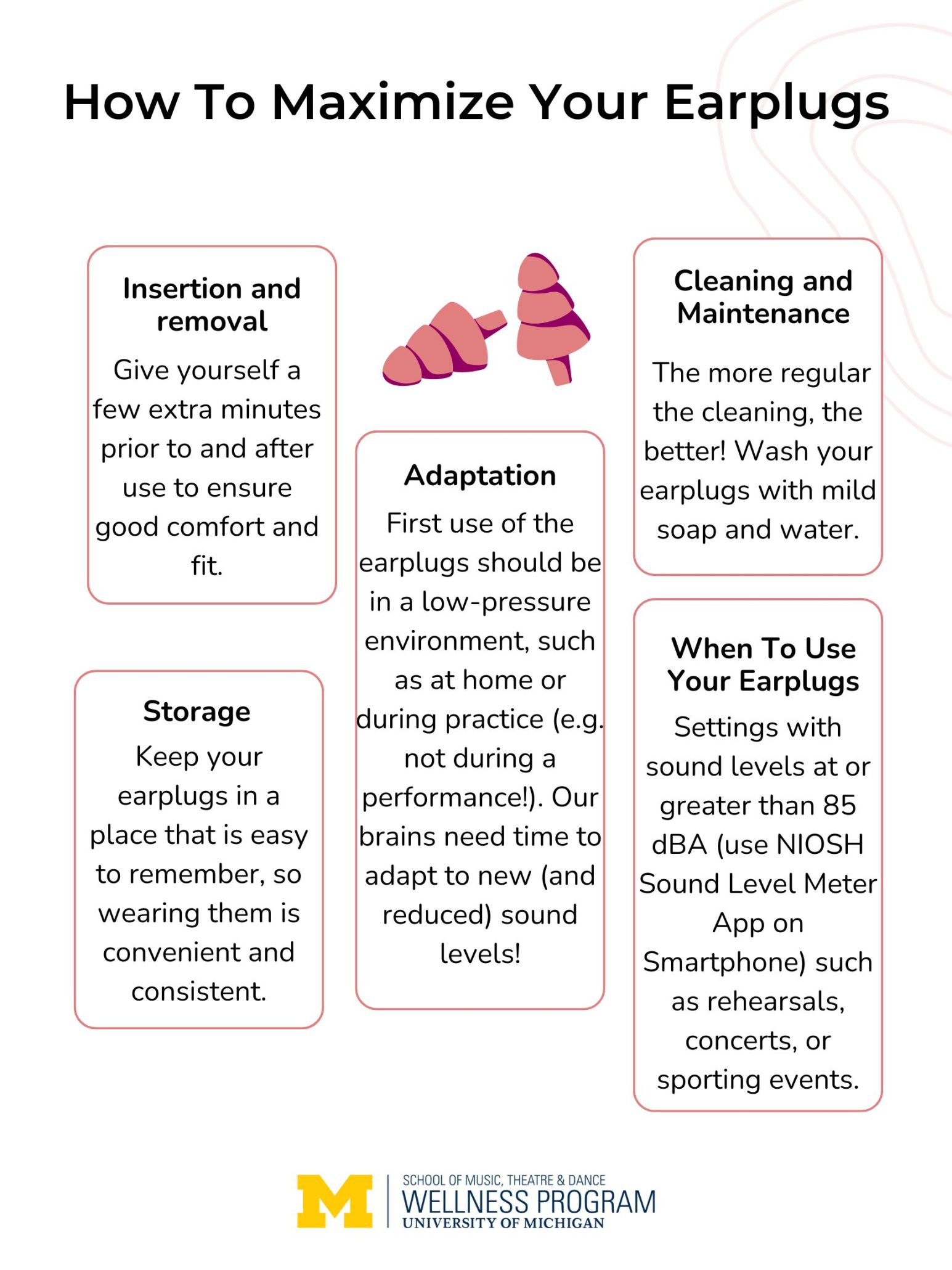

How to Maximize Your Earplugs
- Insertion and Removal: Give yourself a few extra minutes prior to and after use to ensure good comfort and fit.
- Storage: Keep your earplugs in a place that is easy to remember, so wearing them is convenient and consistent.
- Adaptation: First use of the earplugs should be in a low-pressure environment, such as at home or during practice (e.g. not during a performance!). Our brains need time to adapt to new (and reduced) sound levels!
- Maintenance: The more regular the cleaning, the better! Wash your earplugs with mild soap and water.
- Your Earplugs: Settings with sound levels at or greater than 85 dBA (use NIOSH Sound Level Meter App on Smartphone) such as rehearsals, concerts, or sporting events.
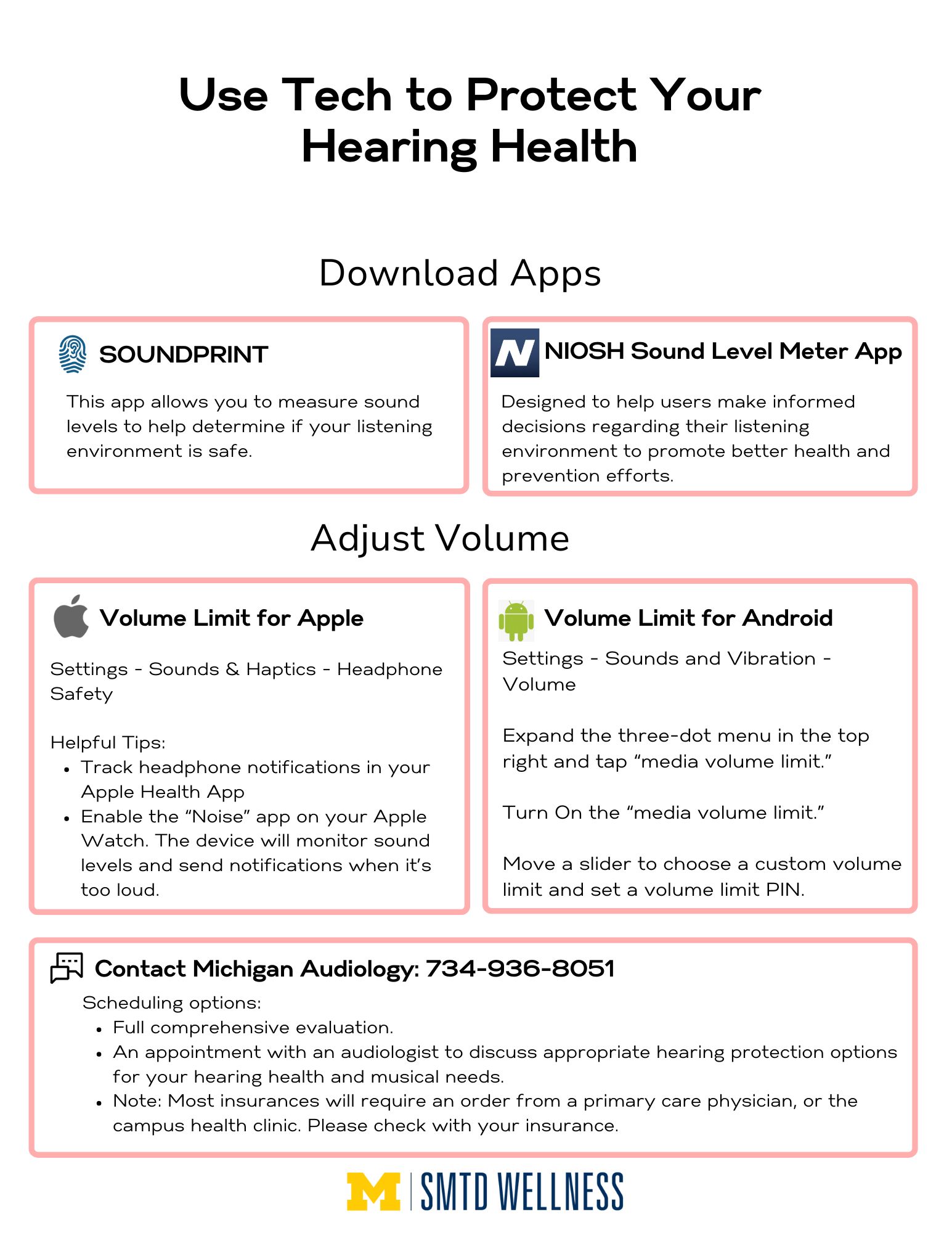
Use Tech to Protect Your Hearing Health
SOUNDPRINT: This app allows you to measure sound levels to help determine if your listening environment is safe.
NIOSH Sound Level Meter App: Designed to help users make informed decisions regarding their listening environment to promote better health and prevention efforts.
Adjust Volume
Volume Limit for Apple
Settings - Sounds & Haptics - Headphone Safety
Helpful Tips:
- Track headphone notifications in your Apple Health App
- Enable the “Noise” app on your Apple Watch. The device will monitor sound levels and send notifications when it’s too loud.
- This app allows you to measure sound levels to help determine if you listening environment is safe.
- Help promote quiet venues by submitting a sound measurement to help you and others find quiet and moderate spaces to hear and connect with others.
- Apple iOS: https://apps.apple.com/us/app/soundprint-find-a-quiet-place/id971189322
- Google Play: https://play.google.com/store/apps/details?id=com.soundprint&hl=en_US&gl=US
Volume Limit for Android
- Designed to help users make informed decisions regarding their listening environment to promote better health and prevention efforts.
- Apple iOS: https://apps.apple.com/us/app/niosh-slm/id1096545820
Contact Michigan Medicine Audiology: 734-936-8051
Scheduling options:
- Full comprehensive evaluation.
- An appointment with an audiologist to discuss appropriate hearing protection options for your hearing health and musical needs.
- Note: Most insurances will require an order from a primary care physician, or the campus health clinic. Please check with your insurance.
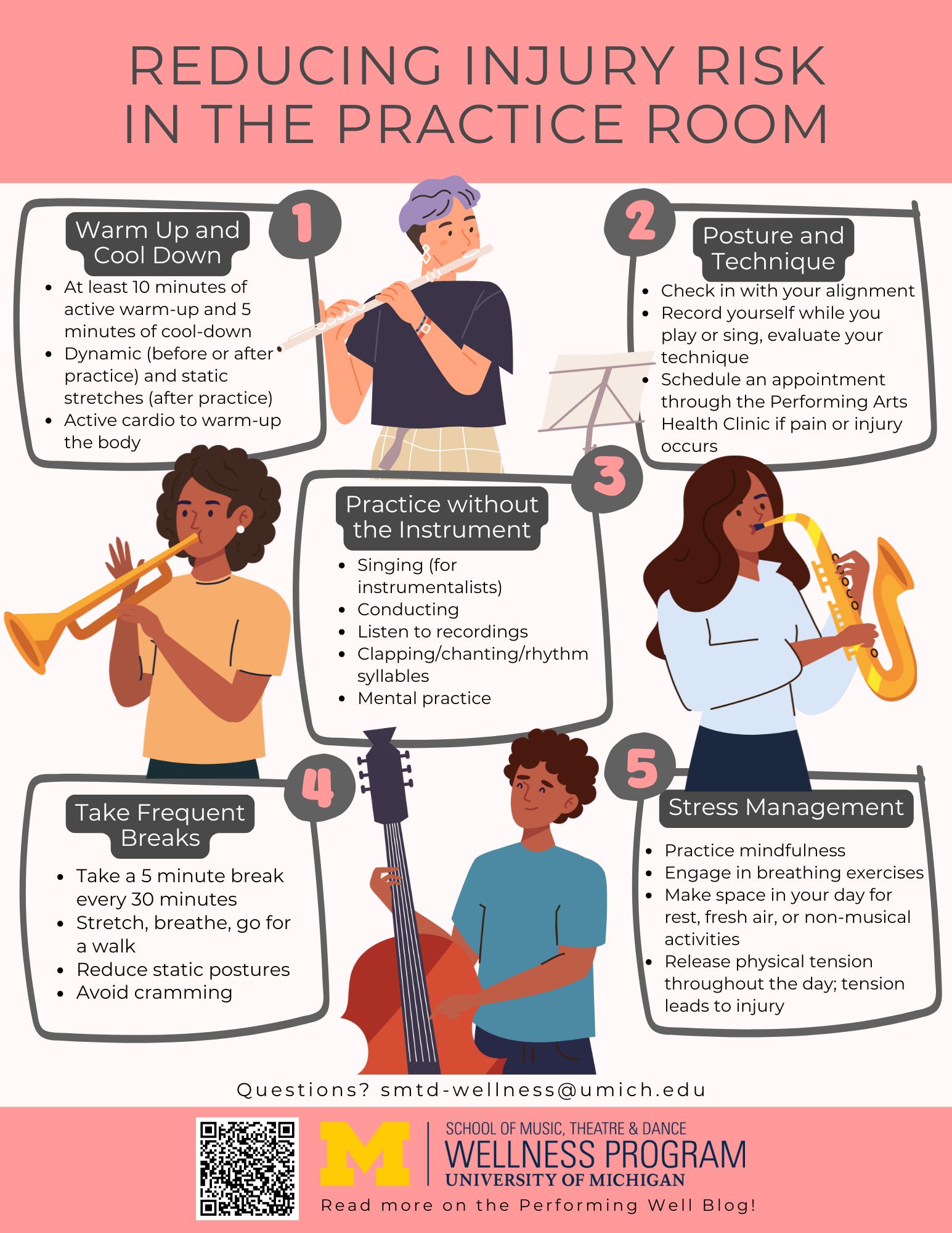
- Warmup and Cooldown
- At least 10 minutes of active warm-up and 5 minutes of cool-down
- Dynamic (before or after practice) and static stretches (after practice)
- Active cardio to warm-up the body
- Posture and Technique
- Check in with your alignment
- Record yourself while you play or sing, evaluate your technique
- Schedule an appointment through the Performing Arts Health Clinic if pain or injury occurs
- Practice without the instrument
- Singing (for instrumentalists)
- Conducting
- Listen to recordings
- Clapping/chanting/rhythm syllables
- Mental practice
- Take Frequent Breaks
- Take a 5 minute break every 30 minutes
- Stretch, breathe, go for a walk
- Reduce static postures
- Avoid cramming
- Stress Management
- Practice mindfulness
- Engage in breathing exercises
- Make space in your day for rest, fresh air, or non-musical activities
- Release physical tension throughout the day; tension leads to injury
Read more on the Performing Well blog!